


South Africa’s Vaccine Train Takes Doses to Poor Areas

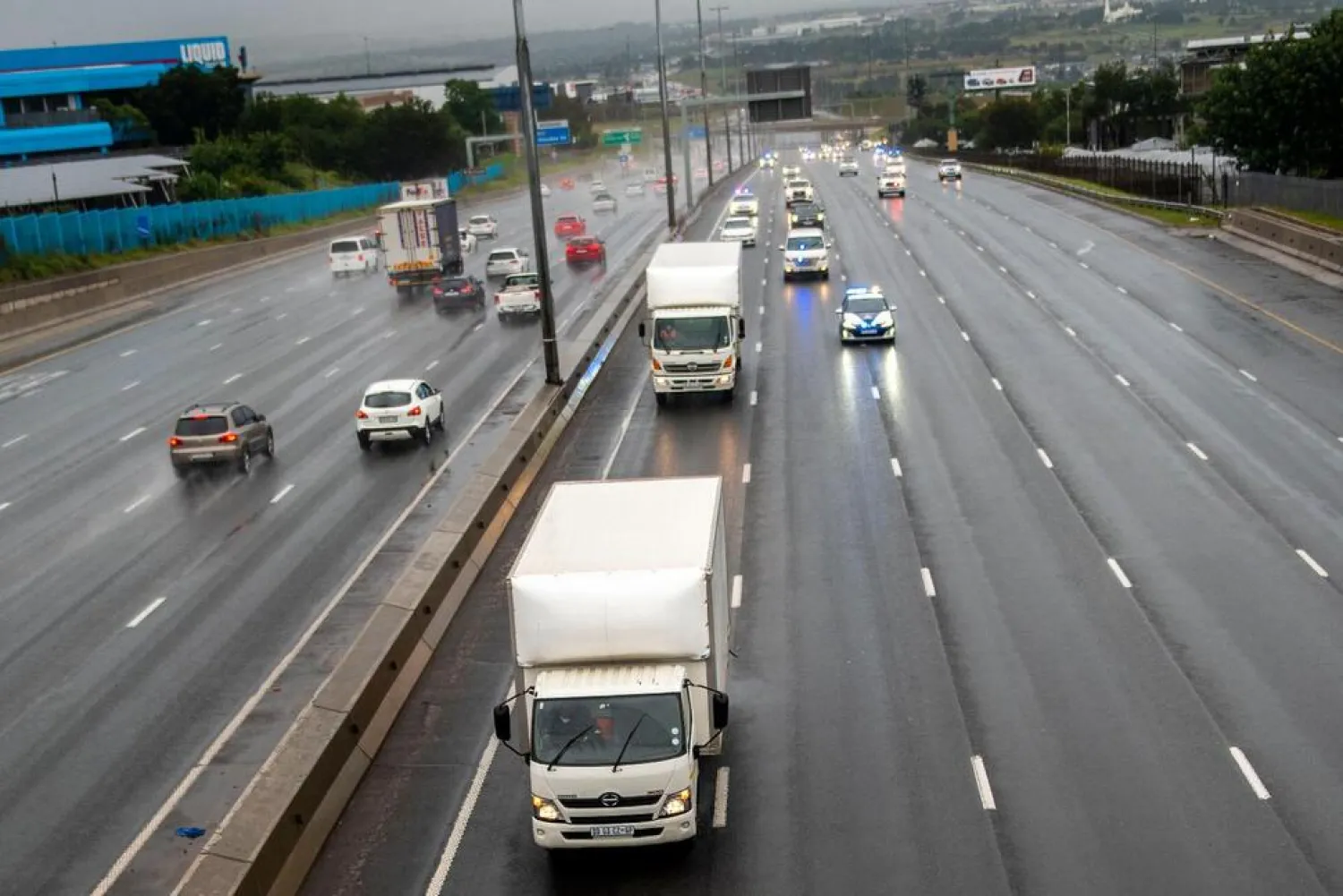
South African law enforcement vehicles provide security for two refrigeration trucks transporting the AstraZenica vaccine that arrived earlier from India, near Johannesburg, Monday, Feb. 1, 2021.  (Photo by Alet Pretorius) THE ASSOCIATED PRESS
South African law enforcement vehicles provide security for two refrigeration trucks transporting the AstraZenica vaccine that arrived earlier from India, near Johannesburg, Monday, Feb. 1, 2021. (Photo by Alet Pretorius) THE ASSOCIATED PRESS
TT

South Africa’s Vaccine Train Takes Doses to Poor Areas

South African law enforcement vehicles provide security for two refrigeration trucks transporting the AstraZenica vaccine that arrived earlier from India, near Johannesburg, Monday, Feb. 1, 2021.  (Photo by Alet Pretorius) THE ASSOCIATED PRESS
South African law enforcement vehicles provide security for two refrigeration trucks transporting the AstraZenica vaccine that arrived earlier from India, near Johannesburg, Monday, Feb. 1, 2021. (Photo by Alet Pretorius) THE ASSOCIATED PRESS

When Wongalwethu Mbanjwa tried to get a COVID-19 vaccination and found his local center closed, a friend told him there was another option: Get one on the train. So Mbanjwa did.

Not any train, but South Africa's vaccine train — which has now made its way to the small town of Swartkops on the country's south coast. Carrying doctors, nurses and, crucially, vaccine doses, it has a mission to bring vaccines closer to people in small towns and poorer parts of South Africa, which has the continent's highest number of coronavirus infections at more than 2.8 million.

The train is parked at the Swartkops rail station, the first stop on a three-month journey through the poor Eastern Cape province. It will stay for about two weeks at a time at seven stations in the province to vaccinate as many people as possible.

State-owned rail company Transnet launched the program to aid the government's rollout. The initiative aims to meet head-on two of the government's biggest challenges: getting doses out beyond big cities to areas where health care facilities are limited and trying to convince hesitant people in those areas to get vaccine shots.

The train, named Transvaco, can hold up to 108,000 vaccine doses in ultra-cold refrigerators. It has nine coaches, including accommodation coaches and a kitchen and dining area for the staff, a vaccination area and consulting rooms.

It's a new take on another train that's been taking doctors and medicine across South Africa since the mid-1990s, The Associated Press reported.

Dr. Paballo Mokwana, the train program's manager, said medical personnel had vaccinated just under 1,000 people so far during the stop in Swartkops. They’ve given jabs on the train but have also sent a vaccination team into nearby factories and businesses to administer shots to people at work.

Untsaphokazi Singaphi was one of the people who received a vaccine shot from the off-site vaccination team at the factory where she works. She arrived to get her second dose of the Pfizer-BioNTech vaccine with a smile on her face.

“I am happy, and I feel at peace,” she said. “I know that I am safe, and so are my children and others around me. So I am really at peace with (the fact) that I’m done."

"I have been waiting for the moment where I too can say that I am among the vaccinated in South Africa,” Singaphi said.

Just 14% of South Africa's population of 60 million is fully vaccinated, and the train is one part of the push to get that number up as quickly as possible.

It doesn't always work, though.

Andiswa Maseko was the first person to arrive at the train for a vaccine early Thursday morning. The head of vaccination, Bongani Nxumalo, explained the options to her. She could either have the one-shot Johnson & Johnson vaccine or go with the two-dose Pfizer-BioNTech. After Maseko showed signs of hesitating, a nurse entered the vaccination cubicle and also tried to reassure her.

But Maseko asked to be given a moment to think about whether she wanted to get a vaccine, stepped off the train and never returned.

Nxumalo said Swartskop and the Eastern Cape province were different from other places they've worked in. People are more reluctant.

“Most of the people here...have misconceptions about the vaccine," he said. ”Many people will say ‘You guys are here to kill us.'"

“So, we keep on telling them that the vaccine is real, COVID is there, and many people have lost their lives. We tell them that we have also been vaccinated,” Nxumalo said.



France Accuses Iran of ‘Repression’ in Sentence for Nobel Laureate

People cross an intersection in downtown Tehran, Iran, Monday, Feb. 9, 2026. (AP)
TT

France Accuses Iran of ‘Repression’ in Sentence for Nobel Laureate

People cross an intersection in downtown Tehran, Iran, Monday, Feb. 9, 2026. (AP)

France accused Iran on Monday of "repression and intimidation" after a court handed Nobel Peace Prize laureate Narges Mohammadi a new six-year prison sentence on charges of harming national security.

Mohammadi, sentenced Saturday, was also handed a one-and-a-half-year prison sentence for "propaganda" against Iran's system, according to her foundation.

"With this sentence, the Iranian regime has, once again, chosen repression and intimidation," the French foreign ministry said in a statement, describing the 53-year-old as a "tireless defender" of human rights.

Paris is calling for the release of the activist, who was arrested before protests erupted nationwide in December after speaking out against the government at a funeral ceremony.

The movement peaked in January as authorities launched a crackdown that activists say has left thousands dead.

Over the past quarter-century, Mohammadi has been repeatedly tried and jailed for her vocal campaigning against Iran's use of capital punishment and the mandatory dress code for women.

Mohammadi has spent much of the past decade behind bars and has not seen her twin children, who live in Paris, since 2015.

Iranian authorities have arrested more than 50,000 people as part of their crackdown on protests, according to US-based Human Rights Activists News Agency (HRANA).


Iran's Supreme Leader Urges Iranians to Show 'Resolve' against Foreign Pressure

Iran's supreme leader Ali Khamenei on (File Photo/Supreme Leader's website).
TT

Iran's Supreme Leader Urges Iranians to Show 'Resolve' against Foreign Pressure

Iran's supreme leader Ali Khamenei on (File Photo/Supreme Leader's website).

Iran's supreme leader Ali Khamenei on Monday called on his compatriots to show "resolve" ahead of the anniversary of the 1979 Islamic revolution this week.

Since the revolution, "foreign powers have always sought to restore the previous situation", Ali Khamenei said, referring to the period when Iran was under the rule of shah Reza Pahlavi and dependent on the United States, AFP reported.

"National power is less about missiles and aircraft and more about the will and steadfastness of the people," the leader said, adding: "Show it again and frustrate the enemy."


UK PM's Communications Director Quits

British Prime Minister Keir Starmer delivers a speech at Horntye Park Sports Complex in St Leonards, Britain, February 05, 2026. Peter Nicholls/Pool via REUTERS
TT

UK PM's Communications Director Quits

British Prime Minister Keir Starmer delivers a speech at Horntye Park Sports Complex in St Leonards, Britain, February 05, 2026. Peter Nicholls/Pool via REUTERS

British Prime Minister Keir Starmer's director of communications Tim Allan resigned on Monday, a day after Starmer's top aide Morgan McSweeney quit over his role in backing Peter Mandelson over his known links to Jeffrey Epstein.

The loss of two senior aides ⁠in quick succession comes as Starmer tries to draw a line under the crisis in his government resulting from his appointment of Mandelson as ambassador to the ⁠US.

"I have decided to stand down to allow a new No10 team to be built. I wish the PM and his team every success," Allan said in a statement on Monday.

Allan served as an adviser to Tony Blair from ⁠1992 to 1998 and went on to found and lead one of the country’s foremost public affairs consultancies in 2001. In September 2025, he was appointed executive director of communications at Downing Street.