


Severe Droughts Dry Up Dreams of Turkish Farmers

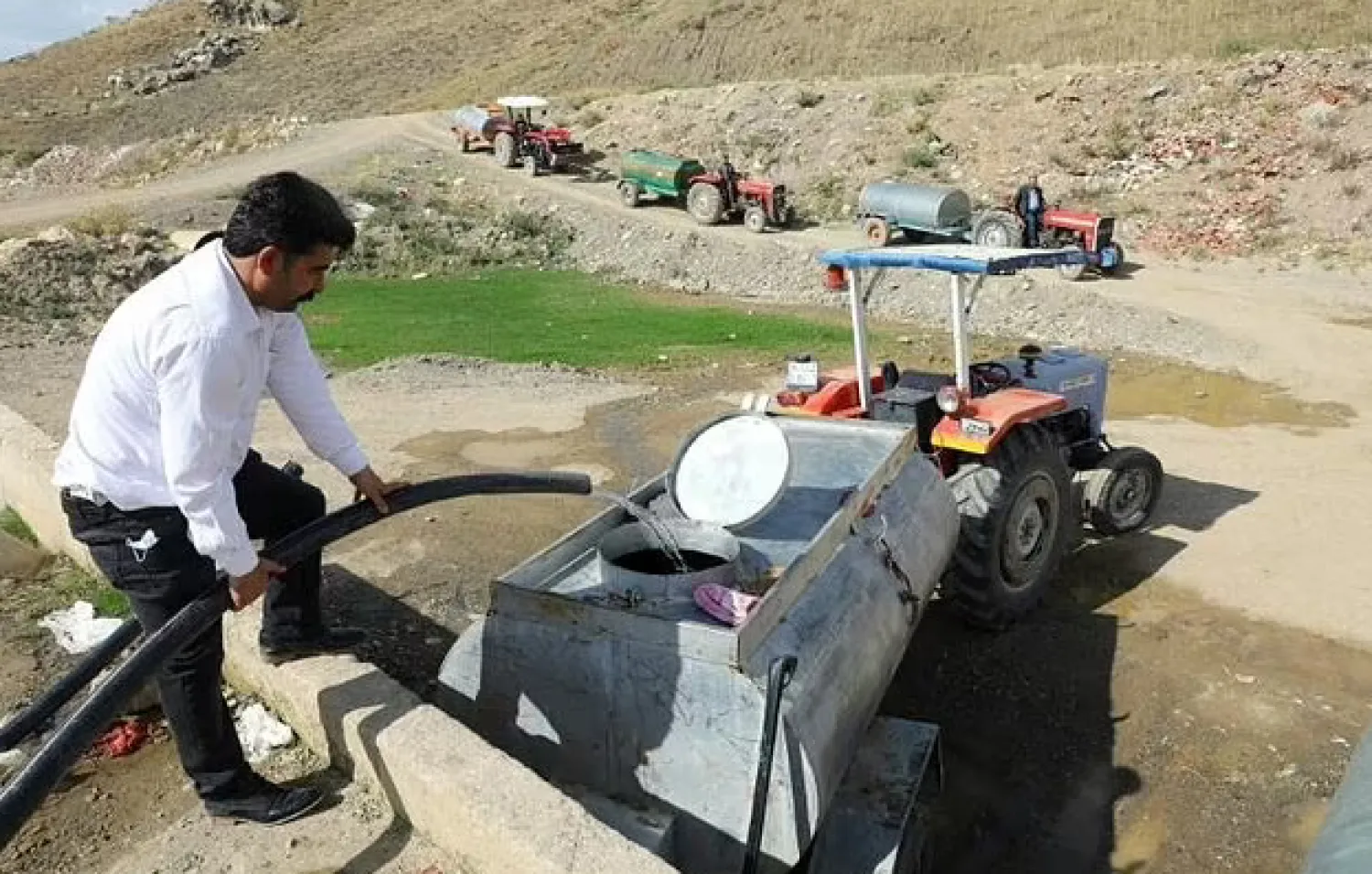
Severe droughts in Turkey have forced farmers to fill tanks with water - AFP
TT

Severe Droughts Dry Up Dreams of Turkish Farmers

Severe droughts in Turkey have forced farmers to fill tanks with water - AFP

Turkish farmer Hava Keles stares inconsolably at withered vines of rotting tomatoes in a field that has been devastated by a series of droughts blamed on climate change.

"My tomatoes, my beans, my peppers are ruined. My watermelons didn't even grow. The cucumbers I planted have shriveled up on the branches," lamented Keles, 58, standing in an arid Anatolian plot in Akkuzulu, north of Ankara, AFP reported.

Keles is among thousands of farmers across Turkey whose livelihoods have been ravaged as little rain has fallen to nourish their crops for the past two years.

Some experts accuse President Recep Tayyip Erdogan -- whose popularity has relied on prosperity driven by fast urban development -- of failing to do enough to address pressing environmental issues in the country.

But Erdogan has promised Turkey would ratify the 2015 Paris Agreement in October before a pivotal UN climate summit next month in Glasgow. Turkey signed the deal in 2016.

Environmental issues had never topped the political agenda in Turkey, but everything changed after a summer of extreme weather events, including forest fires on the Mediterranean coast and devastating floods in the north.

Action cannot come soon enough for indebted farmers like Keles in a country where droughts have spread to more than of the territory.

"My husband says leave the garden. But I can't. I've worked too hard for this. What can I do with it now?" she asks, despite having debts worth thousands of dollars.

This summer, farmers in her neighborhood were unable to dig deep enough to find groundwater, so they had to fetch it in large tanks pulled by tractors.

- 'Serious events coming' -

Agriculture is a major sector of the Turkish economy, accounting for around six percent of GDP and employing 18 percent of the workforce.

Turkey is self-sufficient in food production and is the world's seventh largest agricultural producer, exporting everything from hazelnuts to tea, olives to figs.

But the country's import of wheat has already risen exponentially in nearly two decades from $150 million to $2.3 billion in 2019, according to the agriculture ministry.

Such figures add to fears Turkey will move from producer to becoming a country reliant on the outside to meet its food needs.

"Turkey has a lot to adapt to, especially in terms of agriculture because serious drought events are coming. What we have seen is nothing," warned Levent Kurnaz, director of Bogazici University's centre for climate change and policy studies in Istanbul.

Drought is forcing some farmers to quit while others opt to grow different crops that demand less water, leaving the consumer out of pocket as food prices rise alongside a weakening Turkish lira.

Food inflation hit 29 percent in August from last year, and in a bid to ease the pain, Erdogan cut import customs duties to zero for basics such as wheat, chickpeas and lentils until the end of the year.

Experts say the government has failed in its water management policies, exacerbating the problem.

Farmers are impacted by significantly reduced water levels in dams across Turkey, which put the water needs of every citizen at risk as well, while lakes are drying up.

"We need to build our cities in a way that allows underground water levels to rise," said Ceyhun Ozcelik, associate professor in the water resources department at Mugla Sitki Kocman University.

"If we don't take the necessary measures, if the urban infrastructure is not enough, then I can say we face difficult days in the years ahead," he added.

- 'Transform lifestyles' -

In the west of the country on the Aegean coast, green olive groves coat the hills in Milas, famous for its olive oil which gained European Union protected status in December. But the fruit is also at risk.

Ismail Atici, Milas agricultural chamber chief, said rain had not fallen at all in 2021.

"If there is still no rain for one, or two more months, the trees will not be able to nourish the fruits," he added.

Farmers' costs are spiraling.

Ferdun Cetinceviz, 41, who tends to some 200 cows and corn fields among the mountains, said he is losing up to 40,000 lira per month ($4,500, 3,900 euros).

Surrounded by dry, flat land and green mountains in the distance, Cetinceviz estimated up to 50 percent of his crop yield including corn was lost this year due to drought.

Farmers in Milas used to grow cotton, but it requires vast quantities of water, so they switched to corn.

"If I can't water my crops which my animals also need, they will be left hungry," Cetinceviz said.




Olympic Tourists in Cortina Can Explore the Dolomites with the New ‘Uber Snowmobile’ Service

 The peaks of the Dolomites are seen from the Cortina Sliding Centre during the Milano Cortina 2026 Winter Olympic Games in Cortina d'Ampezzo on February 5, 2026. (AFP)
The peaks of the Dolomites are seen from the Cortina Sliding Centre during the Milano Cortina 2026 Winter Olympic Games in Cortina d'Ampezzo on February 5, 2026. (AFP)
TT

Olympic Tourists in Cortina Can Explore the Dolomites with the New ‘Uber Snowmobile’ Service

 The peaks of the Dolomites are seen from the Cortina Sliding Centre during the Milano Cortina 2026 Winter Olympic Games in Cortina d'Ampezzo on February 5, 2026. (AFP)
The peaks of the Dolomites are seen from the Cortina Sliding Centre during the Milano Cortina 2026 Winter Olympic Games in Cortina d'Ampezzo on February 5, 2026. (AFP)

The peaks of the Dolomites are seen from the Cortina Sliding Centre during the Milano Cortina 2026 Winter Olympic Games in Cortina d'Ampezzo on February 5, 2026. (AFP)

For one month starting on Saturday, Olympic spectators keen for a side trip to a UNESCO World Heritage Site can use Uber to reserve a ride on a snowmobile along the snow-covered road to the base of the Three Peaks of Lavaredo.

The dramatic, jagged limestone pinnacles stand just 23 kilometers (14.3 miles) from the Cortina venues where athletes are competing in the 2026 Winter Olympics and Paralympics.

One of the Olympic torchbearers, Giulia Baffetti, runs snowmobiling tours through Cortina-based winter activities outfit Snowdreamers. The company partnered with Uber, the official ride-hailing sponsor for the Games, to offer free tours on the weekends in February to people in town.

"Uber Snowmobile" tours, which can only be booked through Uber, include a ride in an Uber transfer bus for up to eight people from Cortina to the spot where riders mount their snowmobiles for departure. Tourgoers then follow the instructor, who leads the line of snowmobiles.

The first slots offered went fast, but Uber spokesperson Caspar Nixon said Friday that it planned to add more.

The three peaks are a magical place, Baffetti said, and this is a way for more people to experience it. Hikers and climbers flock there in the warmer months. In the winter, it’s a prime spot for cross-country skiing, snowshoeing and sledding. Snowmobiling is allowed in a limited area in order to protect the environment.

"We want to give an experience to the tourists, so they can feel the mountains in a different way," she said.

The Associated Press took the one-hour tour on Thursday, ahead of the Saturday launch, along with one other person. Helmets are essential, while heated handgrips are a most welcome feature. And that red button? Passengers can push it to stop the snowmobile if it veers off course or they feel unsafe.

The adrenaline-filled ride reaches speeds up to 40 kph (25 mph) when zooming past snow-covered trees, and drivers are instructed to slow when coming upon cross-country skiers and sledders. Deer and wolves are sometimes seen along the 7-kilometer (4.3-mile) route up to the base of the peaks.

Also visible on Thursday was the southernmost of the three Lavaredo peaks, rising sharply out of the fog. While the Dolomites are breathtaking from Cortina — and on Friday, the sun shone and the view was clear from town — they are even more impressive up close.

The route back includes a short loop around Lake Antorno. Before traversing all the ups and downs, the snowmobile instructor leading the tour offers a reminder about that red button.

Saher Deeb, an Israeli tourist, was along for the ride Thursday, one day after his 29th birthday. It was his first time on a snowmobile, and he was all smiles as he climbed off at the end.

"It was perfect," he said.


French Duo Finish Walking from France to Shanghai After 1.5 Years

 Performers throw molten iron to create sparks during a performance on the Bund promenade along the Huangpu river, ahead of the upcoming Lunar New Year of the Horse in Shanghai on February 2, 2026. (AFP)
Performers throw molten iron to create sparks during a performance on the Bund promenade along the Huangpu river, ahead of the upcoming Lunar New Year of the Horse in Shanghai on February 2, 2026. (AFP)
TT

French Duo Finish Walking from France to Shanghai After 1.5 Years

 Performers throw molten iron to create sparks during a performance on the Bund promenade along the Huangpu river, ahead of the upcoming Lunar New Year of the Horse in Shanghai on February 2, 2026. (AFP)
Performers throw molten iron to create sparks during a performance on the Bund promenade along the Huangpu river, ahead of the upcoming Lunar New Year of the Horse in Shanghai on February 2, 2026. (AFP)

Two French adventurers reached the end of an epic walk from France to Shanghai on Saturday, after nearly a year and a half crossing 16 countries almost entirely on foot.

Loic Voisot and Benjamin Humblot embraced as they stood by the river on the Bund promenade, the financial hub's distinctive skyline glittering in the background.

Voisot and Humblot set off from Annecy in September 2024.

"We were thinking about this moment almost every day for more than a year now, so it's a really strong feeling," Humblot said of reaching their destination.

Hanging out after work one day, the two friends realized they both yearned for a "great adventure".

They wanted to visit China -- but without flying, which they believe is too harmful to the environment.

A plan to set out on foot was hatched, and except for a stretch in Russia which was done by bus for safety reasons, 518 days and around 12,850 kilometers (7,980 miles) later they took the last steps to completing it.

Around 50 people gathered at the start point for the last 10km stretch of their odyssey, many local people who have been following them on social media.

Along the way their numbers swelled, as media, French residents of Shanghai and others joined.

"If your dreams are crazy, just take it step by step and sometimes you will not succeed, but sometimes you will," said Voisot.

Asked what he would do first now the walk was over, he joked: "Sleep a lot!"


Annual Orchids Show Brings Vivid Color to Chicago Winter

Orchids adorn a Volkswagen Beetle as finishing touches are placed on the 12th annual Chicago Botanic Garden Orchid Show, Friday, Feb. 6, 2026, in Glencoe, Ill. (AP)
TT

Annual Orchids Show Brings Vivid Color to Chicago Winter

Orchids adorn a Volkswagen Beetle as finishing touches are placed on the 12th annual Chicago Botanic Garden Orchid Show, Friday, Feb. 6, 2026, in Glencoe, Ill. (AP)

A soft layer of white snow blankets the grounds of the Chicago Botanic Garden. The air is chilly, the sky gray.

Inside, however, the air is warm and lights illuminate more than 10,000 vividly colored orchids. Staff members move in and out of greenhouses, preparing to open the garden’s 12th annual Orchid Show on Saturday.

This year’s theme is “Feelin’ Groovy" with several installations calling back to the 1970s, including a yellow Volkswagen Beetle filled with orchids.

“It’s just a really great way to get out of the winter cold and come into our greenhouses,” said Jodi Zombolo, associate vice president of visitor events and programs. “I think people are really looking for something to kind of bring happiness and something that they will enjoy and find whimsy in.”

The orchid family is one of the largest in the plant world and some of the species in the show are rare, exhibits horticulturist Jason Toth said. One example is the Angraecum sesquipedale, also known as Darwin’s orchid, on display in the west gallery.

Toth said the orchid led Darwin to correctly conclude that pollinators have adapted in order to reach down the flower's very long end.

"It has a great story and it’s quite remarkable-looking,” said Toth.

Elsewhere, massive, gnarly roots dangle from purple, pink and yellow Vanda orchids in the south greenhouse. These epiphytic orchids grow on the surface of trees instead of in soil.

“I think everyone’s tired of the winter,” said Toth. “So having some kind of flower show at this point is what we’re all craving. And 'Orchids' fits the bill.”

The show is expected to draw 85,000 visitors this year.