US Accuses Houthis of Standing in the Way of Peace

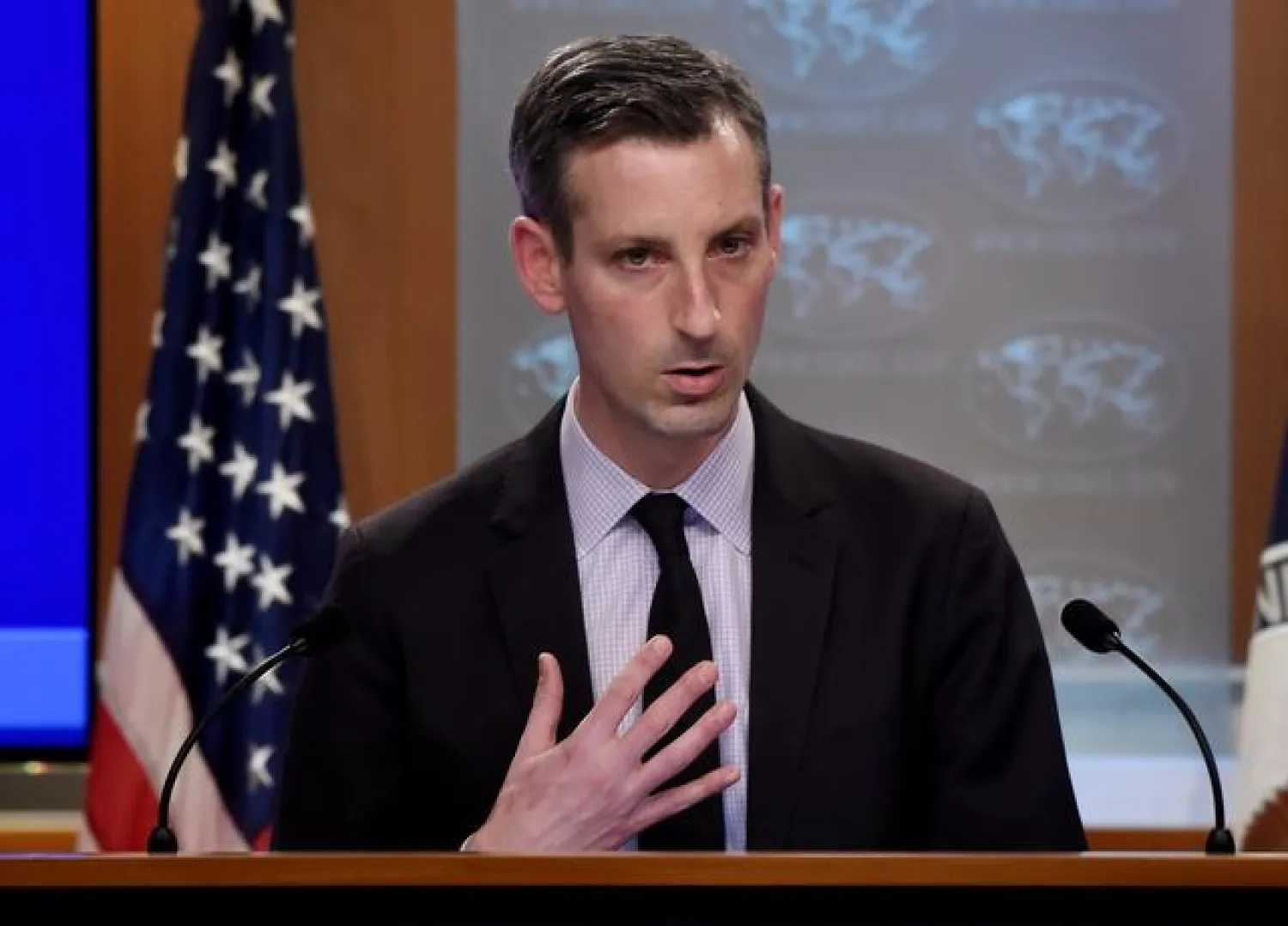
US State Department Spokesman Ned Price (Reuters)
TT

US Accuses Houthis of Standing in the Way of Peace

US State Department Spokesman Ned Price (Reuters)

The United States accused the armed Houthi movement of "standing in the way of peace" and continuing to commit brutal military offensives, unlike the US and Yemeni governments calling on Houthis to engage in UN-led talks.

US State Department Spokesman Ned Price said in a statement that Washington condemns the October 3 Houthi missile attack on the densely populated neighborhood of al-Rawdha in Marib, which killed two children and injured an estimated 33 civilians, including women and children, according to UN agencies.

Price asserted that civilians will suffer as long as the "brutal Houthi military offensives continue," adding that there is an "international consensus that now is the time to end the conflict, and the Republic of Yemen Government and Saudi Arabia have committed to stop fighting and resume political talks."

The spokesman recalled that since the beginning of the year, the Houthis had intensified their attacks, both inside Yemen and against Saudi Arabia, endangering the lives of civilians, including more than 70,000 US citizens living in Saudi Arabia.

"These actions exacerbate Yemen's humanitarian crisis, which has already reached historic proportions."

He called on the Houthis “to stop fighting and engage in UN-led talks to bring an end to this devastating war."

The international community urges the Houthis to return to negotiations and implement a ceasefire to end the Yemeni crisis. However, these efforts have failed to stop the battles in Marib, one of the last Yemeni areas under government control.

Houthis will have near-total control of northern Yemen if they seize control of Marib, giving them access to key oil and gas infrastructure and an "upper hand" in the talks to end the conflict, according to The Washington Post. "As for government forces, this would be a massive setback."

Several media reports indicate that Marib is densely populated after more than 1 million civilians fleeing fighting elsewhere have streamed into the province in recent years, and many could now be displaced again as the battle inches closer.

"Some, including children, have already been killed and wounded by missile attacks and shelling."

This year, the Houthis rejected a Saudi ceasefire offer that could have ended this bloodletting, saying they will agree to discuss a truce only once the airport in the capital, Sanaa, is reopened and all restrictions are lifted from the port of Hodeidah.

"The Saudi-led coalition continues to control the country's airspace and the port, a crucial lifeline for the country, which is submerged in what the United Nations has described as the world's worst humanitarian crisis," said the newspaper.

It indicated that at least 1,700 government troops in Marib province have been killed and around 7,000 wounded so far.

Chief of staff of the Yemeni army Lt. Gen. Sagheer bin Aziz told The Washington Post that the Houthis, who do not release official death counts, are also believed by analysts to be sustaining severe casualties.

The withdrawal of US support "affected our morale as leaders," said bin Aziz. "We want our American friends to reconsider this decision."

The US administration faces many domestic and foreign criticisms for not ending the ongoing Yemeni suffering.

Several US Republican and Democratic members of Congress demand intensifying political and diplomatic efforts and the use of new methods and practical tools to stop the Yemeni bloodshed urgently.


Arab Parliament Affirms Support for Stronger Arab-China Development Partnership

Arab Parliament logo
TT

Arab Parliament Affirms Support for Stronger Arab-China Development Partnership

Arab Parliament logo

The Arab Parliament, marking five years since the launch of the Global Development Initiative (GDI) proposed by Chinese President Xi Jinping, praised the positive and tangible results achieved by the initiative over the past five years, the Saudi Press Agency reported on Thursday.

The Parliament stressed that the initiative has become an important platform for enhancing international cooperation and supporting sustainable development efforts. It also provides an effective forum for exchanging expertise and coordinating efforts to achieve global development goals.

In a statement, President of the Arab Parliament Mohammed Al-Yammahi said the achievements of the GDI over the past five years demonstrate the importance of the vision on which it was launched. He said the initiative places development at the heart of the international agenda, supports the achievement of the Sustainable Development Goals, and strengthens cooperation among countries. This contributes to addressing the economic, social, and development challenges facing people around the world, particularly in developing countries and the Global South.

The Arab Parliament renewed its full support for the GDI and various efforts and proposals aimed at turning the Sustainable Development Goals into tangible results on the ground. It expressed its aspiration to continue joint work with the People's Republic of China and various international partners to boost Arab-Chinese cooperation in the economic, development, investment, technological, scientific, and cultural fields in a manner that serves the shared interests of both sides.


Iraq’s Top Judge in Damascus to Discuss ISIS Detainees, Judicial Cooperation

Iraq’s Supreme Judicial Council President Judge Faiq Zidan and his accompanying delegation at Tishreen Palace in Damascus, with Syrian Justice Minister Mazhar al-Wais in attendance. (SANA/Justice Ministry)
TT

Iraq’s Top Judge in Damascus to Discuss ISIS Detainees, Judicial Cooperation

Iraq’s Supreme Judicial Council President Judge Faiq Zidan and his accompanying delegation at Tishreen Palace in Damascus, with Syrian Justice Minister Mazhar al-Wais in attendance. (SANA/Justice Ministry)

Syrian Justice Minister Mazhar al-Wais met Faiq Zidan, head of Iraq’s Supreme Judicial Council, in Damascus on Thursday for talks aimed at deepening judicial cooperation, and the fate of Syrian detainees transferred to Iraq high on the agenda.

The Iraqi News Agency (INA) said Zidan arrived in the Syrian capital to discuss several issues of mutual concern, foremost among them ISIS detainees transferred to Iraqi prisons.

Al-Wais and Mohammad Taha al-Ahmad, adviser for Arab affairs at Syria’s Ministry of Foreign Affairs and Expatriates, received Zidan.

Judge Laith Jabr, head of Iraq’s Judicial Supervision Authority, said the visit opened broad prospects for judicial and legal cooperation between the two countries and included talks on detainees transferred from al-Hol camp.

Jabr told INA the Iraqi delegation, headed by Zidan, visited Damascus at the Syrian justice minister’s invitation to discuss a range of shared judicial issues.

He said the talks focused on Syrian detainees handed over to Iraq from al-Hol and their legal status, adding that Iraqi authorities had carried out judicial investigations and provided the detainees with all legal guarantees required under Iraqi law.

The two sides agreed to form joint judicial committees that would meet regularly to resolve issues linked to the detainees’ trials, Jabr said.

The meetings also covered stronger judicial coordination, expanded exchanges of information and expertise, and preparations for future memorandums of understanding between the two countries.

Sources following the visit said Zidan was expected to meet Syrian President Ahmed al-Sharaa and hold separate talks with the justice and foreign ministers and other Syrian officials.

The discussions were expected to cover ISIS members detained in Iraq, transitional justice, anti-corruption efforts and greater transparency.

Informed sources also said Iraq and Syria were close to signing a joint agreement to regulate the transfer and prosecution of Syrian detainees held by Iraqi authorities.

Al-Wais said Syria hoped the progress already made in economic and security relations would help drive closer judicial and legal coordination and strengthen ties between the two countries’ justice institutions.

Syria’s state news agency SANA quoted him as saying Damascus was committed to balanced and positive relations with its neighbors based on mutual respect and shared interests.

He said Syria’s historical ties and mutual interests with Iraq gave both countries stronger reason to expand bilateral cooperation.

Al-Wais said Syria was entering a new phase focused on building a state based on the rule of law and institutions, while strengthening national unity and justice.

He said the Justice Ministry was pursuing a broad judicial reform program to bolster judicial independence and integrity, improve judges’ efficiency, speed up the delivery of justice and simplify procedures for citizens.

Zidan, in turn, pointed to the historic and fraternal ties between Iraq and Syria and said Iraq’s judiciary was seeking new avenues of cooperation to improve judicial work and reinforce the rule of law in both countries.

He called for stronger coordination between justice institutions and greater exchanges of expertise, saying regional stability and justice required close judicial cooperation and partnership.

Iraqi and Syrian sources also said preparations were under way for a possible visit by Iraqi Prime Minister Ali al-Zaidi to Damascus for talks with Syrian President Ahmed al-Sharaa.

Asharq Al-Awsat reported on Sunday, citing sources in Baghdad, that Kurdistan Region President Nechirvan Barzani’s recent visit to Damascus had helped ease mutual concerns in Baghdad and Damascus over bilateral relations and several unresolved political and security issues.

The sources said Barzani carried messages between al-Zaidi and al-Sharaa and helped pave the way for a possible visit by the Iraqi prime minister to Damascus.


Israel Rejects Lebanon Withdrawal, Presses on With Destruction in South

Rubble of homes in the town of Mayfadoun, with traces of a large explosion that struck in southern Lebanon seen in the background (Asharq Al-Awsat)
TT

Israel Rejects Lebanon Withdrawal, Presses on With Destruction in South

Rubble of homes in the town of Mayfadoun, with traces of a large explosion that struck in southern Lebanon seen in the background (Asharq Al-Awsat)

Israel has hardened its stance against Lebanese demands for a withdrawal, insisting it will remain in a “security zone” it has carved out inside Lebanon covering about 700 square kilometers.

Israeli Defense Minister Israel Katz summed up the policy bluntly: “We destroy there and build here,” referring to Lebanon and Israel.

The position poses a major challenge to Lebanon and to US-led mediation aimed at securing an Israeli withdrawal and placing all weapons across Lebanese territory exclusively under state control.

US General Joseph Clearfield, head of the Military Coordination Group for Lebanon (MCG4L), is visiting Tel Aviv with Lebanese proposals for a mechanism to inspect designated pilot zones and plans to expand them.

He is due back on Friday to discuss with the Lebanese army the proposed arrangements and missions for implementing the “framework agreement.”

Lebanese President Joseph Aoun and Prime Minister Nawaf Salam discussed developments in the south, particularly continued Israeli attacks and the destruction and demolition of homes and property in several villages and towns.

They also discussed Clearfield’s visit and reviewed items on the cabinet meeting agenda, the Lebanese presidency said.

Three-pronged destruction plan

Israel is pressing ahead in the border area with a three-pronged destruction campaign: bulldozing homes and civilian structures, burning buildings still standing, and blowing up tunnels, homes and other civilian facilities.

Security sources in southern Lebanon told Asharq Al-Awsat that what Lebanese observers could see in the occupied area was “the destruction of all urban infrastructure and the obliteration of the manifestations of life.”

They said Israel was also building military positions and raising mounds over the ruins of homes and villages.

The work was advancing “at a rapid pace,” the sources said, with explosions intensifying over the past two weeks alongside military measures, deployments across towns along the Yellow Line and incursions toward nearby villages.

Ministerial sources told Asharq Al-Awsat that the most dangerous Israeli action in the south was the reshaping of border towns and villages.

The villages no longer resemble what they once were, the sources said, citing changes to the geography of towns and neighborhoods, the opening of new roads and the razing of homes and orchards.

Some villages had not originally been fully surveyed topographically, they added, deepening the impact of the changes underway.

Salam on Wednesday condemned the Israeli bulldozing and demolitions.

“Attempts to justify the razing and destruction on the grounds that military facilities are being targeted are contradicted by the nature of what is actually being struck on the ground,” he said.

“Lebanon’s sovereignty, the security of its people and the right of southerners to return to their land and rebuild their villages are not matters open to compromise.”

After the post was published, Salam’s account on X was hacked and the statement deleted. He later reposted it.

Bulldozing reaches Bani Hayyan

After carrying out hundreds of explosions and bulldozing operations in the border area, the Israeli army on Thursday began razing homes in Bani Hayyan, about 10 kilometers from the border.

The move came two days after a large explosion in the town and marked the first incursion by Israeli bulldozers there.

Local media reported Israeli sweeping operations in Bani Hayyan alongside shelling and the burning of several homes. Israeli military vehicles were also seen moving around the town.

An Israeli infantry force was also reported moving between Aita al-Jabal and Beit Yahoun in the Bint Jbeil district.

Systematic destruction

The repeated explosions and bulldozing point to a systematic Israeli strategy of destruction, one Katz described openly on Thursday after touring southern Lebanon a day earlier and highlighting the scale of the damage caused by Israeli forces.

He said he had seen “the homes of dozens of villages, the Lebanese border villages, that were destroyed, demolished and turned into ruins,” claiming they had been “Hezbollah positions in every sense of the word.”

“Here we build, and there is ruin,” Katz said, adding that Israel had “removed once and for all” the threat he said those areas had posed.

Katz said the Israeli army now controls about 700 square kilometers of what Israel calls a “security zone” inside Lebanon, stretching “from the sea area in the west to al-Shaqif and the outskirts of the summit of Mount Hermon in the east.”

He described the area as “empty of residents” and said Israeli troops were deployed there while what he called Hezbollah infrastructure above and below ground was being destroyed.

Long-term occupation

Katz said Israel would not withdraw from the territory it occupies in southern Lebanon until Hezbollah was disarmed and what he called its “threat” eliminated across the country.

He said he had ordered the military to prepare for a “long-term presence” there.

“This position is clear and we stand behind it, the prime minister and I, whether in direct talks with the US leadership or in practice and everywhere,” Katz said.

He said he had instructed the army “to prepare for a prolonged presence in the area in order to protect the fighting forces and the communities until this goal is fully achieved.”

“We promised the residents of the north security, and that is exactly what we have done and what we will do,” he added.

Katz also said on Thursday that Israel’s position on remaining in Lebanon had been raised “in direct talks with the US leadership,” underscoring the continuing dispute over how the framework agreement should be interpreted and the conditions for withdrawal.

A senior US State Department official had said that “a permanent Israeli military presence in southern Lebanon is inconsistent with the commitments made under the framework agreement and is not compatible with long-term peace and security for both countries.”

The official said Washington remained committed to the agreed path for the gradual redeployment of Israeli forces, alongside steps to verify Hezbollah’s disarmament and the destruction of its military infrastructure.