


India Fears Taliban Fallout in Kashmir

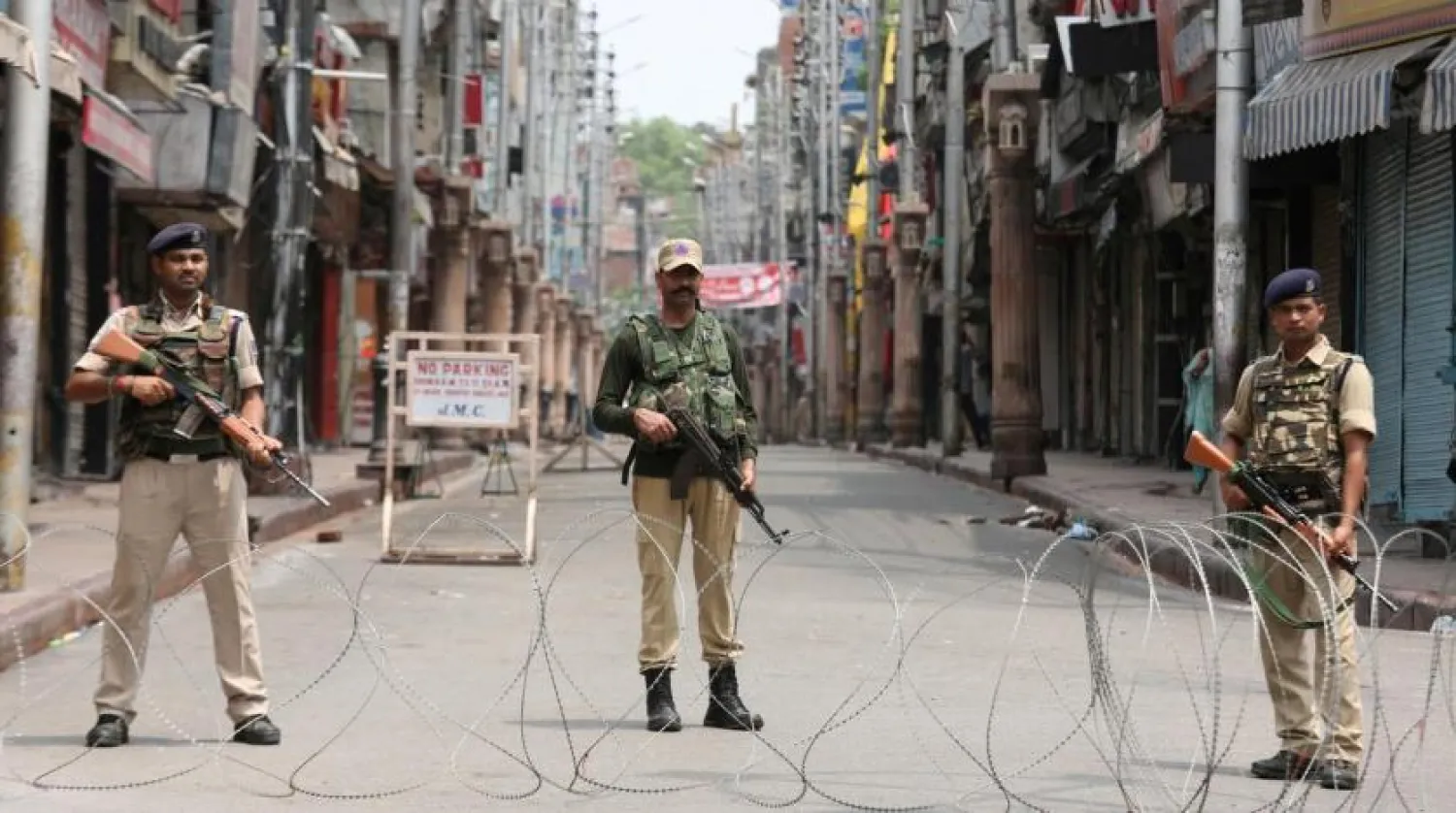
Indian security personnel stand guard along a deserted street during restrictions in Jammu, August 5, 2019. REUTERS/Mukesh Gupta
TT

India Fears Taliban Fallout in Kashmir

Indian security personnel stand guard along a deserted street during restrictions in Jammu, August 5, 2019. REUTERS/Mukesh Gupta

As Prime Minister Narendra Modi set out his Taliban worries to world leaders this week, Indian forces staged raids and battled Kashmir militants who he fears could be emboldened by the group’s victory in Afghanistan.

Kashmir opposition shootings of civilians and police, raids by the security forces on militant hideouts, and insurgent infiltrations across the India-Pakistan ceasefire line have all increased in the Muslim-majority region since the Taliban overran Kabul on August 15.

About 40 people have been killed in shootings and clashes in the two months since then in the Himalayan region, which has been divided since India and Pakistan became independent in 1947.

Militants have targeted minority Hindu and Sikh civilians, while gun battles near the ceasefire line have also left soldiers and militants dead.

India has not openly blamed the Taliban takeover for the uptick in violence, but it has intensified patrols near Pakistani Kashmir and fortified some army camps, according to residents and security officials who spoke to AFP on condition of anonymity.

Modi told a G20 summit in Rome earlier this week that international efforts were needed to make sure Afghanistan does not become a safe haven for "radicalization and terrorism".

He has also raised India's concerns with US President Joe Biden.

In September, he told the UN General Assembly that no country must be allowed to use Afghanistan "as a tool for its own selfish interests" -- a comment widely seen as a reference to neighboring Pakistan, the chief backer of the Taliban's 1996-2001 regime.

This time, Islamabad has stopped short of recognizing the new Taliban government.

Still, New Delhi accuses its arch-rival in Islamabad of fueling Pakistan-based militant groups Lashkar-e-Taiba and Jaish-e-Mohammad, which are blamed for many attacks in Kashmir.

Pakistan denies the claim.

- Weapons and fighters -
India was a backer of the government in Kabul that was overthrown by extremist forces in 1992.

In 2001 it helped the US-led forces that toppled the Taliban. And it was a major donor to the government that the hardline extremists crushed in August.

Afghan militants fought alongside Kashmir fighters in the 1980s and 1990s. About 20 Afghans were killed and 10 were captured, according to a former Kashmiri fighter.

India worries that weapons and fighters could again reach the region, over which it has fought two wars against Pakistan.

"What we can say and learn from the past is that when the previous Taliban regime was in power, that time definitely we had foreign terrorists of Afghan origin in Jammu and Kashmir," said India's military chief of staff General M.M. Naravane.

"So there are reasons to believe that the same thing might happen once again."

- 'Oxygen to our movement' -
Protests are virtually impossible in Kashmir because of restrictions imposed by Delhi since the region's semi-autonomous status was revoked in 2019.

But some in Kashmir have quietly welcomed the Taliban takeover of Afghanistan as a victory against the odds that they too can aspire to one day.

"If they can defeat the world's largest military power, we see a possibility that we too can win our freedom," one businessman in the main Kashmir city of Srinagar told AFP, declining to be named.

A former Kashmir militant who trained in Afghanistan in the 1990s and fought alongside Afghan militants in Kashmir added: "The Taliban victory has already supplied oxygen to our movement."

Given India's security clampdown on Kashmir, Naravane and other military chiefs are confident that Delhi can cope with any surge.

But speaking on condition of anonymity, a senior security official in Kashmir said "there is some panic" inside the security establishment.

Michael Kugelman, a South Asia specialist at the Wilson Centre in Washington, said Afghanistan's new rulers could inspire "stepped up unrest" in Kashmir.

Taliban officials have said they want to maintain trade and other ties with India, meaning that some kind of contact will have to be maintained.

"The Taliban itself won't agitate for unrest in Kashmir, but those it is aligned with likely will do so," he said.

Mosharraf Zaidi, a columnist and security analyst in Pakistan, said he saw no reason the Taliban would want to "deliberately agitate the Indian authorities".

Their victory, he believes, is more important for the signal it sends to "young Kashmiri boys and girls watching the images from Afghanistan".



Top Trump Iran Negotiator Says Visits US Aircraft Carrier in Middle East

US Special Envoy Steve Witkoff delivers a press conference upon the signing of the declaration on deploying post-ceasefire force in Ukraine, during the so-called "Coalition of the Willing" summit, at the Elysee Palace in Paris, France, January 6, 2026. (Reuters)
TT

Top Trump Iran Negotiator Says Visits US Aircraft Carrier in Middle East

US Special Envoy Steve Witkoff delivers a press conference upon the signing of the declaration on deploying post-ceasefire force in Ukraine, during the so-called "Coalition of the Willing" summit, at the Elysee Palace in Paris, France, January 6, 2026. (Reuters)

US President Donald Trump's lead Iran negotiator Steve Witkoff on Saturday said he visited the USS Abraham Lincoln aircraft carrier currently in the Arabian Sea, with Washington and Tehran due to hold further talks soon.

"Today, Adm. Brad Cooper, Commander of US Naval Forces Central Command, Jared Kushner, and I met with the brave sailors and Marines aboard the USS Abraham Lincoln, her strike group, and Carrier Air Wing 9 who are keeping us safe and upholding President Trump's message of peace through strength," said Witkoff in a social media post.

Iranian Foreign Minister Abbas Araghchi said on Saturday he hoped talks with the United States would resume soon, while reiterating Tehran's red lines and warning against any American attack.


Israel’s Netanyahu Expected to Meet Trump in US on Wednesday and Discuss Iran

Israeli Prime Minister Benjamin Netanyahu delivers a speech during a special session to mark the 77th anniversary of the Knesset's establishment and the 60th anniversary of the dedication of the current building at the Knesset, the Israeli parliament, in Jerusalem, 02 February 2026. (EPA)
TT

Israel’s Netanyahu Expected to Meet Trump in US on Wednesday and Discuss Iran

Israeli Prime Minister Benjamin Netanyahu delivers a speech during a special session to mark the 77th anniversary of the Knesset's establishment and the 60th anniversary of the dedication of the current building at the Knesset, the Israeli parliament, in Jerusalem, 02 February 2026. (EPA)

Israeli Prime Minister Benjamin Netanyahu is expected to meet US President Donald Trump on Wednesday in Washington, where they will discuss negotiations with Iran, Netanyahu's office said on Saturday.

Iranian and US officials held indirect nuclear ‌talks in the ‌Omani capital ‌Muscat ⁠on Friday. ‌Both sides said more talks were expected to be held again soon.

A regional diplomat briefed by Tehran on the talks told Reuters Iran insisted ⁠on its "right to enrich uranium" ‌during the negotiations with ‍the US, ‍and that Tehran's missile capabilities ‍were not raised in the discussions.

Iranian officials have ruled out putting Iran's missiles - one of the largest such arsenals in the region - up ⁠for discussion, and have said Tehran wants recognition of its right to enrich uranium.

"The Prime Minister believes that any negotiations must include limiting ballistic missiles and halting support for the Iranian axis," Netanyahu's office said in a ‌statement.


Italy FM Rules Out Joining Trump’s ‘Board of Peace’

Italy's Minister for Foreign Affairs Antonio Tajani speaks to the press during the EPP Leaders’ meeting, in Zagreb, Croatia, 30 January 2026. (EPA)
TT

Italy FM Rules Out Joining Trump’s ‘Board of Peace’

Italy's Minister for Foreign Affairs Antonio Tajani speaks to the press during the EPP Leaders’ meeting, in Zagreb, Croatia, 30 January 2026. (EPA)

Italy will not take part in US President Donald Trump's "Board of Peace", Italian Foreign Minister Antonio Tajani said Saturday, citing "insurmountable" constitutional issues.

Trump launched his "Board of Peace" at the World Economic Forum in Davos in January and some 19 countries have signed its founding charter.

But Italy's constitution bars the country from joining an organization led by a single foreign leader.

Prime Minister Giorgia Meloni, a Trump ally, last month noted "constitutional problems" with joining, but suggested Trump could perhaps reopen the framework "to meet the needs not only of Italy, but also of other European countries".

Tajani appeared Saturday to rule that out.

"We cannot participate in the Board of Peace because there is a constitutional limit," he told the ANSA news agency.

"This is insurmountable from a legal standpoint," he said, the day after meeting US Secretary of State Marco Rubio and US Vice President JD Vance at the Olympics in Milan.

Although originally meant to oversee Gaza's rebuilding, the board's charter does not limit its role to the Palestinian territory and appears to want to rival the United Nations.