


Turkey’s Lake Tuz Dries up Due to Climate Change, Farming

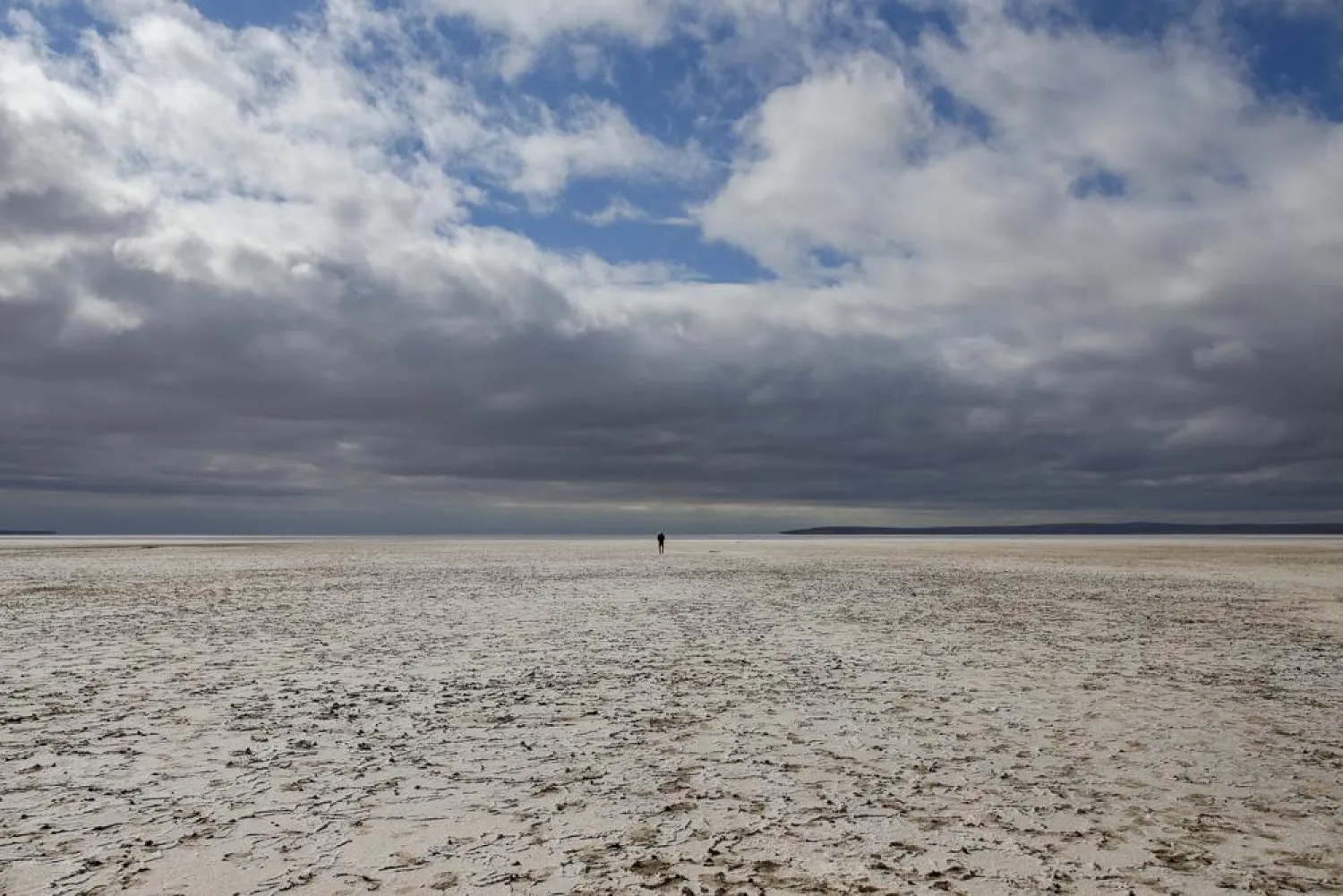
A man walks along Lake Tuz in Aksaray province, Turkey, Monday, Oct. 25, 2021. Lake Tuz, Turkey’s second largest lake, and home to several bird species has seen its waters entirely recede this year, a victim of climate change-induced drought that has hit the region as well as decades-long wrongful agricultural policies that have exhausted the lake’s underground waters. (AP Photo/Emrah Gurel)
TT

Turkey’s Lake Tuz Dries up Due to Climate Change, Farming

A man walks along Lake Tuz in Aksaray province, Turkey, Monday, Oct. 25, 2021. Lake Tuz, Turkey’s second largest lake, and home to several bird species has seen its waters entirely recede this year, a victim of climate change-induced drought that has hit the region as well as decades-long wrongful agricultural policies that have exhausted the lake’s underground waters. (AP Photo/Emrah Gurel)

For centuries, Lake Tuz in central Turkey has hosted huge colonies of flamingos that migrate and breed there when the weather is warm, feeding on algae in the lake’s shallow waters.

This summer, however, a heart-wrenching scene replaced the usual splendid sunset images of the birds captured by wildlife photographer Fahri Tunc. Carcasses of flamingo hatchlings and adults scattered across the cracked, dried-up lake bed.

The 1,665 square kilometer (643 square mile) lake — Turkey’s second-largest lake and home to several bird species — has entirely receded this year. Experts say Lake Tuz (Salt Lake in Turkish) is a victim of climate change-induced drought, which has hit the region hard, and decades of harmful agricultural policies that have exhausted underground water supply, The Associated Press reported.

“There were about 5,0000 young flamingos. They all perished because there was no water,” said Tunc, who also heads the regional branch of the Turkish environmental group Doga Dernegi. “It was an incredibly bad scene. It’s not something I can erase from my life. I hope I do not come across such a scene again.”

Several other lakes across Turkey have similarly dried up or have receded to alarming levels, affected by low precipitation and unsustainable irrigation practices. Climate experts warn that the entire Mediterranean basin, which includes Turkey, is particularly at risk of severe drought and desertification.

In Lake Van, Turkey’s largest lake, located in the country’s east, fishing boats no longer could approach a dock last week after the water fell to unusual levels, HaberTurk television reported.

”(We have) rising temperatures and decreasing rain, and on the other side, the water needs for irrigation in agriculture,” said Levent Kurnaz, a scientist at Bogazici University’s Center for Climate Change and Policy Studies. “It’s a bad situation all over Turkey at the moment.”

A study based on satellite imagery conducted by Turkey’s Ege University shows that water levels at Lake Tuz started to drop beginning in 2000, according to Turkey’s state-run Anadolu Agency. The lake completely receded this year due to rising temperatures, intensified evaporation and insufficient rain, according to the study.

The study also noted a sharp decline in underground water levels around Lake Tuz, a hypersaline lake that straddles the Turkish provinces of Ankara, Konya and Aksaray.

The Konya basin in central Anatolia, which includes Lake Tuz, was once known as Turkey’s breadbasket. Farms in the region have turned to growing profitable but water-intensive crops such as corn, sugar-beet and alfalfa, which have drained groundwater supplies, photographer Tunc said. Farmers have dug thousands of unlicensed wells while streams feeding the lake have dried up or been diverted, he said.

Environmental groups say poor government agricultural policies play a significant role in the deterioration of Turkey’s lakes.

“If you don’t pay them enough money, the farmers, they will plant whatever is water intensive and will make money for them. And if you just tell them it’s not allowed, then they won’t vote for you in the next election,” Kurnaz said.

The overuse of groundwater is also making the region more susceptible to the formation of sinkholes. Dozens of such depressions have been discovered around Konya’s Karapinar district, including one that Associated Press journalists saw next to a newly harvested alfalfa field.

Tunc, 46, a native of Aksaray, is saddened by the thought that he won’t be able to enjoy the flamingos with his 7-month-old son like he did with his 21-year-old son. He remains hopeful, however, that Lake Tuz may replenish itself, if the government stops the water-intensive agriculture.

Kurnaz, the climate scientist, is less optimistic.

“They keep telling people that they shouldn’t use groundwater for this agriculture and people are not listening. There are about 120,000 unlicensed wells in the region, and everybody is pumping out water as if that water will last forever,” Kurnaz said.

“But if you are on a flat place, it can rain as much as you want and it won’t replenish the groundwater in a short time. It takes maybe thousands of years in central Anatolia to replenish the underground water table,” he added.

The drought and flamingo deaths at Lake Tuz were just one of a series of ecological disasters to strike Turkey this summer, believed to be partly due to climate change.

In July, wildfires devastated swaths of forests along Turkey’s southern coast, killing eight people and forcing thousands to flee. Parts of the country’s northern Black Sea coast were struck by floods that killed 82 people. Earlier, a layer of sea mucilage, blamed on soaring temperatures and poor waste management, covered the Sea of Marmara, threatening marine life.

Although Turkey was among the first countries to sign the 2015 Paris climate agreement, the country held off ratifying it until this month as it sought to be reclassified as a developing country instead of a developed one to avoid harsher emission reduction targets. Turkish lawmakers issued a declaration rejecting the status of developed country at the same time they ratified the climate agreement.

In the town of Eskil, near the shores of Lake Tuz, farmer Cengiz Erkol, 54, checked the irrigation system on his field growing animal feed.

“The waters aren’t running as strong and abundant as they used to,” he said. “I have four children. The future doesn’t look good. Each year is worse than the previous year.”



Annual Orchids Show Brings Vivid Color to Chicago Winter

Orchids adorn a Volkswagen Beetle as finishing touches are placed on the 12th annual Chicago Botanic Garden Orchid Show, Friday, Feb. 6, 2026, in Glencoe, Ill. (AP)
TT

Annual Orchids Show Brings Vivid Color to Chicago Winter

Orchids adorn a Volkswagen Beetle as finishing touches are placed on the 12th annual Chicago Botanic Garden Orchid Show, Friday, Feb. 6, 2026, in Glencoe, Ill. (AP)

A soft layer of white snow blankets the grounds of the Chicago Botanic Garden. The air is chilly, the sky gray.

Inside, however, the air is warm and lights illuminate more than 10,000 vividly colored orchids. Staff members move in and out of greenhouses, preparing to open the garden’s 12th annual Orchid Show on Saturday.

This year’s theme is “Feelin’ Groovy" with several installations calling back to the 1970s, including a yellow Volkswagen Beetle filled with orchids.

“It’s just a really great way to get out of the winter cold and come into our greenhouses,” said Jodi Zombolo, associate vice president of visitor events and programs. “I think people are really looking for something to kind of bring happiness and something that they will enjoy and find whimsy in.”

The orchid family is one of the largest in the plant world and some of the species in the show are rare, exhibits horticulturist Jason Toth said. One example is the Angraecum sesquipedale, also known as Darwin’s orchid, on display in the west gallery.

Toth said the orchid led Darwin to correctly conclude that pollinators have adapted in order to reach down the flower's very long end.

"It has a great story and it’s quite remarkable-looking,” said Toth.

Elsewhere, massive, gnarly roots dangle from purple, pink and yellow Vanda orchids in the south greenhouse. These epiphytic orchids grow on the surface of trees instead of in soil.

“I think everyone’s tired of the winter,” said Toth. “So having some kind of flower show at this point is what we’re all craving. And 'Orchids' fits the bill.”

The show is expected to draw 85,000 visitors this year.


UK Zoo Says Tiny Snail ‘Back from Brink’ of Extinction

This photo taken on February 2, 2026 shows a greater Bermuda snail, which is part of a breeding program, sitting under a microscope at Chester Zoo in Chester, north-west England. (AFP)
TT

UK Zoo Says Tiny Snail ‘Back from Brink’ of Extinction

This photo taken on February 2, 2026 shows a greater Bermuda snail, which is part of a breeding program, sitting under a microscope at Chester Zoo in Chester, north-west England. (AFP)

A minuscule snail once thought to have disappeared has been saved from the edge of extinction, a British zoo said Saturday.

The greater Bermuda land snail had not been spotted for years until a cluster of shells was caught slithering through an alleyway in the capital Hamilton in 2014.

Some were flown to Chester Zoo, where experts spent years building up the population before they released thousands back into the wild in 2019.

Unique to Bermuda, this type of snail traces its lineage back over a million years -- a relic of the island's ancient ecosystem.

Now "we can officially say the species is back from the brink", said Chester Zoo in a statement sent to AFP.

The snail "once thought lost has officially been saved from extinction by experts in Chester Zoo, London Zoo, and Bermuda," it said.

They confirmed this after a study in the Oryx biodiversity conservation journal found that six colonies of the re-wilded snails had settled successfully on the archipelago.

"The fact that the snails are firmly established in six areas is massive," said Gerardo Garcia, animal and plant director at Chester Zoo.

From specially designed pods in northwest England, they are now breeding and roaming freely in Bermuda, he said.

"Being able to say that the snails are now safe from extinction is amazing ... and something that conservationists might get to say once or maybe twice in their whole career."

At one point, keeper Katie Kelton said the zoo housed around 60,000 snails.

It was "a lot of snails to look after ... a lot of chopping lettuce, sweet potato and carrot," she told AFP.

- Conservation 'success' story -

The snails faced many threats, including habitat loss, pesticide use, and the cannibalistic "wolf snail".

They were rescued in a process Garcia described as "a war game" with growing numbers tracked by flags pinned across a map of Bermuda.

While they cannot say the species is safe forever, he noted they now knew how to rebuild the population quickly and effectively.

But long-term recovery, he said, would go hand in hand with nature regeneration projects carried out by the Bermudian government.

Chester Zoo has now turned its attention to the lesser Bermuda land snail -- even smaller and much harder to breed.

These snails, which can reach about 23 millimeters (0.9 inches) in length, may now be extinct in the wild.

"We're considering things like seasonality, how long it takes a colony to establish and the complexity of their environments," said expert Iri Gill.

But their experience with the greater Bermuda snail should point them "in the right direction", she said.

"These snails are tiny, but this has been one of the biggest success stories in conservation."


SpaceX Delays Mars Plans to Focus on 2027 Moon Landing

FILE PHOTO: SpaceX headquarters is shown in Hawthorne, California, US June 5, 2025. REUTERS/Daniel Cole/File Photo
TT

SpaceX Delays Mars Plans to Focus on 2027 Moon Landing

FILE PHOTO: SpaceX headquarters is shown in Hawthorne, California, US June 5, 2025. REUTERS/Daniel Cole/File Photo

Elon Musk's SpaceX told investors it will prioritize going to the moon first and attempt a trip to Mars at a later time, the Wall Street Journal reported on Friday, citing sources.

The company will target March 2027 ‌for a ‌lunar landing without ‌astronauts ⁠on board, the ‌report added. The news comes after SpaceX agreed to acquire xAI in a deal that values the rocket and satellite company at $1 trillion and the artificial intelligence outfit ⁠at $250 billion.

SpaceX did not immediately respond ‌to a Reuters request ‍for comment. Musk said ‍last year that he aimed ‍to send an uncrewed mission to Mars by the end of 2026.

SpaceX is developing its next-generation Starship rocket, a stainless steel behemoth designed to be fully reusable and ⁠serve an array of missions including flights to the moon and Mars.

The United States faces intense competition this decade from China in its effort to return astronauts to the moon, where no humans have gone since the final US Apollo mission in ‌1972.