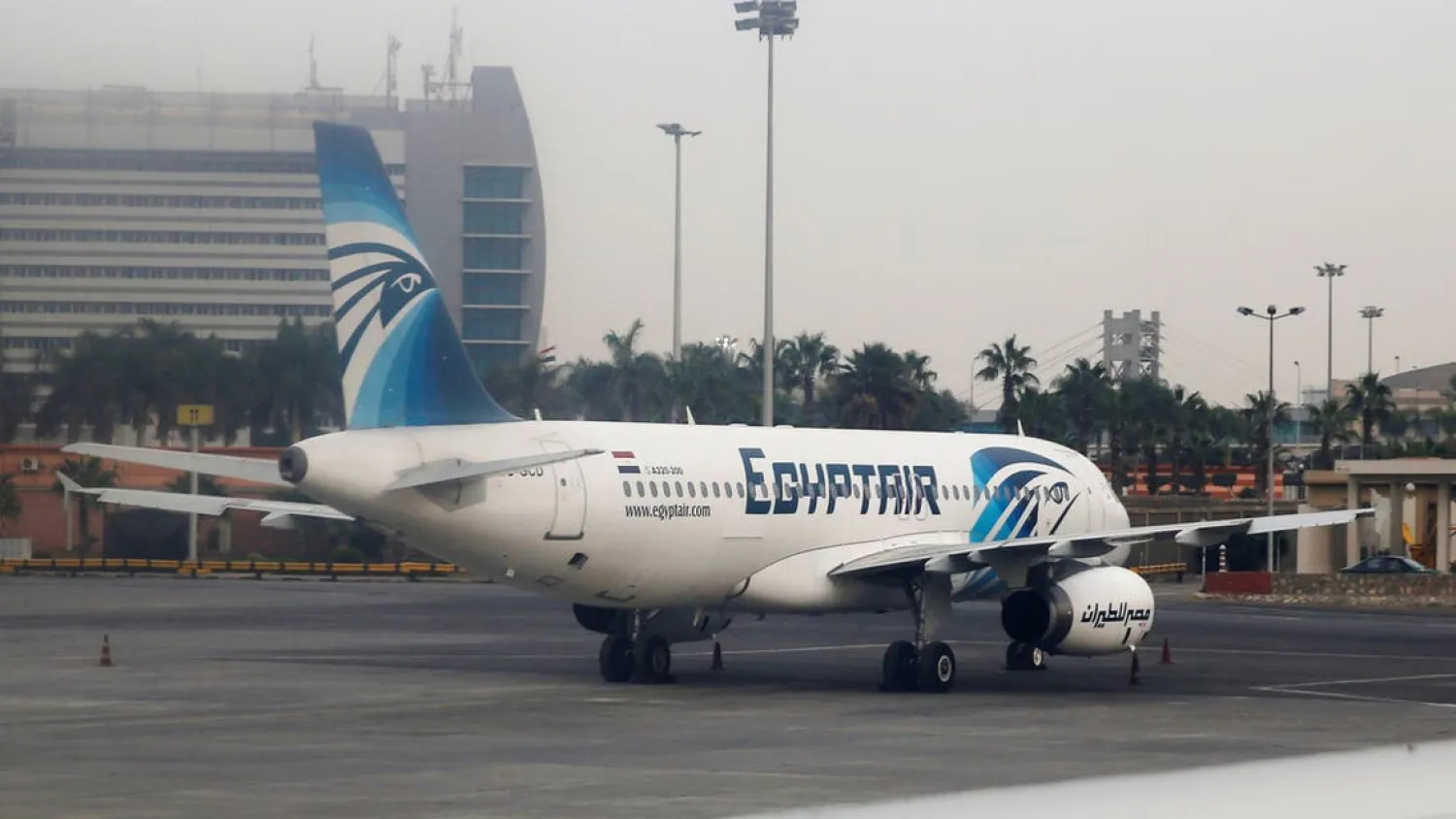
Egyptair Flight Turns Back after Hoax Threat

An EgyptAir passenger plane. (File photo: Reuters)
TT

Egyptair Flight Turns Back after Hoax Threat

An EgyptAir passenger plane. (File photo: Reuters)

A threatening letter that forced a Moscow-bound EgyptAir plane to return to Cairo was found to be a hoax following a security review, Egypt's national carrier said on Wednesday.

Flight MS 729 landed in Cairo airport 22 minutes after taking off earlier on Wednesday.

Citing an unnamed official, the statement said the written message was found on a seat of the Airbus A220-300. It did not elaborate on the content of the message or who wrote it.

"After the landing of EgyptAir flight MS 729, model A220-300, it was confirmed that the threat was negative," the airline said in a statement.

Another plane, a Boeing 737-800, was prepared for the flight to Moscow and later took off with 93 passengers on board, it added.


Syrian Troops Uncover Tunnel Network on Lebanon Border

Syrian soldiers inspect a tunnel on the Lebanon border in the Qusayr area © Bakr ALkasem / AFP
TT

Syrian Troops Uncover Tunnel Network on Lebanon Border

Syrian soldiers inspect a tunnel on the Lebanon border in the Qusayr area © Bakr ALkasem / AFP

In rugged terrain along the Syrian-Lebanese border, yellow bulldozers raised earthen berms in front of armoured vehicles while soldiers combed through tunnels they said were used by Hezbollah, as Syria reinforces its side of the border.

Syria is seeking to stay out of the regional war, whose flames have reached neighboring Lebanon, where Hezbollah is fighting a fierce conflict with Israel.

In rural Qusayr, Syrian soldiers showed an AFP photographer -- granted permission by the defense ministry to film the deployment for the first time since reinforcements were brought in a month ago -- several cross-border tunnels that the army has discovered in recent weeks.

Mohammad Hammoud, the official in charge of Syrian border posts facing Lebanon, told AFP the army discovered by "combing the border areas... a network of tunnels connecting the two countries that were used to smuggle weapons and drugs".

An AFP photographer saw at least five such tunnels, including one whose entrance was dug in the basement of a house, with concrete steps descending into narrow, dark passageways.

Other tunnels in the mountainous area were equipped with electrical wiring and ventilation systems.

In another house leading to a tunnel entrance, a picture of the late Hezbollah chief Hassan Nasrallah hung on the wall, alongside another of the late Iranian general Qasem Soleimani.

A Syrian army field commander said Hezbollah used the tunnels.

The rural Qusayr area serves as a crossroads linking Syria's western Homs province to the Lebanese Bekaa Valley.

- Coordinating with Beirut -

It became a bastion of Hezbollah influence after the Lebanese group's intervention in support of former ruler Bashar al-Assad in 2013 during Syria's civil war.

Since Assad's ouster in December 2024 by an alliance of factions led by new President Ahmed al-Sharaa, Hezbollah's supply lines from Syria have been cut off and the new authorities in Damascus say they are coordinating with Beirut to combat smuggling and to control crossings.

On March 28, Syrian authorities announced the discovery of a tunnel near a village in Homs province linking Syrian territory to Lebanon, saying that "Lebanese militias" used it for smuggling.

Israel has announced multiple times that it attacked border crossings, saying the aim was to prevent military supplies from reaching Hezbollah.

An AFP correspondent saw sites damaged by Israeli strikes, including destroyed buildings near one tunnel.

Nearby, Syrian soldiers were on foot patrol and one fighter stood watching a Lebanese army position from a distance.

On March 4, the Syrian authorities announced a reinforcement of the army on the border with Lebanon, deploying "armoured vehicles, soldiers, rocket launchers, and reconnaissance battalions to monitor border activities and combat smuggling".

The goal, it said, was "securing and controlling the border amid the escalation of the ongoing regional war".

According to a diplomatic source, "the Damascus government has been pressured to intervene in Lebanon to end (Hezbollah's) threat in the region, but it refused".

- No military action -

Syria dominated Lebanon for decades following a military intervention in the latter's 1975-1990 civil war, withdrawing only in 2005, making any new military involvement a fraught proposition.

But a Syrian military source told AFP on Wednesday that "the Syrian army has no intention of any military action, and its mission is currently limited to border control only".

Although Syria has not yet been dragged into the regional conflict, on March 10 Damascus accused Hezbollah of shelling Syrian army positions near Serghaya, west of Damascus.

On the same day, Sharaa and Lebanese President Joseph Aoun, in a telephone call, stressed the need to "control the border" and prevent "any security breakdown".

Sharaa reiterated on Tuesday that his country wanted to remain out of the conflict, in a discussion with the Chatham House think tank during a visit to Britain.

"So long as Syria is not directly targeted by any party, it will remain outside this conflict," he said.

"Fourteen years of war in Syria are enough. We have paid a very heavy price, and we are not ready to go through a new experience."



Sudan Appoints Yassir al-Atta Armed Forces Chief of Staff

A man walks while smoke rises above buildings after aerial bombardment, during clashes between the paramilitary Rapid Support Forces and the army in Khartoum North, Sudan, May 1, 2023. REUTERS/Mohamed Nureldin Abdallah/File Photo
TT

Sudan Appoints Yassir al-Atta Armed Forces Chief of Staff

A man walks while smoke rises above buildings after aerial bombardment, during clashes between the paramilitary Rapid Support Forces and the army in Khartoum North, Sudan, May 1, 2023. REUTERS/Mohamed Nureldin Abdallah/File Photo

Sudan has appointed General Yassir al-Atta, a member of the country's Sovereign Council and assistant to the commander-in-chief Abdel Fattah al-Burhan, chief of staff of the country's Armed Forces, a military spokesman told Reuters on Thursday.

The move is the most significant personnel shift since the Sudanese army's war with the Rapid Support Forces three years ago, and could lead to shifts in strategy as a new front opens in the war in the southeastern Blue Nile state.

Al-Atta takes over the role of chief of staff from career soldier Othman al-Hussein, giving him less of a political role but tighter control of the armed forces.


A Month into War, Lebanon's Prime Minister Says No End in Sight 

Lebanese Prime Minister Nawaf Salam speaks to reporters at the Grand Serail in Beirut, December 3, 2025. (Reuters)
TT

A Month into War, Lebanon's Prime Minister Says No End in Sight 

Lebanese Prime Minister Nawaf Salam speaks to reporters at the Grand Serail in Beirut, December 3, 2025. (Reuters)

Lebanese Prime Minister Nawaf Salam said on Thursday there was no end in sight to a war that had already displaced a million people over the last month, as families fleeing Israeli strikes said they were exhausted by repeated rounds of conflict. Lebanon is entering the second month of conflict between Iran-backed armed group Hezbollah and Israel, which has pledged to occupy swathes of southern Lebanon as part of a "security zone" to protect its own northern residents.

"Lebanon has become a victim of a war - one whose outcomes and end date no one can predict," Salam told reporters on Thursday after a meeting of his cabinet, Reuters reported.
"The positions of Israeli officials, and the practices of their army, reveal far-reaching goals, including a significant expansion in the occupation of Lebanese territories, dangerous talk about establishing buffer zones or security belts, and the displacement of more than one million Lebanese," Salam said.

Israel's assertion that its military will retain control of southern Lebanon has fuelled fears of a long-term occupation, after a two-decade Israeli presence ended in 2000.

Salam said his government would redouble diplomatic and political efforts to end the war. A call by Lebanese President Joseph Aoun for direct talks with Israel has so far received no response.

SALAM SALUTES LEBANESE STILL IN SOUTH

Israel has continued to carry out strikes on Lebanon after a 2024 ceasefire ended its last war with Hezbollah, while keeping troops stationed on five hilltop positions in southern Lebanon.

Israel launched a full-scale air and ground campaign after Hezbollah fired into Israel on March 2 in solidarity with Iran after the US and Israel began their war on Tehran.

Salam, without naming Hezbollah, condemned coordinated attacks carried out with Iran's Revolutionary Guards. More than 1,300 people have been killed in Israeli strikes and about a fifth of Lebanon's population has been displaced. Israel has issued evacuation orders covering around 15% of Lebanese territory.

"I want to direct the biggest salute to our people who are staying in their hometowns and villages in the south, and want to reiterate that we stand by them," Salam said.

Tens of thousands of Lebanese have remained in their homes in southern Lebanon, even as Lebanese troops withdraw from the area to avoid confronting Israeli troops. They include around 9,000 Lebanese Christians living in a cluster of border towns, who told Reuters they were determined to stay despite the advancing military operations.

LEBANESE WANT WARS TO STOP

Salam also stressed the need to preserve internal stability as the war strains Lebanon's sectarian political faultlines. Some communities have been reluctant to host displaced families. As the war drags on, Lebanon is examining ways to house those families in the long-run. Mohammad al-Badran, a Syrian who had lived for years in Beirut's southern suburbs, said he and his family were turned away when they sought refuge in a mountainous area outside the capital.

Badran, his wife and their four children - the youngest of whom was born barely two weeks before the war started - are now sleeping in a makeshift tent area in the capital.

His 10-year-old daughter, Nour, can hear the sound of Israeli strikes on the nearby southern suburbs. "The sound is loud, the children are crying, and I feel like the missiles are flying above us," she said.

Ali al-Aziz, who also fled the southern suburbs, told Reuters that Israel should withdraw from Lebanon so that the conflict could end and he could go back home.

"We want the war to end once and for all. Not for a war to happen every year or every ten years," he said.