

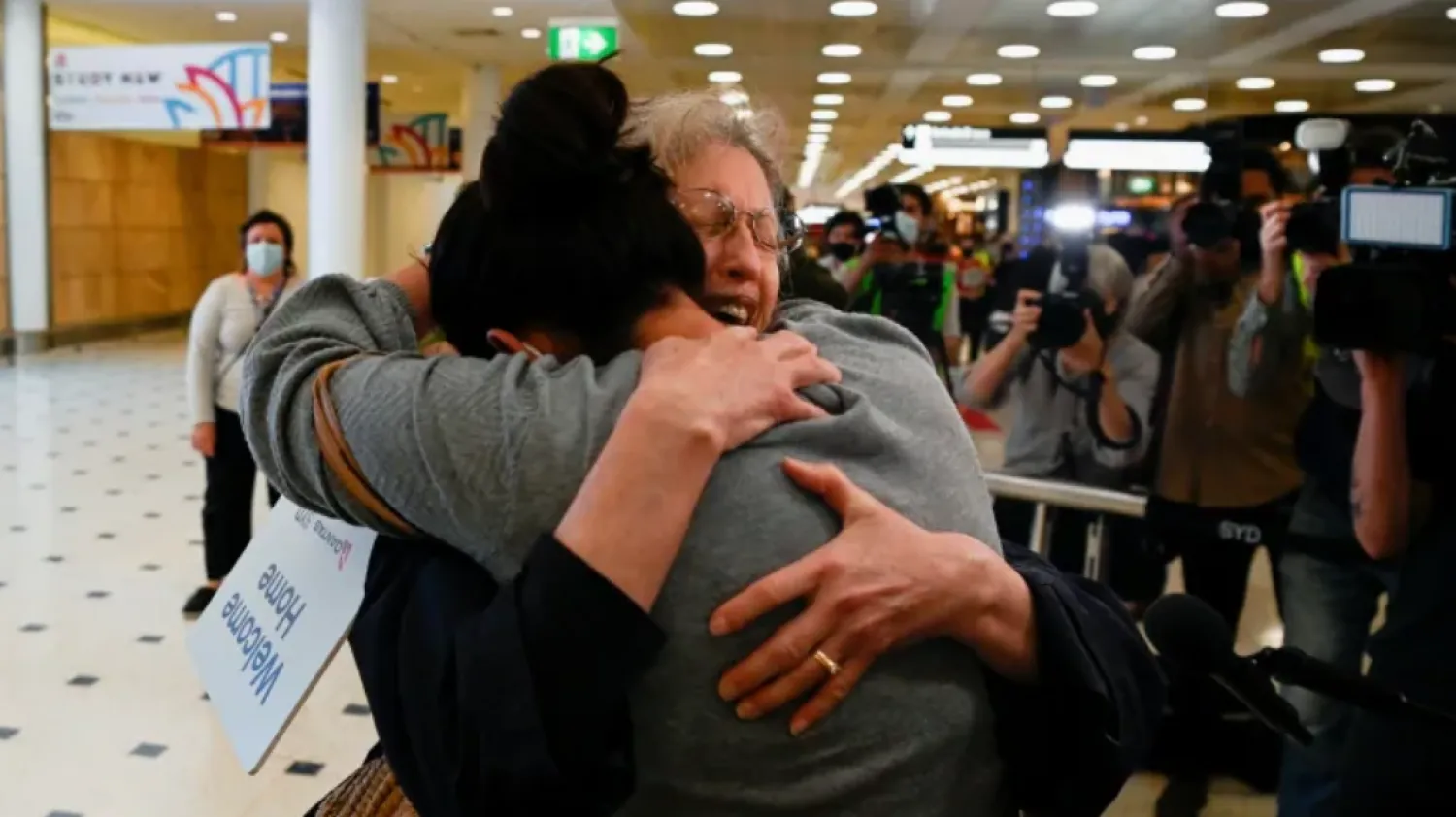

Australians Reunite as Border Reopens after 20-Month Ban

An international traveler is embraced after arriving at Sydney Airport in the wake of coronavirus disease border restrictions easing in Australia on Monday. (Jaimi Joy/Reuters)
TT

Australians Reunite as Border Reopens after 20-Month Ban

An international traveler is embraced after arriving at Sydney Airport in the wake of coronavirus disease border restrictions easing in Australia on Monday. (Jaimi Joy/Reuters)

Sydney’s international airport came alive with tears, embraces and laughter on Monday as Australia’s border opened for the first time in 20 months, with some arriving travelers tearing away mandatory masks to see faces of loved ones they’ve been separated from for so long.

“Just being able to come home without having to go to quarantine is huge,” Carly Boyd, a passenger who had traveled from New York, told reporters at Sydney’s Kingsford-Smith Airport, where Peter Allen's unofficial national anthem “I Still Call Australia Home” was playing.

“There’s a lot of people on that flight who have loved ones who are about to die or have people who died this week. So for them to be able to get off the plane and go see them straight away is pretty amazing,” Boyd added.

Australia is betting that vaccination rates are now high enough to mitigate the danger of allowing international visitors again after maintaining some of the lengthiest and strictest border controls anywhere during the coronavirus pandemic, The Associated Press reported.

Thailand, too, was reopening its border Monday. Fully vaccinated tourists arriving by air from 46 countries and territories no longer have to quarantine and can move freely. And local restrictions such as a curfew in some areas were being lifted.

Before the pandemic, Sydney was Australia’s busiest international airport but until Monday had been almost deserted.

The new freedoms mean that outbound fully vaccinated Australian permanent residents and citizens can leave the country for any reason without asking the government for an exemption from a travel ban that has trapped most at home since March 25, 2020, AP said.

Incoming vaccinated Australians are able to come home without quarantining in a hotel for two weeks. The cap on hotel quarantine numbers had been a major obstacle for thousands of Australians stranded overseas. That cap now only applies to unvaccinated travelers.

Sydney was the first Australian airport to announce it would reopen Monday because New South Wales was the first state where 80% of the population aged 16 and older have been fully vaccinated. Melbourne and the national capital Canberra also opened on Monday after Victoria state and the Australian Capital Territory achieved the vaccination benchmark.

Sydney had 16 scheduled inbound international flights on Monday and 14 outbound. Melbourne, Australia's second largest city, had five scheduled in and five out. Canberra had none.

The first regular international passenger flight to land in Australia was a Singapore Airlines flight from Singapore that landed before 6 a.m. local time, followed by a Qantas Airways flight that had flown 15 hours from Los Angeles.

Qantas customer service manager Paul Wason said landing in Sydney was a “huge day” for passengers and crew alike.

“Very much mixed emotions, great emotions, lots of happiness, lots of sadness, lots of excitement as well,” Wason said.

An Australian who lives in San Francisco, who identified himself only as Jeremy, said he had been trying to fly back to Sydney with his wife and baby daughter since July. They had been prevented at short notice four times from flying, twice because flights were delayed and twice because quarantine caps had been reduced in response to the COVID-19 delta variant taking hold in Sydney in June.



Migrants Missing after Mediterranean Capsize: NGOs

Hellenic coast guard performs SAR operation, following migrant's boat collision with coast guard off the Aegean island of Chios, near Mersinidi, Greece, February 4, 2026. REUTERS
TT

Migrants Missing after Mediterranean Capsize: NGOs

Hellenic coast guard performs SAR operation, following migrant's boat collision with coast guard off the Aegean island of Chios, near Mersinidi, Greece, February 4, 2026. REUTERS

Dozens of people are missing after a migrant boat capsized in the central Mediterranean, the NGOs Mediterranea Saving Humans and Sea-Watch said Sunday on social media.

Two people died and 32 were rescued from the boat, which had left Libya on Saturday afternoon with around 105 people on board, according to Mediterranea Saving Humans, AFP reported.

"Tragic Easter shipwreck. 32 survivors, two bodies recovered and more than 70 people missing," the NGO wrote on X, adding that the boat capsized in a search-and-rescue zone handled by Libyan authorities.

Sea-Watch said two commercial ships saved the survivors and took them to the Italian island of Lampedusa.

An aerial video it posted showed two men clinging to the hull of the capsized vessel, and the approach of one of the commercial ships.

Mediterranea Saving Humans said the accident was "the consequence of policies by European governments that refuse to open safe and legal pathways" for migrants.

Lampedusa is a key entry point for migrants crossing the Mediterranean from North Africa to Europe.

Since the start of 2026, at least 683 migrants have lost their lives or gone missing on attempts to cross the sea, according to the UN's migration agency IOM.

According to the Italian government, 6,175 migrants arrived on Italian territory over the same period.


Trump Vows Strikes on Iran’s Power Plants, Bridges if Strait of Hormuz isn't Reopened

ABD Başkanı Donald Trump (Reuters)
TT

Trump Vows Strikes on Iran’s Power Plants, Bridges if Strait of Hormuz isn't Reopened

ABD Başkanı Donald Trump (Reuters)

US President Donald Trump has promised strikes on Iran’s power plants and bridges on Tuesday, restating his threat to attack civilian infrastructure if the Strait of Hormuz isn’t reopened.

In an expletive-laden post Sunday morning, Trump promised the “crazy bastards” would be “living in Hell” if the waterway isn’t opened to marine traffic, The AP news reported.

Trump had previously threatened strikes two weeks ago, but extended the deadline for Iran to reopen the waterway twice, claiming there were positive signs in negotiations with the Iranians. But there have been few public signs of progress in a diplomatic off-ramp to the war.


Pope Leo Marks First Easter as Pontiff with Call for Hope Amid Global Conflicts

 Pope Leo XIV presides over Easter Mass in St. Peter's Square at the Vatican, Sunday, April 5, 2026 (AP)
Pope Leo XIV presides over Easter Mass in St. Peter's Square at the Vatican, Sunday, April 5, 2026 (AP)
TT

Pope Leo Marks First Easter as Pontiff with Call for Hope Amid Global Conflicts

 Pope Leo XIV presides over Easter Mass in St. Peter's Square at the Vatican, Sunday, April 5, 2026 (AP)
Pope Leo XIV presides over Easter Mass in St. Peter's Square at the Vatican, Sunday, April 5, 2026 (AP)

Pope Leo celebrated his first Easter Mass as pontiff with a call Sunday to exercise hope against “the violence of war that kills and destroys,” saying “we need this song of hope today” as conflicts spread around the world.

With the US-Israeli war on Iran in its second month and Russia’s ongoing campaign in Ukraine, Leo has repeatedly called for a halt in hostilities. In his Easter homily, the pope singled out those who wage war, abuse the weak and prioritize profits.

Leo, the first US-born pope, addressed the faithful from an open-air altar in St. Peter’s Square flanked with white roses, while the steps leading down to the piazza where the faithful gathered were filled with spring perennials, symbolically resonating with the pope’s message of hope.

The pontiff implored the faithful to keep their hope in the face of death, which lurks “in injustices, in partisan selfishness, in the oppression of the poor, in the lack of attention given to the most vulnerable.

“We see it in violence, in the wounds of the world, in the cry of pain that rises from every corner because of the abuses that crush the weakest among us, because of the idolatry of profit that plunders the earth’s resources, because of the violence of war that kills and destroys,” he said.

He quoted his predecessor Pope Francis in warning against falling into indifference in the face of “persistent injustice, evil, indifference and cruelty,” because “it is also true that in the midst of darkness, something new always springs to life and sooner or later produces fruit.”

He will later deliver the traditional “Urbi et Orbi” message — Latin for “to the city and the world.”

Christians in the Holy Land were marking a subdued Easter Traditional ceremonies at the Church of the Holy Sepulchre, revered by Christians as the traditional site of Jesus’ crucifixion and resurrection, were scaled back under an agreement with Israeli police. Authorities have put limits on the sizes of public gatherings due to ongoing missile attacks.

The restrictions also dampened the recent Muslim holy month of Ramadan and Eid al-Fitr holiday, as well as the current weeklong Jewish festival of Passover. On Sunday, the Jewish priestly blessing at the Western Wall — normally attended by tens of thousands — was limited to just 50 people.

The restrictions have strained relations between Israeli authorities and Christian leaders. Police last week prevented two of the church’s top religious leaders, including Latin Patriarch Pierbattista Pizzaballa, from celebrating Palm Sunday at the Church of the Holy Sepulchre.

On Tuesday, the pope had expressed hope that the war could be finished before Easter.