Syria Receives Around Two Million Covid Vaccines in One Week

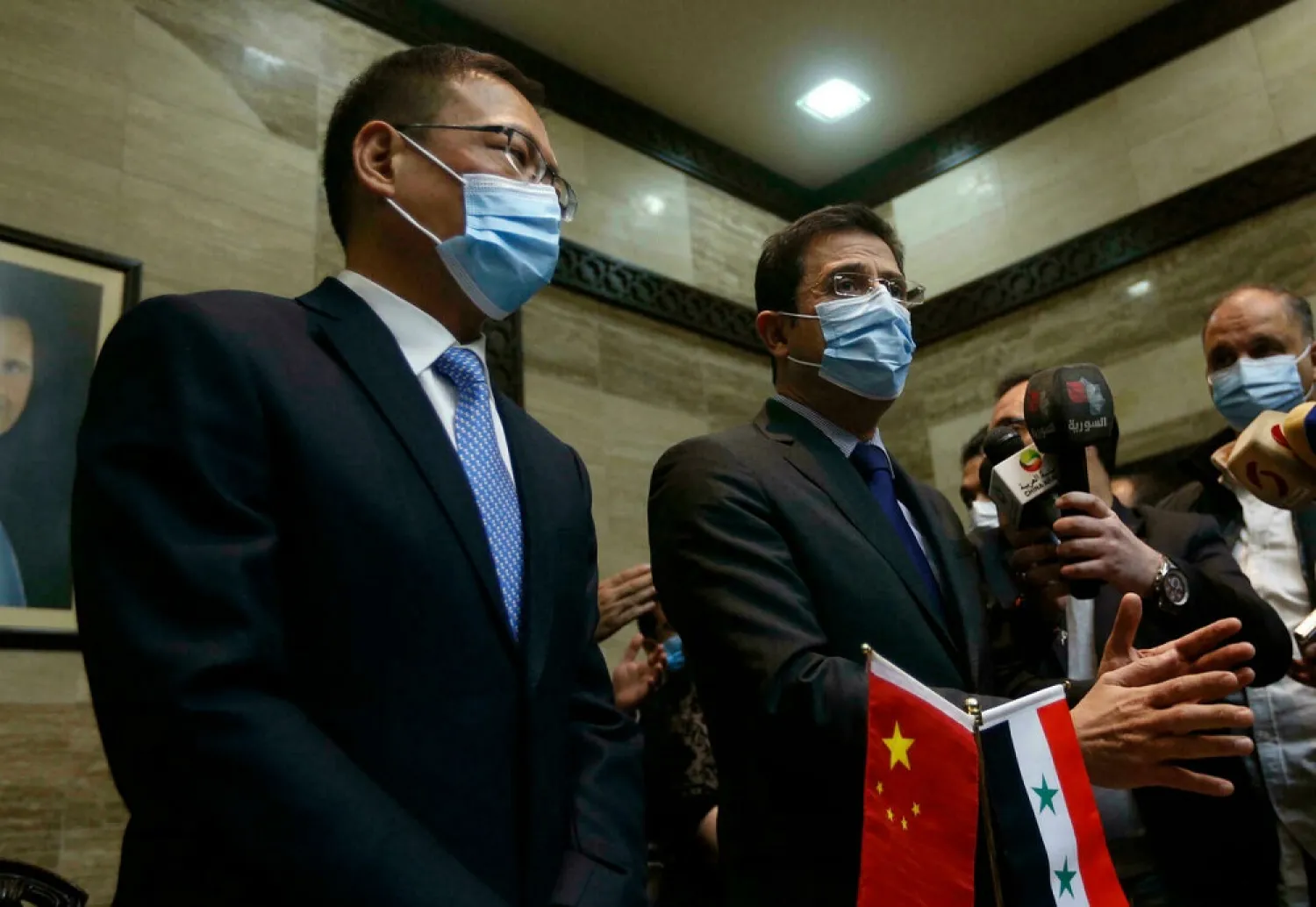
Syrian Health Minister Hassan al-Ghabash (R) and Chinese ambassador Feng Biao (L) take part in a ceremony upon the arrival of Sinopharm Covid-19 vaccine doses, in the capital Damascus. (AFP)
TT

Syria Receives Around Two Million Covid Vaccines in One Week

Syrian Health Minister Hassan al-Ghabash (R) and Chinese ambassador Feng Biao (L) take part in a ceremony upon the arrival of Sinopharm Covid-19 vaccine doses, in the capital Damascus. (AFP)

China donated 500,000 Covid-19 vaccines to Syria on Sunday.

Damascus last week received more than 1.3 million doses of the China's Sinovac under the global Covax program.

Syrian Health Minister Hassan al-Ghabash said China provided 500,000 doses of the Chinese Sinopharm vaccine.

Speaking to journalists on Sunday, he added that health authorities have vaccinated more than 600,000 people and urged more Syrians to come forward to receive the jabs.

Chinese ambassador Feng Biao said Sunday's donation raised to 800,000 the number of Sinopharm doses provided by Beijing.

Head of Mission and WHO Representative to Syria Akjemal Magtymova tweeted: “Pleased with the arrival of the significant Covax shipment to Syria this week and hope for more deliveries soon to meet the vaccination targets to combat the pandemic.”

More than 46,000 cases, including 2,661 deaths, have been officially registered in the war-torn country, but medics and activist groups believe the actual figure is much higher.

The opposition-held northwestern region of Idlib, which has recorded more than 90,000 cases, including 2,000 deaths, says it has received almost 690,000 vaccine doses under the Covax scheme. Some 77,000 people have been inoculated.

The Kurdish administration in the northeast that receives vaccines from Damascus has registered 1,500 Covid deaths from 37,000 cases, Around 40,000 people have been vaccinated.

The medical teams and international organizations fear that the health situation may worsen with the beginning of winter, especially in the refugee camps and in regions not under the government’s control.

Under-Secretary-General for Humanitarian Affairs and Emergency Relief Coordinator Martin Griffiths warned last month that less than two percent of Syria’s population have been vaccinated and infections are surging.


Samsung Logs Best-ever Profit on AI Chip Demand

South Korean tech giant Samsung Electronics posted record quarterly profits on Thursday, riding strong market demand for its artificial intelligence chips. Jung Yeon-je / AFP/File
TT

Samsung Logs Best-ever Profit on AI Chip Demand

South Korean tech giant Samsung Electronics posted record quarterly profits on Thursday, riding strong market demand for its artificial intelligence chips. Jung Yeon-je / AFP/File

South Korean tech giant Samsung Electronics posted record quarterly profits Thursday, riding massive market demand for the memory chips that power artificial intelligence.

A global frenzy to build AI data centers and develop the fast-evolving technology has sent orders for advanced high bandwidth memory microchips soaring.

That is also pushing up prices for less flashy chips used in consumer electronics -- threatening higher prices for phones, laptops and other devices worldwide.

In the quarter to December 2025, Samsung said it saw "its highest-ever quarterly consolidated revenue at KRW 93.8 trillion (US$65.5 billion)", a quarter-on-quarter increase of nine percent.

"Operating profit was also an all-time high, at KRW 20.1 trillion," the company said.

The dazzling earnings came a day after a key competitor, South Korean chip giant SK hynix, said operating profit had doubled last year to a record high, also buoyed by the AI boom.

The South Korean government has pledged to become one of the top three AI powers, behind the United States and China, with Samsung and SK hynix among the leading producers of high-performance memory.

Samsung said Thursday it expects "AI and server demand to continue increasing, leading to more opportunities for structural growth".

Annual revenue stood at 333.6 trillion won, while operating profit came in at 43.6 trillion won. Sales for the division that oversees its semiconductor business rose 33 percent quarter-on-quarter.

The company pointed to a $33.2 billion investment in chip production facilities -- pledging to continue spending in "transitioning to advanced manufacturing processes and upgrading existing production lines to meet rising demand".

- 'Clearly back' -

Major electronics manufacturers and industry analysts have warned that chipmakers focusing on AI sales will cause higher retail prices for consumer products across the board.

This week US chip firm Micron said it was building a $24 billion plant in Singapore in response to AI-driven demand that has caused a global shortage of memory components.

SK hynix announced Wednesday that its operating profit had doubled last year to a record 47.2 trillion won.

The company's shares have surged some 220 percent over the past six months, while Samsung Electronics has risen about 130 percent, part of a huge global tech rally fueled by optimism over AI.

Both companies are on the cusp of producing next-generation high-bandwidth "HBM4" chips for AI data centers, with Samsung reportedly due to start making them in February.

American chip giant Nvidia -- now the world's most valuable company -- is expected to be one of Samsung's customers for HBM4 chips.

But Nvidia has reportedly allocated around 70 percent of its HBM4 demand to SK hynix for 2026, up from the market's previous estimate of 50 percent.

"Samsung is clearly back and we are expecting them to show a significant turnaround with HBM4 for Nvidia's new products -- helping them move past last year's quality issues," Hwang Min-seong, research director at market analysis firm Counterpoint, told AFP.

But SK still "maintains a market lead in both quality and supply" of a number of key components, including Dynamic Random Access Memory chips used in AI servers, he said.

SK also this week said it will set up an "AI solutions firm" in the United States, committing $10 billion and weighing investments in US companies.


Saudi Arabia Concludes Privatization Program

The Saudi capital (Reuters)
TT

Saudi Arabia Concludes Privatization Program

The Saudi capital (Reuters)

Saudi Arabia’s Council of Economic and Development Affairs (CEDA) has approved the conclusion of the Kingdom’s Privatization Program after its implementation and objectives were fully completed, in line with the roadmap established when the initiative was launched in 2018.

The decision was taken during a meeting held via videoconference on Wednesday, during which the council also reviewed key developments in the domestic and global economic landscape.

The council highlighted the strong competitive capabilities of the Saudi economy in confronting expected global shifts in 2026, noting that current financial indicators reflect an upward trajectory driven by robust growth in non-oil sectors, alongside the recovery of petroleum activities and the expansion of the national industrial base.

Launched in 2018, the Privatization Program aimed to support national economic growth, strengthen the role of the private sector, and identify government assets, services, and resources suitable for privatization across multiple sectors. The program sought to improve the quality and efficiency of public services while reducing their cost for individuals and businesses.

At the start of its virtual meeting, the council reviewed the monthly report submitted by the Ministry of Economy and Planning, which addressed recent developments in the global economy and growth prospects for 2026 amid ongoing challenges, as well as their potential impact on the national economy and its ability to adapt to global economic changes.

The report underscored the positive trend reflected in various economic and financial indicators, including GDP growth driven by continued expansion in non-oil activities, the recovery of oil-related sectors, rising industrial output, and stable inflation, supported by government measures to regulate real estate prices and maintain balance in the property market.

The conclusion of the Privatization Program marks a transition from a foundational phase to a new phase focused on implementation and maximizing impact. This shift will be guided by the National Privatization Strategy, which has reviewed targets, developed new opportunities, and established a comprehensive national framework for prioritizing initiatives across key sectors.


Yemeni Officer: Drug-Smuggling Networks Linked to Houthi Preventive Security

Colonel Osama al-Assad said that coordination with the Saudi side is at the highest level to safeguard border security (Asharq Al-Awsat). 
TT

Yemeni Officer: Drug-Smuggling Networks Linked to Houthi Preventive Security

Colonel Osama al-Assad said that coordination with the Saudi side is at the highest level to safeguard border security (Asharq Al-Awsat). 

Colonel Osama al-Assad, commander of Yemen’s Security and Protection Battalion at the Al-Wadiah border crossing, said that most drug-smuggling networks operating from Yemen toward Saudi Arabia are directly linked to the Houthi group’s so-called Preventive Security apparatus.

In an interview with Asharq Al-Awsat, al-Assad revealed that his unit recently arrested a senior Houthi figure who attempted to enter Saudi Arabia using a forged passport and a fake Umrah visa. He suggested that the suspect’s motives were security-related rather than religious, as claimed.

Al-Assad said his battalion faces daily attempts of various types of smuggling, including narcotics, human trafficking, forged documents, and unidentified individuals. He stressed that the unit’s experience has enabled it to thwart many illegal activities.

He also highlighted the high level of coordination with Saudi authorities, expressing appreciation for Riyadh’s continued support for Yemen in general and for border security forces in particular.

Battalion’s Mission

Al-Assad explained that the battalion’s core mission is to secure the Al-Wadiah crossing and combat all forms of smuggling. He noted that the unit arrests around 10 individuals daily carrying forged Umrah visas.

The battalion’s security zone extends 30 kilometers west toward the Rayyan area in Al-Jawf governorate, 50 kilometers toward the 11th Border Guard Brigade, and 40 kilometers toward the Al-Abr region. Its tasks also include arresting wanted members of Al-Qaeda and fugitives evading court rulings.

Links to Houthi Networks

According to al-Assad, most contraband-smuggling operations are directly connected to the Houthi Preventive Security apparatus in Sanaa, with interrogations of suspects revealing direct ties.

He said Houthi-linked networks support both human and drug-smuggling operations. During one operation, a network offered one million Saudi riyals in exchange for releasing a smuggler, abandoning the vehicle and seized contraband.

Secret Meetings

Investigations indicate that smugglers affiliated with the Houthi apparatus hold meetings in border areas near Oman. Some secret gatherings reportedly took place in Al-Ghaydah, the capital of Al-Mahra governorate in eastern Yemen. Al-Assad said Ali al-Huraizi plays a prominent role in these networks.

Close Coordination with Saudi Arabia

Al-Assad noted that security cooperation with Saudi Arabia is at the highest level, with continuous information exchange on smuggling cases. He described Saudi security measures as strong and vigilance as high.

He confirmed that the battalion recently arrested a senior Houthi official attempting to enter Saudi Arabia with a forged Umrah visa, describing the operation as “dramatic.”

Drug Production

Al-Assad further claimed that the Houthis, whom he described as an Iranian proxy, have moved to establish drug-production facilities in Sanaa and Saada following the fall of the Assad regime. He cited the dismantling of a drug factory in Al-Mahra, allegedly under the supervision of Ali al-Huraizi, with a production capacity of about 10,000 pills per hour.

Challenges

Al-Assad said the battalion’s main challenge is limited resources, relying heavily on human effort. He called for heavy equipment to build earth barriers and trenches to curb internal smuggling.