


Thousands of Afghans Seek Temporary US Entry, Few Approved

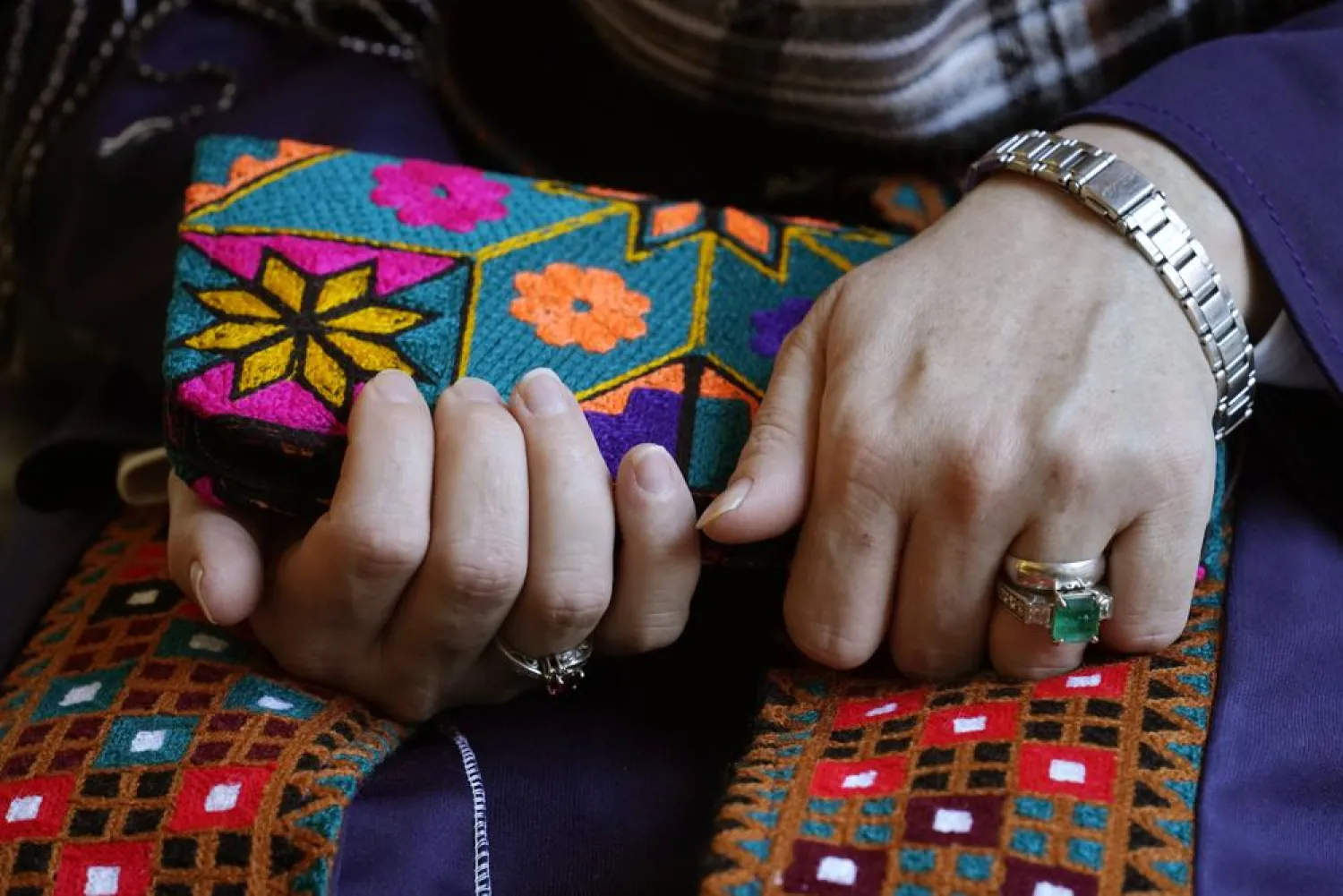
A Massachusetts resident identifying herself only as "Safi," who asked that her last name not be used for fear of retribution against her relatives in Afghanistan, holds a purse with traditional Afghan patterns, Tuesday, Nov. 9, 2021, during an interview with The Associated Press.  (AP Photo/Steven Senne)
A Massachusetts resident identifying herself only as "Safi," who asked that her last name not be used for fear of retribution against her relatives in Afghanistan, holds a purse with traditional Afghan patterns, Tuesday, Nov. 9, 2021, during an interview with The Associated Press. (AP Photo/Steven Senne)
TT

Thousands of Afghans Seek Temporary US Entry, Few Approved

A Massachusetts resident identifying herself only as "Safi," who asked that her last name not be used for fear of retribution against her relatives in Afghanistan, holds a purse with traditional Afghan patterns, Tuesday, Nov. 9, 2021, during an interview with The Associated Press.  (AP Photo/Steven Senne)
A Massachusetts resident identifying herself only as "Safi," who asked that her last name not be used for fear of retribution against her relatives in Afghanistan, holds a purse with traditional Afghan patterns, Tuesday, Nov. 9, 2021, during an interview with The Associated Press. (AP Photo/Steven Senne)

More than 28,000 Afghans have applied for temporary admission into the US for humanitarian reasons since shortly before the Taliban recaptured Afghanistan and sparked a chaotic US withdrawal, but only about 100 of them have been approved, according to federal officials.

US Citizenship and Immigration Services has struggled to keep up with the surge in applicants to a little-used program known as humanitarian parole but promises it’s ramping up staff to address the growing backlog.

Afghan families in the US and the immigrant groups supporting them say the slow pace of approvals threatens the safety of their loved ones, who face an uncertain future under the repressive extremist regime because of their ties to the West, The Associated Press reported.

“We’re worried for their lives,” says Safi, a Massachusetts resident whose family is sponsoring 21 relatives seeking humanitarian parole. “Sometimes, I think there will be a day when I wake up and receive a call saying that they’re no more.”

The 38-year-old US permanent resident, who asked that her last name not be used for fear of retribution against her relatives, is hoping to bring over her sister, her uncle and their families. She says the families have been in hiding and their house was destroyed in a recent bombing because her uncle had been a prominent local official before the Taliban took over.

The slow pace of approvals is frustrating because families have already paid hundreds if not thousands of dollars in processing fees, says Chiara St. Pierre, an attorney at the International Institute of New England in Lowell, Massachusetts, a refugee resettlement agency assisting Safi’s family.

Each parole application comes with a $575 filing charge, meaning USCIS, which is primarily fee-funded, is sitting on some $11.5 million from Afghans in the last few months alone, she and other advocates complain.

“People are desperate to get their families out,” said St. Pierre, whose nonprofit has filed more than 50 parole applications for Afghan nationals. “Do we not owe a duty to the people left behind, especially when they are following our immigration laws and using the options they have?”

Victoria Palmer, a USCIS spokesperson, said the agency has trained 44 additional staff to help address the application surge. As of mid-October, the agency had only six staffers detailed to the program.

Of the more than 100 approved as of July 1, some are still in Afghanistan and some have made it to third countries, she said, declining to provide details. The program typically receives fewer than 2,000 requests annually from all nationalities, of which USCIS approves an average of about 500, according to Palmer.

Part of the challenge is that humanitarian parole requires an in-person interview, meaning those in Afghanistan need to travel to another county with an operating US embassy or consulate after they’ve cleared the initial screening. US officials warn it could then take months longer, and there’s no guarantee parole will be granted, even after the interview.

Humanitarian parole doesn’t provide a path to lawful permanent residence or confer US immigration status. It’s meant for foreigners who are unable to go through the asylum or other traditional visa processes, but who need to leave their country urgently.

The backlog of parole requests comes on top of the more than 73,000 Afghan refugees already evacuated from the country as part of Operations Allies Welcome, which was focused on Afghans who worked for the US government as interpreters and in other jobs.

Most have arrived in the country and have been staying on military bases awaiting resettlement in communities across the country, though about 2,000 still remain overseas awaiting clearance to enter the US, according to Palmer.

But advocates question some of USCIS’s recent decisions for Afghan humanitarian parole, such as prioritizing applications from those already living in other countries. They say that approach is at odds with the program’s purpose of helping those most at risk.

The Biden administration should instead focus on applications from women and girls, and religious minorities still in the country, said Sunil Varghese, of the New York-based International Refugee Assistance Project.

It could also dispense with some of the financial documentation required for applicants and their sponsors, since Congress has passed legislation making Afghan evacuees eligible for refugee benefits, said Lindsay Gray, CEO of Vecina, an Austin, Texas-based group that trains attorneys and volunteers on immigration matters.

Palmer didn’t directly address the critiques but said the agency, in each case, determines if there’s a “distinct, well-documented reason” to approve humanitarian parole and whether other protections are available. USCIS also considers whether the person already has US ties, such as a family member with legal status or prior work for the US government, among other factors.

In the meantime, Afghans in the US have little choice but to wait and fret.

Bahara, another Afghan living in Massachusetts who asked her last name be withheld over concerns for her family, says she’s been wracked with guilt for her decision to leave her country to attend a local university.

The 29-year-old boarded a plane on Aug. 15 just hours before the Taliban swept into the capital of Kabul, leading to one of the largest mass evacuations in US history.

“It was my dream, but it changed completely,” said Bahara, referring to enrolling in a US master’s degree program. “I couldn’t stop thinking about my family. I couldn’t sleep the first few weeks. All I did was cry, but it didn’t help.”

Bahara said her family is worried because Taliban officials have been paying unannounced visits to people like her father who worked with the US government after the militant group was originally ousted from power by the US following the Sept. 11, 2001, terrorist attacks.

An American family is now sponsoring her family for humanitarian parole, giving Bahara hope even as she grieves over her country’s current situation.

“I cannot believe how everything just collapsed,” said Bahara, who founded a children’s literacy program in Afghanistan. “All the achievements and hard work just added up to zero, and now people are suffering.”

Baktash Sharifi Baki, a green-card holder who has been living in the US since 2014, was compelled to take more drastic measures as Afghanistan quickly unraveled this summer.

The Philadelphia resident, who served as an interpreter for the US government, traveled back in August in the hopes of shepherding his wife, daughter, mother and godson to safety.

But the family wasn’t able to board any of the final commercial flights out of Kabul. Baki has appealed to the US government to allow them to board one of the charter flights that have recently resumed.

Meanwhile, a friend in Louisiana has offered to serve as the family’s sponsor for a humanitarian parole application, even covering the costly fees himself.

Baki and his family are staying for now with relatives in the northern city of Mazar-e-Sharif. But he worries his modest cash savings is dwindling just as the region’s harsh winter sets in and Afghanistan’s economic crisis is deepening.

“We are really facing a bad situation here,” Baki said. “We need to get out.”


Russia Evacuates 198 Workers from Iran Nuclear Plant Amid Airstrike

Rosatom State Atomic Energy Corporation Director General Alexey Likhachev arrives to attend the talks between Russian President Vladimir Putin and Armenian Prime Minister Nikol Pashinyan at the Kremlin in Moscow, Russia, 01 April 2026. (EPA/Pavel Bednyakov/AP Pool)
TT

Russia Evacuates 198 Workers from Iran Nuclear Plant Amid Airstrike

Rosatom State Atomic Energy Corporation Director General Alexey Likhachev arrives to attend the talks between Russian President Vladimir Putin and Armenian Prime Minister Nikol Pashinyan at the Kremlin in Moscow, Russia, 01 April 2026. (EPA/Pavel Bednyakov/AP Pool)

Russia started a planned evacuation of 198 workers from Iran's Bushehr atomic plant shortly after a US-Israeli projectile hit near the facility, Russian state media said on Saturday.

This was a third evacuation from the facility in southern Iran on the Gulf coast, which was built with Moscow's help, with about 100 Russian staff remaining there by now.

The area around Bushehr has been struck four times during this war. The latest attack on Saturday saw one person -- a guard at the facility -- killed, but did not damage the plant itself, according to Iranian state media.

"As planned, we began the main phase of the evacuation today," Russia's nuclear agency Rosatom head Alexey Likhachev was quoted as saying by Russia's TASS news agency.

"About 20 minutes after that ill-fated strike, buses set off from Bushehr station towards the Iranian-Armenian border (with) 198 people, to be precise -- this is the largest evacuation," he added.

Likhachev also said that Russia informed the US and Israel about the evacuation.

"The likelihood of a risk of damage or a potential nuclear incident is, unfortunately, only increasing, as has been confirmed by this morning's events," the Rosatom CEO said.

The agency plans to keep only a skeleton staff at Bushehr amid the threat of further strikes.

The Russian foreign ministry slammed the "evil" US-Israeli attack and urged a cessation of hostilities on Iranian nuclear facilities immediately.


Erdogan Says Middle East War Has Caused ‘Geostrategic Impasse’

This handout photograph taken and released by the Turkish presidential press service on April 4, 2026, shows Türkiye's President Recep Tayyip Erdogan (R) welcoming and shaking hands Ukraine's President Volodymyr Zelensky (L) upon arrival for a bilateral meeting on security at Dolmabahce Presidential Office, in Istanbul. (Turkish Presidential Press Service / AFP)
TT

Erdogan Says Middle East War Has Caused ‘Geostrategic Impasse’

This handout photograph taken and released by the Turkish presidential press service on April 4, 2026, shows Türkiye's President Recep Tayyip Erdogan (R) welcoming and shaking hands Ukraine's President Volodymyr Zelensky (L) upon arrival for a bilateral meeting on security at Dolmabahce Presidential Office, in Istanbul. (Turkish Presidential Press Service / AFP)

Türkiye's President Recep Tayyip Erdogan said the war in the Middle East had led to a "geostrategic impasse", during a telephone conversation with NATO chief Mark Rutte, his office said Saturday.

"President Erdogan said the process started by the intervention against Iran had led to a geostrategic impasse and that the international community had to redouble its efforts to bring an end to this war," said the statement.

Türkiye has attempted to mediate an end to the hostilities, notably through negotiations conducted with Pakistan and Egypt.

Erdogan said his country was also continuing efforts "to reach a peaceful outcome" to the conflict between Russia and Ukraine.

Ukrainian President Volodymyr Zelensky arrived in Istanbul Saturday for talks with Erdogan.

A senior Ukrainian official told AFP that the talks would not only be about drone interceptors but also about security cooperation in general.

The Turkish presidency said on X that the talks would focus "efforts towards a ceasefire and a lasting solution."


Several Injured in Israel by Iran Missile Fire

A picture shows the damage at a factory that got hit by a missile in Petah Tikva, east of Tel Aviv, on April 3, 2026. (AFP)
TT

Several Injured in Israel by Iran Missile Fire

A picture shows the damage at a factory that got hit by a missile in Petah Tikva, east of Tel Aviv, on April 3, 2026. (AFP)

Israeli emergency services said its crew treated five people who were injured Saturday in Tel Aviv and surrounding areas after Iran fired several rounds of missiles toward Israel.

Since midnight, seven waves of Iranian missiles have been launched towards Israel, according to the Israeli military.

Israel's Magen David Adom emergency services said a 45-year-old man was treated for minor injuries from glass shrapnel in the central city of Bnei Brak and taken to hospital.

As the day progressed, rescue teams said they had treated three additional casualties -- two men in their 20s hit by glass fragments and one injured by blast.

A 52-year-old man "lightly injured by the blast wave" was also transferred to a hospital in Ramat Gan, in central Israel, the emergency service said.

In a residential neighborhood of Ramat Gan, AFP images showed the top floor of a house completely blown out, exposing its gutted interior, with a crushed bookcase and an exercise bike amid the debris.

Numerous impact marks were visible on the walls.

Nearby, another home was largely destroyed, stripped of its outer walls, according to AFP photographs.

"All this is from shrapnel," Joy Frankel, a social worker told AFP near one of the impacted sites.

According to several local media outlets, including The Times of Israel, a cluster munition missile fired from Iran on Saturday morning landed near the Kirya military base in Tel Aviv, not far from the defense ministry.

The military said its air defenses were working to down missiles fired from Iran, each a time it announced incoming projectiles.

Since February 28, the United States and Israel have conducted joint strikes against Iran, prompting the Tehran to retaliate with daily missile barrages targeting Israel and several neighboring countries across the region.
