


COVID Cases Break Records in Europe, Prompting Booster Shot Rethink

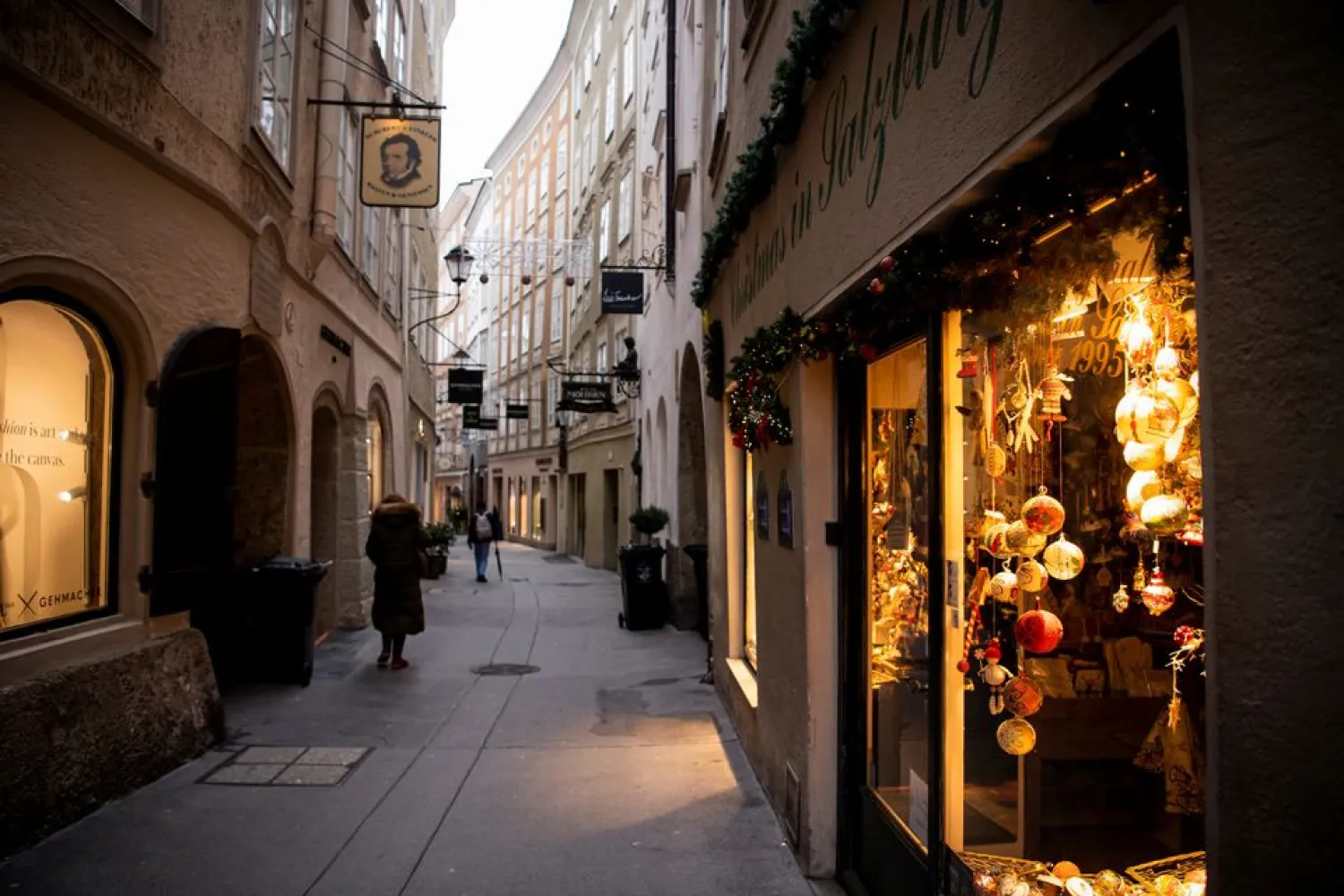
Pedestrians walk at the city center during the coronavirus disease (COVID-19) outbreak, as Austria's government imposed a general lockdown from Monday, in Salzburg, Austria, November 22, 2021. (Reuters)
TT

COVID Cases Break Records in Europe, Prompting Booster Shot Rethink

Pedestrians walk at the city center during the coronavirus disease (COVID-19) outbreak, as Austria's government imposed a general lockdown from Monday, in Salzburg, Austria, November 22, 2021. (Reuters)

Coronavirus infections broke records in parts of Europe on Wednesday, with the continent once again the epicenter of a pandemic that has prompted new curbs on movement and made health experts think again about booster vaccination shots.

Slovakia, the Czech Republic, the Netherlands and Hungary all reported new highs in daily infections as winter grips Europe and people gather indoors in the run-up to Christmas, providing a perfect breeding ground for COVID-19.

The disease has swept the world in the two years since it was first identified in central China, infecting more than 258 million people and killing 5.4 million.

The European Center for Disease Prevention and Control (ECDC), the EU public health agency, recommended vaccine boosters for all adults, with priority for those over 40, in a major shift from its previous guidance which suggested the extra doses should be considered for older frail people and those with weakened immune systems.

"Available evidence emerging from Israel and the UK shows a significant increase in protection against infection and severe disease following a booster dose in all age groups in the short term," the ECDC said in a report published on Wednesday.

Many EU countries have already begun giving booster doses to their populations but are using different criteria to make priorities and different intervals between the first shots and boosters.

ECDC head Andrea Ammon said boosters would increase protection against infection caused by waning immunity and "could potentially reduce the transmission in the population and prevent additional hospitalizations and deaths".

She advised countries with low levels of vaccination to speed up their rollouts and warned of high risks of a further spike in deaths and hospitalizations in Europe in December and January if the recommended measures are not introduced.

World Health Organization chief Tedros Adhanom Ghebreyesus, acknowledging that Europe was again at the epicenter of the pandemic, warned against a "false sense of security" over the protection offered by vaccines.

"No country is out of the woods," he told reporters, adding that he hoped a consensus can be found at a World Trade Organization ministerial meeting next week for an IP waiver for pandemic vaccines, already supported by more than 100 countries.

Sweden will begin gradually rolling out boosters to all adults, government and health officials said. Booster shots of mRNA vaccine have been offered to people aged 65 or above, with an eye to eventually extending the shots to other groups.

"We are faced with an uncertain winter," Health Minister Lena Hallengren told a news conference. "You can contribute by staying home if you're sick or by getting vaccinated if you haven't already, and taking your booster when you're offered it."

Slovakia reported its highest daily rise in cases on Wednesday when the government approved a two-week lockdown, broadcaster TA3 and other media reported, citing Economy Minister Richard Sulik, to quell the world's fastest surge in infections.

Vaccination reservations

Neighboring Austria has already locked down its population this week for at least 10 days, becoming the first to reimpose such restrictions. It will also require the whole population to be vaccinated from Feb. 1, infuriating many in a country where skepticism about state mandates affecting individual freedoms runs high.

The Czech Republic reported its highest daily rise in infections, with cases surpassing 25,000 for the first time and putting further strain on hospitals. The government is looking to institute mandatory vaccines for people over 60 and some professions, like healthcare workers.

The Netherlands recorded more than 23,700 coronavirus infections in 24 hours, the highest number since the start of the pandemic, and the government will announce new measures on Friday.

Hungary reported a record 12,637 new daily COVID-19 cases.

Prime Minister Viktor Orban's government, which opposes further lockdowns for fear of stifling the economy, launched a vaccination campaign this week, offering shots without prior registration.

But the idea of mandatory vaccinations has also raised concerns among Hungarians.

Authorities in Russia, where daily coronavirus-related deaths are near record highs, said they were scouring social networks and media websites to find people spreading false claims about the dangers of vaccination, the latest in a series of measures to invigorate sluggish inoculation rates.

France will announce new COVID containment measures on Thursday as the infection rate surges nationwide.

Italy is expected to restrict access to some indoor venues for people who have not been vaccinated.

Poland will have to tighten restrictions if it does not see daily case numbers decreasing in the near future, the health minister said.

Many German regions have already started to impose tighter rules amid the country's worst COVID surge yet as the curtain comes down on the Angela Merkel era, including demanding that vaccinated people show a negative test to attend indoor events.

Outgoing Health Minister Jens Spahn said on Monday that by the end of the winter almost everyone in Germany would be "vaccinated, recovered or dead".



Russia: Man Suspected of Shooting Top General Detained in Dubai

An investigator works outside a residential building where the assassination attempt on Russian Lieutenant General Vladimir Alexeyev took place in Moscow, Russia February 6, 2026. REUTERS/Anastasia Barashkova
TT

Russia: Man Suspected of Shooting Top General Detained in Dubai

An investigator works outside a residential building where the assassination attempt on Russian Lieutenant General Vladimir Alexeyev took place in Moscow, Russia February 6, 2026. REUTERS/Anastasia Barashkova

Russia's Federal Security Service (FSB) said on Sunday that the man suspected of shooting top Russian military intelligence officer Vladimir Alexeyev in Moscow has been detained in Dubai and handed over to Russia.

Lieutenant General Vladimir Alexeyev, deputy head of the GRU, ⁠Russia's military intelligence arm, was shot several times in an apartment block in Moscow on Friday, investigators said. He underwent surgery after the shooting, Russian media ⁠said.

The FSB said a Russian citizen named Lyubomir Korba was detained in Dubai on suspicion of carrying out the shooting.

Russian Foreign Minister Sergei Lavrov accused Ukraine of being behind the assassination attempt, which he said was designed to sabotage peace talks. ⁠Ukraine said it had nothing to do with the shooting.

Alexeyev's boss, Admiral Igor Kostyukov, the head of the GRU, has been leading Russia's delegation in negotiations with Ukraine in Abu Dhabi on security-related aspects of a potential peace deal.


Factory Explosion Kills 8 in Northern China

Employees work on an electric vehicle (EV) production line at the Volkswagen Anhui factory in Hefei, Anhui province, China, February 4, 2026. REUTERS/Florence Lo
TT

Factory Explosion Kills 8 in Northern China

Employees work on an electric vehicle (EV) production line at the Volkswagen Anhui factory in Hefei, Anhui province, China, February 4, 2026. REUTERS/Florence Lo

An explosion at a biotech factory in northern China has killed eight people, Chinese state media reported Sunday, increasing the total number of fatalities by one.

State news agency Xinhua had previously reported that seven people died and one person was missing after the Saturday morning explosion at the Jiapeng biotech company in Shanxi province, citing local authorities.

Later, Xinhua said eight were dead, adding that the firm's legal representative had been taken into custody.

The company is located in Shanyin County, about 400 kilometers west of Beijing, AFP reported.

Xinhua said clean-up operations were ongoing, noting that reporters observed dark yellow smoke emanating from the site of the explosion.

Authorities have established a team to investigate the cause of the blast, the report added.

Industrial accidents are common in China due to lax safety standards.
In late January, an explosion at a steel factory in the neighboring province of Inner Mongolia left at least nine people dead.


Iran Warns Will Not Give Up Enrichment Despite US War Threat

Traffic moves through a street in Tehran on February 7, 2026. (Photo by ATTA KENARE / AFP)
TT

Iran Warns Will Not Give Up Enrichment Despite US War Threat

Traffic moves through a street in Tehran on February 7, 2026. (Photo by ATTA KENARE / AFP)

Iran will never surrender the right to enrich uranium, even if war "is imposed on us,” its foreign minister said Sunday, defying pressure from Washington.

"Iran has paid a very heavy price for its peaceful nuclear program and for uranium enrichment," Abbas Araghchi told a forum in Tehran.

"Why do we insist so much on enrichment and refuse to give it up even if a war is imposed on us? Because no one has the right to dictate our behavior," he said, two days after he met US envoy Steve Witkoff in Oman.

The foreign minister also declared that his country was not intimidated by the US naval deployment in the Gulf.

"Their military deployment in the region does not scare us," Araghchi said.