UN Special Envoy: Offensive on Marib Undermines Prospects of Settlement

UN Special Envoy for Yemen, Hans Grundberg with a group of Yemeni women and men (OSE)
TT

UN Special Envoy: Offensive on Marib Undermines Prospects of Settlement

UN Special Envoy for Yemen, Hans Grundberg with a group of Yemeni women and men (OSE)

The sustained offensive on Marib has already resulted in ripple effects across Yemen and continues to undermine the prospects of a negotiated settlement to the conflict, warned the UN Special Envoy for Yemen, Hans Grundberg.

"There is no sustainable military solution to the conflict in Yemen. All warring parties need to de-escalate violence and prioritize the interests of civilians over scoring military wins."

He stressed that partial solutions would not lead to a sustainable solution to the conflict, saying that his consultations in various regions and countries aim to crystallize constructive ideas for the peace process.

According to a statement distributed by his office, Grundberg discussed with Egyptian and Yemeni officials in Cairo the ongoing attack on Marib, warning of partial solutions that are not sustainable.

"Piecemeal approaches will not result in a sustainable solution. There needs to be equal focus on immediate priorities that mitigate the impact of the war on civilians and on the longer-term questions needed to reach a durable and just solution to the conflict."

During his visit to Cairo, the Special Envoy met with Egyptian Foreign Minister Sameh Shoukry and Secretary-General of the Arab League Ahmed Aboul Gheit.

The meetings discussed the importance of a stable Yemen for the region and the shared responsibility of regional countries to prevent further escalation in Yemen and help Yemenis reach a negotiated political solution.

They also discussed the region's role in supporting UN efforts in this regard.

Later, the UN official met with a diverse group of Yemeni women and men, including parliamentarians, representatives of political parties, civil society organizations, and media professionals.

Participants stressed the need to de-escalate violence and highlighted the impact of the deteriorating economy on the lives of civilians.

Grundberg consulted Yemeni interlocutors on ways to start an inclusive political dialogue that includes the parties' demands in a broader Yemeni agenda of political, economic, and security priorities.

Official Yemeni sources quoted the UN envoy as saying that he will work under the relevant Security Council resolutions to achieve a just peace that the Yemeni people deserve.

Yemeni Speaker Sultan al-Barakani also met with the UN envoy to discuss latest developments.

The meeting addressed efforts to end the war and ways to achieve a comprehensive and just peace in light of the Houthi militia's continued intransigence and rejection of all initiatives to alleviate the human suffering witnessed in Yemen.

He renewed the legitimacy's desire to bring peace and security to Yemen and reach a political settlement based on the three references.

Barakani stated that the Houthi militias undermine all peace efforts, indicating that they do not want to accept the peace options.

The Speaker stressed the importance of the role of the UN and its envoy to Yemen to take practical and severe steps to end the Houthi coup and implement effective mechanisms to reach a comprehensive and just solution.

He reiterated the need for the international community to pressure the Houthi group to submit to the peace process, adding that Houthis did not implement the Stockholm Agreement and took it as an opportunity to bring in Iranian weapons and continue destabilize security and stability.

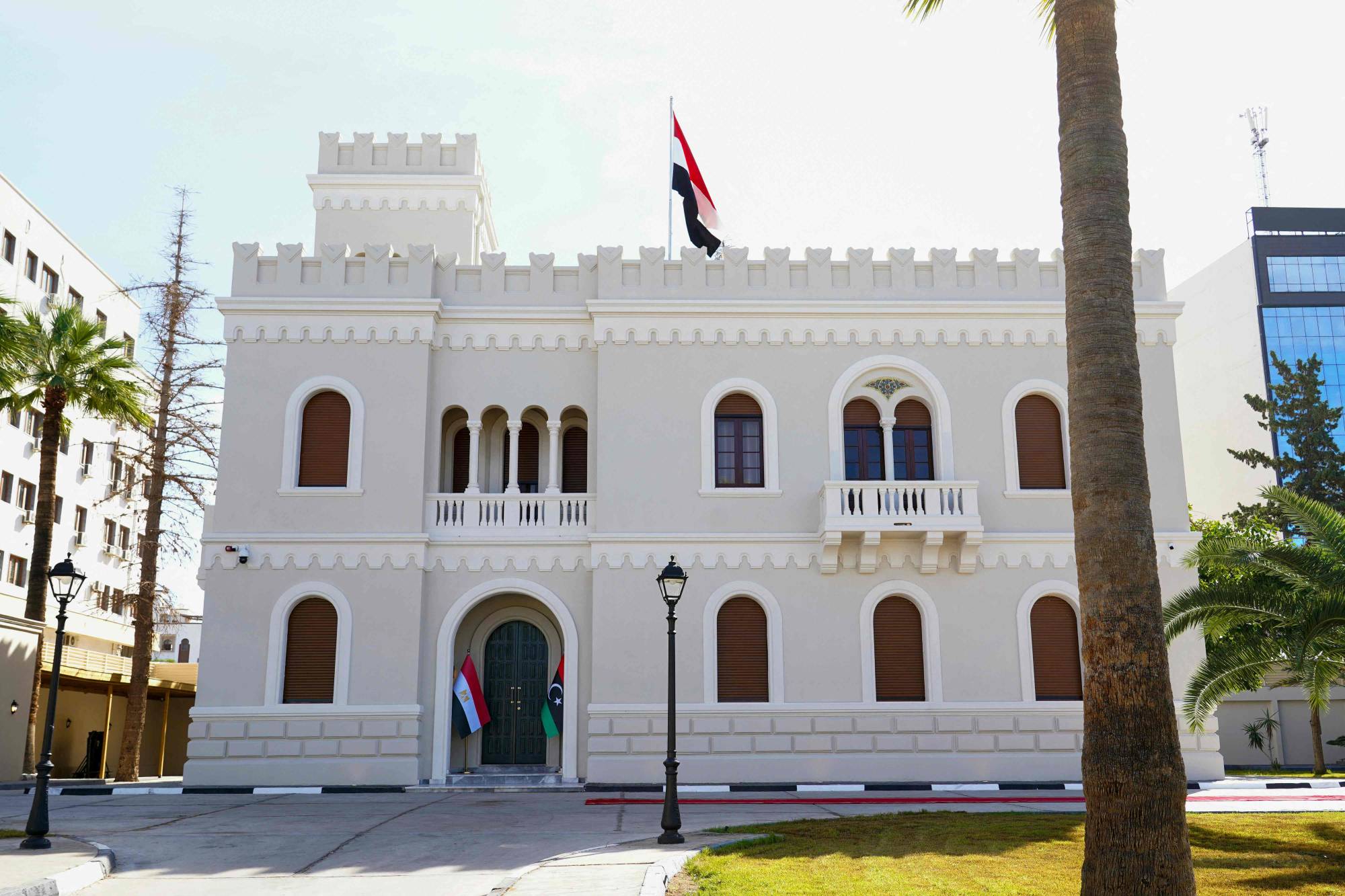

Egypt Reopens Embassy in Libya’s Tripoli After 12-Year Closure

Egypt's Foreign Minister Badr Abdelatty speaks during the reopening ceremony of Egyptian embassy in Libyan capital Tripoli on November 7, 2026. (AFP)
TT

Egypt Reopens Embassy in Libya’s Tripoli After 12-Year Closure

Egypt's Foreign Minister Badr Abdelatty speaks during the reopening ceremony of Egyptian embassy in Libyan capital Tripoli on November 7, 2026. (AFP)

Egypt ‌reopened its embassy in Libya's capital Tripoli on Saturday after a 12-year absence, marking a rapprochement with the country's western-based administration, the foreign affairs ministry in Cairo said in a statement.

Egypt closed its ⁠Tripoli embassy in 2014, when many foreign missions there closed amid an escalating conflict that saw rival governments set themselves up in the capital and in the east of the ⁠North African country.

Egypt's ‌foreign affairs minister ‌Badr Abdelatty was quoted in the statement ‌as saying at the reopening ceremony ‌that the historical significance of the embassy building "aligns with the deep-rooted human and cultural ties that characterize Egyptian-Libyan relations".

This picture shows the Egyptian embassy building in Tripoli on November 7, 2026. (AFP)

Oil producer Libya ‌has been plunged into chaos since the fall of Moammar al-Gaddafi ⁠in ⁠a NATO-backed uprising in 2011.

In Benghazi in eastern Libya there is the Libyan National Army under military commander Khalifa Haftar and the House of Representatives, and a government led by Osama Hammad. In the west there is the Government of National Unity headed by Abdulhamid Dbeibah and the High Council of State in Tripoli.

The embassy's reopening comes weeks after Libya's eastern-based parliament ratified a long-disputed maritime agreement with Türkiye, angering Cairo which said it infringed upon its maritime zone.


Fighting in Yemen’s Al-Jawf and Marib Intensifies

Government forces fire artillery at Houthi positions in Taiz. (AFP)
TT

Fighting in Yemen’s Al-Jawf and Marib Intensifies

Government forces fire artillery at Houthi positions in Taiz. (AFP)

Fighting in Yemen intensified over the past few hours amid widespread clashes between government armed forces and the Houthi movement across the governorates of Taiz, Marib, Al-Jawf, and Lahj.

The Yemeni army launched more than 1,200 strikes targeting Houthi positions, gatherings, and reinforcements, while coalition airstrikes hit Sanaa and Saada, and interceptors downed missiles and drones fired toward Saudi Arabia.

These developments coincide with a worsening humanitarian and health crisis in the city of Taiz, where hospitals are on the verge of shutting down due to acute fuel shortages, amid the ongoing siege imposed by the Houthis.

On the ground, military sources said that the Southern Giants Forces and the Popular Resistance made new field advancements on Saturday in the Al-Madaribah front in Lahj. Following fierce clashes with the Houthis, the forces seized control of several strategic hills and positions, and succeeded in capturing a number of Houthi fighters.

Clashes in Al-Jawf extended to fronts southeast of Al-Hazm city. The Yemeni armed forces engaged in battles supported by fighter jets and drones, while successfully repelling multiple combat lines in the south and southeast of the governorate, according to army statements.

The clashes involved the use of artillery and rocket launchers along the front lines, with the Yemeni army stating that its forces engaged Houthis and inflicted casualties among them.

The army added that fighter jets conducted five airstrikes targeting Houthi military mobilizations and vehicles, which resulted in the destruction and disabling of several pieces of equipment and vehicles, as well as deaths and injuries among the group's ranks.

Field military sources in Marib said that government forces are closing in on securing the strategic Mas camp, following the recapture of several vital positions in the nearby and amid a retreat by the movement's fighters.

In Taiz, the armed forces confirmed that, with the support of the Popular Resistance, they managed to thwart a Houthi attack that lasted for hours on the Al-Aqroud front, affirming that they inflicted casualties and losses on the attackers.

On the Tur Al-Baha front in Lahj, the army announced that the Nation's Shield and Giants forces managed to seize control of new positions and repel Houthi attacks and infiltration attempts.

Meanwhile, the official spokesperson for the Yemeni Armed Forces, Colonel Majed Al-Nuzaili, announced the execution of 1,211 operations against Houthi positions, gatherings, reinforcements, vehicles, and firing sources as part of the Dawn of Yemen Operation.

The operations spanned the fronts of Taiz and Marib, alongside the Tur Al-Baha front. The armed forces continue to carry out their combat missions and take necessary precautions to protect civilians and civilian objects, he stressed.

On the humanitarian front, hospitals in the city of Taiz face the risk of shutting down as fuel reserves needed to run electrical generators near depletion, in a crisis that threatens the continuity of medical services, particularly in dialysis units, intensive care, and neonatal incubators.

Health officials in the governorate warned that the remaining diesel reserves at the Al-Thawra General Hospital are only sufficient for 48 hours, threatening to halt vital departments, including emergency, dialysis, intensive care, and the burn center.


Rains Mark Return of Winter Misery for Gaza's Palestinians

A displaced Palestinian man attempts to clear a water puddle outside his flooded tent amid heavy rainfall in Gaza City's Al-Remal neighbourhood on November 7, 2026. (Photo by Omar AL-QATTAA / AFP)
TT

Rains Mark Return of Winter Misery for Gaza's Palestinians

A displaced Palestinian man attempts to clear a water puddle outside his flooded tent amid heavy rainfall in Gaza City's Al-Remal neighbourhood on November 7, 2026. (Photo by Omar AL-QATTAA / AFP)

Displaced families spent a sleepless night in the Gaza Strip as heavy rain flooded their fragile tents, soaking mattresses and belongings, and turning camp pathways into pools of muddy water.

The rain marks the start of another difficult winter for the more than 1.6 million Palestinians living in tents or other makeshift shelters in the territory, where nearly the entire population has lost its homes during Israel’s campaign triggered by the Oct. 7, 2023, Hamas-led attacks.

Majed Al-Omari, who lost a limb during the war, struggled to make his way between tents on crutches after the rains tore down the wooden frame and plastic sheeting of his shelter.

“We will have to sleep in the street tonight, or find somewhere else to stay,” he told The Associated Press.

The UN humanitarian office has said 294,250 families need shelter assistance for the rainy season, but available supplies are enough to provide only partial assistance to 18% of those in need.

It said a lack of funds, slow procurement procedures and delayed approvals by the Israeli authorities mean additional supplies may not reach Palestinians until more than halfway through winter.