
'From Rwanda to Hollywood': Kigali Style Goes Global

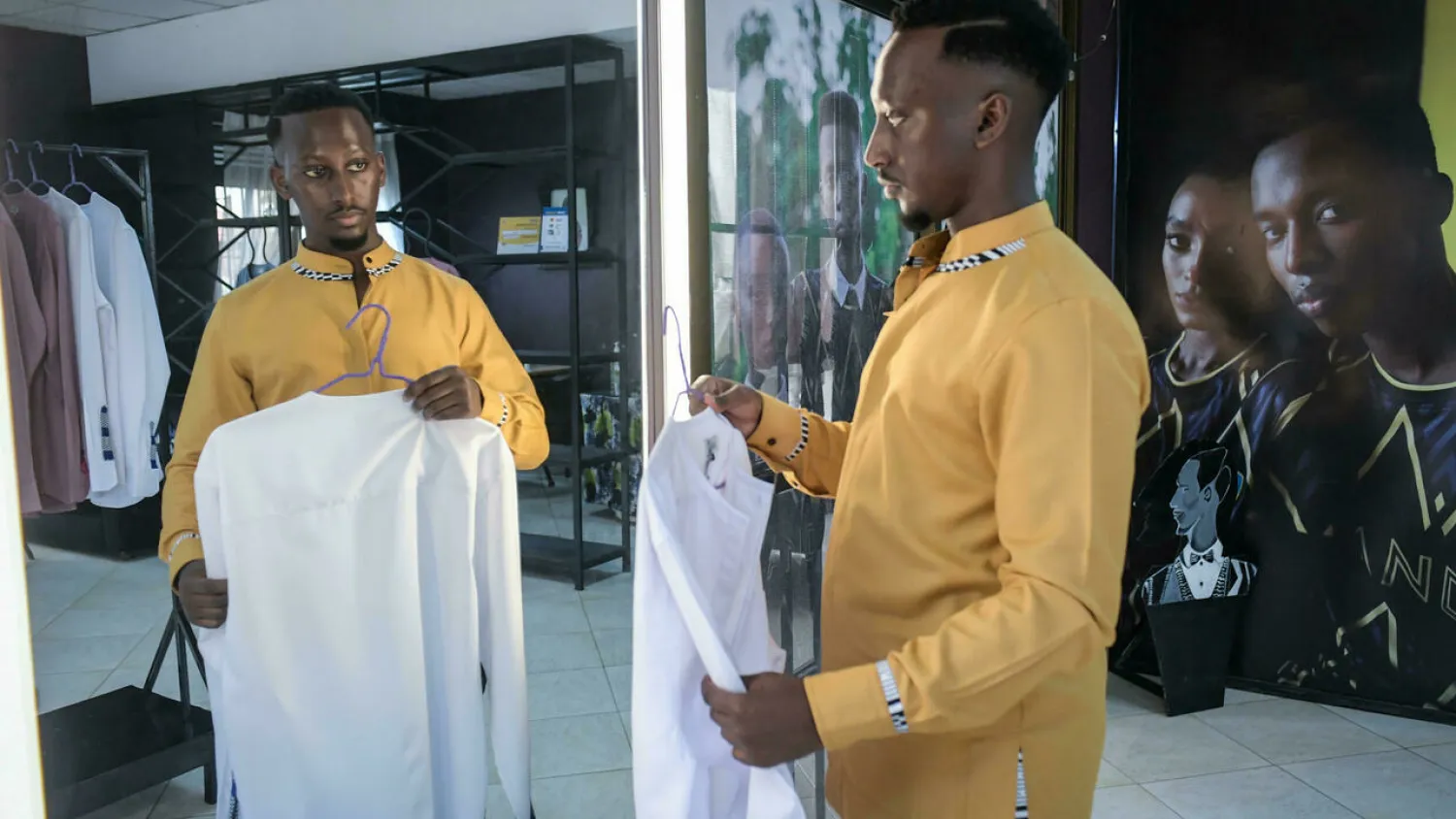
Interest in Matthew Rugamba's brand House of Tayo exploded after one of his creations was worn to the 'Black Panther' premiere Simon MAINA AFP
TT

'From Rwanda to Hollywood': Kigali Style Goes Global

Interest in Matthew Rugamba's brand House of Tayo exploded after one of his creations was worn to the 'Black Panther' premiere Simon MAINA AFP

Matthew Rugamba knew his Rwandan fashion label had arrived when Junior Nyong'o, the brother of Oscar winner Lupita Nyong'o, attended the world premiere of "Black Panther" in a three-piece suit designed by him.

Hours after the glitzy event in Los Angeles, the website for Rugamba's brand House of Tayo exploded as enquiries flooded in from around the globe for his high-end creations.

"It changed the perspective," the 32-year-old told AFP, still stunned by the turn of events that propelled his "made-in-Rwanda" label to a Hollywood red carpet.

"For so many years we have been telling people our fashion is good... but sometimes you need moments like that to really take it to the next level," said Rugamba, who holds dual Rwandan and British nationality.

Kigali has yet to reach the heights of Africa's fashion hub Lagos, but the capital of the small landlocked nation of 13 million hosts its own fashion week and draws a devoted clientele, comprising wealthy locals, expatriates, members of the diaspora and tourists.

"I like the way they tailor the clothes, the way they design their clothes, I like the simplicity of it as well," said Emmanuel Safari, a lawyer and frequent visitor to the House of Tayo boutique located in an upscale Kigali neighborhood.

"The clothes, you put them on and you feel good!"

Some Rwandan labels have even attracted the attentions of President Paul Kagame, who was pictured wearing a shirt by bespoke Kigali brand Moshions.

'Change the narrative'

But what is "Kigali style"?

"It pops but it's not flashy," according to Jean-Victor Brun, a 50-year-old Haitian-American who came to Rwanda to develop projects in new technologies.

"Modern, ethnic, and rooted in the identity of our country," says Joselyne Umutoniwase, founder of Rwanda Clothing.

Identity is at the heart of many Rwandan brands, which excel in producing bespoke clothing -- drawing on a tailoring tradition that dates back decades.

For instance, Umutoniwase, who employs 45 people, incorporates the geometric designs characteristic of imigongo art -- a style of painting which uses cow dung and natural pigments -- into her creations.

Similarly, the beadwork found on royal headdresses and other traditional items finds its way onto jacket lapels, while Rwandan shoe label Uzuri K&Y borrows from the country's weaving traditions to create braided sandals.

The brand's co-founder Ysolde Shimwe said young designers like her were keen to change Rwanda's image, 27 years after the 1994 genocide killed more than 800,000 people, mainly Tutsis.

"Ten years ago when you Googled Rwanda you only saw machetes, people killing each other and hungry kids in the streets," she told AFP.

"We as designers in Rwanda are also contributing to change the narrative of Rwanda and mostly to changing how people perceive Rwanda, because we are more than that, we are more than our historical background."

- Bullish prospects -

Rwanda's fashion industry has also received a helping hand from the government, which in 2016-17 massively hiked import taxes on second-hand clothing -- mainly from the US and Europe -- to promote local manufacturers.

The move, which saw duties multiply more than tenfold, effectively imposed a moratorium on trade involving the sale of secondhand clothing from the West at low prices to East African consumers.

Simultaneously the government allowed designers to import fabric tax-free, giving the nascent industry a boost, said Umutoniwase.

But, with more than 80 percent of the population living in rural areas, according to the World Bank, many Rwandans cannot afford these homegrown brands.

Umutoniwase, whose prices range from around $70 (60 euros) for a shirt to $80 (70 euros) for a dress, told AFP the small market size presented big challenges.

Moreover, the devastation wrought by the genocide has also contributed to a huge skills shortage in the country, said designer Shimwe.

"Eight years ago when we wanted to start a shoemaking brand we could not necessarily find skilled labor, there was literally nobody that had experience or had shoemaking skills," she said.

But in a sign of the industry's bullish growth prospects, some of the nearly 1,100 staff trained by her have since gone on to found their own labels, she said.

"It's a great cycle that we have been able to create."


Nike Shares Rise as Apple’s Cook Doubles His Bet on CEO Hill’s Overhaul Effort

A jogger wearing Nike shoes runs along the Charles River in Cambridge, Massachusetts, US, March 18, 2019. (Reuters)
TT

Nike Shares Rise as Apple’s Cook Doubles His Bet on CEO Hill’s Overhaul Effort

A jogger wearing Nike shoes runs along the Charles River in Cambridge, Massachusetts, US, March 18, 2019. (Reuters)

Nike shares rose 5% in early trading on Wednesday after Apple CEO Tim Cook doubled his personal stake in the sportswear maker, raising his bets on the margin-pinching turnaround efforts led by CEO Elliott Hill.

Cook, who has been on Nike's board since 2005, bought 50,000 shares at $58.97 ‌each, according to ‌a regulatory filing. As of December ‌22, ⁠he holds about ‌105,000 shares, which is now worth nearly $6 million.

It was the largest open market stock purchase for a Nike director or executive and possibly the largest in more than a decade, said Jonathan Komp, analyst at Baird Equity Research.

"(We see) Cook's move as a positive signal for the progress under CEO Elliott Hill and Nike's 'Win ⁠Now' actions," Komp said.

The purchase comes days after Nike reported weaker quarterly margins and weak ‌sales in China even as CEO ‍Hill tries to revive demand ‍through fresh marketing plans and innovation focused on running and sports, ‍while phasing out lagging lifestyle brands.

He has also attempted to mend Nike's ties with wholesalers such as Dicks Sporting Goods to increase visibility among shoppers amid stiff competition from newer brands.

However, the strategy has strained Nike's margins, which have been declining for over a year, while its efforts to win back its ⁠premier position in discount-friendly China appears to be faltering.

Nike's shares have slumped nearly 13% since it reported results on December 18 and are on track for the fourth straight year of declines. They were trading at $60.19 on Wednesday.

Cook has been a lead independent director of Nike since 2016 when co-founder Phil Knight stepped down as its chairman.

The Apple CEO "remains extremely close" with Knight, Komp said, adding that he has advised Nike through key strategic decisions including Hill's appointment last year.

Board director and former Intel CEO ‌Robert Swan also bought about 8,700 shares for about $500,000 this week.


Etro Founding Family Exits Group as New Investors Including Türkiye's RAMS Global Join

L Catterton, a private equity firm backed by French luxury giant LVMH, will remain Etro's majority owner. Reuters
TT

Etro Founding Family Exits Group as New Investors Including Türkiye's RAMS Global Join

L Catterton, a private equity firm backed by French luxury giant LVMH, will remain Etro's majority owner. Reuters

The founding family of Italian fashion house Etro has sold the minority stake it still owned in the brand to a group of investors including Turkish group RAMS Global, the company said on Friday.

L Catterton, a private equity firm backed by French luxury giant LVMH, will remain Etro's majority owner and "will continue to actively support the brand's long-term growth strategy," Etro added, according to Reuters.

The new investors comprise also Italian fashion group Swinger International and small private equity firm ⁠RSI.

In addition to buying the stake, they all subscribed to a capital increase that will lower L Catterton's holding in Etro to between 51% and 55% from around 65%.

When including both the acquisition and the capital increase, the deal is worth around 70 ⁠million euros ($82 million), two sources close to the matter said. Etro did not disclose financial details.

Chief Executive Fabrizio Cardinali will remain at the helm, while Faruk Bülbül, representing RAMS Global, will become chairman of the board.

L Catterton bought a 60% stake in the brand known for its paisley motif four years ago, and it slightly increased the holding over the years.

The company, founded by Gimmo Etro in 1968, has ⁠been struggling with its turnaround. Last year it posted a net loss of 23 million euros with net revenues declining to 245 million euros from 261 million euros, according to filings with the local chambers of commerce reviewed by Reuters.

Rothschild advised L Catterton and the Etro family on the deal.

Rothschild had been hired in 2024 to look for a new investor who could buy all or part of the Etro fashion group, sources had previously told Reuters.


Paris Court Rejects Bid to Suspend Shein Platform in France

A customer holds shopping bags with a Shein logo in the first physical space of Chinese online fast-fashion retailer Shein on the day of its opening inside the Le BHV Marais department store, the Bazar de l'Hotel de Ville, in Paris, France, November 5, 2025. REUTERS/Sarah Meyssonnier/File Photo
TT

Paris Court Rejects Bid to Suspend Shein Platform in France

A customer holds shopping bags with a Shein logo in the first physical space of Chinese online fast-fashion retailer Shein on the day of its opening inside the Le BHV Marais department store, the Bazar de l'Hotel de Ville, in Paris, France, November 5, 2025. REUTERS/Sarah Meyssonnier/File Photo

A Paris court on Friday rejected a government request to suspend Chinese fast-fashion platform Shein in France after authorities found illegal weapons and child-like sex dolls for sale on the fast-fashion giant’s website.

Shein welcomed the decision, saying it remains committed to strengthening its control processes in cooperation with French authorities.

“Our priority remains protecting French consumers and ensuring compliance with local laws and regulations," the company said in an emailed statement to The Associated Press.

The controversy dates to early November, when France’s consumer watchdog and Finance Ministry moved toward suspending Shein’s online marketplace after authorities said they had found childlike sex dolls and prohibited “Class A” weapons listed for sale, even as the company opened its first permanent store in Paris.

French authorities gave Shein hours to remove the items. The company responded by banning the products and largely shutting down third-party marketplace listings in France.

French officials have also asked the European Commission to examine how illegal products were able to appear on the platform under EU rules governing large online intermediaries.