

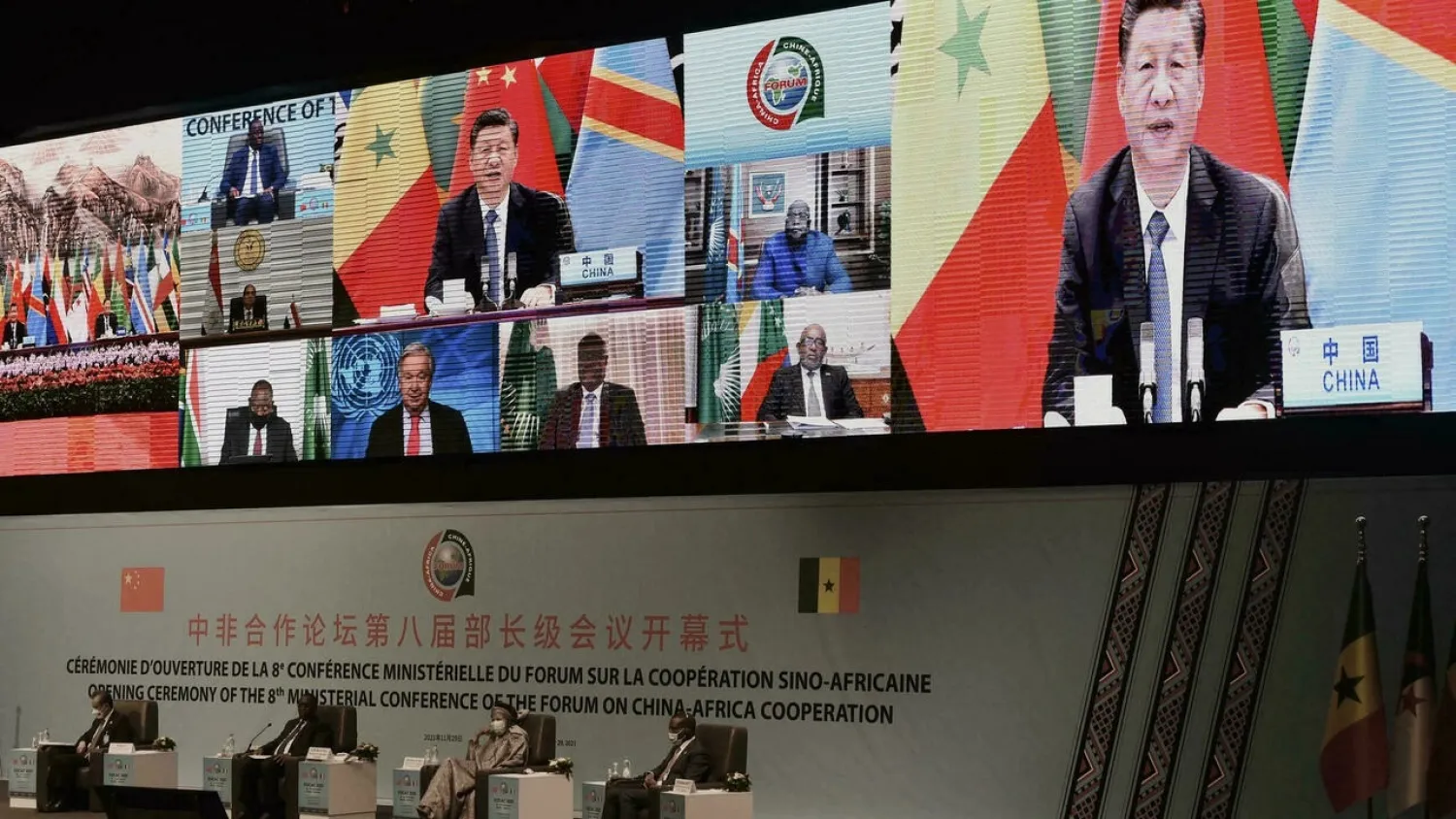

China Leader Promises Africa 1 Bln COVID Vaccine Doses

Xi said it was time to "close the vaccination gap" between Africa and wealthier countries. (AFP)
TT

China Leader Promises Africa 1 Bln COVID Vaccine Doses

Xi said it was time to "close the vaccination gap" between Africa and wealthier countries. (AFP)

China's president pledged to offer Africa one billion Covid vaccine doses on Monday, with the continent struggling to acquire enough jabs to immunize against the disease.

In a speech made via videolink to a China-Africa summit near Senegal's capital Dakar, President Xi Jinping said his country would donate 600 million doses directly.

A further 400 million doses would come from other sources, such as investments in production sites, which are sorely lacking across much of Africa.

Xi's promise comes as part of a forum between China and African states with an emphasis on trade and security, among other issues, held in the city of Diamniadio near Senegal's seaside capital.

China invests heavily in Africa, and is the continent's largest trading partner with direct trade worth over $200 billion in 2019, according to the Chinese embassy in Dakar.

Beijing has also donated millions of doses of its home-produced Sinopharm vaccine to poor African countries since the start of the pandemic.

Critics charge that China's largesse forms part of a diplomatic offensive, however.

"We must continue to fight together against Covid," Xi told the summit, adding that China would send about 1,500 medical workers to Africa.

"We must prioritize the protection of our people and close the vaccination gap," he also said.

Vaccination rates in Africa are low compared to the rest of the world, with many states at the mercy of foreign donations due to the lack of local production facilities and prohibitive costs of mass purchases.

The summit in Senegal follows a visit this month from US Secretary of State Antony Blinken to Kenya, Nigeria and Senegal, against a backdrop of growing rivalry between Beijing and Washington.

Blinken discussed boosting local vaccine-production sites with leaders during the visit, and alluded to the sometimes fraught nature of the continent's deep relationship with China.

Last month, US President Joe Biden also announced vaccine donations to Africa, pledging 17 million doses of the single-shot Johnson & Johnson vaccine to the African Union.

Debt wariness

At the forum, Senegalese economy minister Amadou Hott told attendees that a shift in the commercial relationship with China was needed -- away from projects financed by African governments taking on large debts.

"We need more equity investment," he said, pushing for Chinese entrepreneurs to invest in local companies.

"This pandemic has shown the need for our economies to produce more and become sovereign in strategic sectors," he added, pointing to the pharmaceutical and agriculture sectors, among others.

Beijing has often faced accusations of "debt-trap diplomacy" due to the scale of its lending to developing countries in Africa and elsewhere, using its creditor status to extract diplomatic and commercial concessions.

Blinken, in his recent trip to Africa, referenced the accusations without naming China explicitly, saying in an address in Nigeria that Africans have been "wary of the strings" that often come with foreign engagement.

But China rejects the charges.

Wu Peng, the head of the Africa department at China's foreign ministry, told a news conference in Beijing on Friday that "debt-trap" accusations amount to a cliche.

China takes debt sustainability seriously, state-run news agency Xinhua quoted him as saying.

Peng added that a general lack of funding is holding back African development, rather than unmanageable debts.



Russia: Man Suspected of Shooting Top General Detained in Dubai

An investigator works outside a residential building where the assassination attempt on Russian Lieutenant General Vladimir Alexeyev took place in Moscow, Russia February 6, 2026. REUTERS/Anastasia Barashkova
TT

Russia: Man Suspected of Shooting Top General Detained in Dubai

An investigator works outside a residential building where the assassination attempt on Russian Lieutenant General Vladimir Alexeyev took place in Moscow, Russia February 6, 2026. REUTERS/Anastasia Barashkova

Russia's Federal Security Service (FSB) said on Sunday that the man suspected of shooting top Russian military intelligence officer Vladimir Alexeyev in Moscow has been detained in Dubai and handed over to Russia.

Lieutenant General Vladimir Alexeyev, deputy head of the GRU, ⁠Russia's military intelligence arm, was shot several times in an apartment block in Moscow on Friday, investigators said. He underwent surgery after the shooting, Russian media ⁠said.

The FSB said a Russian citizen named Lyubomir Korba was detained in Dubai on suspicion of carrying out the shooting.

Russian Foreign Minister Sergei Lavrov accused Ukraine of being behind the assassination attempt, which he said was designed to sabotage peace talks. ⁠Ukraine said it had nothing to do with the shooting.

Alexeyev's boss, Admiral Igor Kostyukov, the head of the GRU, has been leading Russia's delegation in negotiations with Ukraine in Abu Dhabi on security-related aspects of a potential peace deal.


Factory Explosion Kills 8 in Northern China

Employees work on an electric vehicle (EV) production line at the Volkswagen Anhui factory in Hefei, Anhui province, China, February 4, 2026. REUTERS/Florence Lo
TT

Factory Explosion Kills 8 in Northern China

Employees work on an electric vehicle (EV) production line at the Volkswagen Anhui factory in Hefei, Anhui province, China, February 4, 2026. REUTERS/Florence Lo

An explosion at a biotech factory in northern China has killed eight people, Chinese state media reported Sunday, increasing the total number of fatalities by one.

State news agency Xinhua had previously reported that seven people died and one person was missing after the Saturday morning explosion at the Jiapeng biotech company in Shanxi province, citing local authorities.

Later, Xinhua said eight were dead, adding that the firm's legal representative had been taken into custody.

The company is located in Shanyin County, about 400 kilometers west of Beijing, AFP reported.

Xinhua said clean-up operations were ongoing, noting that reporters observed dark yellow smoke emanating from the site of the explosion.

Authorities have established a team to investigate the cause of the blast, the report added.

Industrial accidents are common in China due to lax safety standards.
In late January, an explosion at a steel factory in the neighboring province of Inner Mongolia left at least nine people dead.


Iran Warns Will Not Give Up Enrichment Despite US War Threat

Traffic moves through a street in Tehran on February 7, 2026. (Photo by ATTA KENARE / AFP)
TT

Iran Warns Will Not Give Up Enrichment Despite US War Threat

Traffic moves through a street in Tehran on February 7, 2026. (Photo by ATTA KENARE / AFP)

Iran will never surrender the right to enrich uranium, even if war "is imposed on us,” its foreign minister said Sunday, defying pressure from Washington.

"Iran has paid a very heavy price for its peaceful nuclear program and for uranium enrichment," Abbas Araghchi told a forum in Tehran.

"Why do we insist so much on enrichment and refuse to give it up even if a war is imposed on us? Because no one has the right to dictate our behavior," he said, two days after he met US envoy Steve Witkoff in Oman.

The foreign minister also declared that his country was not intimidated by the US naval deployment in the Gulf.

"Their military deployment in the region does not scare us," Araghchi said.