Israeli Police Kill Alleged Car-rammer in Arab Town

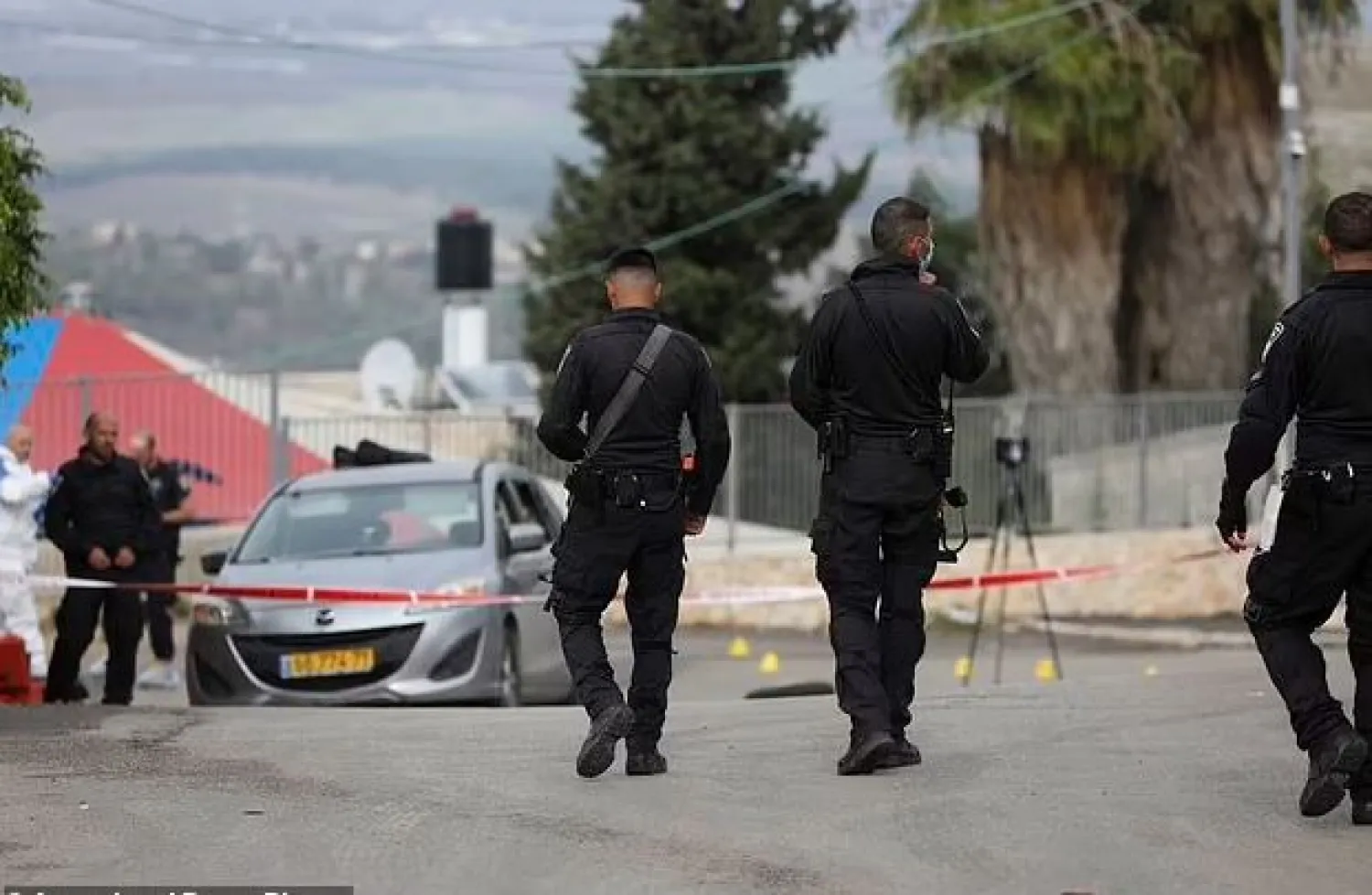
Police work at the scene in Umm el-Fahm, Israel, Friday, Dec. 3, 2021, after a man was shot dead by Israeli police in a car-ramming incident following a night of intense violence in the Arab populated Israeli town. (AP Photo/Mahmoud Illean)
TT

Israeli Police Kill Alleged Car-rammer in Arab Town

Police work at the scene in Umm el-Fahm, Israel, Friday, Dec. 3, 2021, after a man was shot dead by Israeli police in a car-ramming incident following a night of intense violence in the Arab populated Israeli town. (AP Photo/Mahmoud Illean)

Police on Friday shot and killed a man in an Arab town in northern Israel who had allegedly been involved in a car-ramming attack that wounded two officers, Israeli officials said.

The incident came after a round of violence among residents of Umm al-Fahm, including armed clashes. On Thursday, a man was shot and killed in the town. Israeli police and firefighters raced to the community as gunfire rang out and buildings were set ablaze.

The chaos comes amid a wave of violent crime in Israel's Arab community that shows no sign of abating, despite far-reaching action announced in recent months by Israeli authorities, The Associated Press reported.

Friday's incident began when paramilitary Border Police opened fire on a vehicle speeding toward them, fatally shooting one man and wounding the other in the car, who was arrested after receiving medical treatment, Border Police said. They said the two officers suffered light to moderate wounds.

They said a gun and ammunition were found in the car, and that the two men were suspected of involvement in violent family disputes that have rocked Umm al-Fahm in recent months. Authorities said the car-ramming was not politically motivated.

Arab towns across Israel have seen a major escalation in violence in recent years driven by organized crime and family feuds. At least 117 Arabs have been killed in 2021, the highest number on record, according to the Abraham Initiatives, which promotes Jewish-Arab coexistence. The crime rate among Arabs far exceeds their 20% share of the population.

Arab citizens of Israel have the right to vote, most speak fluent Hebrew, and they have a large presence in the country's universities and medical profession. But they face widespread discrimination, especially with housing.

They have close familial ties to Palestinians in the occupied West Bank and Gaza, and largely identify with their cause, leading many Jewish Israelis to view them with suspicion. Jewish-Arab violence erupted across Israel during the Gaza war in May.

Arab activists have long accused police of ignoring crime in their communities. Israeli officials have touted a number of initiatives in recent years, including larger budgets for law enforcement in Arab communities, but police say local leaders could do more to help them.

Israel's current government pledged major action against crime in Arab communities in August as it announced a wave of arrests. That was a central demand of a small party that made history this year by being the first Arab faction to join a ruling coalition.

Israeli Prime Minister Naftali Bennett expressed support for the police on Friday, calling for improved security and further dialogue with Arab leaders.


Somalia's Capital Votes in First Step toward Restoring Universal Suffrage

Members of the Justice and Solidarity Party (JSP) campaign in the streets as they share their political aims with voters in Mogadishu, Somalia, 22 December 2025. EPA/SAID YUSUF WARSAME
TT

Somalia's Capital Votes in First Step toward Restoring Universal Suffrage

Members of the Justice and Solidarity Party (JSP) campaign in the streets as they share their political aims with voters in Mogadishu, Somalia, 22 December 2025. EPA/SAID YUSUF WARSAME

Residents of Somalia's capital Mogadishu will vote on Thursday in municipal elections meant to pave the way for the East African country's first direct national polls in more than half a century.

With the exception of votes in the semi-autonomous region of Puntland and the breakaway region of Somaliland, Somalia last held direct elections in 1969, months before military general, Mohamed Siad Barre, took power in a coup, Reuters said.

After years of civil ‌war that ‌followed Barre's fall in 1991, indirect elections ‌were ⁠introduced in ‌2004. The idea was to promote consensus among rival clans in the face of an armed insurgency, although some Somalis say politicians prefer indirect elections because they create opportunities for corruption.

Under the system, clan representatives elect lawmakers, who then choose the president. The president, in turn, has been responsible for appointing Mogadishu's mayor.

The vote in Mogadishu, a ⁠city of some 3 million people where security conditions have improved in recent years ‌despite continuing attacks by al Qaeda-linked al ‍Shabaab militants, is seen as ‍a test run for direct elections at the national level.

Around ‍1,605 candidates are running on Thursday for 390 posts in Mogadishu's district councils, said Abdishakur Abib Hayir, a member of the National Electoral Commission. Council members will then choose a mayor.

"It shows Somalia is standing on its feet and moving forward," Hayir told Reuters. "After the local election, elections can and will take place in ⁠the entire country."

A 2024 law restored universal suffrage ahead of federal elections expected next year. However, President Hassan Sheikh Mohamud reached a deal in August with some opposition leaders stipulating that while lawmakers would be directly elected in 2026, the president would still be chosen by parliament.

Opposition parties have argued the rapid introduction of a new electoral system would benefit Mohamud's re-election prospects.

They also question whether the country is safe enough for mass voting given al Shabaab's control over vast areas of the countryside and regular strikes ‌on major population centers.


Sudan's RSF Says Captured Areas Near Chad Border

Sudanese refugee girls carry water supplies near a polling station in the refugee camp of Zamzam, on the outskirts of el-Fasher, Darfur, Sudan, on April 13, 2010. (AP)
TT

Sudan's RSF Says Captured Areas Near Chad Border

Sudanese refugee girls carry water supplies near a polling station in the refugee camp of Zamzam, on the outskirts of el-Fasher, Darfur, Sudan, on April 13, 2010. (AP)

Sudan’s Rapid Support Forces (RSF) announced on Wednesday that it had seized full control of areas bordering Chad in North Darfur in western Sudan.

The RSF released videos of its forces as they deployed in several towns in the regions.

The Sudanese army has yet to comment on the development.

In a statement, the RSF said that along with allies forces, it captured the regions of Um Qamra and Abu Barro in the westernmost point in North Darfur.

It accused the army and its allied forces of carrying out “systematic attacks” and “reprisals” against civilians in the area.

The RSF said the capture of the regions “ends the deployment of armed forces” and puts and end to the “reprisals and chaos”.

It added that it has deployed military units “to protect the civilians and secure roads and public areas to restore normal life there.”

On Tuesday, prior to the capture, Darfur region governor and leader of the Sudan Liberation Movement/Army Minni Minnawi had warned of an imminent RSF attack.

He had called on the people to defend themselves and their property, adding: “Defend your existence... the land that is not protected by its people gets stolen, and the dignity that is not defended is killed.”

His call had prompted harsh criticism in Darfur who accused him of attempting to embroil the people in an uneven confrontation with the RSF that is far better equipped and ready to fight.

They wondered why the joint forces of various parties had withdrawn from the area and not held their ground to fight the RSF.

The RSF had in the early hours of Wednesday launched attacks on the towns of al-Tina and Kernoi, capturing them without resistance.

With its latest capture, the RSF now has control of Sudan’s borders with Chad, Libya, Central Africa and South Sudan.


Shaibani: Syrian-Russian Ties Entering New Phase

Russia's Foreign Minister Sergei Lavrov and Syria's Foreign Minister Asaad al-Shaibani attend a meeting in Moscow, Russia December 24, 2025. (Russian Foreign Ministry/Handout via Reuters)
TT

Shaibani: Syrian-Russian Ties Entering New Phase

Russia's Foreign Minister Sergei Lavrov and Syria's Foreign Minister Asaad al-Shaibani attend a meeting in Moscow, Russia December 24, 2025. (Russian Foreign Ministry/Handout via Reuters)

Syrian Foreign Minister Asaad al-Shaibani stressed on Wednesday that relations between Damascus and Moscow were entering a new phase based on mutual respect.

He met in Moscow with his Russian counterpart Sergei Lavrov, saying: “We aspire to establish balanced relations with everyone.”

“We are working on attracting investments to Syria to improve the economy,” he added, remarking: “We are forging ahead in rebuilding the country.”

For his part, Lavrov said the meeting tackled various issues, underlining the importance of maintaining Syria’s territorial integrity and bolstering bilateral ties between Damascus and Moscow.

On Tuesday, Shaibani and Defense Minister Major General Murhaf Abu Qasra met with Russian President Vladimir Putin to discuss political, military, and economic issues of mutual interest, with particular emphasis on strategic cooperation in the defense industry sector, reported Syria’s state news agency SANA.

They reviewed ways to advance military and technical partnership in a manner that strengthens the defensive capabilities of the Syrian army and keeps pace with modern developments in military industries.

Discussions focused on upgrading military equipment, transferring technical expertise and know-how, and expanding cooperation in research and development to boost Syria’s national defense system and support security and stability in Syria and the region.

On the political front, the two sides exchanged views on regional and international developments, underscoring the importance of continued political and diplomatic coordination between Damascus and Moscow in international forums.

They stressed the need to respect international law, rejecting all forms of external interference in the internal affairs of states.

Economically, the meeting addressed prospects for expanding economic and trade cooperation, including support for reconstruction projects, development of infrastructure sectors, and encouragement of investment in Syria.

The talks also covered boosting trade exchange and facilitating partnerships in ways that positively impact the Syrian economy and contribute to improving living conditions.

Putin underscored Russia’s steadfast support for Syria, stressing the importance of preserving Syria’s unity, territorial integrity, and full sovereignty, and rejecting “any projects aimed at partitioning the country or undermining its independent national decision”.

He also renewed Moscow’s condemnation of repeated Israeli violations of Syrian territory, describing them as “a direct threat to regional security and stability”.