

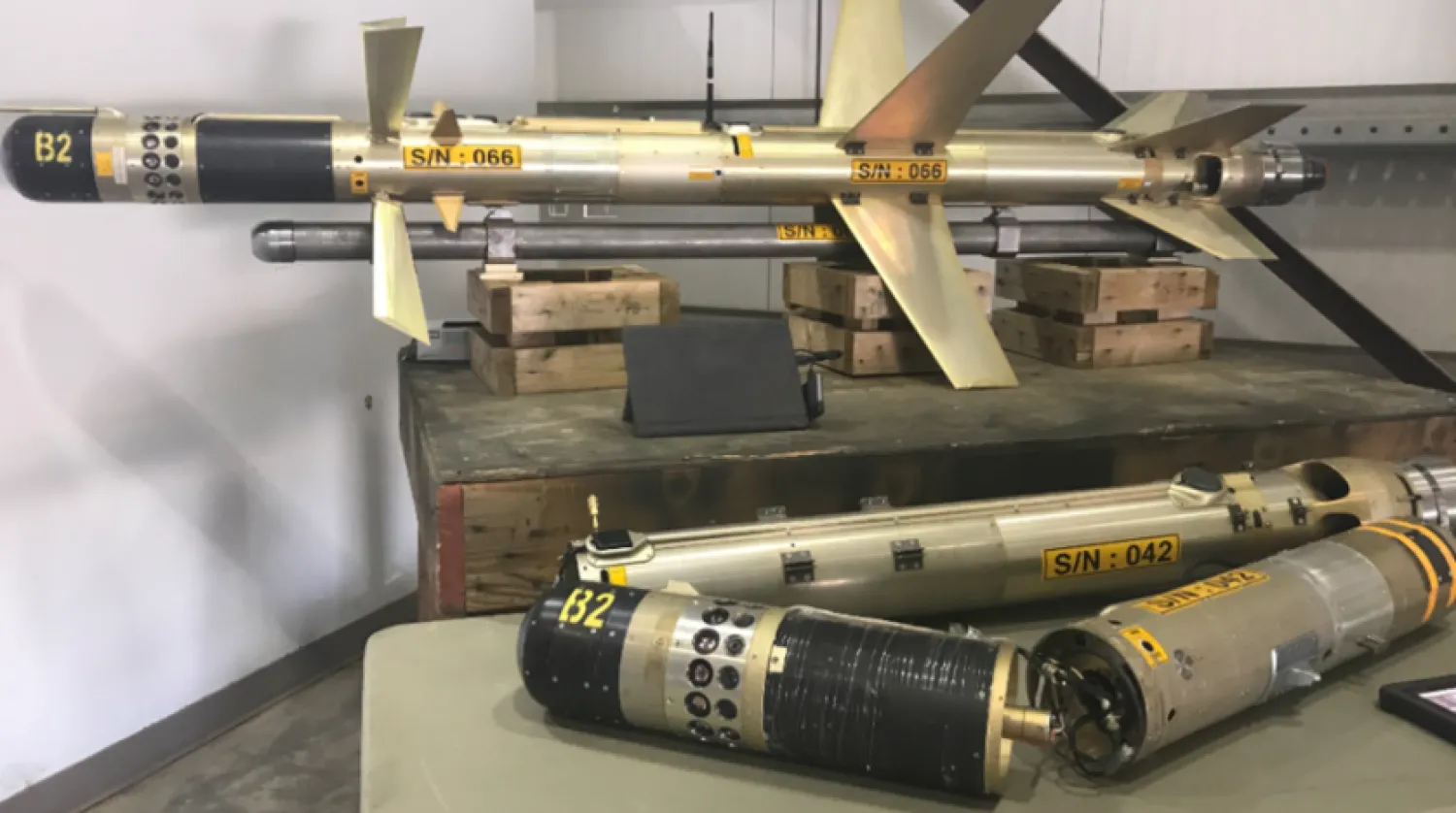

US Seizes Iranian Arms Destined for Yemen’s Houthis

Iran’s Revolutionary Guard Corps (IRGC) orchestrated the arms shipments, which were destined for the Houthis. Photo courtesy of the US Justice Department
TT

US Seizes Iranian Arms Destined for Yemen’s Houthis

Iran’s Revolutionary Guard Corps (IRGC) orchestrated the arms shipments, which were destined for the Houthis. Photo courtesy of the US Justice Department

The US Justice Department announced on Tuesday that it has seized two large caches of Iranian arms, including 171 surface-to-air missiles and eight anti-tank missiles, destined for Yemen’s Houthi militias.

“The US Navy seized the weapons from two vessels in the Arabian Sea while conducting routine maritime security operations,” said the Justice Department.

Iran’s Revolutionary Guard Corps (IRGC) orchestrated the arms shipments, which were destined for the Houthis, it said.

“The US government similarly seized the Iranian petroleum products from four foreign-flagged tankers in or around the Arabian Sea while en route to Venezuela. These actions represent the government’s largest-ever forfeitures of fuel and weapons shipments from Iran,” it added.

The US in the two cases struck a "resounding blow” to the Iranian government and to the criminal networks supporting the IRGC, said Assistant Attorney General Matthew G. Olsen of the Justice Department’s National Security Division.

“The Department of Justice will continue to use all available tools to combat the threats posed by terrorist organizations and all those who seek to harm the United States and its allies.”

“These two cases demonstrate that not only can we disrupt the Islamic Revolutionary Guard Corps’ ability to finance its operations through petroleum sales, but we can also thwart its ability to use the proceeds of such sales to arm its terrorist proxies and export terrorism abroad,” said US Attorney Matthew M. Graves for the District of Columbia. “Given our expertise and special statutory authority, the US Attorney’s Office for the District of Columbia is uniquely positioned to support its law enforcement partners in such terrorism cases. We are deeply committed to this mission.”

“The combined efforts of the FBI and our partners to seize missiles and over a million barrels of petroleum demonstrate our commitment to defend against foreign terrorist organizations and enforce US sanctions,” said Assistant Director Alan E. Kohler Jr. of the FBI’s Counterintelligence Division. “The Government of Iran’s sponsorship of terrorism has left innocent victims in its wake and its attempts to support regimes dangerous to the United States and our allies will be met with the full force of the law. The FBI has a continued resolve to hold the Government of Iran accountable for its illegal actions, and we urge anyone with information about violations of sanctions on Iran to contact the FBI.”

US Navy Central Command (NAVCENT) seized the weapons from two flagless vessels in the Arabian Sea on Nov. 25, 2019, and Feb. 9, 2020, respectively. The weapons included 171 guided anti-tank missiles, eight surface-to-air missiles, land attack cruise missile components, anti-ship cruise missile components, thermal weapons optics and other components for missiles and unmanned aerial vehicles.

On Aug. 20, 2020, the Justice Department filed a complaint seeking to forfeit the seized weapons in US District Court for the District of Columbia. The complaint alleged that the arms shipments were part of an IRGC trafficking network designed to distribute illicit weapons to the Houthis in Yemen. The court granted the government’s motion for default judgment and entered a final order of forfeiture on Nov. 15. In its opinion, the court found that the government had adequately alleged that the weapons belonged to the IRGC and that the IRGC constitutes an entity engaged in planning or perpetrating a federal crime of terrorism against the US.



8 People Die in B-52 Bomber Crash at US Air Force Base in California

Smoke plumes rise from a B-52 bomber that crashed shortly after takeoff at a US Air Force base in Southern California, Monday, June 15, 2026. (Debbie Reyes Katz via AP Photo)
TT

8 People Die in B-52 Bomber Crash at US Air Force Base in California

Smoke plumes rise from a B-52 bomber that crashed shortly after takeoff at a US Air Force base in Southern California, Monday, June 15, 2026. (Debbie Reyes Katz via AP Photo)

A B-52 bomber crashed shortly after takeoff at a US Air Force base in Southern California’s Mojave Desert and burst into flames Monday, killing all eight people aboard, military officials said.

Aerial footage showed virtually nothing left of the aircraft that went down around 11:20 a.m. during a routine test mission at Edwards Air Force Base, which is north of Los Angeles.

Black smoke rose from a large swath of charred desert near the runway on the base, with emergency vehicles nearby.

Those on the B-52 included government contractors and uniformed military, The Associated Press reported. Aircraft manufacturer Boeing confirmed Monday evening that two of its employees were on board.

After reviewing footage of the crash, it was determined that no one could have survived, Col. James Hayes, the deputy commander for the 412 test wing at Edwards, said at a news conference.

“We lost eight great Americans,” Hayes said, adding that officials were working to notify their families.

It was not immediately clear what caused the crash, and it could take up to six months to complete an investigation, Hayes said, but shared that the B-52 was supporting the “radar modernization program.”

The Boeing B-52 Stratofortress is a long-range bomber that entered service in 1955. Designed to carry both conventional and nuclear weapons, it has been used in conflicts involving the US military from Vietnam to Iran.

In 2025, Boeing sent a B-52 to Edwards with a new, modernized radar system.

A test team planned to conduct ground and flight test activities on the aircraft throughout 2026 to feed a production decision, the air force said in a 2025 news release. The modern Active Electronically Scanned Array (AESA) radar system replaced the aircraft’s antiquated radar for efficacy. It was unclear if that was the same aircraft involved in Monday’s crash.

Edwards Air Force Base is home to a large portion of the US Air Force’s aircraft test and development efforts and is about 100 miles (161 km) north of Los Angeles. The 412th Test Wing, which runs the base, also conducts developmental testing of all Air Force aircraft, weapons systems, software and components before purchase by the service as well as throughout their lifespan.

The vast desert base is where Air Force test pilot Chuck Yeager reached a speed of Mach 1.05 and broke the sound barrier in 1947.

The airfield was closed most of Monday and all inbound aircraft were being diverted, but it reopened to people coming onto the base by late afternoon.

Non-commercial visitor passes for the base were suspended as emergency crews doused the flames.

It’s too soon to say what might have happened.

Air Force Secretary Troy Meink said he is deeply saddened by the lives lost.

“We mourn this loss and honor the service of our Airmen, civilians, and contractors who work every day to advance our mission,” he said in a post on X.


Trump Says Iran Deal Has Been Signed, Text to Come Soon

US President Donald Trump (L) shakes hands with France's President Emmanuel Macron during a bilateral meeting on the sidelines of the G7 summit, in Evian, central-eastern France on June 15, 2026. (AFP)
TT

Trump Says Iran Deal Has Been Signed, Text to Come Soon

US President Donald Trump (L) shakes hands with France's President Emmanuel Macron during a bilateral meeting on the sidelines of the G7 summit, in Evian, central-eastern France on June 15, 2026. (AFP)

US President Donald Trump on Monday said an agreement with Iran has been signed and that the text of the deal would be released sometime after a formal signing on Friday, adding that the Strait of Hormuz would also be fully open.

Speaking alongside ‌French President ‌Emmanuel Macron ahead of this ‌week's ⁠G7 meeting, Trump ⁠said he did not know if he would attend the Friday ceremony expected in Geneva, but that US Vice President JD Vance would be there.

"The deal's all signed. ⁠And the strait is ‌already partially opened, ‌as you know," Trump told reporters shortly ‌after arriving in Evian, France. "On Friday, ‌it'll be completely open."

Vance earlier on Monday said the agreement had been signed digitally on Sunday and that no funds ‌were released.

Asked when the text of the memorandum of ⁠understanding ⁠would be made public, Trump said: "Probably pretty soon. I would say after sometime after Friday... I think sometime in the very near future."

Trump said any sanctions relief for Tehran was "really a behavioral thing. If they do what they're supposed to do, that starts taking effect."

There was no immediate response from Tehran to the report that the agreement, which both sides announced overnight, had already been signed. Previous reports from both sides had suggested it would be signed officially at a ceremony in Geneva on Friday.  

In an early reminder of the agreement's fragility, Israel - which launched the war alongside the United States in February and was not consulted on the talks to end it - struck a car with a drone in southern Lebanon, where it has been battling the Iran-aligned Hezbollah movement. Iran has said the deal must bring a full cessation of hostilities there. 

The terms of the memorandum of understanding, reached after more ‌than two months of ‌negotiations, have yet to be published. A US official, speaking on condition of anonymity, said ‌he expected ⁠the terms would ⁠be made public in the next 24-48 hours. 

Oil prices tumbled on the prospect of an end to disruption to global energy supplies, and share prices soared, some hitting new records. 

Trump, who had earlier said the blockaded Strait of Hormuz would be open on Friday, said on Monday that ships had already begun transiting it. However, the US military told shippers it had not yet lifted its blockade of Iranian ports. 

60-DAY NEGOTIATION PERIOD 

According to accounts from both sides, the agreement would reopen the blockaded strait and extend a ceasefire for a 60-day negotiation period, when contentious issues such as the future of Iran's nuclear program are due to be decided. 

Meanwhile, ‌the immediate fate of the pact could hinge on Lebanon, where Israel has been battling the Iran-aligned Hezbollah armed group in parallel with the wider ‌war that it launched alongside the United States against Iran in February. 

Iran has said the preliminary agreement requires a cessation of ‌hostilities on all fronts, including in Lebanon. Israel, which was not consulted on the preliminary deal, has said it reserves the right to act in Lebanon against Hezbollah threats. 

Security sources said fighting in southern Lebanon had tamped down on Monday after the agreement was announced but had not ceased entirely. 

In the first strike of its kind since the announcement, an Israeli drone struck a car in the southern Lebanese town of Kfar Tebnit, killing the ‌driver, Lebanese state media reported. There was no immediate comment from the Israeli military on the strike. 

LEBANON HAS BEEN A STICKING POINT  

While the US and Iran had largely ceased hostilities ⁠in early April, fighting has not ceased ⁠in Lebanon, where Hezbollah opened fire on Israel in support of Tehran on March 2 and Israel responded with an air campaign and ground invasion that has uprooted some 1.2 million people. 

Iran's Foreign Minister Abbas Araqchi said there must be a complete halt to Israeli attacks against Lebanon and wrote on Telegram that the US bears responsibility for implementing the framework deal. 

Hezbollah welcomed the deal and said the inclusion of Lebanon reflected Iran's commitment to securing a halt to the war and preserving Lebanon's rights. 

Israeli Prime Minister Benjamin Netanyahu has yet to respond publicly to the US-Iran agreement. But Defense Minister Israel Katz said that Israel would remain "indefinitely" in areas it is occupying in southern Lebanon to eliminate what it perceives as militant threats.  

Privately, Israeli officials' views of the deal have been negative. One senior Israeli official told Reuters on condition of anonymity that the agreement was "terrible for Israel," and that this assessment was shared throughout the government from Netanyahu on down. 

The reopening of the Strait of Hormuz would help solve a global energy crisis precipitated by the war, which has hurt Trump's political fortunes by forcing up gasoline prices in the United States. 

"Ships of the World, start your engines. Let the oil flow!" he wrote on Sunday. 

On Monday he announced: "Ships are starting to move, many loaded up with Oil, out of the Strait of Hormuz." 


Somaliland Opens Embassy in Jerusalem

 Somaliland's President Abdirahman Mohamed Abdullahi (L) is welcomed by Israeli President Isaac Herzog (R) at the presidential residence in Jerusalem, 14 June 2026, during his first visit to Israel. (EPA)
Somaliland's President Abdirahman Mohamed Abdullahi (L) is welcomed by Israeli President Isaac Herzog (R) at the presidential residence in Jerusalem, 14 June 2026, during his first visit to Israel. (EPA)
TT

Somaliland Opens Embassy in Jerusalem

 Somaliland's President Abdirahman Mohamed Abdullahi (L) is welcomed by Israeli President Isaac Herzog (R) at the presidential residence in Jerusalem, 14 June 2026, during his first visit to Israel. (EPA)
Somaliland's President Abdirahman Mohamed Abdullahi (L) is welcomed by Israeli President Isaac Herzog (R) at the presidential residence in Jerusalem, 14 June 2026, during his first visit to Israel. (EPA)

Somaliland opened its embassy in Jerusalem on Monday, Israel's foreign ministry announced, months after Israel became the first country to recognize the breakaway African state's independence.

"Honored to host my dear friend President @Abdirahmanirro at the Ministry of Foreign Affairs, during his historic State Visit to open Somaliland's embassy in Jerusalem," Israeli Foreign Minister Gideon Saar posted on X, during the first-ever state visit of President Abdirahman Mohamed Abdullahi.

"I'm proud of the privilege I had to write the first pages in the story of the Israel-Somaliland relationship," Saar added.

Somaliland is the eighth country to open its embassy in Jerusalem, following the United States, Guatemala, Honduras, Kosovo, Papua New Guinea, Paraguay and Fiji.

Most foreign diplomatic missions to Israel are located in Tel Aviv, as the status of Jerusalem is one of the thorniest issues in the Palestinian-Israeli conflict.

In December, Israel became the first country to recognize the independence of Somaliland since it declared its autonomy from Somalia in 1991 following a civil war.
