


Biden’s Summit for Democracy Kicks Off with Participation of Over 100 Countries

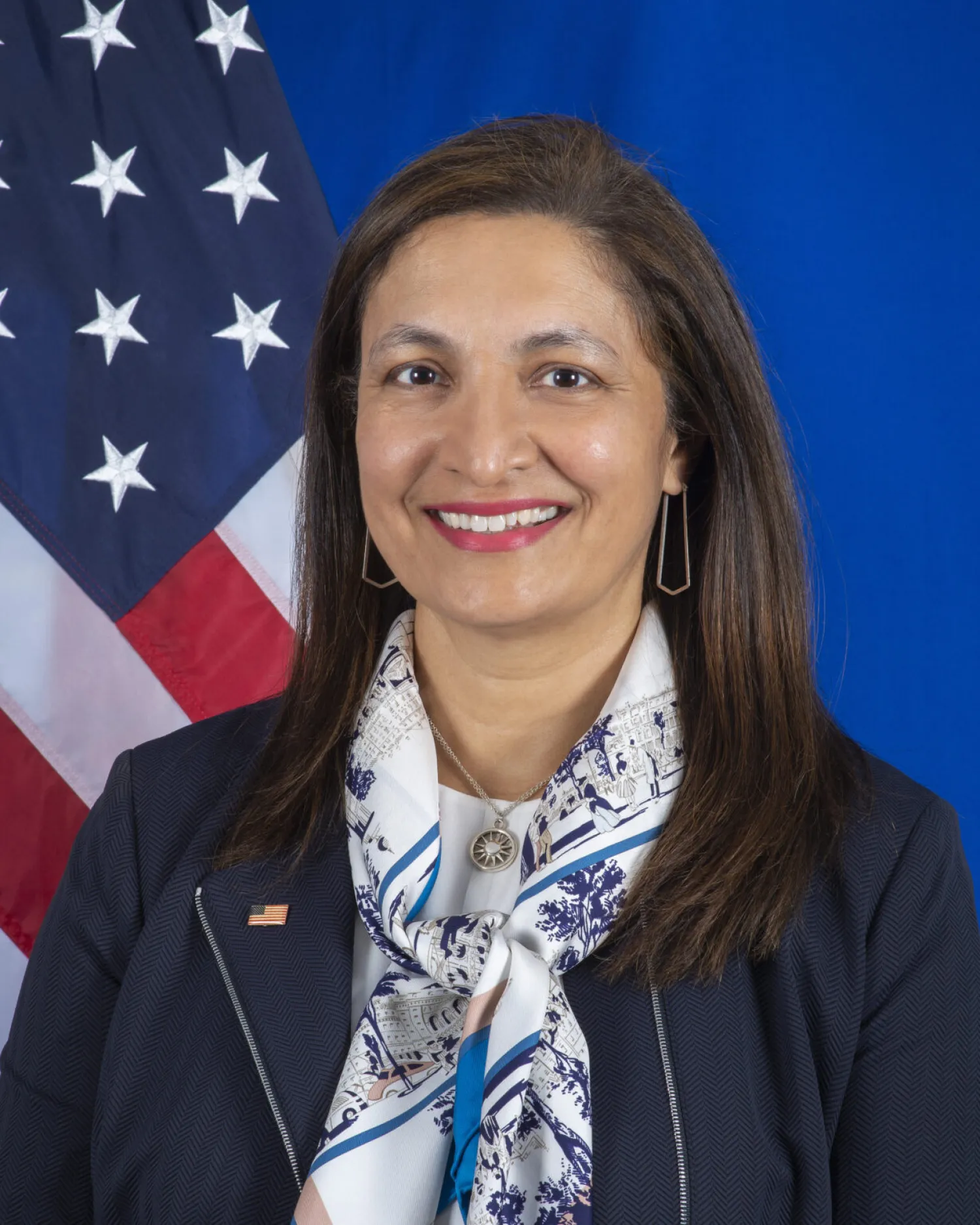
Uzra Zeya, the Under Secretary of State for Civilian Security, Democracy, and Human Rights of the United States
TT

Biden’s Summit for Democracy Kicks Off with Participation of Over 100 Countries

Uzra Zeya, the Under Secretary of State for Civilian Security, Democracy, and Human Rights of the United States

The US Biden administration has kickstarted its two-day “Summit for Democracy” with the participation of over 100 world leaders. It also comes as a confirmation that democracy and human rights values are a priority in President Joe Biden’s foreign policy agenda as promised by him during his 2020 presidential election campaign.

On the eve of the summit, which Biden heads, Asharq Al-Awsat spoke to the Under Secretary of State for Civilian Security, Democracy, and Human Rights about the Biden administration’s plan for human rights worldwide, especially in the Middle East region.

Uzra Zeya, a senior official in the State Department, explained that the summit was being held to fulfill Biden’s pledges on promoting democracy and human rights at the heart of US foreign policy.

She stressed that this policy would be followed in all countries without exception, including the Middle East.

According to Zeya, the world’s most pressing challenges call for democracies to cooperate and “stand together.”

The US pro-democracy summit centers on three critical matters: Confronting authoritarianism worldwide, raising the level of anti-corruption, and promoting respect for human rights at home and abroad.

While the summit gathers government leaders from more than 100 countries, Zeya pointed out that it also presents a significant opportunity for civil society and the private sector to join in what hopefully could be a genuinely global and multilateral effort.

When asked about the Arab region’s widespread protests against corruption and repression of civilians in Iraq, Syria, and Lebanon, the US official noted that demonstrations in the Middle East demand a better future.

In many cases, protesters rightfully express their opposition to corruption, suppression of fundamental rights, or even the lack of opportunities.

Zeya confirmed that the US remains committed and involved in the region and all cases, whether it is Lebanon, Sudan, Iraq, Syria, or others.

As for Libya, Zeya pointed out that the North African country is anticipating “historic” elections that have been preceded by years of conflict and civilian suffering.

The US will continue to advance global solutions for inclusive governance and advocate for the right of people to engage in peaceful protest without retaliation against their governments.

As maintained by Zeya, President Biden pledged to host Summit for Democracy to advance the US commitment to democracy and human rights worldwide.

Regarding Iraq, Zeya pointed out that the Levantine country faces many crises such as the coronavirus pandemic, confusion in oil markets, corruption, and the constant threat from ISIS.

Despite the grave challenges, the US official said that there was a real chance for success in Iraq given that the state there conducts elections fairly and transparently, rejects foreign intimidation and corruption, and places unruly armed groups under the complete control of the central government.

In the opinion of Zeya, those factors all play to the best interest of Iraq and are supported by the US.

Through holding strategic dialogue, the US is keen on truly aiding the people of Iraq so that they arrive at a stable and democratic future. However, Zeya underlined that democracy is a journey, not a destination.

The ride towards democracy is often full of setbacks, noted the US official, reaffirming that the US certainly wants to continue to support the Iraqi people on this journey.

Concerning the turbulent situation in Sudan, Zeya said that the problem there confirms the fragility and danger of democratic transitions in many cases.

For that reason, the Sudanese people need continuous support from the international community.

Washington has been extensively involved in calling for the release of all political prisoners, noted Zeya, adding that the US has spotted true potential and a step forward in the agreement that’s been reached.

Nevertheless, the US must also truly respect the will of the Sudanese people and insist on accountability for human rights violations such as the killing of many protesters. Moreover, the US is calling for the release of all detained leaders and political prisoners as well as the restoration of power to a genuine civilian government leading the democratic transition.

In response to a question about the incompatibility of the world’s countries with US human rights standards, Zeya stressed that holding the summit does not impose the US agenda or its definition of human rights and democracy.

On the contrary, the US approach to advancing human rights is based on the Universal Declaration of Human Rights, which all UN member states have recognized.

But regarding this summit, the US is adopting a big tent approach with the clear realization that there is no perfect democracy. Instead of imposing views, the US encourages positive change and learning from shared experiences.

Zeya stated that the US approach is to reach out to various regional democracies, whose progress and commitments will promote a more just and peaceful world.

Therefore, the US will continue to communicate with the summit participants and other governments worldwide as it realizes that governance takes many different forms in the Middle East and other regions of the world.

The US and participating countries have a common agenda for promoting respect for human rights, noted Zeya.

The US wants to champion the fight against corruption at home and abroad and seeks cooperation to address setbacks facing democracies, internally or externally, in the long term.

More so, the US wants to involve all countries that show a willingness to make commitments that support the summit’s goals.

Zeya stressed that the US indeed welcomes the participation of Iraq and Israel in the summit, adding that Washington looks forward to sharing the results with the region and the world.

Additionally, she underscored that the Biden administration’s priorities include supporting free and independent media, protecting democratic reformers, promoting free and fair elections around the world, encouraging innovation, as well as emphasizing rights and integration and democratic standards.



Pope Leo Summons World's Cardinals for Key Assembly to Help him Govern the Church

A handout picture provided by the Vatican Media shows Pope Leo XIV presiding over the Jubilee Audience in St. Peter's Square, Vatican City, 20 December 2025.  EPA/VATICAN MEDIA HANDOUT
A handout picture provided by the Vatican Media shows Pope Leo XIV presiding over the Jubilee Audience in St. Peter's Square, Vatican City, 20 December 2025. EPA/VATICAN MEDIA HANDOUT
TT

Pope Leo Summons World's Cardinals for Key Assembly to Help him Govern the Church

A handout picture provided by the Vatican Media shows Pope Leo XIV presiding over the Jubilee Audience in St. Peter's Square, Vatican City, 20 December 2025.  EPA/VATICAN MEDIA HANDOUT
A handout picture provided by the Vatican Media shows Pope Leo XIV presiding over the Jubilee Audience in St. Peter's Square, Vatican City, 20 December 2025. EPA/VATICAN MEDIA HANDOUT

Pope Leo XIV has summoned the world’s cardinals for two days of meetings to help him govern the church, the Vatican said Saturday, in the clearest sign yet that the new year will signal the unofficial start of his pontificate.

The consistory, as such gatherings are called, will be held Jan. 7-8, immediately following the Jan. 6 conclusion of the 2025 Holy Year, a once-every-quarter century celebration of Christianity.

Leo’s first few months as pope have been dominated by fulfilling the weekly Holy Year obligations of meeting with pilgrimage groups and celebrating special Jubilee audiences and Masses. Additionally, much of his time has been spent wrapping up the outstanding matters of Pope Francis' pontificate.

As a result, the January consistory in many ways will mark the first time that Leo can look ahead to his own agenda following his May 8 election as the first American pope. It is significant that he has summoned all the world’s cardinals to Rome, The Associated Press reported.

Francis had largely eschewed the consistory tradition as a means of governance. He had instead relied on a small group of eight or nine hand-picked cardinal advisers to help him govern and make key decisions.

The Vatican said Saturday that Leo’s first consistory “will be oriented toward fostering common discernment and offering support and advice to the Holy Father in the exercise of his high and grave responsibility in the government of the universal Church.”

Other types of consistories include the formal installation of new cardinals. But no new cardinals will be made at this meeting, which is purely consultative.


Iran, UK Foreign Ministers in Rare Direct Contact

Iranian Foreign Minister Abbas Araghchi gestures during a joint news conference with Russian Foreign Minister Sergei Lavrov at Zinaida Morozova's Mansion in Moscow, Wednesday, Dec. 17, 2025. (Ramil Sitdikov/Pool Photo via AP)
TT

Iran, UK Foreign Ministers in Rare Direct Contact

Iranian Foreign Minister Abbas Araghchi gestures during a joint news conference with Russian Foreign Minister Sergei Lavrov at Zinaida Morozova's Mansion in Moscow, Wednesday, Dec. 17, 2025. (Ramil Sitdikov/Pool Photo via AP)

Iran's Foreign Minister Abbas Araghchi has spoken by phone with his British counterpart Yvette Cooper, an Iranian foreign ministry statement said on Saturday, in a rare case of direct contact between the two countries.

The ministry said that in Friday's call the ministers "stressed the need to continue consultations at various levels to strengthen mutual understanding and pursue issues of mutual interest."

According to AFP, a UK government source said Cooper "emphasized the need for a diplomatic solution on Iran's nuclear program and raised a number of other issues."

The source in London said Cooper raised the case of Lindsay and Craig Foreman, a British couple detained in Iran for nearly a year on suspicion of espionage.

The Iranian ministry statement did not mention the case of the two Britons.

It said Araghchi criticized "the irresponsible approach of the three European countries towards the Iranian nuclear issue", referring to Britain, France and Germany.

The three countries at the end of September initiated the reinstatement of UN sanctions against Iran because of its nuclear program.

The Foremans, both in their early fifties, were seized in January as they passed through Kerman, in central Iran, while on a round-the-world motorbike trip.

Iran accuses the couple of entering the country pretending to be tourists so as to gather information for foreign intelligence services, an allegation the couple's family rejects.

Before Friday's call, the last exchange between the two ministers was in October.


Netanyahu Plans to Brief Trump on Possible New Iran Strikes, NBC News Reports

Israeli Prime Minister Benjamin Netanyahu speaks at the plenum of the Knesset, Israel's parliament, in Jerusalem, November 10, 2025. REUTERS/Ronen Zvulun/File Photo
TT

Netanyahu Plans to Brief Trump on Possible New Iran Strikes, NBC News Reports

Israeli Prime Minister Benjamin Netanyahu speaks at the plenum of the Knesset, Israel's parliament, in Jerusalem, November 10, 2025. REUTERS/Ronen Zvulun/File Photo

US President Donald Trump is ​set to be briefed by Israel's Prime Minister Benjamin Netanyahu that any expansion ‌of ‌Iran's ‌ballistic ⁠missile ​program ‌poses a threat that could necessitate swift action, NBC News reported on Saturday.

Israeli ⁠officials are ‌concerned that Iran ‍is ‍reconstituting nuclear enrichment ‍sites the US bombed in June, and ​are preparing to brief Trump for options ⁠on attacking the missile program again, the NBC report added.

Reuters could not verify the report.

New satellite imagery shows recent activity at the Natanz nuclear facility that was damaged during June's 12-day war with Israel, according to the US-based Institute for Science and International Security (ISIS).

During the June conflict, the IAEA confirmed Israeli strikes hit Iran's Natanz underground enrichment plant.

The think tank said the satellite imagery from December 13 show panels placed on top of the remaining anti-drone structure at the Pilot Fuel Enrichment Plant (PFEP), providing cover for the damaged facility.

It suggested the new covering allows Iran to examine or retrieve materials from the rubble while limiting external observation.

The Natanz uranium enrichment facility, located some 250 km south of the Iranian capital Tehran, is one of Iran's most important and most controversial nuclear facilities in the Middle East.