
NASA Craft ‘Touches’ the Sun for First Time, Dives Into Atmosphere

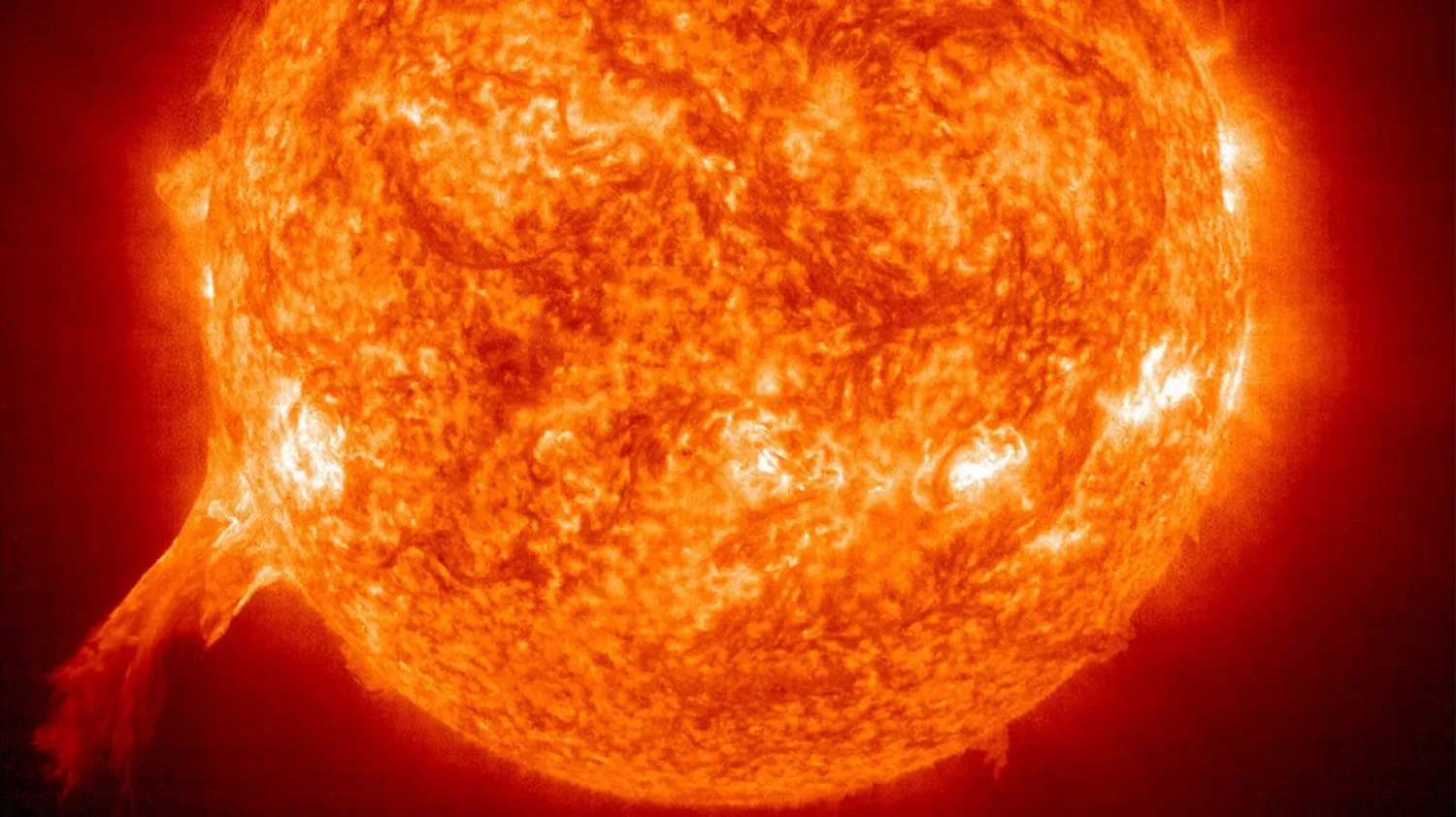
A massive solar eruption, more than 30 times the length of Earth's diameter, blasted away from the Sun on July 1, 2002, and a satellite captured graphic images of the event. (Reuters)
TT

NASA Craft ‘Touches’ the Sun for First Time, Dives Into Atmosphere

A massive solar eruption, more than 30 times the length of Earth's diameter, blasted away from the Sun on July 1, 2002, and a satellite captured graphic images of the event. (Reuters)

A NASA spacecraft has officially “touched” the sun, plunging through the unexplored solar atmosphere known as the corona.

Scientists announced the news Tuesday during a meeting of the American Geophysical Union.

The Parker Solar Probe actually flew through the corona in April during the spacecraft’s eighth close approach to the sun. Scientists said it took a few months to get the data back and then several more months to confirm.

"Fascinatingly exciting,” said project scientist Nour Raouafi of Johns Hopkins University.

Launched in 2018, Parker was 8 million miles (13 million kilometers) from the center of the sun when it first crossed the jagged, uneven boundary between the solar atmosphere and outgoing solar wind. The spacecraft dipped in and out of the corona at least three times, each a smooth transition, according to scientists, Reuters reported.

“The first and most dramatic time we were below for about five hours ... Now you might think five hours, that doesn't sound big," the University of Michigan's Justin Kasper told reporters. But he noted that Parker was moving so fast it covered a vast distance during that time, tearing along at more than 62 miles (100 kilometers) per second.

The corona appeared dustier than expected, according to Raouafi. Future coronal excursions will help scientist better understand the origin of the solar wind, he said, and how it is heated and accelerated out into space. Because the sun lacks a solid surface, the corona is where the action is; exploring this magnetically intense region up close can help scientists better understand solar outbursts that can interfere with life here on Earth.

Preliminary data suggest Parker also dipped into the corona during its ninth close approach in August, but scientists said more analyses are needed. It made its 10th close approach last month.

Parker will keep drawing ever closer to the sun and diving deeper into the corona until its grand finale orbit in 2025.

The latest findings were also published by the American Physical Society.



Crocodile Caught in an Australian Creek 1,200 Miles from Its Tropical Habitat

In this photo provided by Australian Reptile Park, its manager Billy Collett holds a freshwater crocodile caught in a creek near Newcastle, Australia, Monday, March 2, 2026. (Chloe Burgess-Jones/Australian Reptile Park via AP)
TT

Crocodile Caught in an Australian Creek 1,200 Miles from Its Tropical Habitat

In this photo provided by Australian Reptile Park, its manager Billy Collett holds a freshwater crocodile caught in a creek near Newcastle, Australia, Monday, March 2, 2026. (Chloe Burgess-Jones/Australian Reptile Park via AP)

Stephanie Kirsop didn’t believe her son when he phoned to say a crocodile was lurking in a creek near their home.

The family live in the temperate coastal city of Newcastle, which is 2,000 kilometers (1,200 miles) south of Australia's crocodile habitat in the tropical north.

Lionel Saunders, 12, and his friends had spotted the juvenile meter-long (39-inch-long) croc early Saturday afternoon. Authorities were initially skeptical of the reported find but had caught the elusive reptile by Sunday night.

“My son took videos because he was trying to convince me it was real and I didn’t believe him. It did look like a crocodile but I was like, no it’s a log,” Kirsop said Tuesday.

“He rang me back a little bit later and he’s like: ‘I’m so serious mom. You have to come down here and have a look,’” Kirsop said. “The whole drive down there I’m thinking this is going to be a trick. They’re going to laugh at me.”

She was in no doubt it was a crocodile when she arrived.

“There is a little crocodile just swimming around in the creek where local kids go to fish and sometimes kids swim in there. Wow,” Kirsop said.

She phoned a wildlife rescue service and was told crocodiles don’t live in the area. Kirsop sent her own photos and video as proof.

Kirsop was referred to the Australian Reptile Park, which keeps its own crocodiles in a temperature-controlled environment.

Park manager Billy Collett said he suspected the images might have been artificial intelligence-generated fakes. But police confirmed there was a croc in Ironbark Creek.

“I was a bit suspicious because we get a lot of phone calls. These days with AI, it’s just so crazy,” Collett said.

He recognized it was an Australian freshwater crocodile, or crocodylus johnstoni, a smaller and less dangerous species than saltwater crocodiles.

“They’re capable of inflicting a serious injury,” Collett said of the smaller species.

Collett’s team caught the croc Sunday night 3 kilometers (2 miles) from where it was first spotted.

“I just wanted to get him out of there because he would’ve perished in winter,” Collett said. It is currently autumn in the Southern Hemisphere.

The croc is healthy and will stay at the park until authorities decide where it should go permanently, Collett said. Crocs are protected under Australian law.

He suspects the croc was a pet that had been released into the wild after growing too big for a fish tank or too dangerous.


Scores of Grandfather Clocks to be Sold at Auction in the UK

Grandfather pendulum clocks collection for sale at an antique market (Shutterstock)
TT

Scores of Grandfather Clocks to be Sold at Auction in the UK

Grandfather pendulum clocks collection for sale at an antique market (Shutterstock)

A private collection of antique grandfather clocks - which have been assembled over the course of 35 years - is to go on sale.

They come from town such as Devizes, Royal Wootton Bassett and Calne in Wiltshire and currently belong to Paul and Jan Succony, according to BBC.
The couple want to see the historic items go to a good home when they go under the hammer at RWB Auctions on Wednesday.

“I'm now well over 70 and I'm still working as a consultant in the food sector and we felt it was time to move on some clocks from the part of our collection which still need to be restored,” said Paul. “We do have to consider the future and it's not practical for us to keep all that we have.”

The couple's collection includes various clocks and clock parts. What began as a personal purchase grew into a lifelong passion for the pair.

Paul, who lives near Devizes, continued: “My wife had a vision of sitting beside a log fire, reading Thomas Hardy novels with the reassuring tick of a grandfather clock in the room. So 35 years ago I bought her a grandfather clock.”

“That was the start of it. We embraced the challenge of finding clocks made by local makers and restoring them as we both love local history, and each clock has its own identity.”

Paul added: “Today we have well over 60 clocks and we've sold several to buyers across the globe who want to reconnect with their own history or heritage.”

The collection is expected to sell for upwards of £1,000 at RWB Auctions.

Junior auctioneer and valuer Will Walter said, “These are interesting local pieces which will attract local collectors or those with local ties who may live overseas or who have a connection with these places.”


British Sculptors Achieve Notable Victory in Global Ice Carving Competition

The team sculpted a kraken eating a boat
TT

British Sculptors Achieve Notable Victory in Global Ice Carving Competition

The team sculpted a kraken eating a boat

Two stonemasons have won a snow sculpting prize as part of Team GB's entry to the World Snow Festival in Switzerland, according to BBC.

Sheffield sculptors Lily Marsh and Steve Roche were part of Great Britain's four-person team, which won the public vote and came third in the technical judging at the competition in Grindelwald.

They competed against 10 nations with the Spanish team taking first place in the technical category.

Sculptor Lily Marsh said it was “refreshing” to swap stone for snow. “Normally it's very dusty and it's much quicker to move the materials so I really enjoyed it,” she said.

The team - led by Christine Close, a sculptor based in France - carved a kraken eating a boat as part of the myths and legends theme set by the competition organizers.

They worked with a large block of snow, starting with a small model.

“We used big chisels on the end of broom handles. A bit like gardening hoes.

You use those to stab at it and shave stuff way,” explained Roche.

“And we used a length of chain that had nuts and bolts set in it with two handles at the end like a big chain saw to carve off the really big bits that we needed to get rid of at the start of the design,” he added.

Despite the low temperatures, Roche said the work kept the team warm.

“I was working in a T shirt most days. I was moaning it was too warm. I got sunburned. I had to go to the shop to get sun cream because it was so bright,” he said.

After the judging, sadly the sculptures did not last and were left to melt in the snow, said Marsh.

“It's quite a liberating thing because often you can get precious about the stuff you make or get worried about it not being good enough and actually it's quite a good practice to make something and know that it's definitely going to melt. It releases you from that worry a bit,” he said.