


Youth Exodus Takes Joy Out of Syria Christmas

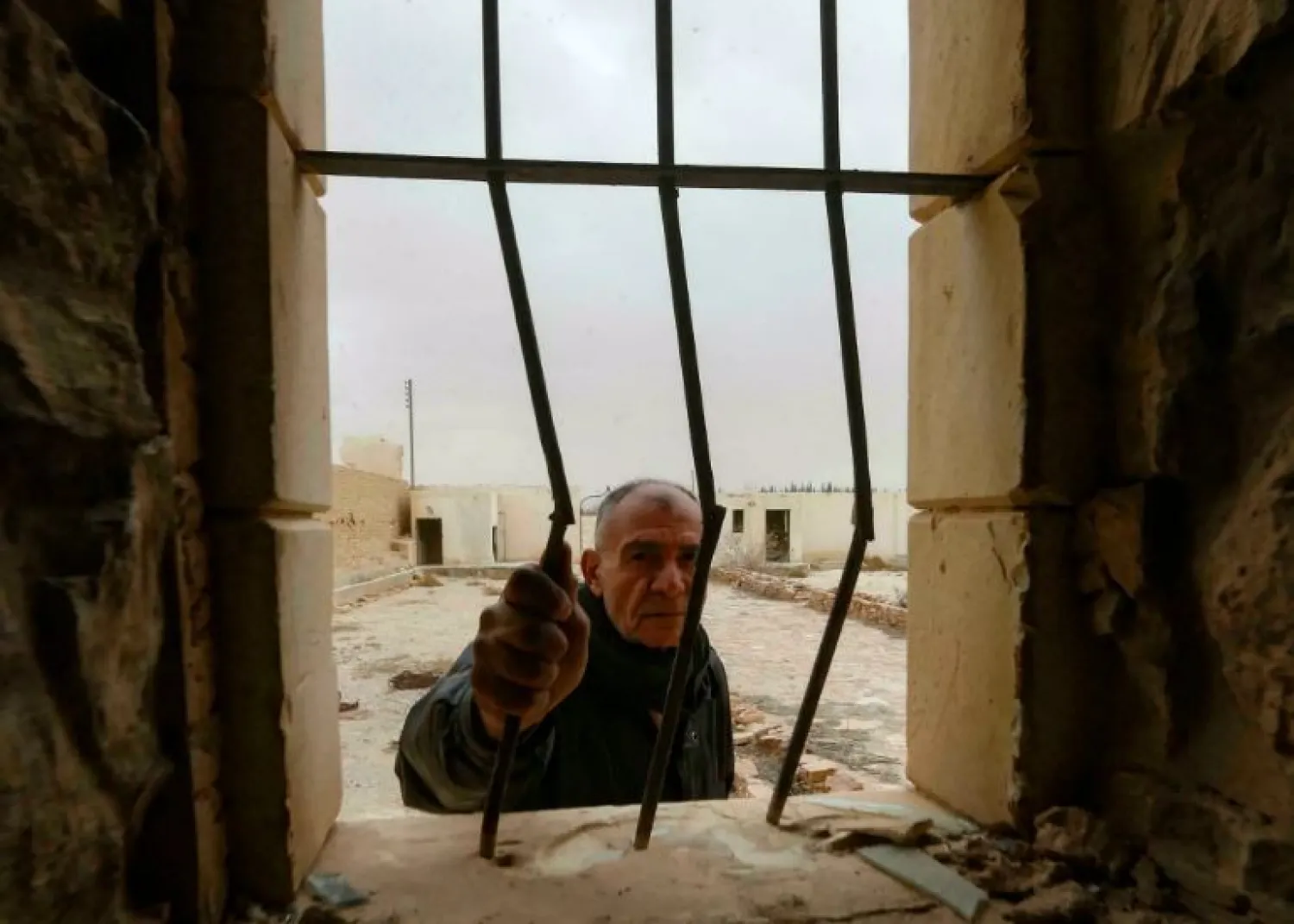
Matanios Dalloul, 62, assesses the damage in the fifth-century Syriac Catholic monastery of Mar Elian, or Saint Elian LOUAI BESHARA AFP
TT

Youth Exodus Takes Joy Out of Syria Christmas

Matanios Dalloul, 62, assesses the damage in the fifth-century Syriac Catholic monastery of Mar Elian, or Saint Elian LOUAI BESHARA AFP

Inside a Syrian monastery desecrated by militants, Matanios Dalloul stood alone by the shattered altar where a once-thriving community celebrated Christmas before the threat of death drove them out.

The 62-year-old is one of 20 Christians remaining in the central town of Al-Qaryatain out of the community that boasted 900 members before conflict broke out a decade ago.

Tracing a cross against his body between piles of broken stone, the lone parishioner prayed for long life for the remnants of a dwindling community which has nobody left under the age of 40.

"The holidays need people, they need young boys and girls, not just piles of stone," Dalloul told AFP, gesturing at what remains of the mud brick walls of the Mar Elian monastery.

"It is people who generate holiday cheer, and if people do not return, there will be no joy."

The town of Al-Qaryatain in Homs province was once viewed as a symbol of coexistence between Christian and Muslim communities who had lived together for centuries before militants of the ISIS group seized the area in 2015.

ISIS militants razed the fifth-century Syriac Catholic monastery of Mar Elian (Saint Elian) and abducted hundreds of Christians, who were locked in an underground dungeon in the desert for 25 days before being freed, AFP reported.

Six years have passed since Russian-backed government forces ousted militants from the town but most of the Christians who fled have not returned and those who remain have neither a church nor a priest to turn to this holiday season.

"The last time the churches of Al-Qaryatain celebrated Christmas was in 2015 before the arrival of ISIS," said Dalloul whose three children have all emigrated to Europe or Canada.

"Now, there are no open churches, nor a priest to oversee Christmas mass," he said.

Dalloul is not alone in his disappointment.

Bassam Debbas said he does not have a single relative left in Syria and will therefore spend Christmas alone, working in a small workshop where he produces grape molasses.

"I don't have anyone left, not a father, nor a mother, nor siblings, nor a wife... I will spend the holiday as though it is any other day, any other working day," the 61-year-old said.

Debbas returned to Al-Qaryatain this year to resume the family trade of molasses production from a small workshop where grapes are fermented and then cooked.

Constant power cuts make the cooking a challenge but he is trying to maintain bare minimum production levels despite the odds.

Outside his home, the street is empty. Traces of ISIS rule are still visible on the crater-riddled walls of neighboring buildings, most of which are either leveled or abandoned.

"The holidays have become completely different since ISIS arrived and brought sadness into the hearts of the people," Debbas said.

"ISIS has gone, but the sadness remains," he lamented, the scent of molasses filling the air around him.

Inside Samira Khoury's home, red rosary beads hang from a small golden cross placed on a wooden table.

A single red candle is lit beside a portrait of Jesus and the Virgin Mary.

There are no Christmas decorations.

The 68-year-old and her three sisters were among dozens of Christians kidnapped and locked up by ISIS in 2015.

"Since that day, happiness has disappeared completely from our home," she said, huddling by a heater.

Without relatives or neighbors to celebrate with, Khoury said "happiness tastes different and the holidays don't look" the way they used to.

"Nothing is the same," she said.

Feeding a small stove with fire wood, Phillipe Azar said his Christmas is once again blighted by the sadness of loss.

"My family has left and my friends are dead," said the 49-year-old, who lives alone in a 10-room house once bustling with relatives.

Azar -- who hasn't put up any Christmas decorations since the start of Syria's war in 2011 -- said he will spend the holiday near his heater.

He may invite an 80-year-old friend over but that is only if he is in good enough health to come visit.

"The Christmas tree has been packed in a box since 2011," Azar said.

"Who should I put it up for? Why would I celebrate alone, without my siblings, neighbors and friends?"



Best Time to Take Vitamin D for Muscle Strength

Vitamin D tablets (file photo – AP)
TT

Best Time to Take Vitamin D for Muscle Strength

Vitamin D tablets (file photo – AP)

Vitamin D is an essential nutrient that plays a central role in both bone and muscle health.

With growing interest in dietary supplements, a key question arises: what is the best time to take vitamin D to support muscle strength?

This article reviews the latest scientific evidence on vitamin D timing and its impact on muscle health, offering practical recommendations based on recent research.

The optimal time to take vitamin D is with or after a meal that contains fat- preferably in the morning or at lunchtime. Taking it with food enhances absorption, supporting bone health and contributing more effectively to muscle strength. It is also advisable to take it at the same time each day for best results.

How Vitamin D Works in Muscles

Vitamin D is a fat-soluble vitamin, meaning its absorption in the intestine depends heavily on dietary fat. When taken with a fat-containing meal, micelles form, facilitating its transport across the intestinal wall into the bloodstream. It then reaches muscle cells, where it helps promote muscle protein synthesis and improve muscle fiber function.

Scientific Evidence on Timing

A randomized controlled trial published in Nutrients (2022) found that taking a combination of whey protein and vitamin D3 either before sleep or after waking led to beneficial increases in muscle mass in young men undergoing resistance training.

Importantly, no statistically significant differences were found between the groups in terms of muscle gains, suggesting that vitamin D’s benefits for muscle health are not dependent on a specific time of day, but rather on consistent intake.

Effects on Sleep and Melatonin

Some research indicates a link between vitamin D levels and sleep quality, with low levels associated with a higher risk of sleep disorders.

Certain recommendations suggest that taking vitamin D in the evening may interfere with melatonin production—the hormone that regulates the sleep-wake cycle. For this reason, experts generally recommend taking vitamin D in the morning or at midday to avoid potential sleep disruption.

Vitamin D and Athletic Performance

A systematic review published in the Journal of Human Sport and Exercise (2025), analyzing 13 studies on vitamin D and athletic performance, found:

  • Vitamin D supplementation consistently increases blood levels in athletes
  • Noticeable improvements in performance among those initially deficient
  • Mixed effects on muscle recovery and blood markers across studies
  • Seasonal fluctuations in vitamin D levels highlight the importance of supplementation timing

Taking vitamin D with main meals and maintaining daily consistency are key to maximizing its benefits for muscle health. Consulting a healthcare provider is recommended to determine the appropriate dosage based on individual health status and blood levels.


Taif Rose Harvest Season Produces over 550 Million Roses

Rose farms are spread across the highlands of Al-Hada and Al-Shafa - SPA
TT

Taif Rose Harvest Season Produces over 550 Million Roses

Rose farms are spread across the highlands of Al-Hada and Al-Shafa - SPA

Taif rose farms are witnessing a notable abundance of production during the current harvest season, amid favorable climatic conditions that have contributed to improved crop quality and increased quantities. Taif Governorate is home to more than 910 farms, comprising around 1.14 million rose shrubs, which produce approximately 550 million roses annually during a season lasting around 45 days.

Rose farms are spread across the highlands of Al-Hada and Al-Shafa, between the slopes of the Sarawat Mountains, in a natural setting characterized by moderate temperatures and abundant water, with fertile valleys that create an ideal environment for Taif roses, SPA reported.

Farmer Khalaf Jaber Al Tuwairqi stated that moderate weather and the availability of irrigation sources contributed to increased flower density and quality this season, thereby positively impacting harvesting and production. He noted that farms produce thousands of roses daily during peak periods, with around 12,000 roses required to produce one unit of rose oil, one of the world's most precious aromatic oils.

Tourism guide Abdullah Al Zahrani affirmed that the abundant rose production has boosted tourism activity in Taif, as rose farms in Al-Hada and Al-Shafa attract growing numbers of visitors during the harvest season to witness harvesting and distillation stages and learn about this traditional craft that forms part of the governorate's agricultural identity.


Artemis Astronauts to Study the Moon’s Surface Using Mainly Their Eyes

 This photo provided by NASA shows the moon seen from a window on the Orion spacecraft Integrity during the Artemis II mission on Friday, April 3, 2026. (NASA via AP)
This photo provided by NASA shows the moon seen from a window on the Orion spacecraft Integrity during the Artemis II mission on Friday, April 3, 2026. (NASA via AP)
TT

Artemis Astronauts to Study the Moon’s Surface Using Mainly Their Eyes

 This photo provided by NASA shows the moon seen from a window on the Orion spacecraft Integrity during the Artemis II mission on Friday, April 3, 2026. (NASA via AP)
This photo provided by NASA shows the moon seen from a window on the Orion spacecraft Integrity during the Artemis II mission on Friday, April 3, 2026. (NASA via AP)

More than 50 years after humans first flew around the Moon, Artemis astronauts will repeat the feat on Monday and use the most basic instrument to study it: their eyes.

Despite the technological advancements since the Apollo missions, NASA still relies on the eyesight of its astronauts to learn more about the Moon.

"The human eye is basically the best camera that could ever or will ever exist," Kelsey Young, the lead scientist for the Artemis 2 mission, told AFP.

"The number of receptors in the human eye far outweighs what a camera is able to do."

Although modern cameras may be superior to human eyesight in some respects, "the human eye is really good at color, and it's really good at context, and it's also really good at photometric observations," Young said.

Humans can understand how lighting changes surface details, like how angled lighting reveals texture but reduces visible color.

In just the blink of an eye, humans can detect a subtle color shift and understand how lighting changes the contours of a landscape like the Moon's surface, details which are scientifically useful but difficult to ascertain from photos or videos.

Artemis 2 astronaut Victor Glover, who pilots the Orion spacecraft, said before liftoff this week that eyes were a "magical instrument."

- Field scientists -

To ensure they made the most of their proximity to the Moon, the four Artemis 2 crew members underwent more than two years of training.

Young said the goal was to turn the astronauts into "field scientists" via a combination of classroom lessons, geological expeditions to Iceland and Canada, and multiple simulated flybys of the Moon, just like the mission they are on.

The three American astronauts -- commander Reid Wiseman, pilot Glover and mission specialist Christina Koch -- along with Canadian astronaut Jeremy Hansen, all had to memorize the Moon's "Big 15," or the 15 features of the Moon that will allow them to orient themselves.

Using an inflatable Moon globe, they practiced seeing how the angle of the sun changed the colors and textures of the lunar surface, honing their observation and note-taking skills for the big moment.

"I can tell you, they are excited and they are ready," Young said with a smile.

- 'About the size of a basketball' -

The Artemis astronauts' mission is to study certain lunar sites and phenomena as part of 10 objectives chosen by NASA and ranked in priority order based on scientific interest.

During the Moon flyby, which will last for several hours, the crew will have to observe the celestial body with their naked eyes, along with cameras they have on board.

Noah Petro, head of NASA's planetary geology lab, told AFP that the Moon will look to the astronauts "about the size of a basketball held at arm's length."

"The question I'm most interested in is, are they going to be able to see color on the lunar surface," Petro said.

"I don't mean rainbow colors, but you know, dark browns or tan colors because that tells us something about the composition, and that tells us something about the history of the Moon."

David Kring of the Lunar and Planetary Institute told AFP he is not expecting any earth-shattering discoveries because of the multiple lunar probes and high-resolution images of the Moon taken since the Apollo missions.

Nevertheless, "having astronauts describing what they're seeing... That is an occurrence that at least two generations of people on Earth have never heard before," he said.

The Artemis 2 flyby will be broadcast live by NASA, save for a period for when the spacecraft is behind the moon.

"Just listening to their practice descriptions in the mission simulations... It brings chills up my arms," Young said.

"I am absolutely confident that these four people are going to deliver some incredible descriptions."