


Bennett Says Not Opposed to ‘Good’ Nuclear Deal With Iran

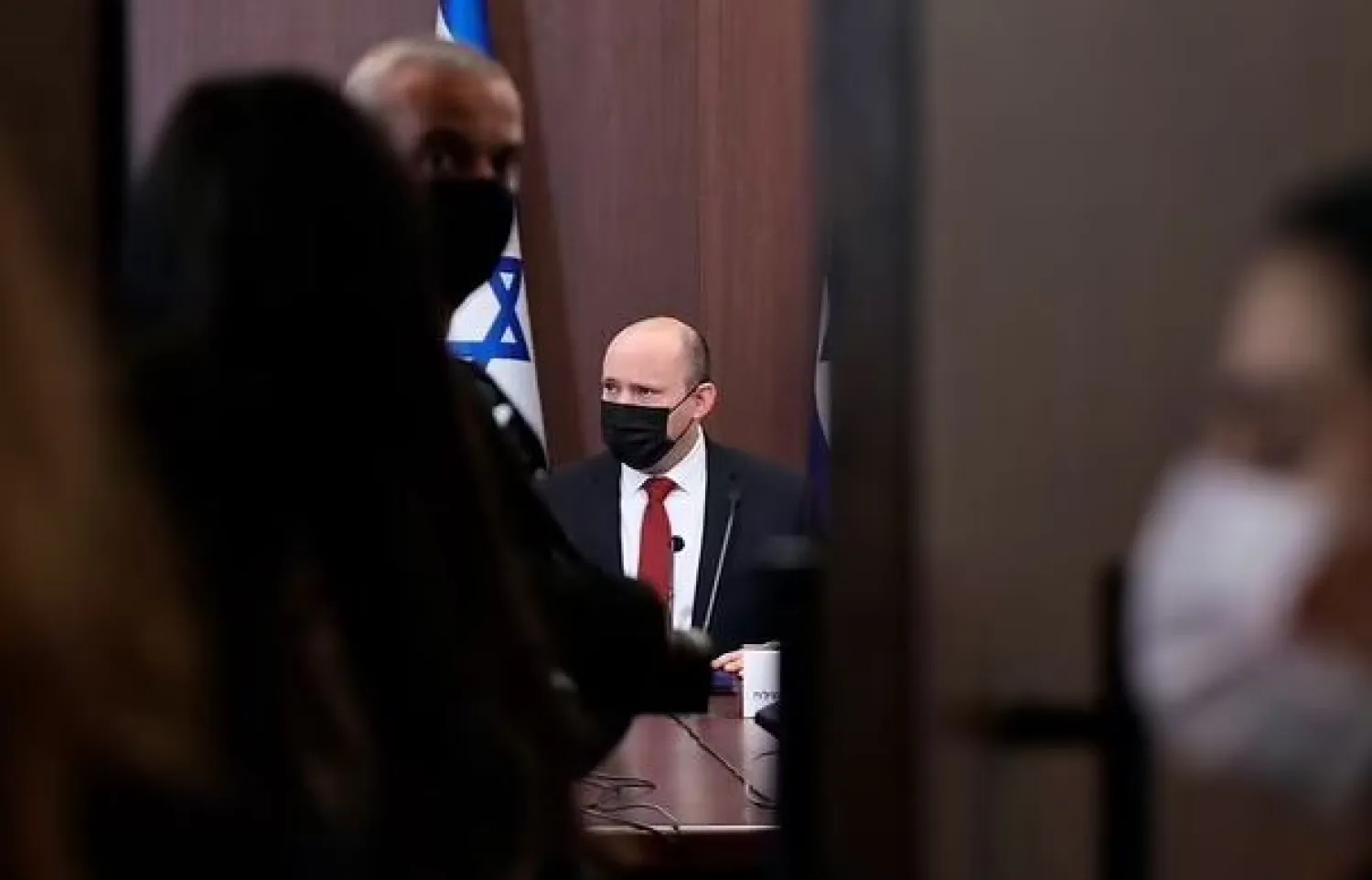
Israeli Prime Minister Naftali Bennett, rear and wearing a face mask, attends during a cabinet meeting at the prime minister's office in Jerusalem, Israel, Sunday, Dec. 19, 2021. (Abir Sultan/Pool Photo via AP)
TT

Bennett Says Not Opposed to ‘Good’ Nuclear Deal With Iran

Israeli Prime Minister Naftali Bennett, rear and wearing a face mask, attends during a cabinet meeting at the prime minister's office in Jerusalem, Israel, Sunday, Dec. 19, 2021. (Abir Sultan/Pool Photo via AP)

Israeli Prime Minister Naftali Bennett said Tuesday he is not opposed to a "good" nuclear deal between Iran and world powers, but voiced skepticism that such an outcome would emerge from the current negotiations.

Bennett spoke a day after negotiators from Iran and five world powers resumed talks in Vienna on restoring Tehran´s tattered 2015 nuclear deal. He reiterated that Israel was not bound by any accord, leaving it room to maneuver militarily.

"At the end of the day, of course there can be a good deal," Bennett told Israeli Army Radio, according to The Associated Press.

"Is that, at the moment, under the current dynamic, expected to happen? No, because a much harder stance is needed."

Bennett also denied claims by former Prime Minister Benjamin Netanyahu that he had agreed to a policy of "no surprises" with Washington, meaning that it would be frank about its military intentions regarding Iran with its prime ally and thus be potentially hobbled.

"Israel will always maintain its right to act and will defend itself by itself," he said.

Bennett has urged negotiators to tow a firmer line against Iran.

Tehran´s landmark 2015 accord granted Iran sanctions relief in exchange for curbs on its nuclear program. But in 2018, then-President Donald Trump withdrew America from the deal and imposed sweeping sanctions on Iran. The other signatories have struggled to keep the agreement alive.

The latest round of talks in Vienna, the eighth, opened Monday, 10 days after negotiations were adjourned for the Iranian negotiator to return home for consultations. The previous round, the first after a more than five-month gap caused by the arrival of a new hard-line government in Iran, was marked by tensions over new Iranian demands.

Israel considers Iran to be its greatest enemy and it strongly opposed the 2015 deal.

It says it wants an improved deal that places tighter restrictions on Iran´s nuclear program and addresses Iran´s long-range missile program and its support for hostile proxies along Israel´s borders.

Israel also says that the negotiations must be accompanied by a "credible" military threat to ensure that Iran does not delay indefinitely.



Egypt Tries to Revive US-Iran Negotiations

 Vessels near the Strait of Hormuz, as seen from Musandam, Oman, August 17, 2026. (Reuters)
Vessels near the Strait of Hormuz, as seen from Musandam, Oman, August 17, 2026. (Reuters)
TT

Egypt Tries to Revive US-Iran Negotiations

 Vessels near the Strait of Hormuz, as seen from Musandam, Oman, August 17, 2026. (Reuters)
Vessels near the Strait of Hormuz, as seen from Musandam, Oman, August 17, 2026. (Reuters)

The top diplomats for Egypt and Iran discussed efforts to bring Tehran and Washington back to the negotiating table to settle the war, Egypt's foreign ministry said on Saturday.

Iranian Foreign Minister Abbas Araghchi and Egyptian counterpart Badr Abdelatty also discussed the Iranian-Omani talks on the management of the Strait of Hormuz, the ministry said.

Araghchi briefed Egypt's foreign minister about “Iran’s view of ongoing developments, the course of negotiations and their challenges,” the ministry said, without elaborating.

There was no immediate statement from Araghchi.


Putin Says Ukraine Opened ‘Pandora’s Box’ with Strikes on Economic Targets

 Russian President Vladimir Putin gives an interview to journalist Pavel Zarubin in Moscow, Russia, August 22, 2026. (Sputnik/Mikhail Metzel/Pool via Reuters)
Russian President Vladimir Putin gives an interview to journalist Pavel Zarubin in Moscow, Russia, August 22, 2026. (Sputnik/Mikhail Metzel/Pool via Reuters)
TT

Putin Says Ukraine Opened ‘Pandora’s Box’ with Strikes on Economic Targets

 Russian President Vladimir Putin gives an interview to journalist Pavel Zarubin in Moscow, Russia, August 22, 2026. (Sputnik/Mikhail Metzel/Pool via Reuters)
Russian President Vladimir Putin gives an interview to journalist Pavel Zarubin in Moscow, Russia, August 22, 2026. (Sputnik/Mikhail Metzel/Pool via Reuters)

Russian President Vladimir Putin said in comments published on Saturday that Kyiv had opened "Pandora's box" with its strikes on Russian economic targets, saying that Russia would hit back at Ukraine's "most sensitive economic sectors".

Ukraine has this summer escalated a campaign of drone strikes targeting Russian economic infrastructure, including oil refineries and online retailers' warehouses, seeking to ‌destroy infrastructure it ‌says is central to Russia's ‌war ⁠effort.

Russia has responded ⁠with strikes against Ukrainian economic infrastructure, including Ukrainian grain exports via the Black Sea.

"The Kyiv regime set out to damage our economy. What did it do? It opened this Pandora’s box itself. Well then, expect a response targeting your ⁠most sensitive economic sectors," Putin said ‌in comments to ‌a Russian state television journalist.

He said that the strikes, ‌which have jeopardized Ukraine's agricultural exports, would ‌not cause global food shortages, because Russia would be able to replace Ukrainian exports, even as Kyiv has targeted Russian grain export infrastructure.

"We do face ‌challenges regarding the shipment of our goods, but we will resolve these issues. ⁠Consequently, ⁠there will be no shortage on the global market," Putin said.

Russia and Ukraine had previously adhered to a Turkish-brokered deal to protect grain exports on the Black Sea. But Russia exited the deal in 2023.

The Russian leader also restated his position that Moscow is open to peace talks, but only on the basis of "realities on the ground", rather than what he called "exotic" proposals that he said had been made by Ukraine via intermediaries.


Iran Condemns US Plans to Announce New Sanctions

Iranian people walk past an anti-US mural in Tehran, Iran, 17 August 2026. (EPA)
TT

Iran Condemns US Plans to Announce New Sanctions

Iranian people walk past an anti-US mural in Tehran, Iran, 17 August 2026. (EPA)

Iran on Saturday denounced US plans to announce new sanctions that could put further strain on the country’s economy and have an impact on its most important trading partners including China.

After nearly six months of war since the US and Israel launched airstrikes against Iran on February 28, the sides are not firing at each other but also showing no sign of pursuing peace talks.

Oil shipments are at a virtual standstill in the Strait of Hormuz, with Tehran threatening to strike any unauthorized oil tankers that try to transit the vital waterway, and Iran's economy is already under immense pressure from sanctions.

US Treasury Secretary Scott Bessent is due to hold a press conference at 2 p.m. EDT (1800 GMT) on Monday after threatening "the toughest sanctions in history" on Iran.

Bessent has also urged cooperation with Washington by China, which buys more than 80% of Iran's shipped oil, according to 2025 data from ‌analytics firm Kpler. ‌Beijing has urged diplomacy.

Iran's Foreign Ministry spokesperson, Esmaeil Baghaei, said on Saturday the imminent US announcement of ‌new ⁠economic sanctions was an "assertion ⁠of extraterritorial sovereignty over every independent member state of the United Nations."

"Such secondary sanctions find no foundation in international law," he said in a post on X.

The chief of staff of Iran's armed forces, Major General Ali Abdollahi, promised on Friday that Iran would respond to enemy threats militarily with "crushing, punishing and devastating responses.”

US President Donald Trump, who has warned of economic consequences against any country that provides "any type of lifeline to Iran," said on Friday that Washington was observing "what happens" in the conflict.

"They would love to make a deal, but they're not ready to make the right deal, in my opinion," Trump said of Iran.

HORMUZ TRAFFIC HALTED

While the US has effectively blockaded Iranian vessels in their ports, the Strait of ⁠Hormuz remained bottled up with thousands of seafarers stranded on hundreds of vessels.

Only four commodity ships ‌sailed along the strait on Thursday, none of them large crude carriers or liquefied ‌natural gas tankers, ship-tracking data showed.

However, Iran has granted permission for a number of Iraqi oil tankers to pass through the Strait following repeated requests from ‌Baghdad, Iran’s state news agency IRNA reported on Saturday.

IRNA said obtaining special permission for Iraqi tankers was one of Baghdad’s main requests ‌during a visit to Iraq by Parliament Speaker Mohammad Baqer Qalibaf.

US Energy Secretary Chris Wright said the US military helped move a seven-day average of 8 million barrels a day of oil through the strait. That's down from more than 20 million per day before the war or about one of every five barrels consumed worldwide.

US attacks have severely diminished Iran's economy and devastated its navy and air force, but Tehran maintains enough missile and drone capability ‌to impede oil tanker traffic and attack regional rivals.

Abdollahi, the armed forces chief of staff, sought to underline Iran's missile capabilities during a visit to an underground plant manufacturing ballistic missiles that was reported ⁠by state television on Saturday.

"This ⁠plant has been able, much better than in the past, to produce equipment superior both in capacities and quality and in quantity," he said.

Trump, meanwhile, has yet to achieve objectives he set at the start of the war such as dismantling Iran's nuclear program - the state of which remains uncertain given that UN inspectors have been shut out since 2025 - and creating conditions for Iranians to overthrow their clerical rulers.

Thousands have been killed, mainly in Iran, where 168 Iranian school children were killed on the first day of the war. The US has reported more than 750 military personnel wounded and 18 killed.

While Iran remains defiant, President Masoud Pezeshkian has also called for a diplomatic solution.

"It would be better to end the war today, when we are powerful and have dignity, and the whole world acknowledges our victory and emphasizes that America, contrary to all regulations, attacked our schools, hospitals, and infrastructure and is hated in the world," the ISNA news agency quoted him as saying on Friday.