

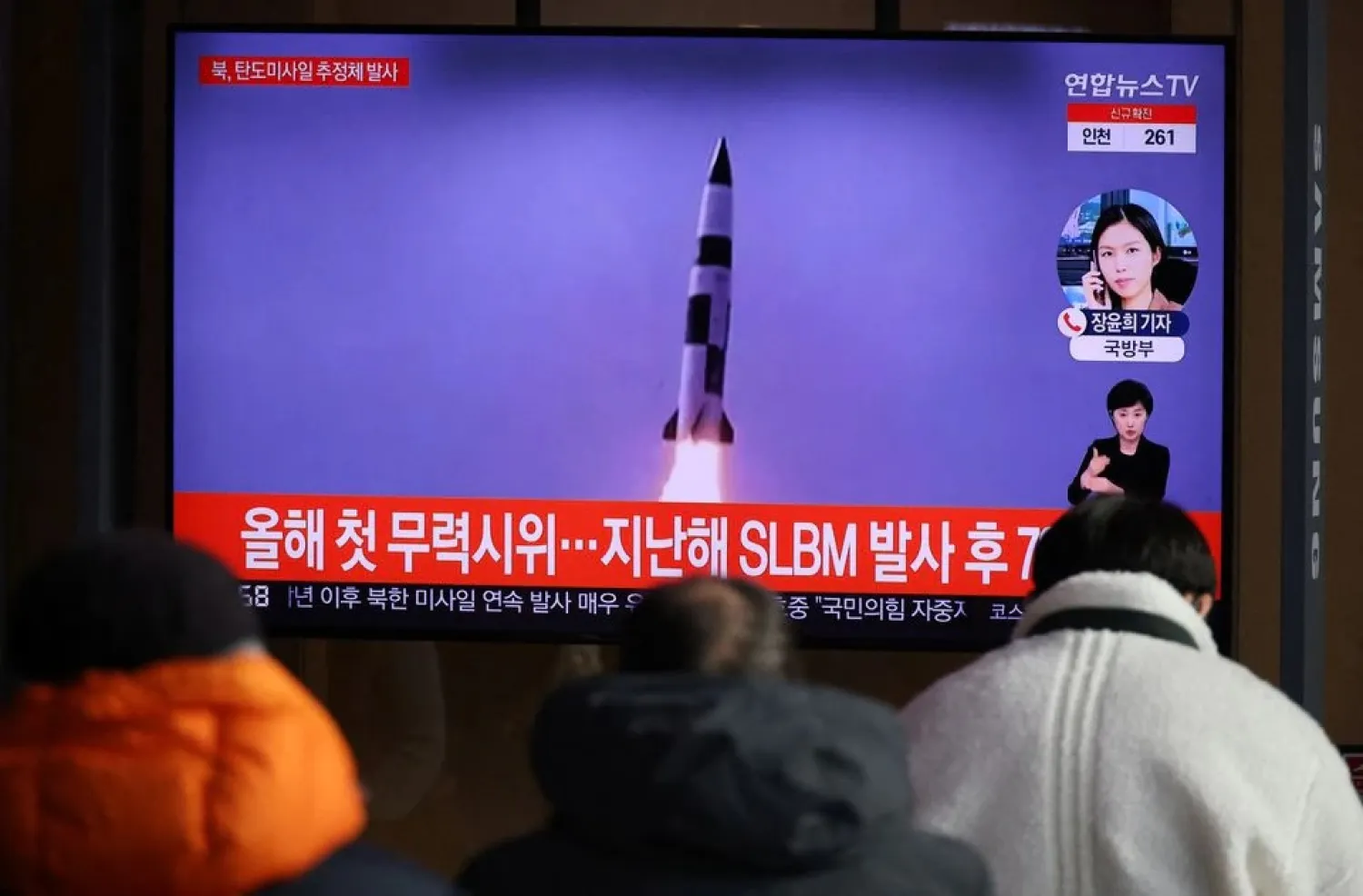

North Korea Fires Suspected Missile as S.Korea Breaks Ground for ‘Peace’ Railway

People watch a TV broadcasting file footage of a news report on North Korea firing a ballistic missile off its east coast, in Seoul, South Korea, January 5, 2022. (Reuters)
TT

North Korea Fires Suspected Missile as S.Korea Breaks Ground for ‘Peace’ Railway

People watch a TV broadcasting file footage of a news report on North Korea firing a ballistic missile off its east coast, in Seoul, South Korea, January 5, 2022. (Reuters)

North Korea fired a suspected ballistic missile off its east coast on Wednesday, just hours before South Korean President Moon Jae-in attended a groundbreaking ceremony for a rail line he hopes will eventually connect the divided Korean peninsula.

North Korea's first launch since October underscored leader Kim Jong Un's New Year vow to bolster the military to counter an unstable international situation amid stalled talks with South Korea and the United States.

The presumed missile was fired around 8:10 a.m. (2310 GMT) from an inland location, over the east coast and into the sea, South Korea's Joint Chiefs of Staff (JCS) said.

A few hours later, Moon visited the South Korean east coast city of Goseong, near the border with the North, where he broke ground for a new rail line that he called "a stepping stone for peace and regional balance" on the peninsula.

In remarks at the ceremony, Moon acknowledged the launch raised concerns of tensions and damage to inter-Korean relations, and called for North Korea to make sincere efforts for dialogue.

"We should not give up the hope for dialogue in order to fundamentally overcome this situation," he said. "If both Koreas work together and build trust, peace would be achieved one day."

The apparent missile launch by the nuclear-armed North highlighted the challenges Moon faces in his push to achieve a diplomatic breakthrough before his five-year term ends in May.

Reconnecting the two Koreas by rail was a central issue in meetings between Kim and Moon in 2018, but those efforts went nowhere as talks aimed at convincing North Korea to surrender its nuclear weapons in exchange for easing international sanctions faltered in 2019.

Kim's New Year speech made no mention of efforts by South Korea to restart negotiations or offers by the United States to talk, though analysts noted that doesn't mean he has closed the door on diplomacy.

'Very regrettable'

South Korea's National Security Council convened an emergency meeting, expressing concern the launch "came at a time when internal and external stability is extremely important" and calling on North Korea to return to talks.

Japan's defense minister said the suspected ballistic missile had flown an estimated 500 km (310 miles).

"Since last year, North Korea has repeatedly launched missiles, which is very regrettable," Japanese Prime Minister Fumio Kishida told reporters.

UN Security Council resolutions ban all ballistic missile and nuclear tests by North Korea, and have imposed sanctions over the programs.

In state media summaries of a speech Kim gave ahead of the New Year, the North Korean leader did not specifically mention missiles or nuclear weapons but said national defense must be bolstered.

For several weeks, North Korean troops have been conducting winter exercises, South Korean military officials have said.

"Our military is maintaining readiness posture in preparation for a possible additional launch while closely monitoring the situation in close cooperation with the United States," the JCS said in a statement. Recent North Korean missile tests have often featured double or multiple launches.

Since the start of the COVID-19 pandemic, North Korea has become even more isolated, imposing border lockdowns that have slowed trade to a trickle and choking off any in-person diplomatic engagements.

It has also stuck to a self-imposed moratorium on testing its largest intercontinental ballistic missiles (ICBMs) or nuclear weapons. The last tests of ICBMs or a nuclear bomb were in 2017, before Kim met with then US President Donald Trump.

But Pyongyang has continued test firing a variety of new, short-range ballistic missiles, including one launched from a submarine in October, arguing it should not be penalized for developing weapons that other countries also wield.

"While the readout from North Korea's recent plenary meetings may have prioritized rural development for the coming year, it doesn't mean the country will halt its ballistic missile tests," said Michelle Kae, deputy director of 38 North, a North Korea monitoring program at Washington's Stimson Center.

Missile development

In a report last month, the US government's Congressional Research Service concluded North Korea continues to advance its nuclear weapons and missile programs despite U.N. sanctions and diplomatic efforts.

"Recent ballistic missile tests and military parades suggest that North Korea is continuing to build a nuclear war-fighting capability designed to evade regional ballistic missile defenses," the report said.

Just hours after the North Korean launch, Japan announced its foreign and defense ministers will hold talks with their US counterparts on Friday to discuss security.

Speaking at a regular news conference in Beijing on Wednesday, Chinese foreign ministry spokesman Wang Wenbin urged all parties to "bear in mind the bigger picture", cherish the "hard won" peace and stability on the peninsula and stick to the use of dialogue and consultation to reach political settlement.

The White House, Pentagon and US State Department did not immediately respond to requests for comment on Wednesday's launch. At a regular news briefing on Monday, State Department spokesperson Ned Price reiterated the US desire for dialogue with North Korea, saying Washington had no hostile intent and was prepared to meet without preconditions.



Trump Set to Expand Immigration Crackdown in 2026 despite Brewing Backlash

A woman holds a poster as immigrants rights activists stage a traditional Mexican posada, reenacting Mary and Joseph’s search for shelter, to symbolize immigrants seeking refuge from Immigration and Customs Enforcement (ICE) agents during the ongoing immigration operation "Catahoula Crunch", in New Orleans, Louisiana, US, December 18, 2025. REUTERS/Seth Herald
TT

Trump Set to Expand Immigration Crackdown in 2026 despite Brewing Backlash

A woman holds a poster as immigrants rights activists stage a traditional Mexican posada, reenacting Mary and Joseph’s search for shelter, to symbolize immigrants seeking refuge from Immigration and Customs Enforcement (ICE) agents during the ongoing immigration operation "Catahoula Crunch", in New Orleans, Louisiana, US, December 18, 2025. REUTERS/Seth Herald

US President Donald Trump is preparing for a more aggressive immigration crackdown in 2026 with billions in new funding, including by raiding more workplaces — even as backlash builds ahead of next year’s midterm elections.

Trump has already surged immigration agents into major US cities, where they swept through neighborhoods and clashed with residents. While federal agents this year conducted some high-profile raids on businesses, they largely avoided raiding farms, factories and other businesses that are economically important but known to employ immigrants without legal status.

ICE and Border Patrol will get $170 billion in additional funds through September 2029 - a huge surge of funding over their existing annual budgets of about $19 billion after the Republican-controlled Congress passed a massive spending package in July.

Administration officials say they plan to hire thousands more agents, open new detention centers, pick up more immigrants in local jails and partner with outside companies to track down people without legal status, Reuters reported.

The expanded deportation plans come despite growing signs of political backlash ahead of next year’s midterm elections.

Miami, one of the cities most affected by Trump’s crackdown because of its large immigrant population, elected its first Democratic mayor in nearly three decades last week in what the mayor-elect said was, in part, a reaction to the president.

Other local elections and polling ‌have suggested rising concern among ‌voters wary of aggressive immigration tactics. "People are beginning to see this not as an immigration question anymore ‌as ⁠much as it ‌is a violation of rights, a violation of due process and militarizing neighborhoods extraconstitutionally," said Mike Madrid, a moderate Republican political strategist.

"There is no question that is a problem for the president and Republicans." Trump’s overall approval rating on immigration policy fell from 50% in March, before he launched crackdowns in several major US cities, to 41% in mid-December, for what had been his strongest issue.

Rising public unease has focused on masked federal agents using aggressive tactics such as deploying tear gas in residential neighborhoods and detaining US citizens.

'NUMBERS WILL EXPLODE'

In addition to expanding enforcement actions, Trump has stripped hundreds of thousands of Haitian, Venezuelan and Afghan immigrants of temporary legal status, expanding the pool of people who could be deported as the president promises to remove 1 million immigrants each year – a goal he almost certainly will miss this year. So far, some 622,000 immigrants ⁠have been deported since Trump took office in January.

White House border czar Tom Homan told Reuters Trump had delivered on his promise of a historic deportation operation and removing criminals while shutting down illegal immigration across ‌the US-Mexico border. Homan said the number of arrests will increase sharply as ICE hires more ‍officers and expands detention capacity with the new funding.

“I think you're going to ‍see the numbers explode greatly next year,” Homan said.

Homan said the plans “absolutely” include more enforcement actions at workplaces.

Sarah Pierce, director of social policy at the ‍center-left group Third Way, said US businesses have been reluctant to push back on Trump's immigration crackdown in the past year but could be prompted to speak up if the focus turns to employers.

Pierce said it will be interesting to see "whether or not businesses finally stand up to this administration."

Trump, a Republican, recaptured the White House promising record levels of deportations, saying it was needed after years of high levels of illegal immigration under his Democratic predecessor, Joe Biden. He kicked off a campaign that dispatched federal agents to US cities in search of possible immigration offenders, sparking protests and lawsuits over racial profiling and violent tactics.

Some businesses shut down to avoid raids or because of a lack of customers. Parents vulnerable to arrest kept their children home from school or had neighbors ⁠walk them. Some US citizens started carrying passports. Despite the focus on criminals in its public statements, government data shows that the Trump administration has been arresting more people who have not been charged with any crimes beyond their alleged immigration violations than previous administrations.

Some 41% of the roughly 54,000 people arrested by ICE and detained by late November had no criminal record beyond a suspected immigration violation, agency figures show.

In the first few weeks in January, before Trump took office, just 6% of those arrested and detained by ICE were not facing charges for other crimes or previously convicted.

The Trump administration has taken aim at legal immigrants as well. Agents have arrested spouses of US citizens at their green card interviews, pulled people from certain countries out of their naturalization ceremonies, moments before they were to become citizens, and revoked thousands of student visas.

PLANS TO TARGET EMPLOYERS

The administration’s planned focus on job sites in the coming year could generate many more arrests and affect the US economy and Republican-leaning business owners.

Replacing immigrants arrested during workplace raids could lead to higher labor costs, undermining Trump’s fight against inflation, which analysts expect to be a major issue in the closely watched November elections, determining control of Congress. Administration officials earlier this year exempted such businesses from enforcement on Trump’s orders, then quickly reversed, Reuters reported at the time.

Some immigration hardliners have ‌called for more workplace enforcement.

"Eventually you’re going to have to go after these employers,” said Jessica Vaughan, policy director for the Center for Immigration Studies, which backs lower levels of immigration. “When that starts happening the employers will start cleaning up their acts on their own.”


At Least 16 Files Have Disappeared from the DOJ Webpage for Documents Related to Jeffrey Epstein

Ghislaine Maxwell and Jeffrey Epstein are seen in this image released by the Department of Justice in Washington, D.C., US, on December 19, 2025 as part of a new trove of documents from its investigations into the late financier and convicted sex offender Jeffrey Epstein. US Justice Department/Handout via REUTERS
TT

At Least 16 Files Have Disappeared from the DOJ Webpage for Documents Related to Jeffrey Epstein

Ghislaine Maxwell and Jeffrey Epstein are seen in this image released by the Department of Justice in Washington, D.C., US, on December 19, 2025 as part of a new trove of documents from its investigations into the late financier and convicted sex offender Jeffrey Epstein. US Justice Department/Handout via REUTERS

At least 16 files disappeared from the Justice Department’s public webpage for documents related to Jeffrey Epstein — including a photograph showing President Donald Trump — less than a day after they were posted, with no explanation from the government and no notice to the public.

The missing files, which were available Friday and no longer accessible by Saturday, included images of paintings depicting nude women, and one showing a series of photographs along a credenza and in drawers. In that image, inside a drawer among other photos, was a photograph of Trump, alongside Epstein, Melania Trump and Epstein's longtime associate Ghislaine Maxwell.

The Justice Department did not say why the files were removed or whether their disappearance was intentional. A spokesperson for the department did not immediately respond to a request for comment.

Online, the unexplained missing files fueled speculation about what was taken down and why the public was not notified, compounding long-standing intrigue about Epstein and the powerful figures who surrounded him. Democrats on the House Oversight Committee pointed to the missing image featuring a Trump photo in a post on X, writing: “What else is being covered up? We need transparency for the American public.”

The episode deepened concerns that had already emerged from the Justice Department’s much-anticipated document release. The tens of thousands of pages made public offered little new insight into Epstein’s crimes or the prosecutorial decisions that allowed him to avoid serious federal charges for years, while omitting some of the most closely watched materials, including FBI interviews with victims and internal Justice Department memos on charging decisions.

Scant new insight in the initial disclosures

Some of the most consequential records expected about Epstein are nowhere to be found in the Justice Department's initial disclosures, which span tens of thousands of pages.

Missing are FBI interviews with survivors and internal Justice Department memos examining charging decisions — records that could have helped explain how investigators viewed the case and why Epstein was allowed in 2008 to plead guilty to a relatively minor state-level prostitution charge.

The gaps go further.

The records, required to be released under a recent law passed by Congress, hardly reference several powerful figures long associated with Epstein, including Britain’s former Prince Andrew, renewing questions about who was scrutinized, who was not, and how much the disclosures truly advance public accountability

Among the fresh nuggets: insight into the Justice Department’s decision to abandon an investigation into Epstein in the 2000s, which enabled him to plead guilty to that state-level charge, and a previously unseen 1996 complaint accusing Epstein of stealing photographs of children.

The releases so far have been heavy on images of Epstein’s homes in New York City and the US Virgin Islands, with some photos of celebrities and politicians.

There was a series of never-before-seen photos of former President Bill Clinton but fleetingly few of Trump. Both have been associated with Epstein, but both have since disowned those friendships. Neither has been accused of any wrongdoing in connection with Epstein and there was no indication the photos played a role in the criminal cases brought against him.

Despite a Friday deadline set by Congress to make everything public, the Justice Department said it plans to release records on a rolling basis. It blamed the delay on the time-consuming process of obscuring survivors' names and other identifying information. The department has not given any notice when more records might arrive.

That approach angered some Epstein accusers and members of Congress who fought to pass the law forced the department to act. Instead of marking the end of a yearslong battle for transparency, the document release Friday was merely the beginning of an indefinite wait for a complete picture of Epstein’s crimes and the steps taken to investigate them.

“I feel like again the DOJ, the justice system is failing us,” said Marina Lacerda, who alleges Epstein started sexually abusing her at his New York City mansion when she was 14.

Many of the long-anticipated records were redacted or lacked context Federal prosecutors in New York brought sex trafficking charges against Epstein in 2019, but he killed himself in jail after his arrest.

The documents just made public were a sliver of potentially millions of pages records in the department’s possession. In one example, Deputy Attorney General Todd Blanche said Manhattan federal prosecutors had more than 3.6 million records from sex trafficking investigations into Epstein and Maxwell, though many duplicated material already turned over by the FBI.

Many of the records released so far had been made public in court filings, congressional releases or freedom of information requests, though, for the first time, they were all in one place and available for the public to search for free.

Ones that were new were often lacking necessary context or heavily blacked out. A 119-page document marked “Grand Jury-NY," likely from one of the federal sex trafficking investigations that led to the charges against Epstein in 2019 or Maxwell in 2021, was entirely blacked out.

Trump’s Republican allies seized on the Clinton images, including photos of the Democrat with singers Michael Jackson and Diana Ross. There were also photos of Epstein with actors Chris Tucker and Kevin Spacey, and even Epstein with TV newscaster Walter Cronkite. But none of the photos had captions and was no explanation given for why any of them were together.

The meatiest records released so far showed that federal prosecutors had what appeared to be a strong case against Epstein in 2007 yet never charged him.

Transcripts of grand jury proceedings, released publicly for the first time, included testimony from FBI agents who described interviews they had with several girls and young women who described being paid to perform sex acts for Epstein. The youngest was 14 and in ninth grade.

One had told investigators about being sexually assaulted by Epstein when she initially resisted his advances during a massage.

Another, then 21, testified before the grand jury about how Epstein had hired her when she was 16 to perform a sexual massage and how she had gone on to recruit other girls to do the same.

“For every girl that I brought to the table he would give me $200,” she said. They were mostly people she knew from high school, she said. “I also told them that if they are under age, just lie about it and tell him that you are 18.”

The documents also contain a transcript of an interview Justice Department lawyers did more than a decade later with the US attorney who oversaw the case, Alexander Acosta, about his ultimate decision not to bring federal charges.

Acosta, who was labor secretary during Trump’s first term, cited concerns about whether a jury would believe Epstein’s accusers.

He also said the Justice Department might have been more reluctant to make a federal prosecution out of a case that straddled the legal border between sex trafficking and soliciting prostitution, something more commonly handled by state prosecutors.

“I’m not saying it was the right view,” Acosta added. He also said that the public today would likely view the survivors differently.

“There’s been a lot of changes in victim shaming,” Acosta said.


Kremlin Says Chances of Peace Not Improved by European and Ukrainian Changes to US Proposals

Russian President Vladimir Putin, right, and Russian Presidential foreign policy adviser Yuri Ushakov, left, attend talks with US special envoy Steve Witkoff, back to a camera, at the Senate Palace of the Kremlin in Moscow, Russia, Tuesday, Dec. 2, 2025. (Alexander Kazakov, Sputnik, Kremlin Pool Photo via AP)
TT

Kremlin Says Chances of Peace Not Improved by European and Ukrainian Changes to US Proposals

Russian President Vladimir Putin, right, and Russian Presidential foreign policy adviser Yuri Ushakov, left, attend talks with US special envoy Steve Witkoff, back to a camera, at the Senate Palace of the Kremlin in Moscow, Russia, Tuesday, Dec. 2, 2025. (Alexander Kazakov, Sputnik, Kremlin Pool Photo via AP)

Russian President Vladimir Putin's top foreign policy aide said on Sunday that he was sure the chances of peace in Ukraine were not improved by changes to US proposals made by the Europeans and Ukraine, ‌Interfax news agency ‌reported. 

"This is ‌not ⁠a forecast," ‌Kremlin foreign policy aide Yuri Ushakov told reporters. 

"I am sure that the proposals that the Europeans and Ukrainians have made or are trying to make definitely ⁠do not improve the document and do ‌not improve the possibility ‍of achieving long-term ‍peace." 

European and Ukrainian negotiators have ‍been discussing changes to a US set of proposals for an agreement to end the nearly four-year-old war, though it is unclear exactly what changes have been ⁠made to the original US proposals. 

US negotiators met Russian officials in Florida on Saturday. 

Putin's special envoy Kirill Dmitriev told reporters after meeting US special envoy Steve Witkoff and President Donald Trump’s son-in-law, Jared Kushner, that the talks were constructive and would continue ‌on Sunday.