


Israel Sets COVID-19 Record amid Zigzag Policy and 4th Jab

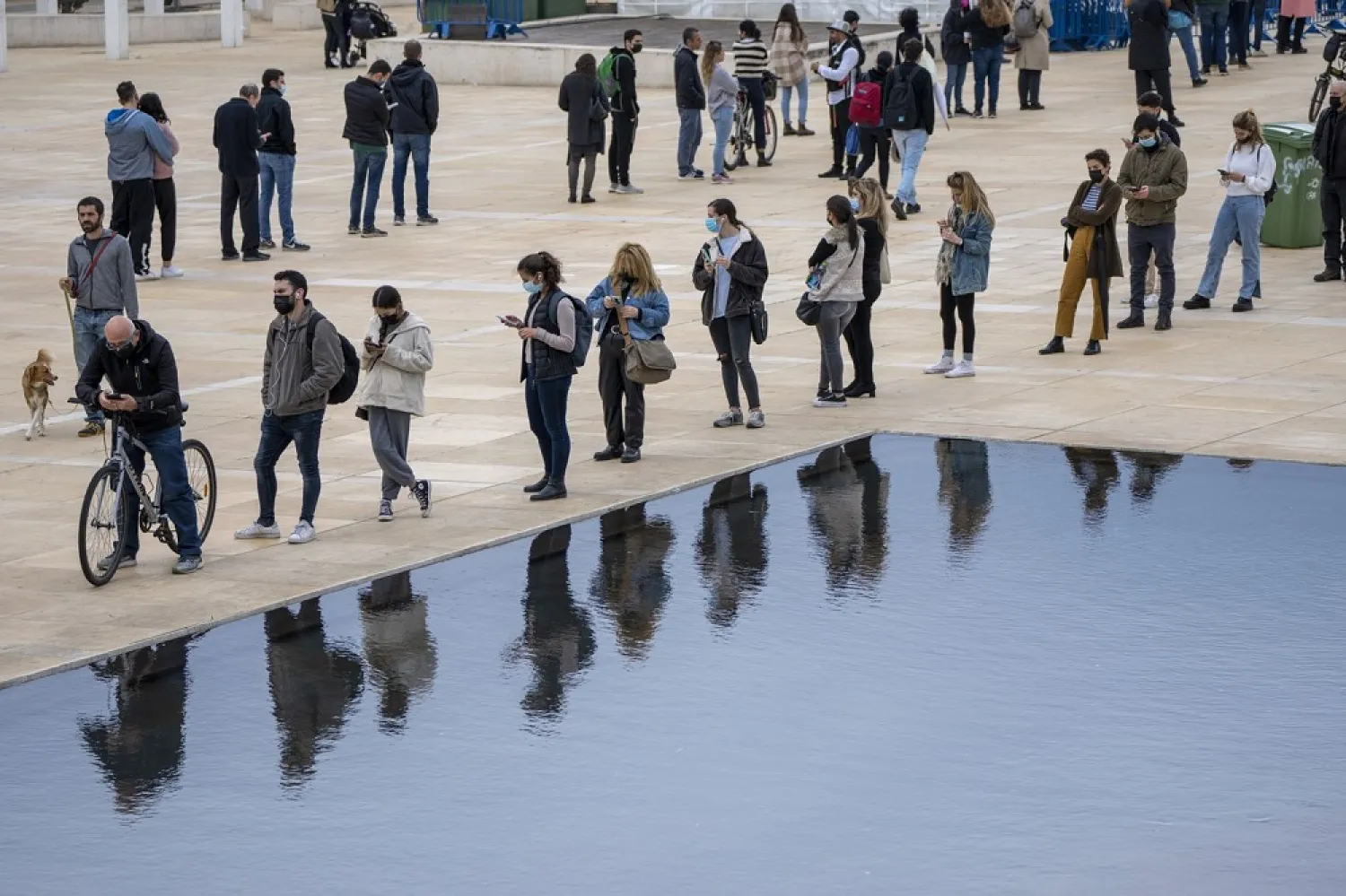
People, some wearing protective face masks, line up for PCR and Rapid Antigen COVID-19 coronavirus tests in Tel Aviv, Israel, Tuesday, Jan. 4, 2022. (AP)
TT

Israel Sets COVID-19 Record amid Zigzag Policy and 4th Jab

People, some wearing protective face masks, line up for PCR and Rapid Antigen COVID-19 coronavirus tests in Tel Aviv, Israel, Tuesday, Jan. 4, 2022. (AP)

Israel opened to tourists for the first time in nearly two years. After just a month, it slammed shut. Now the omicron variant has set a widely-expected record for new infections in the country, which will once again crack open on Sunday — but only to travelers from certain nations.

The back-and-forth has created whiplash for many Israelis. Even in the relatively small, wealthy Mideast nation - an early global leader against the coronavirus pandemic - the omicron variant is outpacing the government's ability to make and execute clear pandemic public policy. What once was a straightforward regimen of vaccines, testing, contact tracing and distancing for the nation of 9.4 million has splintered into a zigzag of rules that seem to change every few days.

The confusion here, on everything from tourism to testing, quarantines, masks and school policy, offers a glimpse of the pandemic puzzle facing governments worldwide as the omicron variant burns through the population. Someday, the World Heath Organization will declare the pandemic over. But in the meantime, leaders are weighing how much illness, isolation and death people are willing to risk.

In Israel as elsewhere, what's clear is that the ultra-contagious omicron variant has pushed the fight against COVID-19 into a messier phase of rules governed by a key assumption: Large portions of the public will contract the omicron version, which is more contagious but appears to cause less severe illness and death, especially among vaccinated people. But vaccinated people are catching the variant too, driving a surge fed in part by gatherings over the winter holidays.

On Wednesday, the government reported a record for the pandemic in Israel, with 11,978 new infections a day earlier. That beats the previous high of 11,345 infections in a single day set on Sept. 2 during the delta variant wave.

“There is no control of the omicron wave,” said Sharon Alroy-Preis, the Health Ministry’s top public health official on Israel’s Channel 13 this week.

“Probably no one is protected from infection,” said Jonathan Halevy, president of Shaare Zedek Medical Center in Jerusalem on Tuesday.

The new goal is to protect society's most vulnerable people without another national lockdown — the red line Prime Minister Naftali Bennett and the country's seven-month-old government are laboring to avoid.

“It’s a different ballgame altogether,” Bennett said during a press conference Sunday as he warned that the number of daily infections is expected to soar to new records in the coming weeks.

“We must keep our eye on the ball if we want to continue engaging and working with an open country as much as possible,” he added.

In everyday life, that's meant a morass of confusion as Bennett and the coalition government he leads struggle to agree on rules and communicate their decisions to the public.

“Education Ministry Leaves Principals to Contend With COVID-19 Chaos Alone,” blared a headline in the Haaretz daily Tuesday. A lack of national guidance, the story said, is forcing some school principals to decide on their own whether to hold classes in person, remotely or some combination.

Bennett at the press conference argued the government was staying agile in the face of the more challenging variant. This included a government decision, after some back-and-forth, to give a fourth vaccination to the immuno-compromised and people at least age 60. Israel is believed to be the first country in the world to offer segments of its population a second booster shot.

On Tuesday, Bennett announced that a preliminary study at Sheba Medical Center found the fourth jab produced a five-fold increase in antibodies in the blood. Israel also is on the cusp of making available drugs that could help people in at-risk groups avoid severe infections.

"Most ministries are working together now better than they were under the old government," led by divisive former Prime Minister Benjamin Netanyahu, said Dr. Nadav Davidovich, who heads Ben-Gurion University's school of public health and sits on the national advisory committee on coronavirus.

So the government's decision, for example, to shutter Israel's borders in late November bought time to raise the country's vaccination rates, which rose toward the middle and end of the month. It also allowed hospitals to prepare for a likely wave of illness.

The vaccinated population has been steadily on the rise, but is limited in part by ultra-Orthodox Jews and some Arabs who have been slow to roll up their sleeves. About 63% of people in Israel have been vaccinated twice, while around 46% have received three jabs.

Our World in Data ranks Israel 17th in the world for vaccination rates, behind other wealthy nations like the United Arab Emirates and the United States — and just ahead of archrival Iran. Back in June, Israel was No. 1 on the list.

But it's been clear for days that a new wave has arrived. Government data showed new infections in Israel spiking to 10,815 on Monday, some 7,000 more than a week earlier. Severe illnesses have stayed mostly constant for several months and daily deaths from coronavirus have not exceeded two since Dec. 13, government records show.

Still, the process remains messy and confusing given the variant's fast-moving spread.

Quarantines that two weeks ago were required of anyone who might have been exposed to the virus are being scaled back in order to prevent the economy from grinding to a halt.

Contact tracing has become more complicated given the shortage of tests. The government also plans on tightening requirements for testing to ease the burden on overloaded testing stations, where people have been forced to wait for hours to be checked. New rules are expected soon that will focus testing requirements on high-risk groups, such as older people.

Israel's list of countries whose tourists are banned has been scaled back, with the Health Ministry on Monday recommending that Canada, France, South Africa, Hungary, Nigeria, Spain and Portugal be removed.

Travel to and from the United States and United Kingdom remains forbidden.

There's been considerable hand-wringing over any suggestion of “herd immunity” — when enough people have either been vaccinated or recovered from a past infection to stop the virus' uncontrolled spread.

Israel's health chief, Nachman Ash, said the fourth shot could be offered to more Israelis, but it's not certain whether it could be rolled out quickly enough.

“The price of herd immunity is very many infections, and that may end up happening,” Ash told Radio 103FM on Sunday. “But we don’t want to reach it by means of infections.”

Challenged at Sunday's press conference over charges of flip-flopping, Bennett said he understands the frustration and confusion, but suggested the virus offers limited choices.

“We could have opted for the strategy that other countries chose, and that’s to impose a lockdown ... that's what happened last year, with enormous damage,” he replied. Or, “We could have gone with it and done nothing.”

Instead, he said, “We are deciding to take responsibility, to make decisions, even if they’re hard."



Turkish, Greek Leaders Voice Desire to Resolve Issues After Talks

In this photo released by the Turkish Presidency, Türkiye’s President Recep Tayyip Erdogan, right, and Greece's Prime Minister Kyriakos Mitsotakis, shake hands during their meeting in Ankara, Türkiye, Wednesday, Feb. 11, 2026. (Turkish Presidency via AP)
TT

Turkish, Greek Leaders Voice Desire to Resolve Issues After Talks

In this photo released by the Turkish Presidency, Türkiye’s President Recep Tayyip Erdogan, right, and Greece's Prime Minister Kyriakos Mitsotakis, shake hands during their meeting in Ankara, Türkiye, Wednesday, Feb. 11, 2026. (Turkish Presidency via AP)

The leaders of Türkiye and Greece voiced their desire to resolve longstanding maritime disputes hobbling ties during discussions in Ankara on Wednesday, as the NATO allies and historic rivals try to build on warming relations.

The neighbors have been at odds over a range of issues for decades, primarily maritime boundaries and rights in the Aegean, an area widely believed to hold energy resources and with key implications for airspace and military activity.

Following years of heightened tensions, a 2023 declaration on friendly relations prompted a thaw in rhetoric, though their maritime issues have remained unresolved and the two sides still disagree over ‌regional matters.

Speaking at ‌a press conference in Ankara with Greek Prime Minister Kyriakos Mitsotakis, ‌Turkish ⁠President Recep Tayyip Erdogan said ⁠they had discussed their issues in the Aegean and eastern Mediterranean "in an open and sincere way" during the talks.

"While the issues may be thorny, they are not unsolvable on the basis of international law. I saw that we were in agreement with my friend Kyriakos," Erdogan said.

He added that the two countries would continue working to achieve their goal of reaching $10 billion in bilateral trade.

Mitsotakis said he hoped circumstances would allow the sides to solve a dispute on ⁠the demarcation of maritime and exclusive economic zones in the Aegean ‌and eastern Mediterranean.

'IF NOT NOW, WHEN?'

"It is time to ‌remove any substantial and formal threats to our relations, if not now, when?" Mitsotakis said.

"Destiny has ‌appointed us to live in the same neighborhood. We cannot change geography, but we can ‌make it an ally, choosing convergence, dialogue and trust in international law... to build a future of peace, progress and prosperity for our people."

Despite the positive tone, Greece's foreign minister earlier said Athens planned to extend its territorial waters further, including potentially in the Aegean.

Shortly after, Ankara said it had issued ‌a maritime notice urging Greece to coordinate research activities in areas of the Aegean that Türkiye considers part of its continental shelf.

In ⁠1995, Türkiye’s parliament ⁠declared a casus belli — a cause for war — should Greece unilaterally extend its territorial waters beyond six nautical miles in the Aegean, a stance Athens says violates international maritime law. Greece says it wants only to discuss demarcation of maritime zones.

Mitsotakis also said the flows of migrants in the Aegean Sea had decreased by almost 60% last year due to cooperation between the two countries, adding this should be strengthened.

Fifteen migrants died in a shipwreck off the Greek island of Chios last week after their boat collided with a Greek coastguard vessel and sank in the Aegean Sea off the Turkish coast.

Türkiye is a transit country for migrants seeking to reach the European Union via Greece. Ankara says the EU has not fully delivered on commitments under a 2016 migration deal and Athens wants Türkiye to do more to curb irregular crossings.


US Energy Secretary in Venezuela for Oil Talks

Handout picture released by the US Embassy in Venezuela showing US Secretary of Energy Chris Wright (2-R) walking next to the new head of the United States diplomatic mission for Venezuela, Laura Dogu (2-L), upon his arrival at Maiquetia International Airport in Maiquetia, La Guaira state, Venezuela, on February 11, 2026. (Handout / US Embassy in Venezuela / AFP)
TT

US Energy Secretary in Venezuela for Oil Talks

Handout picture released by the US Embassy in Venezuela showing US Secretary of Energy Chris Wright (2-R) walking next to the new head of the United States diplomatic mission for Venezuela, Laura Dogu (2-L), upon his arrival at Maiquetia International Airport in Maiquetia, La Guaira state, Venezuela, on February 11, 2026. (Handout / US Embassy in Venezuela / AFP)

US Energy Secretary Chris Wright arrived in Venezuela on Wednesday for talks with acting president Delcy Rodriguez and oil industry executives on harnessing the country's vast crude reserves.

Wright is the highest-ranking official in the administration of US President Donald Trump to travel to Venezuela since US special forces seized and overthrew longtime socialist leader Nicolas Maduro on January 3.

Trump has backed Maduro's former deputy Rodriguez to succeed the ousted leader, on condition that she abide by US demands, including granting the United States access to Venezuelan oil and ease state repression.

Welcoming Wright to Venezuela on X, the US embassy in the country said: "Your visit is key to advancing @POTUS's (Trump's) vision of a prosperous Venezuela."

It added that "the US private sector will be essential to boost the oil sector, modernize the electric grid, and unlock Venezuela's enormous potential."

A photo posted by the embassy showed Wright on the tarmac at Maiquetia International Airport, which serves the capital Caracas, together with the new US charge d'affaires in Venezuela, Laura Dogu.

Venezuela sits on about a fifth of the world's oil reserves and was once a major crude supplier to the United States.

But it produced only around one percent of the world's total crude output in 2024, according to OPEC, due to years of under-investment, mismanagement and US sanctions.

Washington eased sanctions on Venezuelan oil last month after Rodriguez's administration passed a law throwing open the sector to private investment.

Trump wants US oil majors to rapidly rebuild the sector and boost output by millions of barrels a day.


Trump Meets Netanyahu, with US-Iran Nuclear Diplomacy Topping Agenda

 President Donald Trump shakes hands with Israel's Prime Minister Benjamin Netanyahu at the end of a news conference at Mar-a-Lago, Dec. 29, 2025, in Palm Beach, Fla. (AP)
President Donald Trump shakes hands with Israel's Prime Minister Benjamin Netanyahu at the end of a news conference at Mar-a-Lago, Dec. 29, 2025, in Palm Beach, Fla. (AP)
TT

Trump Meets Netanyahu, with US-Iran Nuclear Diplomacy Topping Agenda

 President Donald Trump shakes hands with Israel's Prime Minister Benjamin Netanyahu at the end of a news conference at Mar-a-Lago, Dec. 29, 2025, in Palm Beach, Fla. (AP)
President Donald Trump shakes hands with Israel's Prime Minister Benjamin Netanyahu at the end of a news conference at Mar-a-Lago, Dec. 29, 2025, in Palm Beach, Fla. (AP)

President Donald Trump hosted Benjamin Netanyahu at the White House on Wednesday, with the Israeli prime minister expected to press him to widen US talks with Iran to include limits on Tehran's missile arsenal and other security threats beyond its nuclear program.

In his seventh meeting with Trump since the president returned to office nearly 13 months ago, Netanyahu was looking to influence the next round of US discussions with Iran following nuclear negotiations held in Oman last Friday.

Trump has threatened strikes on Iran if no agreement is reached, while Tehran has vowed to retaliate, stoking fears of a wider war. He has repeatedly voiced support for a secure Israel, a longstanding US ally and arch-foe of Iran.

In media interviews on Tuesday, Trump reiterated his warning, saying that while he believes Iran wants a deal, he would do "something very tough" if it refused.

TRUMP SAYS NO TO IRANIAN NUCLEAR WEAPONS, MISSILES

Trump told Fox Business that a good deal with Iran would mean "no nuclear weapons, no missiles," without elaborating. He also told Axios he was considering sending a second aircraft carrier ‌strike group as part ‌of a major US buildup near Iran.

Israel fears that the US might pursue a narrow ‌nuclear deal ⁠that does not ⁠include restrictions on Iran's ballistic missile program or an end to Iranian support for armed proxies such as Hamas and Hezbollah, according to people familiar with the matter. Israeli officials have urged the US not to trust Iran's promises.

"I will present to the president our perceptions of the principles in the negotiations," Netanyahu told reporters before departing for the US. The two leaders could also discuss potential military action if diplomacy with Iran fails, one source said.

Iran has said it is prepared to discuss curbs on its nuclear program in exchange for lifting sanctions but has ruled out linking the issue to missiles.

Iran’s "missile capabilities are non-negotiable," Ali Shamkhani, an adviser to Iran's supreme leader, said on Wednesday.

Netanyahu's arrival at the White House was lower-key than usual. He entered the building away ⁠from the view of reporters and cameras, and a White House official then confirmed he was inside ‌meeting with Trump.

GAZA ON THE AGENDA

Also on the agenda was Gaza, with Trump looking to ‌push ahead with a ceasefire agreement he helped to broker. Progress on his 20-point plan to end the war and rebuild the shattered Palestinian enclave has stalled, ‌with major gaps over steps such as Hamas disarming as Israeli troops withdraw in phases.

Netanyahu's visit, originally scheduled for February 18, was brought forward ‌amid renewed US engagement with Iran. Both sides at last week's Oman meeting said the talks were positive and further talks were expected soon.

US Secretary of State Marco Rubio said ahead of the Oman meeting that negotiations would need to address Iran's missiles, its proxy groups, and its treatment of its own population. Iran said Friday’s talks focused only on nuclear issues.

Trump has been vague about broadening the negotiations. He was quoted as telling Axios on Tuesday that it was a "no-brainer" ‌for any deal to cover Iran's nuclear program, but that he also thought it possible to address its missile stockpiles.

Iran says its nuclear activities are for peaceful purposes, while the US and Israel have ⁠accused it of past efforts to develop ⁠nuclear weapons.

Last June, the US joined Israel's strikes on Iranian nuclear facilities during a 12-day war.

Israel also heavily damaged Iran's air defenses and missile arsenal. Two Israeli officials say there are signs Iran is working to restore those capabilities.

Trump threatened last month to intervene militarily during a bloody crackdown on anti-government protests in Iran, but ultimately held off.

ISRAEL WARY OF A WEAKENED IRAN REBUILDING

Tehran's regional influence has been weakened by Israel’s June attack, losses suffered by its proxies in Gaza, Lebanon, Yemen and Iraq, and the ousting of its ally, former Syrian President Bashar al-Assad.

But Israel is wary of its adversaries rebuilding after the multi-front war triggered by Hamas' October 2023 assault on southern Israel.

While Trump and Netanyahu have mostly been in sync and the US remains Israel's main arms supplier, Wednesday’s meeting could expose tensions.

Part of Trump's Gaza plan holds out the prospect for eventual Palestinian statehood - which Netanyahu and his coalition, the most far-right in Israel's history, have long resisted.

Netanyahu's security cabinet on Sunday authorized steps that would make it easier for Israeli settlers in the occupied West Bank to buy land while granting Israel broader powers in what the Palestinians see as the heartland of a future state. The decision drew international condemnation.

"I am against annexation," Trump told Axios, reiterating his stance. "We have enough things to think about now."