


Kazakh President Fires Powerful Security Chief amid Worst Unrest in Decade

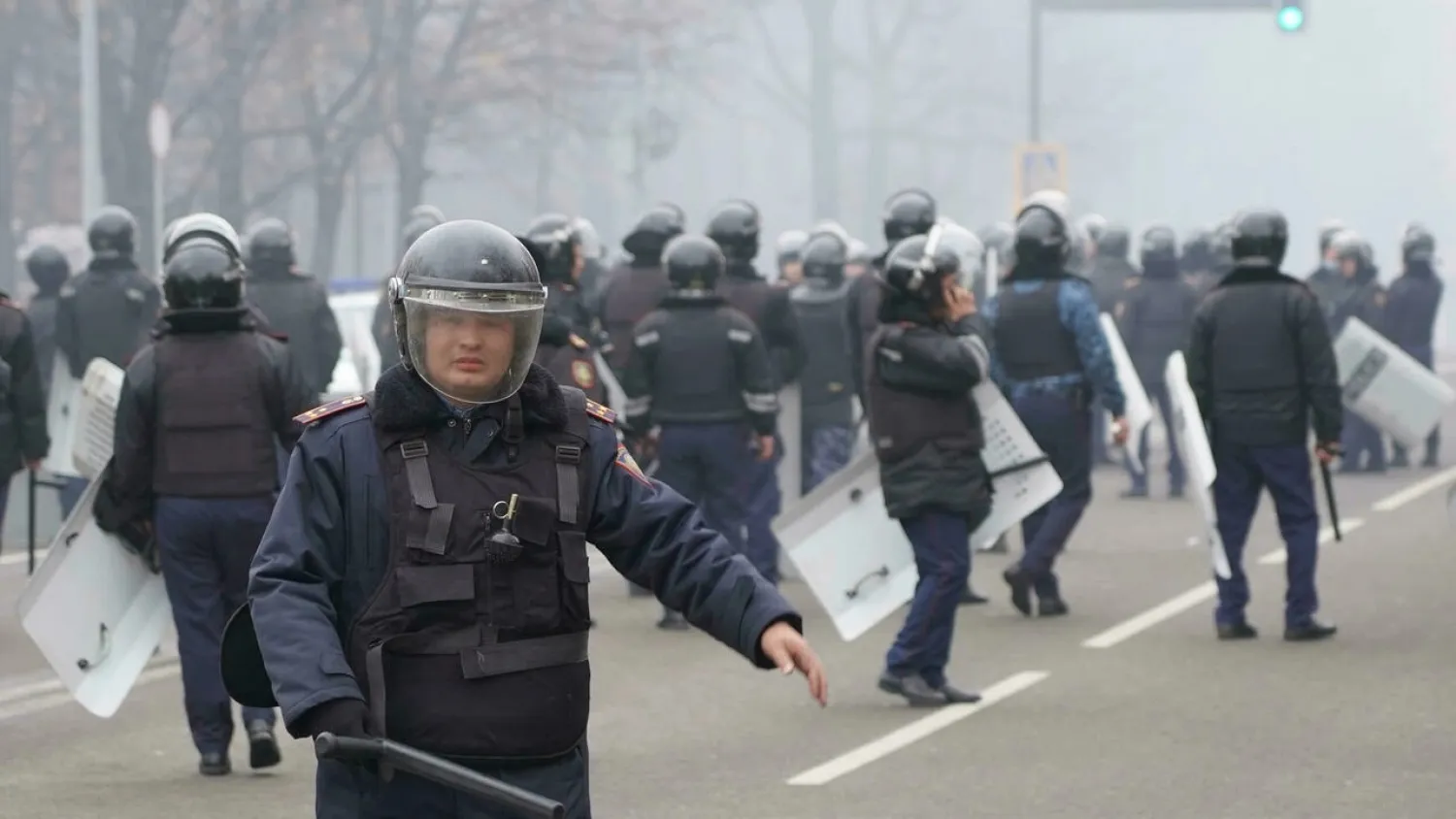
 Police fired stun grenades and tear gas at a crowd of several thousand protesters in Almaty. (AFP)
Police fired stun grenades and tear gas at a crowd of several thousand protesters in Almaty. (AFP)
TT

Kazakh President Fires Powerful Security Chief amid Worst Unrest in Decade

 Police fired stun grenades and tear gas at a crowd of several thousand protesters in Almaty. (AFP)
Police fired stun grenades and tear gas at a crowd of several thousand protesters in Almaty. (AFP)

Kazakhstan's president fired the powerful head of the country's security council on Wednesday in an attempt to calm the worst unrest to rock the Central Asian nation for more than a decade.

Protesters, initially angered by a New Year's Day fuel price rise, have stormed and torched public buildings and chanted slogans against security chief Nursultan Nazarbayev, who has retained wide authority despite stepping down as president in 2019 after nearly three decades at the helm.

The cabinet also resigned on Wednesday, but that failed to quell the demonstrations, which have quickly come to encompass wider political demands beyond gas prices.

The protesters seized control of the airport in Almaty, Kazakhstan's biggest city, a source familiar with the matter told Reuters. All flights to and from Almaty were temporarily canceled, the source said.

Earlier, riot police used teargas and flash grenades against the protesters but then appeared to abandon some streets in Almaty, witnesses said.

Both the United States and Russia appealed for calm.

Nazarbayev's hand-chosen successor as president, Kassym-Jomart Tokayev, said in a national televised address that he had taken over as head of the State Security Committee, a post that had been retained by Nazarbayev.

The 81-year-old former president has still been widely seen as the main political force in Nur-Sultan, the purpose-built capital which bears his name. His family is believed to control much of the Kazakh economy, the largest in Central Asia.

In his TV address, Tokayev did not mention his predecessor by name. Nazarbayev has not been seen or heard from since the protests began.

Tokayev also removed Nazarbayev's nephew as No. 2 at the State Security Committee, successor to the Soviet-era KGB.

'Complete anarchy'

A resident of Almaty who mingled with the protesters on Wednesday said most of those he met appeared to come from the city's impoverished outskirts or nearby villages and towns.

At the main square, vodka was being distributed and some people were discussing whether to head towards the city bazaar or a wealthy residential area for possible looting, the resident said.

"There is complete anarchy in the street. Police are nowhere to be seen," he said.

Footage posted on the internet showed protesters chanting below a giant bronze statue of Nazarbayev, strung with ropes in an apparent attempt to pull it down. A woman who posted it to Twitter said it was filmed in the eastern city of Taldykorgan.

Earlier, an Instagram live stream by a Kazakh blogger had shown a fire blazing in the office of the Almaty mayor, with apparent gunshots audible. Videos posted online also showed the nearby prosecutor's office burning.

Early on Wednesday, Reuters journalists had seen thousands of protesters pressing towards Almaty city center, some of them on a large truck. The city's police chief said Almaty was under attack by "extremists and radicals."

States of emergency were declared in Nur-Sultan, Almaty, and westerly Mangistau province. The internet was shut down in what monitoring site Netblocks called "a nation-scale internet blackout."

Though the unrest was triggered by a fuel price rise, crowds expressed clear anger at Nazarbayev's continued influence.

'Old man, go away'

In the city of Aqtobe, what appeared to be several hundred protesters gathered on a square shouting: "Old Man, go away!." A video posted online showed police using water cannon and stun grenades against protesters near the mayor's office there.

After accepting the cabinet's resignation, Tokayev ordered acting ministers to reverse the fuel price rise, which doubled the cost of liquefied petroleum gas from the start of the year. The gas is widely used to power vehicles in Kazakhstan where official prices had made it much cheaper than gasoline.

The unrest saw the price of Kazakhstan's dollar bonds plunge by nearly 6 cents, the worst showing since the height of the market collapse of 2020 after the start of the COVID-19 pandemic.

Kazakhstan's reputation for stability under Nazarbayev helped attract hundreds of billions of dollars of foreign investment in its oil and metals industries. But political analysts said a younger generation was demanding the liberalization seen in other former Soviet states.

"I think there is an underlying undercurrent of frustrations in Kazakhstan over the lack of democracy," said Tim Ash, emerging market strategist at BlueBay Asset Management.

"Young, internet-savvy Kazakhs, especially in Almaty, likely want similar freedoms as Ukrainians, Georgians, Moldovans, Kyrgyz and Armenians, who have also vented their frustrations over the years with authoritarian regimes."

The unrest was the worst in Kazakhstan at least since 2011, when at least 14 protesters were killed by police during a strike by oil workers in the western city of Zhanaozen.

The Kremlin said it expected Kazakhstan, a close ally of Russia, to quickly resolve its internal problems, warning other countries against interfering.

Expressing concern over the situation, White House press secretary Jen Psaki said Russian accusations that the United States had instigated the unrest were "absolutely false."

Kazakhstan has been grappling with rising price pressures. Inflation was closing in on 9% year-on-year late last year - its highest in more than five years - forcing the central bank to raise interest rates to 9.75%.



US Military Says It Destroyed 2 Small Iranian Boats Trying to Steal a Drone

A US Navy sailor walks across the flight deck of the USS George Washington in the Arabian Sea, September 11, 2026. (Reuters)
TT

US Military Says It Destroyed 2 Small Iranian Boats Trying to Steal a Drone

A US Navy sailor walks across the flight deck of the USS George Washington in the Arabian Sea, September 11, 2026. (Reuters)

The US military said Tuesday that it opened fire and destroyed two small Iranian boats this week trying to steal a drone ship in the waters off Iran.

Capt. Tim Hawkins, US Central Command spokesman said that “Iranian small boats recently attempted to take possession of a US unmanned surface vessel, but they were unsuccessful after CENTCOM forcefully responded."

Iranian state media reported Monday that a pair of fishing boats came under attack in Hormozgan province on Iran’s southern coast and that several fishermen were reported missing, citing a provincial official.

It is the latest volley of fire in the more than six-month-old war as both sides seek control over the Strait of Hormuz, where the US has succeeded in recent weeks in loosening Iran’s grip over the critical energy shipping corridor. But the impact of the unpopular conflict has driven up the cost of oil and gasoline prices, posing political problems for President Donald Trump and his Republican Party.

Hawkins said Tuesday that the drone involved is a “Saildrone” — a small, roughly 25-foot (8-meter) craft — that can operate by itself. US Central Command has been using them in the region for several years to surveil maritime traffic.

Hawkins said all of the command’s surface drones “remain fully accounted for.” The military has long asserted that the technology on the Saildrones is commercially available and not sensitive in nature.

The latest drone incident, which was reported earlier by Axios, comes a week after Iranian state television reported that the country's navy captured one of the US military’s underwater drones at the entrance to the Strait of Hormuz.

Hawkins said then that an Anduril Dive-LD drone had malfunctioned while it was surveying the waters in the region and that the US military no longer had possession of it.

He stressed that the drone was defective and noted that it was also an “older model that neither collected sensitive data no carried any classified sonar or radar equipment.”


UK, US and Netherlands Issue Advisory on Iran-Linked Spyware

Iranians walk past a wall decorated with the image of assassinated Iranian supreme leader Ali Khamenei and the national flag, in central of Tehran on September 14, 2026. (AFP)
TT

UK, US and Netherlands Issue Advisory on Iran-Linked Spyware

Iranians walk past a wall decorated with the image of assassinated Iranian supreme leader Ali Khamenei and the national flag, in central of Tehran on September 14, 2026. (AFP)

Britain, the United States and the Netherlands on Tuesday issued a joint cybersecurity advisory detailing spyware they say is used by Iranian state-linked actors to target dissidents, activists and journalists.

Britain's National Cyber Security Centre said Iranian state-linked cyber actors had used a spyware family known as "CHOSEN ‌BRICK" to steal ‌emails, messages and other ‌sensitive information ⁠through "spear-phishing" campaigns on ⁠messaging platforms including WhatsApp and Telegram.

"The details of this cyber campaign reveal how Iran ruthlessly uses digital surveillance in pursuit of its aim to repress critics of the regime, stealing emails and messages and accessing ⁠devices," Paul Chichester, NCSC Director of Operations, ‌said in ‌a statement.

Iran's embassy in London did not immediately ‌respond to a request for comment.

The malware, ‌according to the advisory, can collect information from contact lists, emails and social media accounts, capture screen content and access a device's microphone. ‌The NCSC said some victims' personal details had later appeared on pro-Iranian ⁠leak ⁠sites.

The NCSC said the attackers often posed as trusted contacts on messaging apps and tailored their approach to individual targets. In some cases, it said, they used fake documents, including fabricated MRI test results, to persuade victims to download the malware.

The NCSC, alongside the FBI and the Netherlands' AIVD intelligence service, said Iran "almost certainly" uses cyber operations to help suppress people it sees as threats.


EU Must Impose ‘Greater Cost’ on Russia to Curb ‘Hybrid Attacks’, Says Kallas

High Representative of the European Union for Foreign Affairs and Security Policy Kaja Kallas speaks during a debate on the "Urgent need for EU support to Ukraine against Russia’s escalation of its war of aggression" at the European Parliament in Strasbourg, France, 15 September 2026. (EPA)
TT

EU Must Impose ‘Greater Cost’ on Russia to Curb ‘Hybrid Attacks’, Says Kallas

High Representative of the European Union for Foreign Affairs and Security Policy Kaja Kallas speaks during a debate on the "Urgent need for EU support to Ukraine against Russia’s escalation of its war of aggression" at the European Parliament in Strasbourg, France, 15 September 2026. (EPA)

The European Union must ramp up measures against the Kremlin, including reviewing the issuance of tourist visas to Russians, to counter Moscow's "hybrid attacks", foreign policy chief Kaja Kallas said Tuesday.

"Despite international efforts to end the war, (Russian President Vladimir) Putin chooses to intensify his war of aggression against Ukraine and hostilities against Europe, and one thing is very clear: Putin will not stop unless he is stopped," Kallas told the European Parliament.

"So, as Russia is willing to take greater risks, Europe must impose a greater cost."

Europe is grappling with what Kallas called a "steady increase in hybrid attacks" by Russia designed to weaken support for Ukraine.

Fears rose over the summer when an explosive-laden drone was discovered at a German airport in an incident Berlin blamed on Moscow.

Beyond ramping up support for Kyiv and sanctioning the Kremlin, Kallas said the EU should look to increase controls on Russians coming into the bloc.

"We can tighten control further over the movement of Russian diplomats within Schengen. We can ban issuing visas for Russian ex-combatants, and we should review the issuance of tourist fissures to Russian citizens," she said.

"We must reduce the pool of people conducting attacks on European soil."

Kallas also urged EU states to better share intelligence and step up the use of artificial intelligence to tackle Russian disinformation.

While the EU eyes more measures, officials admit that the West is struggling to halt actions from Moscow that float in a grey zone beneath open conflict.

"We have all the response options we need when it comes to hybrid. It will not always be visible and public, what we do," NATO chief Mark Rutte said Monday.

"The most important one, of course, is making sure that Ukraine has what it needs to stay in the fight."