


North Korea Says It Tested Hypersonic Missile

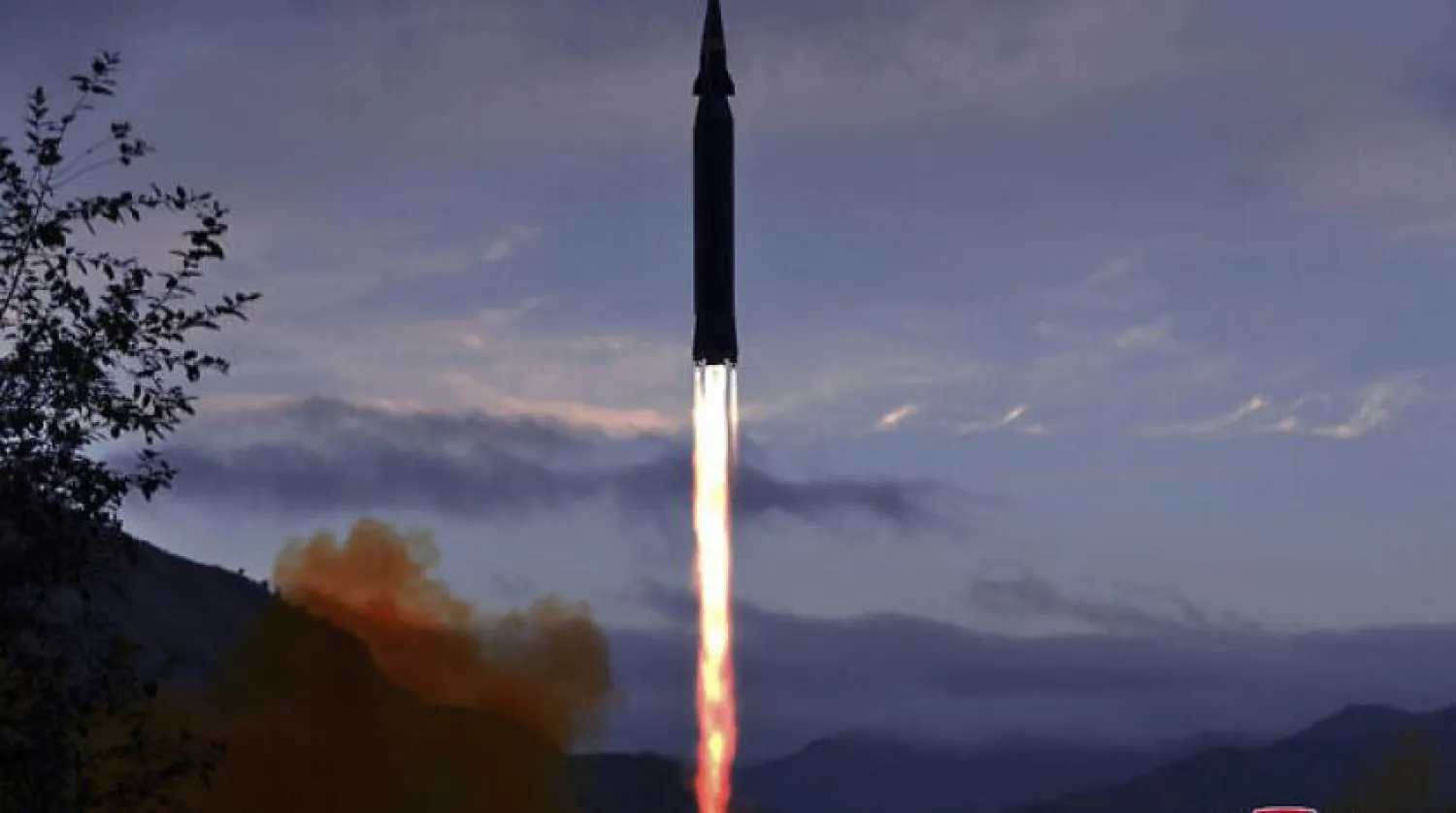
This photo provided by the North Korean government shows what North Korea claims to be a new hypersonic missile launched from Toyang-ri, Ryongrim County, Jagang Province, North Korea, September 28, 2021. (Korean Central News Agency/Korea News Service via AP)
TT

North Korea Says It Tested Hypersonic Missile

This photo provided by the North Korean government shows what North Korea claims to be a new hypersonic missile launched from Toyang-ri, Ryongrim County, Jagang Province, North Korea, September 28, 2021. (Korean Central News Agency/Korea News Service via AP)

North Korea has successfully tested a hypersonic missile, state media reported Thursday, in the first major weapons test by the nuclear-armed nation this year.

This was the second reported test of what Pyongyang claimed were hypersonic gliding missiles, as it pursues the sophisticated technology despite international sanctions and condemnation.

Hypersonic missiles move far faster and are more agile than standard ones, making them much harder for missile defence systems -- on which the United States is spending billions -- to intercept.

The missile fired on Wednesday carried a "hypersonic gliding warhead" that "precisely hit a target 700 km away", the official Korean Central News Agency (KCNA) reported, without identifying the launcher.

The warhead also demonstrated a "new" capability, moving 120 km laterally after it detached from the launcher to strike the target, it added.

"The successive successes in the test launches in the hypersonic missile sector have strategic significance," KCNA said.

Hypersonic missiles were listed among the "top priority" tasks for strategic weapons in North Korea's current five-year plan, and it announced its first test -- of the Hwasong-8 -- in September last year.

The Wednesday launch also tested the "fuel ampoule system under winter weather conditions", according to KCNA.

An ampoule system involves a propellant canister attached to the missile when it is manufactured, and could eliminate the need for fueling it at the launch site.

This offers an advantage over ordinary liquid-fueled missiles, which have to be loaded with propellant on-site just before launch -- a time-consuming process that gives an enemy ample opportunity to locate and destroy them.

- Growing arsenal -
Depending on their design, hypersonic missiles can carry conventional and nuclear warheads, and have the potential to alter the strategic balance. They are generally defined as travelling more than five times the speed of sound, or Mach 5.

The KCNA report did not mention the speed at which the missile travelled on Wednesday, and assessments of its performance from other nations have yet to be released.

"It looks like the North Koreans identified hypersonic gliders as a military requirement (probably because they perceive this to be effective at dealing with BMD)," tweeted Ankit Panda of the US think tank Carnegie Endowment for International Peace, referring to ballistic missile defense.

"We'd need independent, detailed data to assess how effective these missiles actually are, but taking the two North Korean statements about the Hwasong-8 and this missile at face value, this test appears to have gone better" than the one in September, Panda added.

Some experts caution that hypersonic weapons may have only limited advantages, while others warn that if North Korea fully develops the technology, it would pose a serious threat.

In the decade since Kim Jong Un took power, his country has made rapid progress in its military technology, at the cost of international sanctions.

In 2021, in addition to the hypersonic Hwasong-8, Pyongyang said it successfully tested a new type of submarine-launched ballistic missile, a long-range cruise missile, and a train-launched weapon.

- Condemnation -
The United States, Japan and Canada condemned Wednesday's test.

"This launch is in violation of multiple UN Security Council Resolutions and poses a threat to the DPRK's neighbors and the international community," a US State Department spokesperson said, using the official name of North Korea, prior to the KCNA report about a hypersonic test.

Dialogue between Washington and Pyongyang remains stalled, following the collapse of talks between Kim and then US president Donald Trump in 2019.

Under Trump's successor Joe Biden, the United States has repeatedly declared its willingness to meet North Korean representatives, while saying it will seek denuclearization.

But Pyongyang has so far dismissed the offer, accusing Washington of pursuing "hostile" policies. North Korea says it needs its arsenal to defend against a US invasion.



Prime Minister Takaichi’s Party Wins a Supermajority in Japan's Lower House

TOPSHOT - Japan's Prime Minister and President of the Liberal Democratic Party (LDP) Sanae Takaichi reacts as she speaks with media on the House of Representatives election day at the LDP headquarters in Tokyo on February 8, 2026. (Photo by Kim Kyung-Hoon / POOL / AFP)
TT

Prime Minister Takaichi’s Party Wins a Supermajority in Japan's Lower House

TOPSHOT - Japan's Prime Minister and President of the Liberal Democratic Party (LDP) Sanae Takaichi reacts as she speaks with media on the House of Representatives election day at the LDP headquarters in Tokyo on February 8, 2026. (Photo by Kim Kyung-Hoon / POOL / AFP)

Japanese Prime Minister Sanae Takaichi 's governing party secured a two-thirds supermajority in parliamentary elections, Japanese media reported, citing preliminary results. The landslide victory was due, in large part, to the extraordinary popularity of Japan's first female prime minister, and allows her to pursue a significant conservative shift in Japan’s security, immigration and other policies.

Takaichi, in a televised interview with public television network NHK following her victory, said she will emphasize policies meant to make Japan strong and prosperous, The Associated Press said.

NHK, citing vote count results, said Takaichi’s Liberal Democratic Party, or LDP, alone secured 316 seats by early Monday, comfortably surpassing a 261-seat absolute majority in the 465-member lower house, the more powerful of Japan's two-chamber parliament. That marks a record since the party's foundation in 1955 and surpasses the previous record of 300 seats won in 1986 by late Prime Minister Yasuhiro Nakasone.

With 36 seats won by its new ally, Japan Innovation Party, Takaichi's ruling coalition has won 352 seats.

A smiling Takaichi placed a big red ribbon above each winner’s name on a signboard at the LDP's headquarters, as accompanying party executives applauded.

Despite the lack of a majority in the upper house, the huge jump from the preelection share in the superior lower house would allow Takaichi to make progress on a right-wing agenda that aims to boost Japan’s economy and military capabilities as tensions grow with China and she tries to nurture ties with the United States.

Takaichi said she would try to gain support from the opposition while firmly pushing forward with her policy goals.

“I will be flexible,” she said.

Takaichi is popular, but the LDP, which has ruled Japan for most of the last seven decades, has struggled with funding and religious scandals in recent years. She called Sunday’s early election after only three months in office, hoping to turn that around while her popularity is high.

Popular leader

The ultraconservative Takaichi, who took office as Japan’s first female leader in October, pledged to “work, work, work,” and her style, which is seen as both playful and tough, has resonated with younger fans who say they weren't previously interested in politics.

The opposition, despite the formation of a new centrist alliance and a rising far-right, was too splintered to be a real challenger. The new opposition alliance of LDP’s former coalition partner, Buddhist-backed dovish Komeito, and the liberal-leaning Constitutional Democratic Party of Japan, is projected to sink to half of their combined preelection share of 167 seats.

Takaichi was betting with this election that her LDP party, together with its new partner, the JIP, would secure a majority.

Trump in a post on his Truth Social platform Sunday congratulated Takaichi "on a LANDSLIDE Victory in today’s very important Vote. She is a highly respected and very popular Leader. Sanae’s bold and wise decision to call for an Election paid off big time.”

Akihito Iwatake, a 53-year-old office worker, said he welcomed the big win by the LDP because he felt the party went too liberal in the past few years. “With Takaichi shifting things more toward the conservative side, I think that brought this positive result,” he said.

Takaichi's policies

The LDP's right-wing partner, JIP leader Hirofumi Yoshimura, has said his party will serve as an “accelerator” for Takaichi's push to conservative policies.

Japan has recently seen far-right populists gain ground, such as the anti-globalist and surging nationalist party Sanseito. Exit polls projected a big gain for Sanseito.

The first major task for Takaichi when the lower house reconvenes in mid-February is to work on a budget bill, delayed by the election, to fund economic measures that address rising costs and sluggish wages.

Takaichi has pledged to revise security and defense policies by December to bolster Japan’s offensive military capabilities, lifting a ban on weapons exports and moving further away from the country’s postwar pacifist principles.

She has been pushing for tougher policies on foreigners, anti-espionage and other measures that resonate with a far-right audience, but ones that experts say could undermine civil rights.

Takaichi also wants to increase defense spending in response to US President Donald Trump’s pressure for Japan to loosen its purse strings.

She now has time to work on these policies, without an election until 2028.

Divisive policies

Though Takaichi said that she's seeking to win support for policies seen as divisive in Japan, she largely avoided discussing ways to fund soaring military spending, how to fix diplomatic tension with China and other issues.

Despite her rightward shift, Takaichi is expected to maintain good relations with South Korea, given shared worries about threats from North Korea and China. But Seoul would worry about a Japanese attempt to revise the country's pacifist constitution or to further build up its military because of Japan's wartime past, said Leif-Eric Easley, professor of international studies at Ewha Womans University in Seoul.

In her campaign speeches, Takaichi enthusiastically talked about the need for government spending to fund “crisis management investment and growth,” such as measures to strengthen economic security, technology and other industries. Takaichi also seeks to push tougher measures on immigration, including stricter requirements for foreign property owners and a cap on foreign residents.

Sunday's election “underscores a problematic trend in Japanese politics in which political survival takes priority over substantive policy outcomes,” said Masato Kamikubo, a Ritsumeikan University politics professor. “Whenever the government attempts necessary but unpopular reforms ... the next election looms.”


UK PM's Top Aide Quits over Mandelson-Epstein Scandal

FILE PHOTO: British Prime Minister Keir Starmer talks with Britain's ambassador to the United States Peter Mandelson during a welcome reception at the ambassador's residence on February 26, 2025, in Washington, DC, US. Carl Court/Pool via REUTERS/File Photo
TT

UK PM's Top Aide Quits over Mandelson-Epstein Scandal

FILE PHOTO: British Prime Minister Keir Starmer talks with Britain's ambassador to the United States Peter Mandelson during a welcome reception at the ambassador's residence on February 26, 2025, in Washington, DC, US. Carl Court/Pool via REUTERS/File Photo

British Prime Minister Keir Starmer's chief of staff, Morgan McSweeney, quit on Sunday, saying he took responsibility for advising Starmer to name Peter Mandelson as ambassador to the US despite his known links to Jeffrey Epstein.

After new files revealed the depth of the Labour veteran's relationship with the late sex offender, Starmer is facing what is widely seen as the gravest crisis of his 18 months in power over his decision to send Mandelson to Washington in 2024, Reuters reported.

The loss of McSweeney, 48, a strategist who was instrumental in Starmer's rise to power, is the latest in a series of setbacks, less than two years after the Labour Party won one of the largest parliamentary majorities in modern British history.

With polls showing Starmer is hugely unpopular with voters after a series of embarrassing U-turns, some in his own party are openly questioning his judgment and his future, and it remains to be seen whether McSweeney's exit will be enough to silence critics.

The files released in the US on January 30 sparked a police investigation for misconduct in office over indications that Mandelson leaked market-sensitive information to Epstein when he was a government minister during the global financial crisis in 2009 and 2010.

In a statement, McSweeney said: "The decision to ⁠appoint Peter Mandelson was wrong. He has damaged our party, our country and trust in politics itself.
"When asked, I advised the Prime Minister to make that appointment and I take full responsibility for that advice."

The leader of the opposition Conservative Party, Kemi Badenoch, said the resignation was overdue and that "Keir Starmer has to take responsibility for his own terrible decisions".

Nigel Farage, head of the populist Reform UK party, which is leading in the polls, said he believed Starmer's time would soon be up.

Starmer has spent the last week defending McSweeney, a strategy that could prompt further questions about his own judgment. In a statement on Sunday, Starmer said it had been "an honor" working with him.

Many Labour members of parliament had blamed McSweeney for the appointment of Mandelson and the damage caused by the publication of the exchanges between Epstein ⁠and Mandelson. Others have said Starmer must go.

One Labour lawmaker, speaking on condition of anonymity, said McSweeney's resignation had come too late: "It buys the PM time, but it's still the end of days."

Starmer sacked Mandelson as ambassador in September over his links to Epstein.

The government agreed last week to release virtually all previously private communications between members of his government from the time when Mandelson was being appointed.

That release could come as early as this week, creating a new headache for Starmer just as he hopes to move on. If previously secret messages about how London planned to approach its relationship with Donald Trump are made public, it could damage Starmer's relationship with the US President.

McSweeney had held the role of chief of staff since October 2024, when he was handed the job following the resignation of Sue Gray after a row over pay and donations.

Starmer on Sunday appointed his deputy chiefs of staff, Jill Cuthbertson and Vidhya Alakeson, to serve as joint acting chiefs of staff.


Iran Sentences Nobel Laureate Narges Mohammadi to 7 More Years in Prison

(FILES) A handout photo provided by the Narges Mohammadi Foundation on October 2, 2023 shows an undated, unlocated photo of Iranian rights campaigner Narges Mohammadi. (Photo by Handout / NARGES MOHAMMADI FOUNDATION / AFP)
TT

Iran Sentences Nobel Laureate Narges Mohammadi to 7 More Years in Prison

(FILES) A handout photo provided by the Narges Mohammadi Foundation on October 2, 2023 shows an undated, unlocated photo of Iranian rights campaigner Narges Mohammadi. (Photo by Handout / NARGES MOHAMMADI FOUNDATION / AFP)

Iran sentenced Nobel Peace Prize laureate Narges Mohammadi to over seven more years in prison after she began a hunger strike, supporters said Sunday.

Mohammadi’s supporters cited her lawyer, who spoke to Mohammadi.

The lawyer, Mostafa Nili, confirmed the sentence on X, saying it had been handed down Saturday by a Revolutionary Court in the city of Mashhad. Such courts typically issue verdicts with little or no opportunity for defendants to contest their charges.

“She has been sentenced to six years in prison for ‘gathering and collusion’ and one and a half years for propaganda and two-year travel ban,” he wrote, according to The Associated Press.

She received another two years of internal exile to the city of Khosf, some 740 kilometers (460 miles) southeast of Tehran, the capital, the lawyer added.

Supporters say Mohammadi has been on a hunger strike since Feb. 2. She had been arrested in December at a ceremony honoring Khosrow Alikordi, a 46-year-old Iranian lawyer and human rights advocate who had been based in Mashhad. Footage from the demonstration showed her shouting, demanding justice for Alikordi and others.

Supporters had warned for months before her December arrest that Mohammadi, 53, was at risk of being put back into prison after she received a furlough in December 2024 over medical concerns.

While that was to be only three weeks, Mohammadi’s time out of prison lengthened, possibly as activists and Western powers pushed Iran to keep her free. She remained out even during the 12-day war in June between Iran and Israel.

Mohammadi still kept up her activism with public protests and international media appearances, including even demonstrating at one point in front of Tehran’s notorious Evin prison, where she had been held.

Mohammadi had been serving 13 years and nine months on charges of collusion against state security and propaganda against Iran’s government.

She also had backed the nationwide protests sparked by the 2022 death of Mahsa Amini, which have seen women openly defy the government by not wearing the hijab.

Mohammadi suffered multiple heart attacks while imprisoned before undergoing emergency surgery in 2022, her supporters say. Her lawyer in late 2024 revealed doctors had found a bone lesion that they feared could be cancerous that later was removed.

“Considering her illnesses, it is expected that she will be temporarily released on bail so that she can receive treatment,” Nili wrote.

However, Iranian officials have been signaling a harder line against all dissent since the recent demonstrations. Speaking on Sunday, Iranian judiciary chief Gholamhossein Mohseni-Ejei made comments suggesting harsh prison sentences awaited many.

“Look at some individuals who once were with the revolution and accompanied the revolution," he said. "Today, what they are saying, what they are writing, what statements they issue, they are unfortunate, they are forlorn (and) they will face damage.”