


Fresh Violence in Kazakhstan after Russia Sends Troops to Put Down Uprising

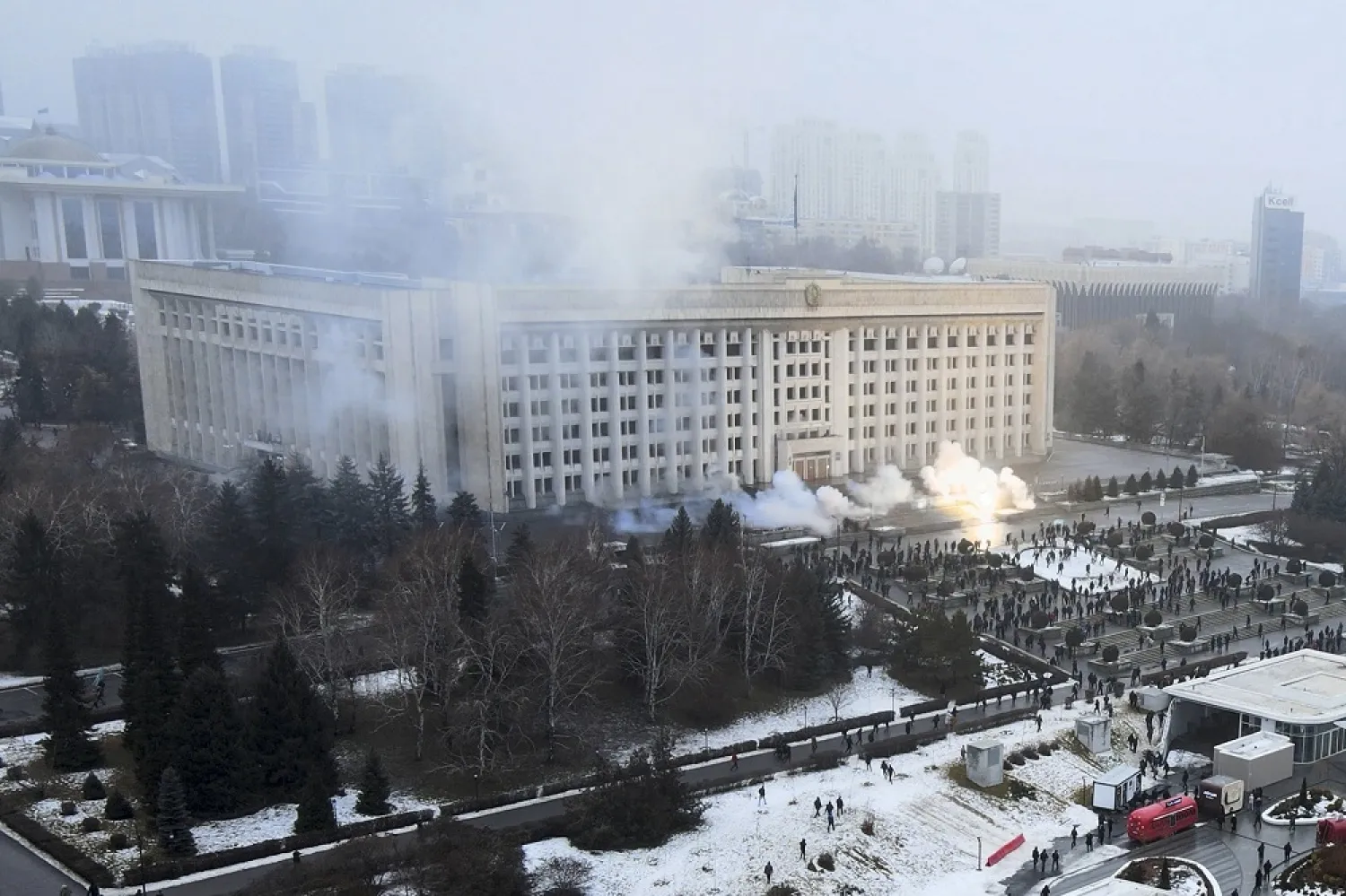
Smoke rises from the city hall building during a protest in Almaty, Kazakhstan, Jan. 5, 2022. (AP)
TT

Fresh Violence in Kazakhstan after Russia Sends Troops to Put Down Uprising

Smoke rises from the city hall building during a protest in Almaty, Kazakhstan, Jan. 5, 2022. (AP)

Fresh violence erupted in Kazakhstan's main city on Thursday after Russia rushed in paratroopers overnight to put down a countrywide uprising in one of Moscow's closest former Soviet allies.

Police in the main city Almaty said they had killed dozens of rioters overnight. The authorities said at least 18 members of the security forces had died, including two found decapitated. More than 2,000 people had been arrested.

After a night of running confrontations between protesters and troops on the streets, a presidential residence in the city and its mayor's office were both ablaze, and burnt out cars littered the city, Reuters journalists said.

Military personnel regained control of the main airport, seized earlier by protesters. Thursday evening saw renewed battles in Almaty's main square, occupied alternately by troops and hundreds of protesters throughout much of the day.

The Russian deployment was a gamble by the Kremlin that rapid military force could secure its interests in the oil and uranium-producing Central Asian nation, by swiftly putting down the worst violence in Kazakhstan's 30 years of independence.

Reuters reporters heard explosions and gunfire as military vehicles and scores of soldiers advanced, although the shooting stopped again after nightfall. TASS news agency quoted witnesses as saying people had been killed and wounded in the new gunfire.

Oil production at Kazakhstan's top field Tengiz was reduced on Thursday, its operator Chevron said, as some contractors disrupted train lines in support of the protests.

The internet was shut down across the country, making it impossible to gauge the extent of the unrest. But the violence was unprecedented in a state ruled firmly since Soviet times by leader Nursultan Nazarbayev, 81, who held on to the reins despite stepping down three years ago as president.

'Attack on our citizens'
Nazarbayev's hand-picked successor, President Kassym-Jomart Tokayev, called in the Russian forces overnight as part of a Moscow-led military alliance of ex-Soviet states. He blamed the unrest on foreign-trained terrorists who he said had seized buildings and weapons.

"It is an undermining of the integrity of the state and most importantly it is an attack on our citizens who are asking me... to help them urgently," he said.

Moscow said it would consult with Kazakhstan and allies on steps to support the Kazakh "counter-terrorist operation" and repeated Tokayev's assertion that the uprising was foreign-inspired. Neither Kazakhstan nor Russia provided evidence to support that.

Moscow did not disclose how many troops it was sending or what role they were playing, and it was not possible to determine the extent to which Russians may have been involved in Thursday's unrest.

The uprising, which began as protests against a New Year's Day fuel price hike, swelled on Wednesday, when protesters chanting slogans against Nazarbayev stormed and torched public buildings in Almaty and other cities.

Tokayev initially responded by dismissing his cabinet, reversing the fuel price rise and distancing himself from his predecessor, including by taking over a powerful security post Nazarbayev had retained. But those moves failed to mollify crowds who accuse Nazarbayev's family and allies of amassing vast wealth while the nation of 19 million remained poor.

Nazarbayev stepped aside from the presidency in 2019 as the last Soviet-era Communist Party boss still ruling a former Soviet state. But he and his family kept posts overseeing security forces and the political apparatus in Nur-Sultan, the purpose-built capital bearing his name. He has not been seen or heard from since the unrest began.

'Looters came in'
The swift arrival of Russian troops demonstrated the Kremlin's willingness to safeguard its influence in the ex-Soviet Union with force. Since late 2020, Moscow has shored up the leader of Belarus against a popular uprising, intervened to halt a war between Azerbaijan and Armenia, and, to the West's alarm, massed troops again near Ukraine, which Russia invaded eight years ago.

Deployment in Kazakhstan carries risk: by exposing the Kazakh authorities as dependent on Russian muscle, Moscow could further inflame the protesters.

"They are Kazakhs and Tokayev will try putting them down with Russian troops. That will not look great for Moscow," tweeted economist Tim Ash, who specializes in the region.

But it is difficult to say how broad support might be for protests in a country with little organized opposition, especially if demonstrators are blamed for violence.

"Thank God, the military has arrived, finally," Ali, a manager at Holiday Inn hotel near Almaty's main square, told Reuters by phone. "Looters came in last night, smashing car windows near us."

The West has so far mainly limited its response to calls for calm. US Secretary of State Antony Blinken spoke to his Kazakh counterpart "and advocated for a peaceful, rights-respecting resolution to the crisis", spokesperson Ned Price said.

EU top diplomat Josep Borrell said Russia's military intervention brought "memories of situations to be avoided".

Kazakhstan's long-dated dollar-denominated sovereign bonds have plunged, losing around 7 cents since the start of the week.

Kazakhstan is the top global producer of uranium, which jumped in price by 8% after the unrest.

The country is also the world's second-largest miner of bitcoin. Bitcoin's "hashrate" - the computing power of machines in its network - dropped by over 10% on Wednesday after Kazakhstan's internet was shut off, according to crypto mining firm BTC.com.



Top Trump Iran Negotiator Says Visits US Aircraft Carrier in Middle East

US Special Envoy Steve Witkoff delivers a press conference upon the signing of the declaration on deploying post-ceasefire force in Ukraine, during the so-called "Coalition of the Willing" summit, at the Elysee Palace in Paris, France, January 6, 2026. (Reuters)
TT

Top Trump Iran Negotiator Says Visits US Aircraft Carrier in Middle East

US Special Envoy Steve Witkoff delivers a press conference upon the signing of the declaration on deploying post-ceasefire force in Ukraine, during the so-called "Coalition of the Willing" summit, at the Elysee Palace in Paris, France, January 6, 2026. (Reuters)

US President Donald Trump's lead Iran negotiator Steve Witkoff on Saturday said he visited the USS Abraham Lincoln aircraft carrier currently in the Arabian Sea, with Washington and Tehran due to hold further talks soon.

"Today, Adm. Brad Cooper, Commander of US Naval Forces Central Command, Jared Kushner, and I met with the brave sailors and Marines aboard the USS Abraham Lincoln, her strike group, and Carrier Air Wing 9 who are keeping us safe and upholding President Trump's message of peace through strength," said Witkoff in a social media post.

Iranian Foreign Minister Abbas Araghchi said on Saturday he hoped talks with the United States would resume soon, while reiterating Tehran's red lines and warning against any American attack.


Israel’s Netanyahu Expected to Meet Trump in US on Wednesday and Discuss Iran

Israeli Prime Minister Benjamin Netanyahu delivers a speech during a special session to mark the 77th anniversary of the Knesset's establishment and the 60th anniversary of the dedication of the current building at the Knesset, the Israeli parliament, in Jerusalem, 02 February 2026. (EPA)
TT

Israel’s Netanyahu Expected to Meet Trump in US on Wednesday and Discuss Iran

Israeli Prime Minister Benjamin Netanyahu delivers a speech during a special session to mark the 77th anniversary of the Knesset's establishment and the 60th anniversary of the dedication of the current building at the Knesset, the Israeli parliament, in Jerusalem, 02 February 2026. (EPA)

Israeli Prime Minister Benjamin Netanyahu is expected to meet US President Donald Trump on Wednesday in Washington, where they will discuss negotiations with Iran, Netanyahu's office said on Saturday.

Iranian and US officials held indirect nuclear ‌talks in the ‌Omani capital ‌Muscat ⁠on Friday. ‌Both sides said more talks were expected to be held again soon.

A regional diplomat briefed by Tehran on the talks told Reuters Iran insisted ⁠on its "right to enrich uranium" ‌during the negotiations with ‍the US, ‍and that Tehran's missile capabilities ‍were not raised in the discussions.

Iranian officials have ruled out putting Iran's missiles - one of the largest such arsenals in the region - up ⁠for discussion, and have said Tehran wants recognition of its right to enrich uranium.

"The Prime Minister believes that any negotiations must include limiting ballistic missiles and halting support for the Iranian axis," Netanyahu's office said in a ‌statement.


Italy FM Rules Out Joining Trump’s ‘Board of Peace’

Italy's Minister for Foreign Affairs Antonio Tajani speaks to the press during the EPP Leaders’ meeting, in Zagreb, Croatia, 30 January 2026. (EPA)
TT

Italy FM Rules Out Joining Trump’s ‘Board of Peace’

Italy's Minister for Foreign Affairs Antonio Tajani speaks to the press during the EPP Leaders’ meeting, in Zagreb, Croatia, 30 January 2026. (EPA)

Italy will not take part in US President Donald Trump's "Board of Peace", Italian Foreign Minister Antonio Tajani said Saturday, citing "insurmountable" constitutional issues.

Trump launched his "Board of Peace" at the World Economic Forum in Davos in January and some 19 countries have signed its founding charter.

But Italy's constitution bars the country from joining an organization led by a single foreign leader.

Prime Minister Giorgia Meloni, a Trump ally, last month noted "constitutional problems" with joining, but suggested Trump could perhaps reopen the framework "to meet the needs not only of Italy, but also of other European countries".

Tajani appeared Saturday to rule that out.

"We cannot participate in the Board of Peace because there is a constitutional limit," he told the ANSA news agency.

"This is insurmountable from a legal standpoint," he said, the day after meeting US Secretary of State Marco Rubio and US Vice President JD Vance at the Olympics in Milan.

Although originally meant to oversee Gaza's rebuilding, the board's charter does not limit its role to the Palestinian territory and appears to want to rival the United Nations.