

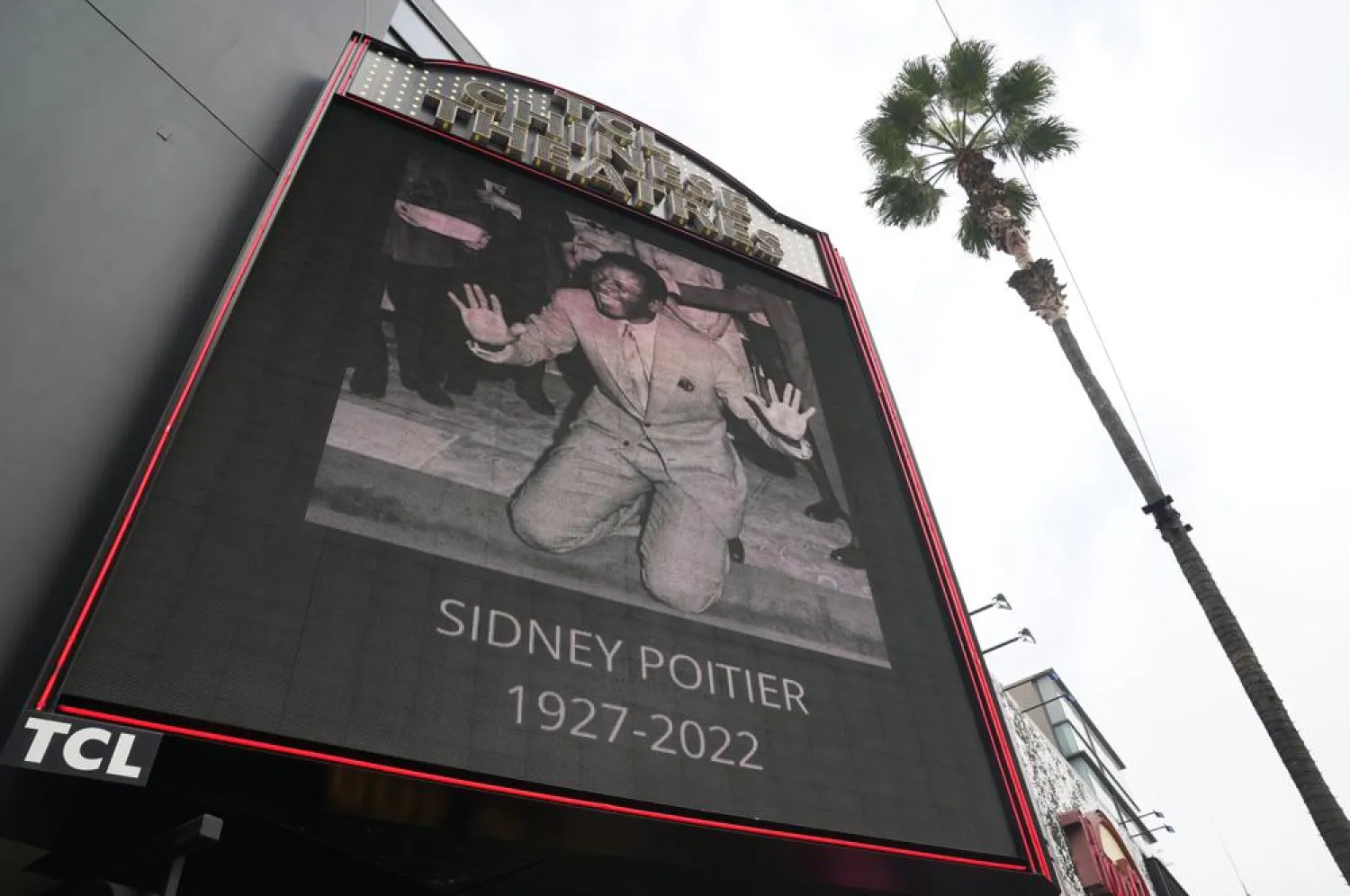

Sidney Poitier Changed Movies, and Changed Lives

The TCL Chinese Theater marquee displays a picture of the late actor Sidney Poitier, Friday, Jan. 7, 2022, in Los Angeles. (AP)
TT

Sidney Poitier Changed Movies, and Changed Lives

The TCL Chinese Theater marquee displays a picture of the late actor Sidney Poitier, Friday, Jan. 7, 2022, in Los Angeles. (AP)

We go to movies not just to escape, but to discover. We might identify with the cowboy or the runaway bride or the kid who befriends a creature from another planet.

To see yourself on screen has long been another way of knowing you exist.

Sidney Poitier, who died Thursday at 94, was the rare performer who really did change lives, who embodied possibilities once absent from the movies. His impact was as profound as Method acting or digital technology, his story inseparable from the story of the country he emigrated to as a teenager.

“What emerges on the screen reminds people of something in themselves, because I’m so many different things,” he wrote in his memoir “The Measure of a Man,” published in 2000. “I’m a network of primal feelings, instinctive emotions that have been wrestled with so long they’re automatic.”

Poitier made Hollywood history, by breaking from the stereotypes of bug-eyed entertainers, and American history, by appearing in films during the 1950s and 1960s that paralleled the growth of the civil rights movement. As segregation laws were challenged and fell, Poitier was the performer to whom a cautious Hollywood turned for stories of progress, a bridge to the growing candor and variety of Black filmmaking today.

He was the escaped Black convict who befriends a racist white prisoner (Tony Curtis) in “The Defiant Ones.” He was the courtly office worker who falls in love with a blind white girl in “A Patch of Blue.” He was the handyman in “Lilies of the Field” who builds a church for a group of nuns. In one of the great roles of stage or screen, he was the ambitious young man whose dreams clashed with those of other family members in Lorraine Hansberry’s “A Raisin in the Sun.”

Poitier not only upended the kinds of movies Hollywood made, but how they were filmed. For decades, Black and white actors had been shot with similar lighting, leading to an unnatural glare in the faces of Black performers. On the 1967 production “In the Heat of the Night,” cinematographer Haskell Wexler adjusted the lighting for Poitier so the actor’s features were as clear as those of white cast members.

The long-running debate over Hollywood diversity often turns to Poitier. With his handsome, flawless face, intense stare and disciplined style, Poitier was for years not just the most popular Black movie star, but the only one; his unique appeal brought him burdens familiar to Jackie Robinson and others who broke color lines. He faced bigotry from whites and accusations of compromise from the Black community. Poitier was held, and held himself, to standards well above his white peers. He refused to play cowards or cads and took on characters, especially in “Guess Who’s Coming to Dinner,” of almost divine goodness. He developed an even, but resolved and occasionally humorous persona crystallized in his most famous line — “They call me Mr. Tibbs!” — from “In the Heat of the Night.”

“All those who see unworthiness when they look at me and are given thereby to denying me value — to you I say, ‘I’m not talking about being as good as you. I hereby declare myself better than you,’” he wrote in “The Measure of a Man.”

In 1964, he became the first Black performer to win the best actor Oscar, for “Lilies of the Field.” He peaked in 1967 with three of the year’s most notable movies: “To Sir, With Love,” in which he starred as a school teacher who wins over his unruly students at a London secondary school; “In the Heat of the Night,” as the determined police detective Virgil Tibbs; and in “Guess Who’s Coming to Dinner,” as the prominent doctor who wishes to marry a young white woman he only recently met, her parents played by Spencer Tracy and Katharine Hepburn in their final film together.

In 2009 President Barack Obama, whose own steady bearing was sometimes compared to Poitier’s, awarded him the Presidential Medal of Freedom, saying that the actor “not only entertained but enlightened ... revealing the power of the silver screen to bring us closer together.”

Poitier was not as engaged politically as his friend and contemporary Harry Belafonte, leading to occasional conflicts between them. But he was active in the 1963 March on Washington for Jobs and Freedom and other civil rights events and even helped deliver tens of thousands of dollars to civil rights volunteers in Mississippi in 1964, around the same time that three workers had been murdered. He also risked his career. He refused to sign loyalty oaths during the 1950s, when Hollywood was blacklisting suspected Communists, and turned down roles he found offensive.

“Almost all the job opportunities were reflective of the stereotypical perception of Blacks that had infected the whole consciousness of the country,” he later told The Associated Press. “I came with an inability to do those things. It just wasn’t in me. I had chosen to use my work as a reflection of my values.”

Poitier’s films were usually about personal triumphs rather than broad political themes, but the classic Poitier role, from “Guess Who’s Coming to Dinner” to “In the Heat of the Night,” seemed to mirror the drama the Rev. Martin Luther King Jr. played out in real life: An eloquent and accomplished Black man — Poitier became synonymous with the word “dignified”— who confronts the whites opposed to him.

But even in his prime, his films were chastised as sentimental and out of touch. He was called an Uncle Tom and a “million-dollar shoeshine boy.” In 1967, The New York Times published Black playwright Clifford Mason’s essay “Why Does White America Love Sidney Poitier So?” Mason dismissed Poitier’s films as “a schizophrenic flight from historical fact” and the actor as a pawn for the “white man’s sense of what’s wrong with the world.”

James Baldwin, in his classic essay on movies “The Devil Finds Work,” helped define the affinity and disillusion that Poitier inspired. He remembered watching “The Defiant Ones” at a Harlem theater and how the audience responded to the train ride at the end, when Poitier’s character decided to imperil his own freedom out of loyalty to Curtis’ character.

“The Harlem audience was outraged, and yelled, ‘Get back on the train, you fool!” Baldwin wrote. “And yet, even at that, recognized in Sidney’s face, at the very end, as he sings ‘Sewing Machine,’ something noble, true, and terrible, something out of which we come.”

In his memoir, Poitier wrote that he didn’t have a responsibility to be “angry and defiant,” even if he often felt those emotions. He noted that such historical figures as King and Nelson Mandela could never have been so forgiving had they not first “gone through much, much anger and much, much resentment and much, much anguish.”

“When these come along, their anger, their rage, their resentment, their frustration — these feelings ultimately mature by will of their own discipline into a positive energy that can be used to fuel their positive, healthy excursions in life,” he wrote.

His screen career faded in the late 1960s as political movements, Black and white, became more radical and movies more explicit. He would tell Oprah Winfrey in 2000 that his response was to go the Bahamas, fish and think. He acted less often, gave fewer interviews and began directing, his credits including the Richard Pryor-Gene Wilder farce “Stir Crazy,” “Buck and the Preacher” (co-starring Poitier and Belafonte) and the comedies “Uptown Saturday Night” and “Let’s Do It Again,” both featuring Bill Cosby.

He continued to work in the 1980s and ’90s. He appeared in the feature films “Sneakers” and “The Jackal” and several television movies, receiving an Emmy and Golden Globe nomination as future Supreme Court Justice Thurgood Marshall in “Separate But Equal” and an Emmy nomination for his portrayal of Mandela in “Mandela and De Klerk.” Theatergoers were reminded of the actor through an acclaimed play that featured him in name only: John Guare’s “Six Degrees of Separation,” about a con artist claiming to be Poitier’s son. A Broadway adaptation of “The Measure of a Man” is in the works.

In recent years, a new generation learned of him through Winfrey, who chose “The Measure of a Man” for her book club, and through the praise of such Black stars as Denzel Washington, Will Smith and Danny Glover. Poitier’s eminence was never more movingly dramatized than at the Academy Awards ceremony in 2002 when he received an honorary Oscar, preceding Washington’s best actor win for “Training Day,” the first time a Black person had won in that category since Poitier nearly 40 years earlier.

“I’ll always be chasing you, Sidney,” Washington said as he accepted his award. “I’ll always be following in your footsteps.”

Poitier’s life ended in adulation, but began in hardship, and nearly ended days after his birth. He was born prematurely in Miami, where his parents had gone to deliver tomatoes from their farm on tiny Cat Island in the Bahamas. He spent his early years on the remote island, which had no paved roads or electricity, but was so free from racial hierarchy that only when he left did he think about the color of his skin.

“Walking on the beach, or sitting on rocks, my eyes on the horizon, aroused curiosity, stirring joy,” he wrote in his 2008 book “Life Beyond Measure: Letters to My Great-Granddaughter” about his time on Cat Island.

By his late teens, he had moved to Harlem, but was so overwhelmed by his first winter there that he enlisted in the Army, cheating on his age and swearing he was 18 when he had yet to turn 17. Assigned to a mental hospital on Long Island, Poitier was appalled at how cruelly the doctors and nurses treated the soldier patients and acknowledged that he got out of the Army by pretending he was insane.

Back in Harlem in the mid-1940s, he was looking in the Amsterdam News for a dishwasher job when he noticed an ad seeking actors at the American Negro Theater. He went there and was handed a script and told to go on the stage and read from it. Poitier had never seen a play and stumbled through his lines in a thick Caribbean accent. The director sent him off.

“As I walked to the bus, what humiliated me was the suggestion that all he could see in me was a dishwasher. If I submitted to him, I would be aiding him in making that perception a prophetic one,” Poitier later told the AP.

“I got so pissed, I said, ‘I’m going to become an actor — whatever that is. I don’t want to be an actor, but I’ve got to become one to go back there and show him that I could be more than a dishwasher.’ That became my goal.”

Poitier’s now-famous cadence and diction came in part through reading and studying the voices he heard on the radio. He found an early job in a student production of “Days Of Our Youth,” as the understudy to another determined young performer: Belafonte. When Belafonte didn’t show up one night, Poitier stepped in and caught the attention of a Broadway director who happened to be in attendance. He was soon in a cross-country touring group — often staying in segregated hotels — and by 1950 had his first notable film role: He played a doctor in an all-white hospital in Joseph Mackiewicz drama “No Way Out.”

Other early films included “Cry, the Beloved Country” and “Blackboard Jungle,” featuring Poitier as a tough high school student, the kind of character he might have had to face down when he starred in “To Sir, With Love.” By the late 1950s, he was one of the industry’s leading performers — of any race. In “The Defiant Ones,” co-star Tony Curtis helped Poitier make history by insisting that his name appear above the title of the movie, as a star, rare status for a Black performer at the time.

By the time he received his Oscar for “Lilies of the Field,” his career and the country were well aligned. Congress was months away from passing the Civil Rights Act of 1964, banning discrimination on the basis of race, and a victory for Poitier was so desired in Hollywood that even one of his Oscar competitors, Paul Newman, was rooting for him.

When presenter Anne Bancroft announced his victory, the audience cheered for so long that Poitier was able to re-remember the speech he briefly forgot. “It has been a long journey to this moment,” he declared.

Poitier never pretended that his Oscar was “a magic wand” for Black performers, as he observed after his victory, and he shared his critics’ frustration with some of the roles he took on. But he also believed himself fortunate and encouraged those who followed him.

Accepting a life achievement award from the American Film Institute in 1992, he spoke to a new generation. “To the young African American filmmakers who have arrived on the playing field, I am filled with pride you are here. I am sure, like me, you have discovered it was never impossible, it was just harder.

“Welcome, young Blacks. Those of us who go before you glance back with satisfaction and leave you with a simple trust: Be true to yourselves and be useful to the journey.”



Nicolas Cage Film Stopped Amid Nazi Flag Concerns

Nicolas Cage is set to star in WWII espionage thriller Operation Fortitude (Getty Images) 
TT

Nicolas Cage Film Stopped Amid Nazi Flag Concerns

Nicolas Cage is set to star in WWII espionage thriller Operation Fortitude (Getty Images) 

The East London council shut down the production of an upcoming war film starring Nicolas Cage due to concerns over Nazi iconography, according to British METRO website.

The American Oscar-winning actor, 62, is due to star in Fortitude, a historical spy action-adventure film directed by Simon West.

Set during the Second World War, the film tells the true story of Operation Fortitude, which was undertaken by the Allied Forces in 1944 to deceive Nazi Germany leaders and mislead Nazi Intelligence.

British Intelligence operatives utilized unprecedented strategic operations such as double agents, fake armies, and military equipment to mislead the Nazis about the nature and timing of D-Day, the storming of Normandy.

Filming began in London on September 8, 2025, with other cast members including Matthew Goode, Ed Skrein, Alice Eve, Michael Sheen, and Ben Kingsley.

However, the crew encountered a hurdle when plans to shoot at Waltham Forest Town Hall fell through.

Set dressing would have included draping flags emblazoned with the swastika over the building.

While a filming permit was not formally granted and the council did not collect a fee for such, Waltham Forest Council initially signed off on the project under the conditions that residents would be consulted and “Nazi-era flags and symbols were not publicly visible.”

But production was “abruptly” brought forward to September, having originally been planned for October, meaning there was not enough time for consultation with locals.


Paramount Skydance Sues Warner Bros for Details on Netflix Deal

Paramount and Warner Bros logos are seen in this illustration taken December 8, 2025. (Reuters)
TT

Paramount Skydance Sues Warner Bros for Details on Netflix Deal

Paramount and Warner Bros logos are seen in this illustration taken December 8, 2025. (Reuters)

Paramount Skydance on Monday sued Warner Bros Discovery for more information on a rival $82.7 billion deal with Netflix, escalating a battle to take control of one of the most storied Hollywood studios.

The David Ellison-led company also said it plans to nominate directors to Warner Bros Discovery's board, in one of its most aggressive steps yet to convince shareholders that its hostile $30-per-share cash bid is superior to the $27.75-per-share cash-and-stock offer from Netflix.

The CBS parent and Netflix have been in a heated battle for Warner Bros, its prized film and television studios, and its extensive content library that ‌includes "Harry Potter" and ‌the DC Comics universe.

In a letter to ‌shareholders, ⁠Paramount also ‌said it would propose an amendment to Warner Bros' bylaws that would require shareholder approval for any separation of the media giant's cable TV business - which is key to the Netflix deal.

Paramount said last week the value of the cable spinoff was virtually worthless and reiterated its amended $108.4 billion bid after another rejection from the Warner Bros board.

The amended offer ⁠had included $40 billion in equity personally guaranteed by Oracle's co-founder Larry Ellison, the father of ‌Paramount CEO David Ellison, and $54 billion in ‍debt.

"WBD has provided increasingly novel ‍reasons for avoiding a transaction with Paramount, but what it has ‍never said, because it cannot, is that the Netflix transaction is financially superior to our actual offer," Paramount wrote in a letter to Warner Bros shareholders.

"Unless the WBD board of directors decides to exercise its right to engage with us under the Netflix merger agreement, this will likely come down to your vote at a shareholder meeting."

Netflix ⁠and Warner Bros did not immediately respond to requests for comment.

Shares of Warner Bros were down 1.5% in early trading, while Netflix ticked up 0.8% and Paramount 0.3%.

Paramount's argument - one it is using to sway investors - is that its all-cash offer for the whole of Warner Bros offers more certainty than the deal with Netflix for the studios and streaming assets and will more easily clear regulatory hurdles.

The sour performance of Versant, the Comcast cable spinoff, has also given fresh ammunition to Paramount's campaign to convince Warner Bros shareholders its offer is better.

Paramount's tender ‌offer will expire on January 21, but the company can extend it.


‘Hamnet’ and ‘One Battle After Another’ Take Top Honors at Golden Globes

(L-R) British actors Joe Alwyn, Noah Jupe, Chinese filmmaker Chloe Zhao, Irish actors Jessie Buckley, Paul Mescal, and British actor Jacobi Jupe pose in the press room with the award for best motion picture - drama for "Hamnet" during the 83rd annual Golden Globe Awards ceremony at the Beverly Hilton Hotel in Beverly Hills, California, USA, 11 January 2026. (EPA)
TT

‘Hamnet’ and ‘One Battle After Another’ Take Top Honors at Golden Globes

(L-R) British actors Joe Alwyn, Noah Jupe, Chinese filmmaker Chloe Zhao, Irish actors Jessie Buckley, Paul Mescal, and British actor Jacobi Jupe pose in the press room with the award for best motion picture - drama for "Hamnet" during the 83rd annual Golden Globe Awards ceremony at the Beverly Hilton Hotel in Beverly Hills, California, USA, 11 January 2026. (EPA)

Paul Thomas Anderson’s ragtag revolutionary saga “One Battle After Another” took top honors at Sunday’s 83rd Golden Globes in the comedy category, while Chloé Zhao's Shakespeare drama “Hamnet” pulled off an upset over “Sinners” to win best film, drama.

“One Battle After Another” won best film, comedy, supporting female actor for Teyana Taylor and best director and best screenplay for Anderson. He became just the second filmmaker to sweep director, screenplay and film, as a producer, at the Globes. Only Oliver Stone, for “Born on the Fourth of July,” managed the same feat.

In an awards ceremony that went almost entirely as expected, the night's final award was the most surprising. While “One Battle After Another” has been the clear front-runner this awards season, most have pegged Ryan Coogler's Jim Crow-era vampire thriller as its closest competition.

But “Hamnet,” a speculative drama about William and Agnes Shakespeare based on Maggie O’Farrell's bestseller, won in the dramatic category shortly after its star, Jessie Buckley, won best female actor in a drama.

It was a banner night for Warner Bros., the studio behind “One Battle After Another” and “Sinners.” Warner Bros. Discovery has agreed to be sold to Netflix in an $83 billion deal. Paramount Skydance has appealed to shareholders with its own rival offer.

In his speech after winning best director, Anderson praised Warner co-chief Michael DeLuca. “He said he wanted to run a studio one day and let filmmakers make whatever they want,” said Anderson. “That’s how you get ‘Sinners.’ That’s how you get a ‘Weapons.' That’s how you get ‘One Battle After Another.’”

The final awards brought to, or near, the stage a handful of the most talented filmmakers together in Anderson, Zhao and Coogler — plus Steven Spielberg, a producer of “Hamnet.” Regardless of who won what, it was a heartening moment of solidarity between them, with a shared sense of purpose. Zhao fondly recalled being at Sundance Labs with Coogler when they were each starting out.

“As students, let’s keep our hearts open and let’s keep seeing each other and allowing each other to be seen,” said Zhao, while Coogler smiled from the front row.

“Sinners” won for best score and cinematic and box-office achievement. The win for box office and cinematic achievement, over franchise films like “Avatar: Fire and Ash,” was notable for Coogler's film, a movie that some reports labeled a qualified success on its release.

Yet “Sinners” ultimately grossed $278 million domestically and $368 million worldwide, making it highest grossing original film in 15 years.

“I just want to thank the audience for showing up,” said Coogler. “It’s means the world.”

Coming off years of scandal and subsequent rehabilitation, the Globes and host Nikki Glaser put on a star-studded ceremony that saw wins for the streaming sensation “KPop Demon Hunters” (best animated film, song), a meta triumph for Seth Rogen’s “The Studio” and an inaugural award for podcasting that went to Amy Poehler’s “Good Hang.”

Many of the Oscar favorites won. Timothee Chalamet won his first Golden Globe, for “Marty Supreme,” after four previous nominations. The 30-year-old is poised to win his first Oscar. Fellow nominees like Leonardo DiCaprio and George Clooney stood to applaud his win.

“My dad instilled in me a spirit of gratitude growing up: Always be grateful for what you have,” said Chalamet. “It’s allowed me to leave this ceremony in the past empty handed, my head held high, grateful just to be here. I’d be lying if I didn’t say those moments didn’t make this moment that much sweeter.”

Glaser comes out swinging

The Globes, held at the Beverly Hilton in Beverly Hills, California, got underway with a pointedly political opening from host Nikki Glaser and an early award for the night’s favorite, “One Battle After Another.” Emceeing the show for the second straight year, Glaser kicked off the show with self-aware satire.

“Yes, the Golden Globes, without a doubt the most important thing happening in the world right now,” she said.

In a winning, rapid-fire opening monologue that landed some punch lines on the usual subjects — the age of Leonardo DiCaprio’s dates, Kevin Hart’s height — Glaser also dove right into some of her most topical material.

For the on-the-block Warner Bros., Glaser started the bidding at $5. Referencing the Epstein files, she suggested best editing should go to the Justice Dept. The “most editing,” however, she suggested deserved to go to Bari Weiss’ new CBS News — a dig at the Paramount Skydance-owned network airing the Globes.

Political tension and industrywide uncertainty were the prevailing moods heading into Sunday’s awards. Hollywood is coming off a disappointing box-office year and now anxiously awaits the fate of one of its most storied studios, Warner Bros.

The Globes, formerly presented by the Hollywood Foreign Press Association, have no overlap or direct correlation with the Academy Awards. After being sold in 2023 to Todd Boehly’s Eldridge Industries and Dick Clark Productions, a part of Penske Media, the Globes are voted on by around 400 people. The Oscars are voted on by more than 10,500 professionals.

But in the fluctuating undulations of awards season, a good speech at the Globes can boost an Oscar campaign. Winners Sunday included Rose Byrne (“If I Had Legs I'd Kick You”) for best female actor in a comedy or musical, and Wagner Moura, the Brazilian star of “The Secret Agent,” for best male actor in a drama. Kleber Mendonça Filho's period political thriller also won best international film.

“I think if trauma can be passed along generations, values can do,” Moura said. “So this to the ones who are sticking with their values in difficult moments.”

Other winners Sunday included the supporting actor front-runner, Stellan Skarsgård who won for the Norwegian family drama “Sentimental Value.” It was the first major Hollywood movie award for the 74-year-old, a respected veteran actor who drew a standing ovation.

“I was not prepared for this because I, of course, thought I was too old,” said Skarsgård.

‘The Studio' and 'Adolesence' win

In the television awards, “The Pitt” took best drama series, while Noah Wyle won, too, brushing past his former “ER”-star Clooney on the way to the stage. Netflix’s “Adolescence” won four awards: best limited series, and acting awards for Erin Doherty, Stephen Graham and 16-year-old Owen Cooper.

Other winners included Rhea Seehorn for “Pluribus” and Jean Smart for “Hacks.”

But the most comically poignant award of the night went to “The Studio,” the best comedy series winner. Seth Rogen’s Hollywood satire memorably included an episode devoted to drama around a night at the Globes. (Sample line: “I remember when the red carpet of the Golden Globes actually stood for something.”)

Rogen also won best male actor in a comedy. “This is so weird,” Rogen said, chuckling. “We just pretended to do this. And now it’s happening.”