North Korea Fires Second Suspected Missile in Less Than a Week

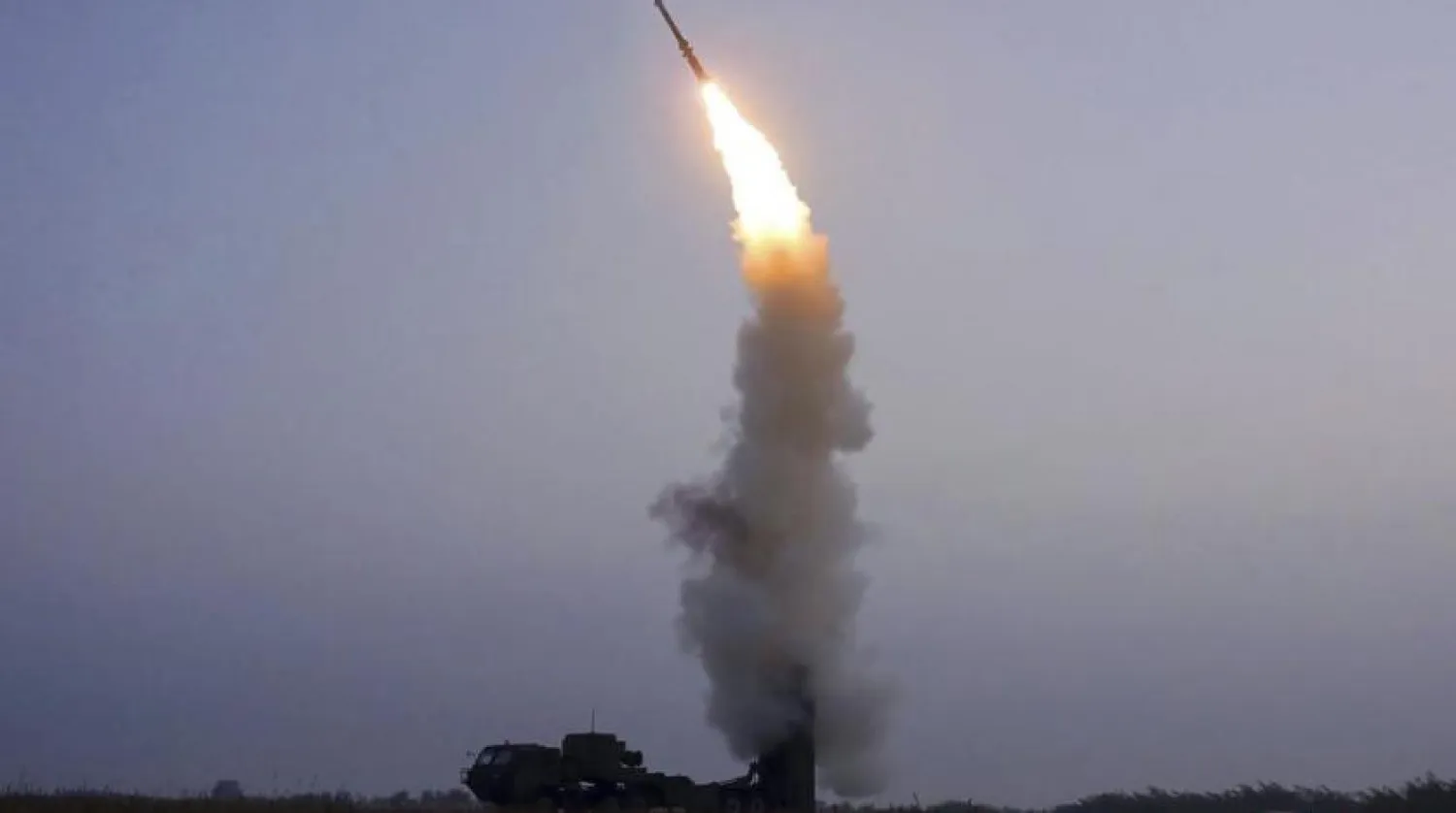
This photo provided on Oct. 1, 2021, by the North Korean government shows what North Korea claims to be the test firing of a newly developed anti-aircraft missile in North Korea, Thursday, Sept. 30, 2021. (Korean Central News Agency/Korea News Service via AP)
TT

North Korea Fires Second Suspected Missile in Less Than a Week

This photo provided on Oct. 1, 2021, by the North Korean government shows what North Korea claims to be the test firing of a newly developed anti-aircraft missile in North Korea, Thursday, Sept. 30, 2021. (Korean Central News Agency/Korea News Service via AP)

North Korea fired a suspected ballistic missile into the sea, South Korea's military said Tuesday, ratcheting up tensions less than a week after Pyongyang reported testing a hypersonic missile.

The early-morning launch came as the UN Security Council met in New York to discuss last week's test of what Pyongyang called a hypersonic missile, although Seoul has cast doubt on that claim, AFP reported.

After an emergency meeting, South Korea's national security council expressed "strong regret over the launch", according to a statement from the president's office.

Japanese Prime Minister Fumio Kishida told reporters that it was "extremely regrettable that North Korea continues to launch missiles".

There were no immediate reports of damage to Japanese aircraft or vessels, according to government spokesman Hirokazu Matsuno.

"(The suspected missile) is estimated to have flown approximately up to 700 kilometers and landed outside of Japan's exclusive economic zone," he said.

Seoul's Joint Chiefs of Staff said it had been fired from land at around 7:27 am local time (2227 GMT on Monday).

Pyongyang's second test in a week came after six countries, including the United States and Japan, urged North Korea Monday to cease "destabilizing actions" ahead of a UN Security Council closed-door meeting.

France, Britain, Ireland and Albania joined the call for North Korea to "engage in meaningful dialogue towards our shared goal of complete denuclearization".

Analysts said Pyongyang had likely planned the latest launch to coincide with the UN meeting.

"North Korea continues testing to diversify its nuclear arsenal, but it timed the launch on the day of the UNSC meeting to maximize its political impact," Shin Beom-chul, a researcher at the Korea Research Institute for National Strategy, told AFP.

The frequency of testing indicated Pyongyang could be fitting in the launches ahead of the Beijing Olympics next month, said Park Won-gon, a professor at the Ewha Womans University in Seoul.

North Korea has been barred from the Beijing Winter Olympics after skipping the pandemic-delayed Tokyo Games over Covid-19 concerns, a move Pyongyang has blamed on "hostile forces".

- Hypersonic? -
In the decade since leader Kim Jong Un took power, North Korea has seen rapid progress in its military technology at the cost of international sanctions.

In 2021, nuclear-armed North Korea said it had successfully tested a new type of submarine-launched ballistic missile, a long-range cruise missile, a train-launched weapon, and what it described as a hypersonic warhead.

South Korea has cast doubts over Pyongyang's hypersonic claims, saying last week's test represented limited progress on the regime's existing ballistic missiles.

A second hypersonic test so soon could indicate last week's launch was actually a failure, said Kim Dong-yub, a professor at the University of North Korean Studies.

"It's hard to understand why they would carry out another test less than a week after they announced a success," he added.

Hypersonic missiles move far faster and are more agile than standard ones, making them much harder for missile defense systems -- on which the United States is spending billions -- to intercept.

They were listed among the "top priority" tasks for strategic weapons in North Korea's current five-year plan, and it announced its first test -- of the Hwasong-8 -- in September last year.

- No talks -
The tests come as North Korea has refused to respond to US appeals for talks.

At a key meeting of North Korea's ruling party last month, Kim vowed to continue building up the country's defense capabilities, without mentioning America.

Instead of the policy positions on diplomacy, for which Kim's New Year statements are closely watched, he focused on food security and economic development.

Dialogue between Washington and Pyongyang remains stalled and the country is under multiple sets of international sanctions over its nuclear and ballistic missile programs.

The impoverished nation has also been under a rigid self-imposed coronavirus blockade that has hammered its economy.


Dispute Over PKK Disarmament Hinders Türkiye’s Peace Process

The PKK says it has withdrawn all its fighters from Türkiye and areas near its borders, accusing Ankara of failing to implement the peace process. (AP)
TT

Dispute Over PKK Disarmament Hinders Türkiye’s Peace Process

The PKK says it has withdrawn all its fighters from Türkiye and areas near its borders, accusing Ankara of failing to implement the peace process. (AP)

Disagreements over the disarmament of the Kurdistan Workers’ Party (PKK) have become the biggest obstacle to Türkiye’s peace initiative, which Ankara calls the “Terror-Free Türkiye” process.

Statements by Turkish officials indicate that disarmament remains underway under the supervision of relevant state institutions.

President Recep Tayyip Erdogan said last week that “the government’s priority was to ensure the PKK completed its dissolution, surrendered all its weapons and had both steps conclusively verified by the relevant authorities.”

He added that state institutions were clearing the group’s hideouts according to a predetermined plan and that the process would continue as scheduled.

Türkiye’s National Security Council must formally confirm the completion of disarmament before implementation can begin of the Law on Strengthening National Solidarity and Social Cohesion, the peace process’s framework legislation, approved by parliament on August 10.

The 12-article law provides for the conditional return and reintegration of PKK members, excluding the group’s leadership.

The PKK, meanwhile, insists it has fulfilled all its commitments, withdrawing its fighters and evacuating hideouts near the Turkish border, leaving no threat to Türkiye’s security.

It accused Ankara of failing to improve the detention conditions of imprisoned PKK leader Abdullah Ocalan, introduce the necessary legal measures or facilitate the return and reintegration of its members.

In a statement published by Turkish media Monday, the group’s leadership, which has operated under the name “Movement Leadership” since the PKK announced its dissolution on May 12, 2025, following Ocalan’s appeal, expressed frustration with Ankara’s response.

The statement said PKK fighters had withdrawn completely from Türkiye and areas near its borders, while more than 10 caves and hideouts in northern Iraq previously used as combat positions had been evacuated over the past two months.

“We no longer have any forces near the border or at any military positions where the Turkish army is stationed,” it said.

The group also claimed that its “sleeper cells” in major Turkish cities had relocated to what it calls the “Media Defense Areas” in northern Iraq, and that positions near the Turkish border had been abandoned.

It recalled that its unilateral ceasefire, announced on March 1, 2025, followed Ocalan’s February 27 “Call for Peace and a Democratic Society,” which urged the PKK to dissolve, lay down its arms and pursue democratic political activity within a legal framework.

The PKK criticized the Turkish government for failing to take concrete steps to accelerate the peace process.

It called for changes to Ocalan’s detention conditions to allow him to exercise a leadership role in managing the initiative, alongside legislation and regulations facilitating the return of PKK members to Türkiye.

“The government’s failure to take concrete steps in response to the measures taken by the PKK has raised public doubts,” the statement said.

It argued that Ankara had made no progress toward democratization even on matters requiring no new legislation, fueling debate over whether the process had stalled or been frozen.

“Our commitment to a democratic political solution is firm and unwavering. We are seriously pursuing peace and building a democratic society, and the steps we have taken are the best evidence of that,” it stated.

Erdogan, meanwhile, reiterated last week that the “Terror-Free Türkiye” initiative would proceed as planned and that no one should doubt its continuation.

Despite reports that the PKK has evacuated more than 10 caves near the Turkish border, Ankara reportedly considers the clearance of major weapons depots in the Gara and Hakurk regions of northern Iraq essential to completing disarmament.

Turkish authorities are also placing greater emphasis on the surrender of PKK members stationed in those areas.

According to press reports, a final assessment confirming the completion of disarmament cannot be issued until those facilities have been cleared.


Ukraine, Russia Hit Key Bridges Ahead of Putin-Xi-Trump Summit

A cloud of smoke rises over Kyiv after a local air defence unit shot down a Russian drone amid Russia's attack on Ukraine, November 14, 2026. Picture taken with a mobile phone. REUTERS/Taras Garanich
TT

Ukraine, Russia Hit Key Bridges Ahead of Putin-Xi-Trump Summit

A cloud of smoke rises over Kyiv after a local air defence unit shot down a Russian drone amid Russia's attack on Ukraine, November 14, 2026. Picture taken with a mobile phone. REUTERS/Taras Garanich

Ukraine struck Russia's Crimean bridge for the second night in a row on Tuesday, shutting it down, while Russia hit two major bridges in Kyiv -- the latest wave of attacks that come ahead of a historic meeting of the Chinese, US and Russian leaders.

Russia's defense ministry said it downed 1,441 Ukrainian drones in a major overnight barrage -- the second-highest one-day figure this year.

Moscow Mayor Sergei Sobyanin reported that more than 800 of them were headed to the capital itself, while officials reported attacks across 19 regions of the country.

Ukraine's President Volodymyr Zelensky had warned of a major Russian attack in the days leading up to a meeting in China's Shenzhen on Thursday between presidents Xi Jinping, Donald Trump and Vladimir Putin.

Trump said the fighting in Ukraine would be among the topics canvassed in the talks, which come at a time of renewed diplomatic efforts to end almost five years of war.

Traffic was halted across the Crimean bridge -- a highly symbolic target for Ukraine -- for hours after it was hit shortly after midnight on Tuesday.

There was no official comment on the damage, but unverified social media images appeared to show a section of the road bridge completely collapsed and in the water. The bridge carries both automobile and rail traffic.

"Experts are assessing the damage caused," Russia's transport ministry said.

"Motorists are advised not to travel in the direction of the Crimean bridge," it added, according to AFP.

Traffic had been halted on the bridge for almost 17 hours from 23:54 (2054 GMT) on Monday following a previous attack, according to the road traffic authority.

In Kyiv, Russian ballistic missiles hit the Northern and Southern bridges -- two major transport arteries that cross the Dnipro river.

Traffic was also suspended, causing gridlock early on Tuesday morning.

Russia's army confirmed it had hit both bridges in a "massive attack" on Ukraine's infrastructure.

Mayor Vitali Klitschko posted a video from the Northern Bridge showing debris strewn across the road.

The strikes on Kyiv also disrupted heating and water in parts of the capital, he said.

The wave of strikes comes as the United States renews its push for an end to the war.

But diplomatic efforts have so far failed to reach a breakthrough, with fighting grinding into another winter.

Moscow wants a sweeping deal to rewrite "Europe's security architecture" as part of any agreement to halt the fighting.

Russia has previously demanded curbs on NATO's presence in central and eastern Europe and restrictions on the deployment of foreign troops and hardware to Ukraine.

Kyiv and Europe are resisting any attempts to overhaul the continent's post-Cold War defense, calling for a ceasefire in the Ukraine war before any discussion of terms.

Zelensky has raised alarm that the talks between the leaders of Russia, China and the United States on the sidelines of a regional summit could be a Yalta-like "redistribution of spheres of influence" for the 21st century.

The 1945 Yalta summit -- held in Crimea, then part of the Soviet Union -- saw US president Franklin D. Roosevelt, Britain's Winston Churchill and Soviet leader Joseph Stalin carve up new post-WWII territorial boundaries.

Ukraine's Foreign Minister Andriy Sybiga said the presidents' meeting would "only encourage Putin to continue this war".

China has not provided specific details on the topics to be discussed beyond "safeguarding world peace" and "promoting strategic stability in major power relations".

The White House had earlier signaled the Ukraine war was not expected to be addressed -- before Trump said on Monday that it would be.

"We'll talk about my favorite subject, Ukraine," Trump told reporters.

As the trio gather in China, Ukraine and its allies will this week hold meetings on defense support and aligning positions ahead of any future talks.


France Braces for Fresh Public Sector Strike Over Pay

Minor clashes break out between protesters and riot police at the end of a march in Paris on Saturday, Nov. 14, 2026, as demonstrators called for higher wages, voiced support for the high school protest movement and opposed a proposed security bill that would expand police powers. (AP)
TT

France Braces for Fresh Public Sector Strike Over Pay

Minor clashes break out between protesters and riot police at the end of a march in Paris on Saturday, Nov. 14, 2026, as demonstrators called for higher wages, voiced support for the high school protest movement and opposed a proposed security bill that would expand police powers. (AP)

France braced for fresh protests on Tuesday after unions called a nationwide strike by public sector workers in a bid to secure pay rises, despite government efforts to ease tensions as demonstrations roil the country.

France's 5.8 million public sector employees have been called to mobilize after talks with Prime Minister Sebastien Lecornu on Friday failed to satisfy unions, which had been pushing for across-the-board pay rises since last week's boost to the minimum wage for private-sector workers.

Tuesday marks the third call for a united day of action and strikes in the public sector since September, including one earlier this month that saw hundreds of thousands of workers march and police firing tear gas as clashes broke out in some cities.

More unions joined the call after the meeting organized by Lecornu, which union representatives left saying proposed measures failed to address the urgency of the pay situation.

In Paris, a main rally is scheduled to begin at 2:00 pm (1300 GMT), with dozens of other gatherings planned across the country.

Between 40,000 and 80,000 people are expected to demonstrate in the capital, and between 220,000 and 300,000 nationwide, a police source told AFP.

The European Union's second-largest economy has been rocked by more than a month of high school blockades and cost-of-living protests, with presidential elections looming next year and the far right hoping to seize power.

Youth union organizations and Yellow Vest activists also plan to join the latest demonstrations, which come after weekend protests over grievances ranging from inflation to a proposed police law.

Some of the largely peaceful rallies have seen fringe violence, as well as accusations of police brutality.

Authorities have imposed restrictions on undeclared gatherings near several schools and universities in Paris and temporarily banned the sale of firecrackers, citing concerns about possible violence during protests.

The protests come as France races to adopt a 2027 budget under pressure to reduce its deficit.

Public-sector staff aim to pressure the government to unfreeze the pay scale point used to calculate their basic salary. In its draft budget, the government has ruled out any general pay rise for the fourth consecutive year.

This is unacceptable for the unions, which put the loss of purchasing power for public servants at 16 percent since 2017, leading to increasing numbers of public employees ending up on or close to the minimum wage against a backdrop of inflation.