


'Amazing Milestone' as NASA Fully Deploys Webb Telescope in Space

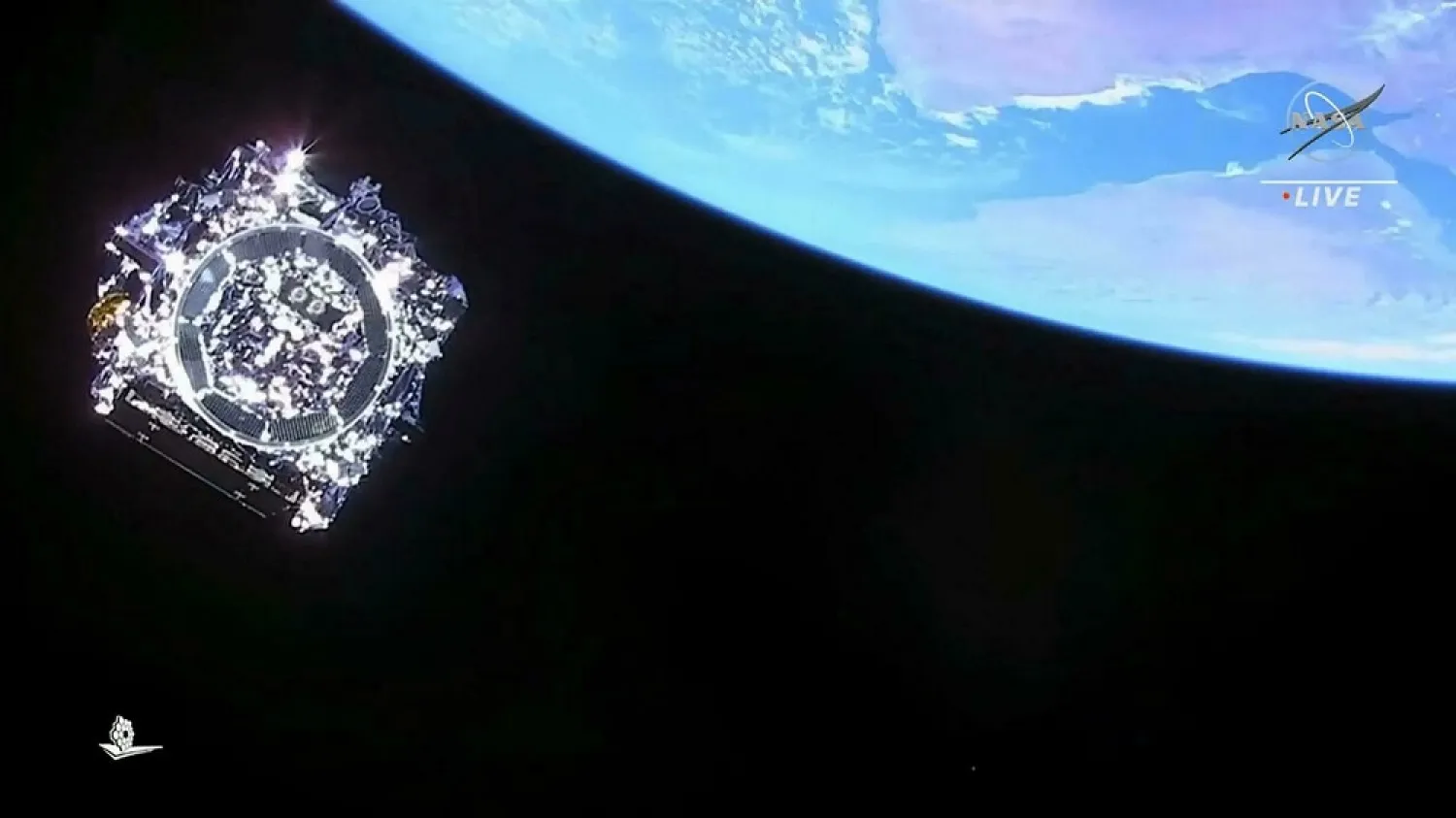
 The James Webb Space Telescope separates from Arianespace's Ariane 5 rocket after launching from Europe’s Spaceport, the Guiana Space Center in Kourou, French Guiana - NASA TV/AFP/File
The James Webb Space Telescope separates from Arianespace's Ariane 5 rocket after launching from Europe’s Spaceport, the Guiana Space Center in Kourou, French Guiana - NASA TV/AFP/File
TT

'Amazing Milestone' as NASA Fully Deploys Webb Telescope in Space

 The James Webb Space Telescope separates from Arianespace's Ariane 5 rocket after launching from Europe’s Spaceport, the Guiana Space Center in Kourou, French Guiana - NASA TV/AFP/File
The James Webb Space Telescope separates from Arianespace's Ariane 5 rocket after launching from Europe’s Spaceport, the Guiana Space Center in Kourou, French Guiana - NASA TV/AFP/File

The most powerful space telescope ever built completed a tricky two-week-long deployment phase Saturday, unfolding its final golden mirror panel, as it readies to study every phase of cosmic history.

Engineering teams in the James Webb Space Telescope's control room cheered as confirmation came back that its final wing was deployed and latched into place.

"I'm emotional about it -- what an amazing milestone," Thomas Zurbuchen, a senior NASA engineer, said during the live video feed as stargazers worldwide celebrated.

Because the telescope was too large to fit into a rocket's nose cone in its operational configuration, it was transported folded up.

Unfurling has been a complex and risky task -- "arguably the most challenging deployment program ever done by NASA," said NASA engineer Mike Menzel.

On Saturday morning, engineers sent a command from the Space Telescope Science Institute in Baltimore, Maryland for the final section of golden mirror to unfold.

According to NASA, after the mirror was latched into place at 1:17 PM (1817 GMT), "the team declared all major deployments successfully completed."

"I want to tell you just how excited and emotional I am right now," said Zurbuchen on the live video feed. "We have a deployed telescope on orbit."

Webb, the successor to Hubble, blasted off in an Ariane 5 rocket from French Guiana on December 25, and is heading to its orbital point, a million miles (1.6 million kilometers) from Earth.

Though Webb will reach its space destination, known as the second Lagrange point, in a matter of weeks, it still has around another five and a half months of setup to go.

"While the journey is not complete, I join the Webb team in breathing a little easier and imagining the future breakthroughs bound to inspire the world," said NASA Administrator Bill Nelson.

Next steps include aligning the telescope's optics, and calibrating its scientific instruments.

Its infrared technology will allow it to see the first stars and galaxies that formed 13.5 billion years ago, giving astronomers new insight into the earliest epoch of the Universe.

Earlier this week, the telescope deployed its five-layered sunshield -- a 70-foot (21 meter) long, kite-shaped apparatus that acts like a parasol, ensuring Webb's instruments are kept in the shade so they can detect faint infrared signals from the far reaches of the Universe.

The sunshield will be permanently positioned between the telescope and the Sun, Earth and Moon, with the Sun-facing side built to withstand 230 degrees Fahrenheit (110 degrees Celsius).

Visible and ultraviolet light emitted by the very first luminous objects has been stretched by the Universe's expansion, and arrives today in the form of infrared, which Webb is equipped to detect with unprecedented clarity.

Its mission also includes the study of distant planets to determine their origin, evolution, and habitability.

The NASA telescope blog said Saturday's procedure was "the last of the major deployments on the observatory."

According to the telescope's deputy project mangaer at NASA, John Durning, the deployments have been "100 percent successful."

"That was probably the highest risk part of the mission," said Bill Ochs, NASA's lead project manager for Webb, at a post-deployment press briefing.

"That doesn't mean all our risk goes away."

Over the next five and half months, the telescope will finish its "commissioning", which, according to the NASA blog, "consist of settling into stable operating temperature, aligning the mirrors, and calibrating the science instruments."

At the end of the commissioning period, NASA is planning to release a series of "wow images" says Jane Rigby, a NASA project scientist.

Though she won't say what the images will be of, they are sure to "really knock everybody's socks off."



AI to Track Icebergs Adrift at Sea in Boon for Science

© Jonathan NACKSTRAND / AFP
TT

AI to Track Icebergs Adrift at Sea in Boon for Science

© Jonathan NACKSTRAND / AFP

British scientists said Thursday that a world-first AI tool to catalogue and track icebergs as they break apart into smaller chunks could fill a "major blind spot" in predicting climate change.

Icebergs release enormous volumes of freshwater when they melt on the open water, affecting global climate patterns and altering ocean currents and ecosystems, reported AFP.

But scientists have long struggled to keep track of these floating behemoths once they break into thousands of smaller chunks, their fate and impact on the climate largely lost to the seas.

To fill in the gap, the British Antarctic Survey has developed an AI system that automatically identifies and names individual icebergs at birth and tracks their sometimes decades-long journey to a watery grave.

Using satellite images, the tool captures the distinct shape of icebergs as they break off -- or calve -- from glaciers and ice sheets on land.

As they disintegrate over time, the machine performs a giant puzzle problem, linking the smaller "child" fragments back to the "parent" and creating detailed family trees never before possible at this scale.

It represents a huge improvement on existing methods, where scientists pore over satellite images to visually identify and track only the largest icebergs one by one.

The AI system, which was tested using satellite observations over Greenland, provides "vital new information" for scientists and improves predictions about the future climate, said the British Antarctic Survey.

Knowing where these giant slabs of freshwater were melting into the ocean was especially crucial with ice loss expected to increase in a warming world, it added.

"What's exciting is that this finally gives us the observations we've been missing," Ben Evans, a machine learning expert at the British Antarctic Survey, said in a statement.

"We've gone from tracking a few famous icebergs to building full family trees. For the first time, we can see where each fragment came from, where it goes and why that matters for the climate."

This use of AI could also be adapted to aid safe passage for navigators through treacherous polar regions littered by icebergs.

Iceberg calving is a natural process. But scientists say the rate at which they were being lost from Antarctica is increasing, probably because of human-induced climate change.


AMD Predicts Weaker First-Quarter Sales, Shares Plunge on Nvidia Comparisons

An AMD logo and a computer motherboard appear in this illustration created on August 25, 2025. (Reuters)
TT

AMD Predicts Weaker First-Quarter Sales, Shares Plunge on Nvidia Comparisons

An AMD logo and a computer motherboard appear in this illustration created on August 25, 2025. (Reuters)

Advanced Micro Devices on Tuesday forecast a slight decline in quarterly revenue, raising concerns about whether it ​can effectively challenge Nvidia in the booming AI market and sending its shares tumbling 8% in after-hours trade.

The lackluster prediction comes despite an unexpected boost from sales of certain artificial intelligence chips to China, which began in the last quarter after the Trump administration approved a license for orders that AMD received in early 2025.

And without those sales to China which generated $390 million, AMD's data-center segment would have missed estimates for the fourth quarter.

AMD said it expects revenue of about $9.8 billion this quarter, plus or minus $300 million. That's down from $10.27 billion in the fourth-quarter which was up 34% year-on-year and ahead of LSEG ‌estimates for $9.67 billion.

PALES ‌NEXT TO NVIDIA

Though AMD is seen as one of the ‌few ⁠contenders ​that can seriously ‌challenge Nvidia, investors noted the stark contrast between the two companies' performances. AMD expects an adjusted gross margin of 55% this quarter. Nvidia has said it expects adjusted gross margin in the mid-70% range during its fiscal 2027.

"The expectations for large blowout quarters for AI-related hardware companies have skewed what the market is looking for," said Bob O'Donnell, president of TECHnalysis Research.

The forecast for the current first quarter includes $100 million from sales to China, where the situation remains "dynamic," AMD CEO Lisa Su said on a conference call with investors.

The US government ⁠has placed restrictions on the exports of advanced chips to China, but AMD received licenses to sell modified versions of its MI300 series ‌of AI chips there. Its MI308 chip competes with Nvidia's H20 ‍chip in China.

OPENAI SALES

AMD has accelerated its ‍product launches and is moving into selling full AI systems to better compete against Nvidia, which now ‍provides "rack-scale" systems that combine GPUs, CPUs and networking gear.

Last year, it entered into a multi-year deal to supply AI chips to ChatGPT-owner OpenAI, which would bring in tens of billions of dollars in annual revenue and give the startup the option to buy up to roughly 10% of the chipmaker.

Su reiterated on Tuesday that the company ​expects sales of a new flagship AI server to OpenAI and others to rise rapidly in the second half of this year, saying a global memory-chip crunch will not ⁠slow its plans.

"I do not believe that we will be supply-limited in terms of the ramp that we put in place," Su said.

BEYOND OPENAI

As Big Tech and governments across the globe double down on investing in AI hardware, shares in Santa Clara, California-based AMD have doubled since the start of 2025, outperforming a 60% bump in the broader chip index.

But analysts remain concerned that AMD's success remains tied to a handful of customers that rivals such as Nvidia could try to poach. Reuters reported this week that Nvidia made a $20 billion move to hire most of chip startup Groq's founders after OpenAI held chip supply discussions with the startup.

"Growth appears concentrated in large deployments and specific regions, and China shipments are significant enough to influence a quarter," said eMarketer analyst Gadjo Sevilla.

Revenue in AMD's key data-center segment grew 39% to $5.38 billion in the ‌fourth quarter. But excluding sales of the MI308, which is a data-center chip, that revenue would have been $4.99 billion, below estimates of $5.07 billion.


Switch 2 Sales Boost Nintendo Results but Chip Shortage Looms

This photo taken on November 4, 2025 shows a woman taking photos of a Super Mario figure at the Nintendo Tokyo store in Tokyo. (AFP)
TT

Switch 2 Sales Boost Nintendo Results but Chip Shortage Looms

This photo taken on November 4, 2025 shows a woman taking photos of a Super Mario figure at the Nintendo Tokyo store in Tokyo. (AFP)

The runaway success of the Switch 2 console drove up Nintendo's net profit by more than 50 percent in the nine months to December, the Japanese video game giant said Tuesday.

But a global memory chip shortage, created by frenzied demand for artificial intelligence hardware, could push up manufacturing costs.

The Switch 2 became the world's fastest-selling games console after launching to a fan frenzy last summer.

It is the successor to the original Switch, which soared in popularity during the pandemic when games such as "Animal Crossing" struck a chord during long lockdowns.

Both are hybrid devices that can be connected to a TV or used on-the-go.

In April-December, net profit jumped 51.3 percent year-on-year to 358.9 billion yen ($2.3 billion), and revenue nearly doubled on-year to 1.9 trillion yen, Nintendo said.

But the firm kept its annual unit sales target for the Switch 2 steady at 19 million, and also held its full-year net profit forecast of 350 billion yen.

"Nintendo Switch 2 got off to a good start following its launch on June 5 and unit sales continued to grow through the holiday season," the company said.

Nearly 17.4 million Switch 2 devices were sold in the nine-month period, it added.

"Maintaining momentum is certainly a big focus for Nintendo," Krysta Yang of the Nintendo-focused Kit and Krysta Podcast told AFP.

A lack of heavy-hitting first-party new games for the Switch 2 in coming months risks hindering growth, although third-party titles such as "Resident Evil Requiem" should help fill the gap, she said.

Nintendo said Tuesday it planned to release "Mario Tennis Fever" this month and "Pokemon Pokopia" in March.

While the firm is diversifying into hit movies and theme parks, consoles remain the core of its business.

The Switch 1 has now sold 155.37 million units -- overtaking the Nintendo DS console to be its best-selling hardware of all time.

But soaring prices for memory chips, used in gaming consoles as well as phones, laptops and other electronics, will likely be a headwind for the company.

Their prices have been pushed up as chipmakers focus on producing the advanced memory chips in huge demand to power AI data centers.

"Nintendo and other console manufacturers are publicly keeping quiet about the impact of the shortage," gaming industry consultant Serkan Toto told AFP.

But "users can forget the past when consoles always became cheaper in tandem with component costs falling over time", with price hikes potentially on the way in 2026, he said.

Yang said she thought a price increase for the Switch 2 "is not out of the question" but added that Nintendo "would likely exhaust all other options" before doing so.