

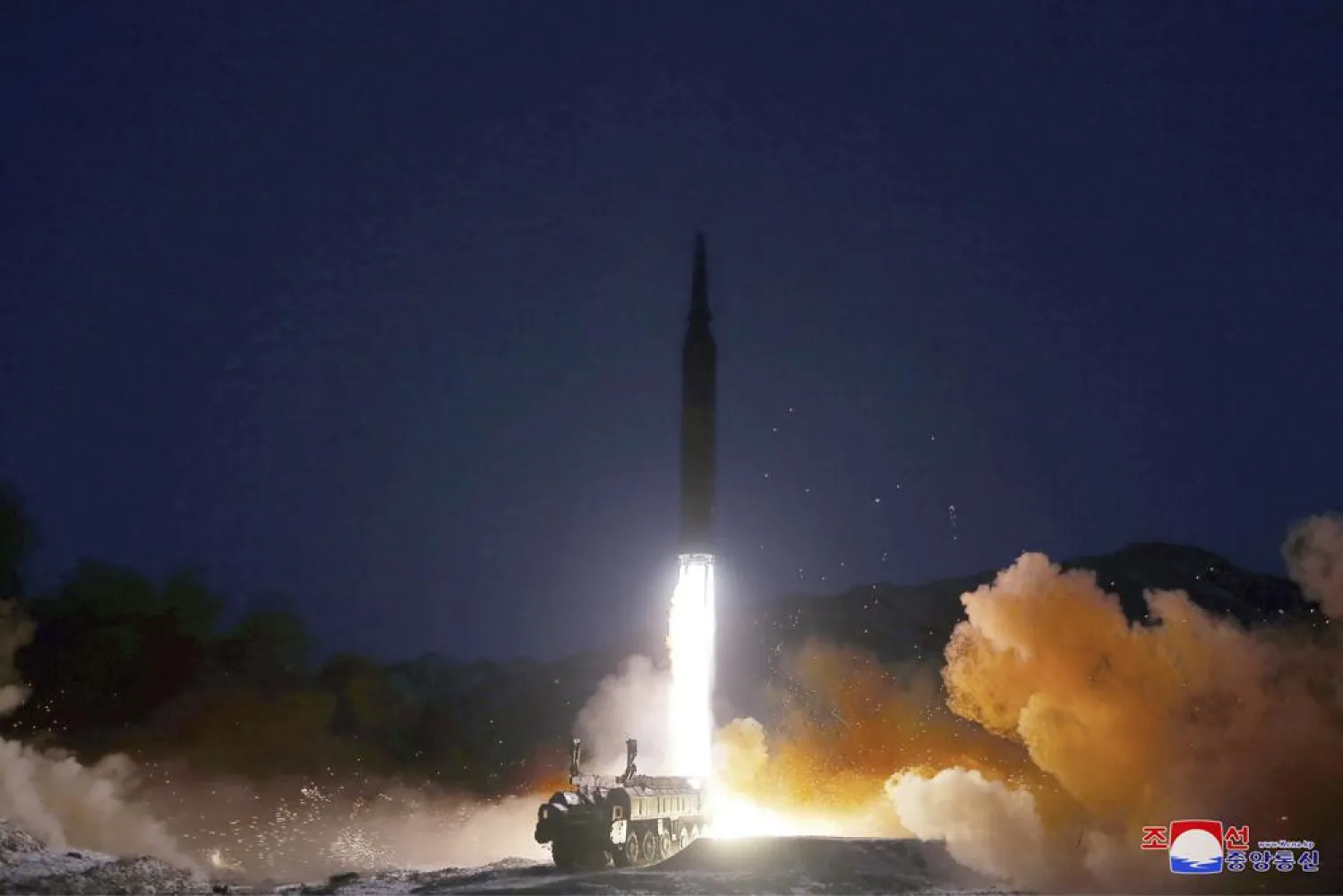

North Korea Claims Successful Test of Hypersonic Missile

This photo provided by the North Korean government shows what it says a test launch of a hypersonic missile on Jan. 11, 2022 in North Korea.  (Korean Central News Agency/Korea News Service via AP)
This photo provided by the North Korean government shows what it says a test launch of a hypersonic missile on Jan. 11, 2022 in North Korea. (Korean Central News Agency/Korea News Service via AP)
TT

North Korea Claims Successful Test of Hypersonic Missile

This photo provided by the North Korean government shows what it says a test launch of a hypersonic missile on Jan. 11, 2022 in North Korea.  (Korean Central News Agency/Korea News Service via AP)
This photo provided by the North Korean government shows what it says a test launch of a hypersonic missile on Jan. 11, 2022 in North Korea. (Korean Central News Agency/Korea News Service via AP)

North Korea said Wednesday its leader Kim Jong Un oversaw a successful flight test of a hypersonic missile he claimed would remarkably increase the country’s nuclear “war deterrent.”

The state media report came a day after the militaries of the United States, South Korea and Japan said they detected North Korea firing a suspected ballistic missile into its eastern sea.

The Korean Central News Agency said Tuesday’s launch involved a hypersonic glide vehicle, which after its release from the rocket booster demonstrated “glide jump flight” and “corkscrew maneuvering” before hitting a sea target 1,000 kilometers (621 miles) away.

According to The Associated Press, photos released by the agency showed a missile mounted with a pointed cone-shaped payload soaring into the sky while leaving a trail of orange flames and Kim watching from a small cabin with top officials, including his sister Kim Yo Jong.

The launch was North Korea’s second test of its purported hypersonic missile in a week, a type of weaponry it first tested in September, as Kim Jong Un continues a defiant push to expand his nuclear weapons capabilities in the face of international sanctions, pandemic-related difficulties and deadlocked diplomacy with the United States.

The North has been ramping up its testing activity since last fall, demonstrating various missiles and delivery systems apparently designed to overwhelm missile defense systems in the region. Experts say Kim is trying to apply more pressure on rivals Washington and Seoul to accept it as a nuclear power in hopes of winning relief from economic sanctions.

It was the first time since March 2020 that North Korean state media reported Kim’s attendance at a missile test.

The KCNA said Kim praised his military scientists and officials involved in developing the hypersonic missile system, which he described as the most significant part of a new five-year plan announced in early 2021 to build up the North’s military force.

The North has described the new missile as part of its “strategic” weaponry, implying that the system is being developed to deliver nuclear weapons.

“The superior maneuverability of the hypersonic glide vehicle was more strikingly verified through the final test-fire,” KCNA said. It said Kim stressed the need to speed up the expansion of the country’s “strategic military muscle both in quality and quantity and further modernize the army” and vowed further success in “remarkably increasing the war deterrent of the country.”

Hypersonic weapons, which fly at speeds in excess of Mach 5, or five times the speed of sound, could pose a crucial challenge to missile defense systems because of their speed and maneuverability. Such weapons were on a wish-list of sophisticated military assets Kim unveiled last year along with multi-warhead missiles, spy satellites, solid-fuel long-range missiles and submarine-launched nuclear missiles.

Experts say North Korea needs more successful and longer-range tests that would take years before acquiring a credible hypersonic system.

“North Korea seems to believe that hypersonic weapons are game changers and provide entrance into the nuclear club when the US, Russia, and China have been racing to build them,” said Duyeon Kim, a senior analyst at Washington’s Center for a New American Security.

She said the North’s recent advancements in its missile program indicate an aim to secure a “second-strike nuclear capability, make its missiles modern and more survivable, reassure the North Korean people of its military might and credibly gain entrance into the nuclear club.”

US State Department spokesman Ned Price said Washington condemns the North’s latest launch, which violates multiple UN Security Council resolutions, and urged Pyongyang to engage in “sustained and substantive dialogue.”

The US Indo-Pacific Command said the launch highlighted the “destabilizing impact of (North Korea’s) illicit weapons program” but didn’t pose an immediate threat to US territory or its allies.

Minutes after Tuesday’s launch, airports across the western United States halted flights for a short time without explanation. A spokeswoman for San Diego International Airport referred questions to the Federal Aviation Administration.

The FAA acknowledged the “ground stop” in a tweet, without offering a reason why it issued the order.

“Full operations resumed in less than 15 minutes,” the FAA said. “The FAA regularly takes precautionary measures. We are reviewing the process around this ground stop as we do after all such events.”

South Korea’s Joint Chiefs of Staff had said the North Korean missile flew 700 kilometers (434 miles) at a maximum speed of around Mach 10 before landing in waters off the North’s eastern coast.

South Korea’s Defense Ministry had played down North Korea’s earlier test on Jan. 5, insisting that the North exaggerated its capabilities after testing a conventional ballistic missile. Following Tuesday’s launch, the Joint Chief of Staff acknowledged that the North demonstrated more advanced capability compared to its previous test.

Japanese Defense Minister Nobuo Kishi described the new missile as hypersonic and said the North’s efforts to advance its missile capabilities posed a serious threat to Japan. He said Japan will consider all options, including the possibility of pursuing pre-emptive strike capabilities, to strengthen its defense.

Kim Jong Un entered the new year renewing his vow to bolster his military forces, even as the nation grapples with pandemic-related difficulties that have further strained its economy, which is crippled by US-led sanctions over its nuclear program.

The economic setbacks have left Kim with little to show for his diplomacy with former US President Donald Trump, which derailed after their second meeting in 2019 when the Americans rejected North Korea’s demand for major sanctions relief in exchange for a partial surrender of its nuclear capabilities.

The Biden administration, whose policies have reflected a broader shift in US focus from counterterrorism and so-called rogue states like North Korea and Iran to confronting China, has said it’s willing to resume talks with North Korea at any time without preconditions.

But North Korea has so far rejected the idea of open-ended talks, saying the US must first withdraw its “hostile policy,” a term Pyongyang mainly uses to describe the sanctions and joint US-South Korea military drills.



Iran Strikes Hard Line on US Talks, Saying Tehran's Power Comes From Saying 'No'

Traffic moves through a street in Tehran on February 7, 2026. (Photo by ATTA KENARE / AFP)
TT

Iran Strikes Hard Line on US Talks, Saying Tehran's Power Comes From Saying 'No'

Traffic moves through a street in Tehran on February 7, 2026. (Photo by ATTA KENARE / AFP)

Iran's top diplomat insisted Sunday that Tehran's strength came from its ability to “say no to the great powers," striking a maximalist position just after negotiations with the United States over its nuclear program and in the wake of nationwide protests.

Foreign Minister Abbas Araghchi, speaking to diplomats at a summit in Tehran, signaled that Iran would stick to its position that it must be able to enrich uranium — a major point of contention with President Donald Trump, who bombed Iranian atomic sites in June during the 12-day Iran-Israel war.

Iran will never surrender the right to enrich uranium, even if war "is imposed on us,” he noted.

"Iran has paid a very heavy price for its peaceful nuclear program and for uranium enrichment." 

Israeli Prime Minister Benjamin Netanyahu is expected to travel to Washington this week, with Iran expected to be the major subject of discussion, his office said.

While Iranian President Masoud Pezeshkian praised the talks Friday in Oman with the Americans as “a step forward,” Araghchi's remarks show the challenge ahead. Already, the US moved the aircraft carrier USS Abraham Lincoln, ships and warplanes to the Middle East to pressure Iran into an agreement and have the firepower necessary to strike the Islamic Republic should Trump choose to do so, according to The AP news.

“I believe the secret of the Islamic Republic of Iran’s power lies in its ability to stand against bullying, domination and pressures from others," Araghchi said.

"They fear our atomic bomb, while we are not pursuing an atomic bomb. Our atomic bomb is the power to say no to the great powers. The secret of the Islamic Republic’s power is in the power to say no to the powers.”

‘Atomic bomb’ as rhetorical device Araghchi's choice to explicitly use an “atomic bomb” as a rhetorical device likely wasn't accidental. While Iran has long maintained its nuclear program is peaceful, the West and the International Atomic Energy Agency say Tehran had an organized military program to seek the bomb up until 2003.

Iran had been enriching uranium up to 60% purity, a short, technical step to weapons-grade levels of 90%, the only non-weapons state to do so. Iranian officials in recent years had also been increasingly threatening that Tehran could seek the bomb, even while its diplomats have pointed to Iranian Supreme Leader Ali Khamenei’s preachings as a binding fatwa, or religious edict, that Iran wouldn’t build one.

Pezeshkian, who ordered Araghchi to pursue talks with the Americans after likely getting Khamenei's blessing, also wrote on X on Sunday about the talks.

“The Iran-US talks, held through the follow-up efforts of friendly governments in the region, were a step forward,” the president wrote. “Dialogue has always been our strategy for peaceful resolution. ... The Iranian nation has always responded to respect with respect, but it does not tolerate the language of force.”

It remains unclear when and where, or if, there will be a second round of talks. Trump, after the talks Friday, offered few details but said: “Iran looks like they want to make a deal very badly — as they should.”

Aircraft carrier in the Arabian Sea During Friday's talks, US Navy Adm. Brad Cooper, the head of the American military's Central Command, was in Oman. Cooper's presence was apparently an intentional reminder to Iran about US military power in the region. Cooper later accompanied US special envoy Steve Witkoff and Jared Kushner, Trump's son-in-law, to the Lincoln out in the Arabian Sea after the indirect negotiations.

Araghchi appeared to be taking the threat of an American military strike seriously, as many worried Iranians have in recent weeks. He noted that after multiple rounds of talks last year, the US “attacked us in the midst of negotiations."

“If you take a step back (in negotiations), it is not clear up to where it will go,” Araghchi said.


Russia: Man Suspected of Shooting Top General Detained in Dubai

An investigator works outside a residential building where the assassination attempt on Russian Lieutenant General Vladimir Alexeyev took place in Moscow, Russia February 6, 2026. REUTERS/Anastasia Barashkova
TT

Russia: Man Suspected of Shooting Top General Detained in Dubai

An investigator works outside a residential building where the assassination attempt on Russian Lieutenant General Vladimir Alexeyev took place in Moscow, Russia February 6, 2026. REUTERS/Anastasia Barashkova

Russia's Federal Security Service (FSB) said on Sunday that the man suspected of shooting top Russian military intelligence officer Vladimir Alexeyev in Moscow has been detained in Dubai and handed over to Russia.

Lieutenant General Vladimir Alexeyev, deputy head of the GRU, ⁠Russia's military intelligence arm, was shot several times in an apartment block in Moscow on Friday, investigators said. He underwent surgery after the shooting, Russian media ⁠said.

The FSB said a Russian citizen named Lyubomir Korba was detained in Dubai on suspicion of carrying out the shooting.

Russian Foreign Minister Sergei Lavrov accused Ukraine of being behind the assassination attempt, which he said was designed to sabotage peace talks. ⁠Ukraine said it had nothing to do with the shooting.

Alexeyev's boss, Admiral Igor Kostyukov, the head of the GRU, has been leading Russia's delegation in negotiations with Ukraine in Abu Dhabi on security-related aspects of a potential peace deal.


Factory Explosion Kills 8 in Northern China

Employees work on an electric vehicle (EV) production line at the Volkswagen Anhui factory in Hefei, Anhui province, China, February 4, 2026. REUTERS/Florence Lo
TT

Factory Explosion Kills 8 in Northern China

Employees work on an electric vehicle (EV) production line at the Volkswagen Anhui factory in Hefei, Anhui province, China, February 4, 2026. REUTERS/Florence Lo

An explosion at a biotech factory in northern China has killed eight people, Chinese state media reported Sunday, increasing the total number of fatalities by one.

State news agency Xinhua had previously reported that seven people died and one person was missing after the Saturday morning explosion at the Jiapeng biotech company in Shanxi province, citing local authorities.

Later, Xinhua said eight were dead, adding that the firm's legal representative had been taken into custody.

The company is located in Shanyin County, about 400 kilometers west of Beijing, AFP reported.

Xinhua said clean-up operations were ongoing, noting that reporters observed dark yellow smoke emanating from the site of the explosion.

Authorities have established a team to investigate the cause of the blast, the report added.

Industrial accidents are common in China due to lax safety standards.
In late January, an explosion at a steel factory in the neighboring province of Inner Mongolia left at least nine people dead.