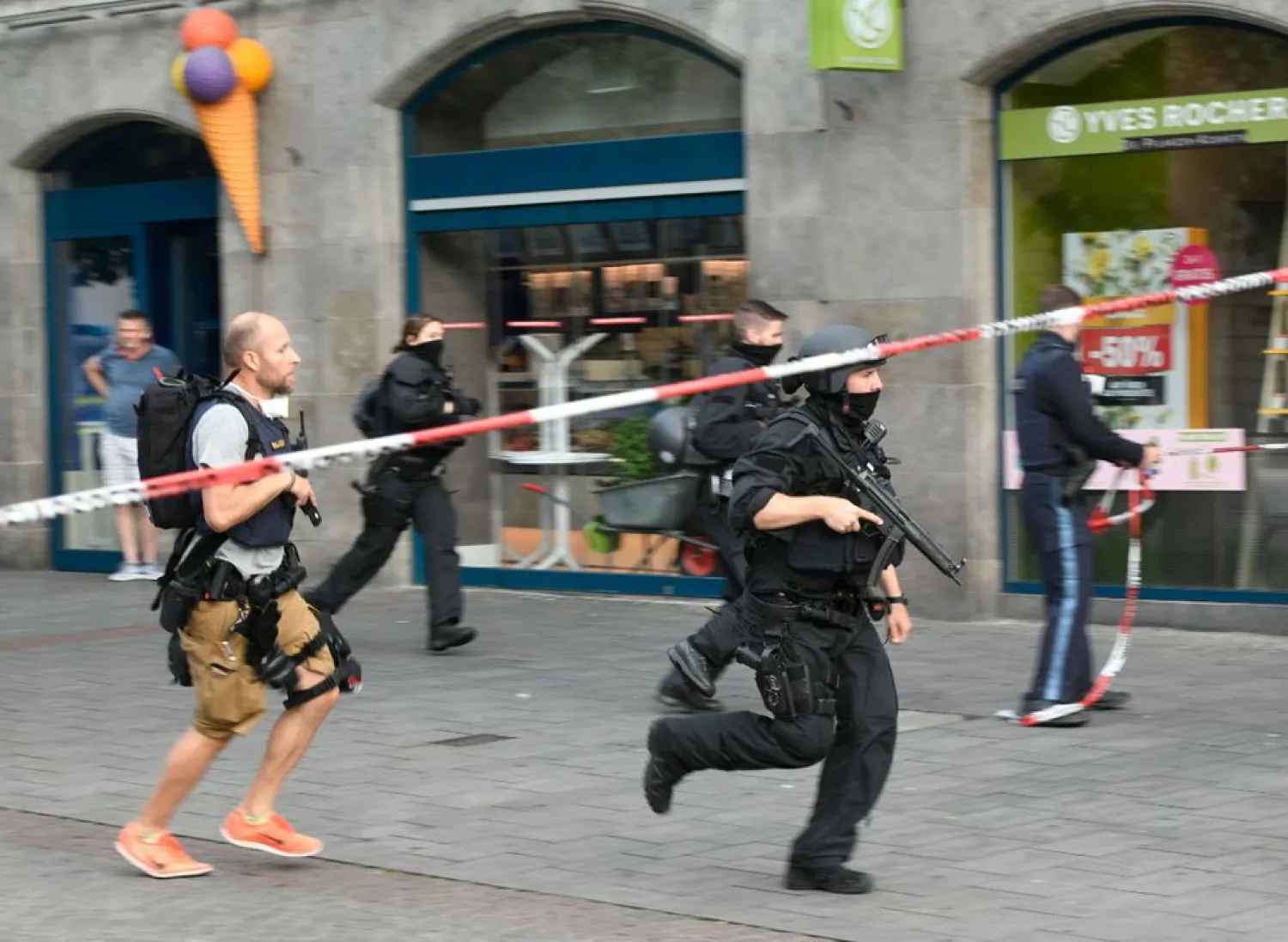
For Victims, Syria Torture Trial is 1st Step Toward Justice

German police in action in the German town of Wuerzburg, Germany, June 25, 2021. REUTERS/Thomas Obermeier/Main-Post
TT

For Victims, Syria Torture Trial is 1st Step Toward Justice

German police in action in the German town of Wuerzburg, Germany, June 25, 2021. REUTERS/Thomas Obermeier/Main-Post

Victims of torture in Syria and human rights activists say they hope the upcoming verdict in a landmark trial will be a first step toward justice for countless Syrians who suffered abuse at the hands of President Bashar Assad’s government in the country’s long-running conflict.

A court in the German city of Koblenz is scheduled to deliver its ruling Thursday in the trial of Anwar Raslan, a former Syrian secret police officer who is accused of crimes against humanity for overseeing the abuse of detainees at a jail near Damascus a decade ago.

Speaking this week before the verdict, one of those who testified against Raslan said that whatever the outcome, the court proceedings in Germany would send an important message that those responsible for crimes in Syria can be held to account.

“As Syrians who suffered a lot, especially after the beginning of the revolution, (the trials shows) those sufferings are not in vain," said Wassim Mukdad, a torture survivor and co-plaintiff who — like the defendant — now lives in Germany.

Mukdad was among dozens of witnesses who testified against Raslan and a second defendant, Eyad al-Gharib, who was convicted last year of accessory to crimes against humanity and sentenced by the Koblenz state court to 4½ years in prison.

The court concluded that al-Gharib was part of a unit which detained anti-government protests and took them to a facility in the Syrian city of Douma known as Al Khatib, or Branch 251, where they were tortured.

According to The Associated Press, federal prosecutors allege that Raslan was the senior officer in charge of the jail and supervised the “systematic and brutal torture” of more than 4,000 prisoners between April 2011 and September 2012, resulting in the deaths of at least 58 people.

The court heard evidence implicating Raslan in 30 of those deaths, said Patrick Kroker, a lawyer with the European Center for Constitutional and Human Rights who represented several survivors at the trial. Instances of sexual violence are also being considered as part of the charge, he said.

If convicted, Raslan could face life in prison. His lawyers last week asked the court to acquit their client, claiming that he never personally tortured anybody and that he defected in late 2012.


Iraq to Send Delegation to Lebanon over ex-MP Killing

People walk next to a building, where former Iraqi MP Ahmed al-Alwani was found strangled to death, in Beirut, Lebanon, November 11, 2026. REUTERS/Mohamed Azakir
TT

Iraq to Send Delegation to Lebanon over ex-MP Killing

People walk next to a building, where former Iraqi MP Ahmed al-Alwani was found strangled to death, in Beirut, Lebanon, November 11, 2026. REUTERS/Mohamed Azakir

Iraq will send a delegation to Lebanon to support the probe into the killing of a former lawmaker in Beirut, a security official told AFP on Wednesday.

Former Sunni Iraqi politician Ahmed al-Alwani was found strangled to death in a Beirut apartment on Monday night.

"A specialized security delegation will head to Lebanon to follow developments" in the case with the Lebanese security agencies, the official said.

Another Iraqi official said that the motives for the killing remained unclear.

A Lebanese judicial official told AFP that initial findings showed that three people were involved, including two foreign nationals who fled to Syria. Their identities have yet to be determined.

A third suspect, a Lebanese national, has been detained and is being interrogated.

The source added that Alwani was lured in a "highly calculated" operation, with the suspects renting an apartment for him and taking him there directly from the airport.

Alwani was sentenced to death in Iraq in 2014 for the murder of two soldiers, but was ultimately released from prison last year.

He came from a prominent Sunni tribe in the western Anbar province, and was a prominent supporter of a 2013 Sunni-led protest movement against the Shia-dominated government.

His arrest had further inflamed anger towards the government, which many Sunnis viewed as having marginalized their community.

Alwani arrived in Beirut on November 5, his media office said in a statement posted on his Facebook page.

It added that his last call with his team took place after he reached the apartment from the airport.

Iraqi President Nizar Amede, who met Lebanese Prime Minister Nawaf Salam in Türkiye, called on Wednesday for a swift investigation to determine the circumstances surrounding the killing and identify the perpetrators.


Ahmed al-Alwani: From Iraq's Protest Front Lines to a Violent Death in Beirut

Former Iraqi lawmaker Ahmed al-Alwani (X)
TT

Ahmed al-Alwani: From Iraq's Protest Front Lines to a Violent Death in Beirut

Former Iraqi lawmaker Ahmed al-Alwani (X)

Iraqi politician Ahmed al-Alwani, found dead in an apartment in Beirut on Tuesday, lived a political career shaped by the turmoil that engulfed Iraq after 2003.

From parliament, he rose to the forefront of protests against former Prime Minister Nouri al-Maliki, only to spend more than 11 years behind bars after a deadly raid on his home in Ramadi. His release in April 2025 marked a return to public life that ended with his killing in the Lebanese capital.

Al-Alwani belonged to the Albu Alwan tribe, one of the largest in Iraq's western Anbar province, which he represented in parliament. He was a member of the Iraqiya coalition led by former Prime Minister Iyad Allawi, held a doctorate in earth sciences from the University of Baghdad and chaired parliament's economic committee.

He emerged as a prominent political figure in late 2012, joining protests that erupted in Anbar before spreading to other predominantly Sunni provinces.

Centered on protest camps in Ramadi, Falluja and other Anbar cities, the demonstrations demanded an end to what protesters called the political marginalization and security targeting of Iraq's Sunni community. They also sought a review of government policies toward western Iraq.

A showdown with Maliki

Al-Alwani became one of the most outspoken champions of the protesters' demands, sharpening the confrontation with Maliki's government.

His support went well beyond the protest camps. Through speeches and public statements fiercely critical of Maliki, he became a leading figure in the political standoff between Baghdad and Sunni leaders in Anbar.

But government figures and Shi'ite political groups saw the sit-ins as a threat to political and security stability, accusing some participants of allowing armed groups to exploit the protest camps.

As tensions escalated, the protests became a major fault line in Iraq's deepening divisions, ahead of the security collapse across much of Anbar in 2014 and the rise of ISIS.

The defining turning point came on Dec. 28, 2013, when security forces raided al-Alwani's home in Ramadi and arrested him.

The raid sparked a deadly gunbattle between security personnel and al-Alwani's guards and relatives. His brother Ali and several guards were killed, along with an officer and other members of the security force.

Iraqi authorities said the force had been carrying out a judicial arrest warrant against his brother Ali when it came under fire, leaving security personnel dead and wounded.

Al-Alwani's arrest sparked political and legal objections, particularly because he was a sitting lawmaker protected by parliamentary immunity. It also deepened the confrontation between Baghdad and Anbar's protest movement.

The fallout was swift. The government ordered the Ramadi sit-in dismantled, armed clashes erupted across Anbar, and ISIS expanded into Falluja and other areas in early 2014.

Death sentences and more than a decade in prison

Al-Alwani faced a series of criminal charges stemming from the clashes during his arrest.

In November 2014, the Central Criminal Court sentenced him to death for killing two security personnel in the confrontation. He also received life sentences in separate cases involving injuries to other members of the security force.

He denied the charges.

Human rights organizations questioned the fairness of the proceedings, citing concerns over trial safeguards and his right to a defense. The Inter-Parliamentary Union, which monitored his case for years, considered the circumstances of his arrest a violation of parliamentary immunity.

Despite the death sentences, al-Alwani remained imprisoned for more than a decade until his case came under Iraq's general amnesty procedures.

On April 23, 2025, he walked free following a legal and tribal settlement. The family of one of the raid's victims withdrew its complaint and accepted financial compensation, clearing the way for his release under the general amnesty law.

A final trip to Beirut

Al-Alwani never returned to his former seat in parliament. Instead, he resumed political and social contacts, spending time in Ramadi before moving to Erbil, the capital of Iraq's Kurdistan region.

His reemergence and meetings with political and tribal figures raised fresh questions about his possible role in the next political phase, amid discussions over the future of Sunni-majority areas, including proposals for a federal region encompassing Anbar and other areas.

On Nov. 5, he traveled from Erbil to Beirut.

Lebanese media reported that he initially stayed at a hotel in the Hamra district before moving to an apartment in the Tariq al-Jadida neighborhood rented by other people.

After several days without contact, his body was found inside the apartment. Preliminary security and judicial reports indicated that he had been strangled.

His killing has thrust back into the spotlight a figure whose political rise was bound up with Iraq's fierce polarization after 2011, the protests and security clashes that followed, and the shifting balance of power in Anbar and beyond.

Whether his death in Beirut was connected to his political activities, or to his recent contacts and movements, remains an open question.


Yemeni Govt Forces Expand Operations as Houthis Face Fighting on Multiple Fronts

Government forces press ahead with Operation Dawn of Yemen against the Houthis on multiple fronts. (Military media)
TT

Yemeni Govt Forces Expand Operations as Houthis Face Fighting on Multiple Fronts

Government forces press ahead with Operation Dawn of Yemen against the Houthis on multiple fronts. (Military media)

Yemeni government forces launched 874 strikes against Houthi positions across several governorates under Operation Dawn of Yemen, as ground fighting continued and troops repelled attacks and attempted advances by the militia.

The operations targeted Houthi positions, troop concentrations and reinforcements in Marib, Al-Jawf, Taiz, Hajjah and Dhale, the military said.

Armed forces spokesperson Colonel Majed Al-Nuzaili said the strikes included 29 airstrikes, 39 drone strikes, 62 rocket launcher strikes and 744 artillery strikes.

Preliminary battlefield reports showed about 190 Houthi commanders and fighters killed or wounded and roughly 130 military vehicles and pieces of equipment destroyed or damaged, he revealed.

In Al-Jawf, warplanes struck a Houthi tank. Other airstrikes hit Houthi positions and military vehicles near Jabal Han, west of Taiz, and Dar Al-Saynah in the south. The army released footage showing strikes on Houthi fighters and equipment in both provinces.

In Marib, artillery pounded Houthi positions, concentrations and vehicles on the southern front. Drones struck reinforcements and vehicles on the northern front, while other strikes targeted newly established positions and fortifications in the south.

Fighting also continued on northern fronts and southeast of Al-Hazm, the capital of Al-Jawf, where government forces repelled Houthi movements and attacks while striking firing positions, troop concentrations and military vehicles.

In Hajjah, drones targeted Houthi sniper positions and fighters in the Hiran sector as part of wider operations against the militia's positions and fortifications.

Fierce fighting displaces families in Lahj

Heavy fighting and intensified military movements gripped the Al-Mudaribah and Ras Al-Arah in western Lahj. The Southern Giants Brigades and National Shield Forces said they had repelled major Houthi attacks on the Al-Bukrah and Al-Ruwais fronts.

Military sources reported the destruction of Houthi military vehicles. The Giants Brigades released footage showing strikes on Houthi fighters and vehicles in Lahj.

In Al-Maqatirah district, northwest of Lahj, Houthi-affiliated media reported a series of airstrikes on areas under the group's control on Wednesday. Government forces said they had destroyed Houthi military vehicles on the same front as fighting spread across areas bordering southwestern Taiz.

The clashes have worsened humanitarian conditions and driven more families from their homes as fighting nears populated areas in Al-Mudaribah, Al-Maqatirah and around Tur Al-Baha.

Families from other frontline areas have begun fleeing toward Aden and safer locations, raising fears of further displacement if fighting spreads to more residential areas.

Clashes persist in Taiz and Dhale

Government forces and the Popular Resistance continued battling the Houthis across several fronts in Taiz, particularly Al-Shaqab and Al-Aqroud, with fighting entering its 61st consecutive day, military sources said.

Airstrikes hit Houthi positions near Jabal Han, west of Taiz, and Dar Al-Saynah as troops continued repelling attacks in the province's western countryside.

Colonel Muwaffaq Al-Sabai, of the Fifth Presidential Guard Brigade in Taiz, said the Houthis had failed to break through government defenses despite massing fighters and launching attacks over more than a month.

He attributed the failure to government forces and the Popular Resistance taking the offensive initiative and improving coordination.

In Dhale, government troops repelled a Houthi attack on the Hajar front in the province's northwest. Clashes at the foot of Jabal Al-Hasha forced the attackers to retreat after suffering casualties and equipment losses, a military source said.

Meanwhile, the Giants Brigades, National Shield Forces and National Resistance continued operations on the southern and southwestern fronts.

The military spokesperson reported the recapture of positions in some sectors, while fighting continued and troops confronted Houthi movements elsewhere.