


Iran, US Lock Horns over Sanctions Relief, Nuclear Curbs in Vienna Talks

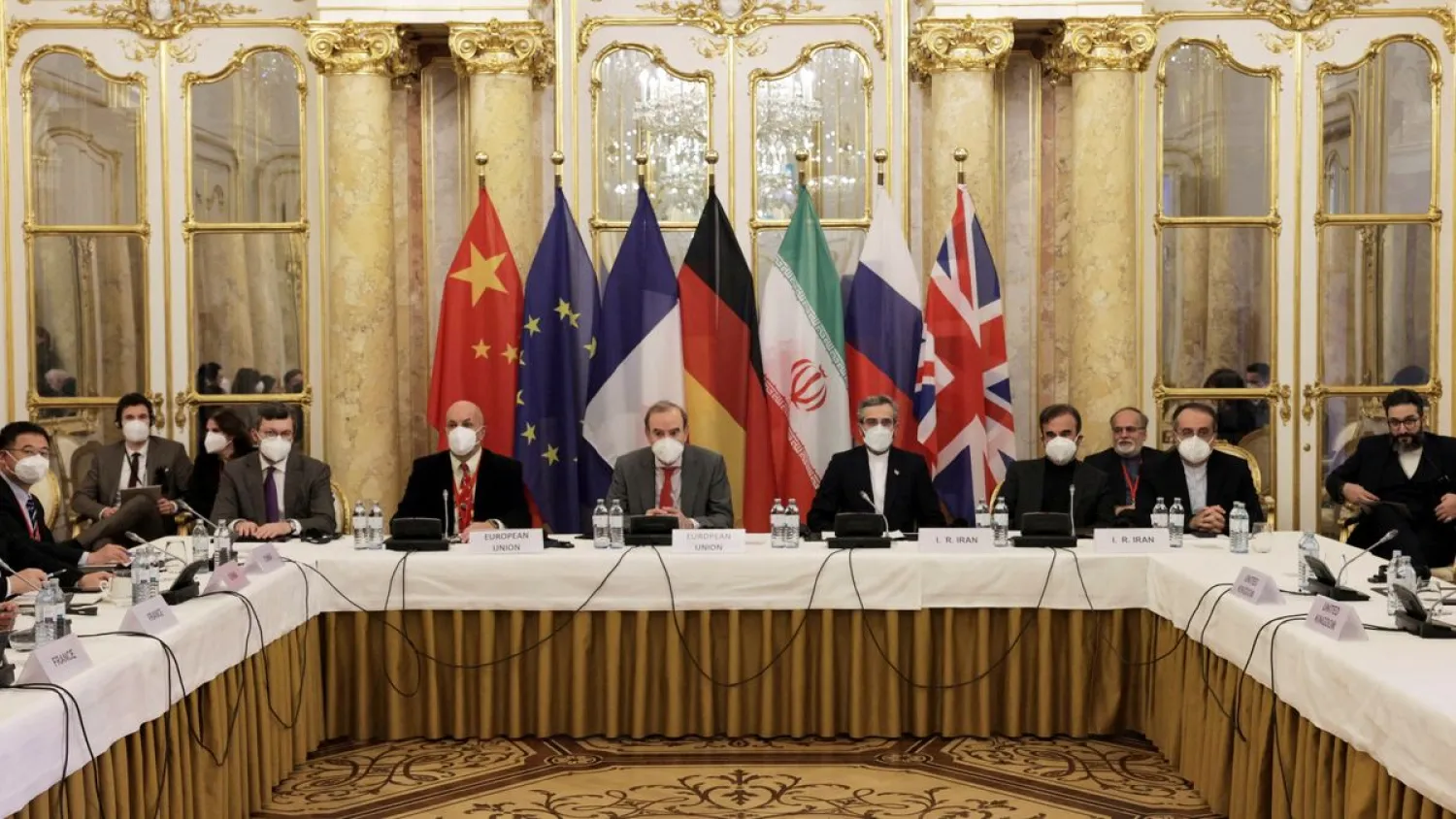
Deputy Secretary General of the European External Action Service (EEAS) Enrique Mora and Iran's chief nuclear negotiator Ali Bagheri Kani and delegations wait for the start of a meeting of the JCPOA Joint Commission in Vienna, Austria December 17, 2021. EU Delegation in Vienna/EEAS/Handout via Reuters
TT

Iran, US Lock Horns over Sanctions Relief, Nuclear Curbs in Vienna Talks

Deputy Secretary General of the European External Action Service (EEAS) Enrique Mora and Iran's chief nuclear negotiator Ali Bagheri Kani and delegations wait for the start of a meeting of the JCPOA Joint Commission in Vienna, Austria December 17, 2021. EU Delegation in Vienna/EEAS/Handout via Reuters

Iran and the United States are displaying little flexibility on core issues in indirect nuclear talks, raising questions about whether a compromise can be found soon to renew a 2015 deal that could dispel fears of a wider Middle East war, diplomats say.

After eight rounds of talks, the thorniest points remain the speed and scope of lifting sanctions on Tehran -- including Iran's demand for a US guarantee of no further punitive steps -- and how and when to restore curbs on Iran's atomic work.

The nuclear deal limited Iran´'s uranium enrichment activity to make it harder for it to develop nuclear arms -- an ambition Tehran denies -- in return for lifting international sanctions.

But former US President Donald Trump ditched the pact in 2018, saying it did not do enough to curb Iran's nuclear activities, ballistic missile program and regional influence, and reimposed sanctions that badly damaged Iran's economy.

After waiting for a year, Iran responded to Trump's pressure by gradually breaching the accord, including rebuilding stockpiles of enriched uranium, refining it to higher fissile purity and installing advanced centrifuges to speed up output.

Following months of stop-start talks that began after Joe Biden replaced Trump in the White House, Western officials now say time is running out to resurrect the pact. But Iranian officials deny they are under time pressure, arguing the economy can survive thanks to oil sales to China.

'We need guarantees'

A former Iranian official said Iran's rulers "are certain that their uncompromising, maximalist approach will give results."

France said on Tuesday that despite some progress at the end of December, Iran and world powers were still far away from reviving the deal.

The US State Department said on Jan. 4 the issues "at the heart of the negotiations" were sanctions relief and the nuclear steps that Iran would take to return the accord.

Iran insists on immediate removal of all Trump-era sanctions in a verifiable process. Washington has said it would remove curbs inconsistent with the 2015 pact if Iran resumed compliance with the deal, implying it would leave in place others such as those imposed under terrorism or human rights measures.

"Americans should give assurances that no new sanctions under any label would be imposed on Iran in future. We need guarantees that America will not abandon the deal again," said a senior Iranian official.

Iran's Nournews, a media outlet affiliated to the Supreme National Security Council, reported on Wednesday that Iran's key conditions at the talks "are assurances and verifications."

US officials were not immediately available to comment on the question of guarantees. However, US officials have said Biden cannot promise the US government will not renege on the agreement because the nuclear deal is a non-binding political understanding, not a legally-binding treaty.

Asked to comment on that US constitutional reality, an Iranian official said: "It's their internal problem."

On the issue of obtaining verification that sanctions have been removed -- at which point Iran would have to revive curbs on its nuclear program -- the senior Iranian official said Iran and Washington differed over the timetable.

"Iran needs a couple of weeks to verify sanctions removal (before it reverses its nuclear steps). But the other party says a few days would be enough to load oil on a ship, export it and transfer its money through banking system," the official said.

Threats

Shadowing the background of the talks have been threats by Israel, widely believed to have the Middle East's only nuclear weaponry but which sees Iran as a existential threat, to attack Iranian nuclear installations if it deems diplomacy ultimately futile in containing Tehran's atomic abilities and potential.

Iran says it would hit back hard if it were attacked.

A Western diplomat said "early-February is a realistic end-date for Vienna talks" as the longer Iran remains outside the deal, the more nuclear expertise it will gain, shortening the time it might need to race to build a bomb if it chose to.

"Still we are not sure whether Iran really wants a deal," said another Western diplomat.

Iran has ruled out adhering to any "artificial" deadline.

"Several times, they asked Iran to slow down its nuclear work during the talks, and even Americans conveyed messages about an interim deal through other parties," said a second Iranian official, close to Iran's negotiating team.

"It was rejected by Iran."

Asked for comment, a State Department spokesperson who declined to be identified told Reuters: "Of course we - and the whole international community - want Iran to slow down their nuclear program and have communicated that very clearly."

"Beyond that, we don't negotiate the details in public, but these reports are far off."

Other points of contention include Iran's advanced nuclear centrifuges -- machines that purify uranium for use as fuel in atomic power plants or, if purified to a high level, weapons.

"Discussions continue on Iran's demand to store and seal its advanced centrifuges ... They wanted those centrifuges to be dismantled and shipped abroad," the first official said.

Asked to comment on this question, a Western diplomat said: "We are looking for ways to overcome our differences with Iran about verification process.



Top Trump Iran Negotiator Says Visits US Aircraft Carrier in Middle East

US Special Envoy Steve Witkoff delivers a press conference upon the signing of the declaration on deploying post-ceasefire force in Ukraine, during the so-called "Coalition of the Willing" summit, at the Elysee Palace in Paris, France, January 6, 2026. (Reuters)
TT

Top Trump Iran Negotiator Says Visits US Aircraft Carrier in Middle East

US Special Envoy Steve Witkoff delivers a press conference upon the signing of the declaration on deploying post-ceasefire force in Ukraine, during the so-called "Coalition of the Willing" summit, at the Elysee Palace in Paris, France, January 6, 2026. (Reuters)

US President Donald Trump's lead Iran negotiator Steve Witkoff on Saturday said he visited the USS Abraham Lincoln aircraft carrier currently in the Arabian Sea, with Washington and Tehran due to hold further talks soon.

"Today, Adm. Brad Cooper, Commander of US Naval Forces Central Command, Jared Kushner, and I met with the brave sailors and Marines aboard the USS Abraham Lincoln, her strike group, and Carrier Air Wing 9 who are keeping us safe and upholding President Trump's message of peace through strength," said Witkoff in a social media post.

Iranian Foreign Minister Abbas Araghchi said on Saturday he hoped talks with the United States would resume soon, while reiterating Tehran's red lines and warning against any American attack.


Israel’s Netanyahu Expected to Meet Trump in US on Wednesday and Discuss Iran

Israeli Prime Minister Benjamin Netanyahu delivers a speech during a special session to mark the 77th anniversary of the Knesset's establishment and the 60th anniversary of the dedication of the current building at the Knesset, the Israeli parliament, in Jerusalem, 02 February 2026. (EPA)
TT

Israel’s Netanyahu Expected to Meet Trump in US on Wednesday and Discuss Iran

Israeli Prime Minister Benjamin Netanyahu delivers a speech during a special session to mark the 77th anniversary of the Knesset's establishment and the 60th anniversary of the dedication of the current building at the Knesset, the Israeli parliament, in Jerusalem, 02 February 2026. (EPA)

Israeli Prime Minister Benjamin Netanyahu is expected to meet US President Donald Trump on Wednesday in Washington, where they will discuss negotiations with Iran, Netanyahu's office said on Saturday.

Iranian and US officials held indirect nuclear ‌talks in the ‌Omani capital ‌Muscat ⁠on Friday. ‌Both sides said more talks were expected to be held again soon.

A regional diplomat briefed by Tehran on the talks told Reuters Iran insisted ⁠on its "right to enrich uranium" ‌during the negotiations with ‍the US, ‍and that Tehran's missile capabilities ‍were not raised in the discussions.

Iranian officials have ruled out putting Iran's missiles - one of the largest such arsenals in the region - up ⁠for discussion, and have said Tehran wants recognition of its right to enrich uranium.

"The Prime Minister believes that any negotiations must include limiting ballistic missiles and halting support for the Iranian axis," Netanyahu's office said in a ‌statement.


Italy FM Rules Out Joining Trump’s ‘Board of Peace’

Italy's Minister for Foreign Affairs Antonio Tajani speaks to the press during the EPP Leaders’ meeting, in Zagreb, Croatia, 30 January 2026. (EPA)
TT

Italy FM Rules Out Joining Trump’s ‘Board of Peace’

Italy's Minister for Foreign Affairs Antonio Tajani speaks to the press during the EPP Leaders’ meeting, in Zagreb, Croatia, 30 January 2026. (EPA)

Italy will not take part in US President Donald Trump's "Board of Peace", Italian Foreign Minister Antonio Tajani said Saturday, citing "insurmountable" constitutional issues.

Trump launched his "Board of Peace" at the World Economic Forum in Davos in January and some 19 countries have signed its founding charter.

But Italy's constitution bars the country from joining an organization led by a single foreign leader.

Prime Minister Giorgia Meloni, a Trump ally, last month noted "constitutional problems" with joining, but suggested Trump could perhaps reopen the framework "to meet the needs not only of Italy, but also of other European countries".

Tajani appeared Saturday to rule that out.

"We cannot participate in the Board of Peace because there is a constitutional limit," he told the ANSA news agency.

"This is insurmountable from a legal standpoint," he said, the day after meeting US Secretary of State Marco Rubio and US Vice President JD Vance at the Olympics in Milan.

Although originally meant to oversee Gaza's rebuilding, the board's charter does not limit its role to the Palestinian territory and appears to want to rival the United Nations.