


What in the Wordle? Five-Letter Puzzle Craze Goes Global

The online word game "Wordle" has gripped the attention of millions around the world. (AFP)
TT

What in the Wordle? Five-Letter Puzzle Craze Goes Global

The online word game "Wordle" has gripped the attention of millions around the world. (AFP)

Five letters, six attempts, and just one puzzle to solve per day: the "Wordle" formula couldn't be simpler, but in a matter of weeks the online brain teaser has got millions guessing around the world.

"It just grabs you," daily player Susan Drubin told AFP of the code-breaking word challenge -- perhaps best described as a cross between the retro board game "Mastermind" and a daily crossword.

"The great thing about it, is it only takes a few minutes, usually, and it's a very nice, tiny distraction," said the 65-year-old from the Washington suburbs.

The puzzle's rise has been meteoric: according to The New York Times, 90 people played on November 1. Two months later, on January 2, more than 300,000 tackled the challenge. The Guardian put the daily player count last weekend at two million, and rising...

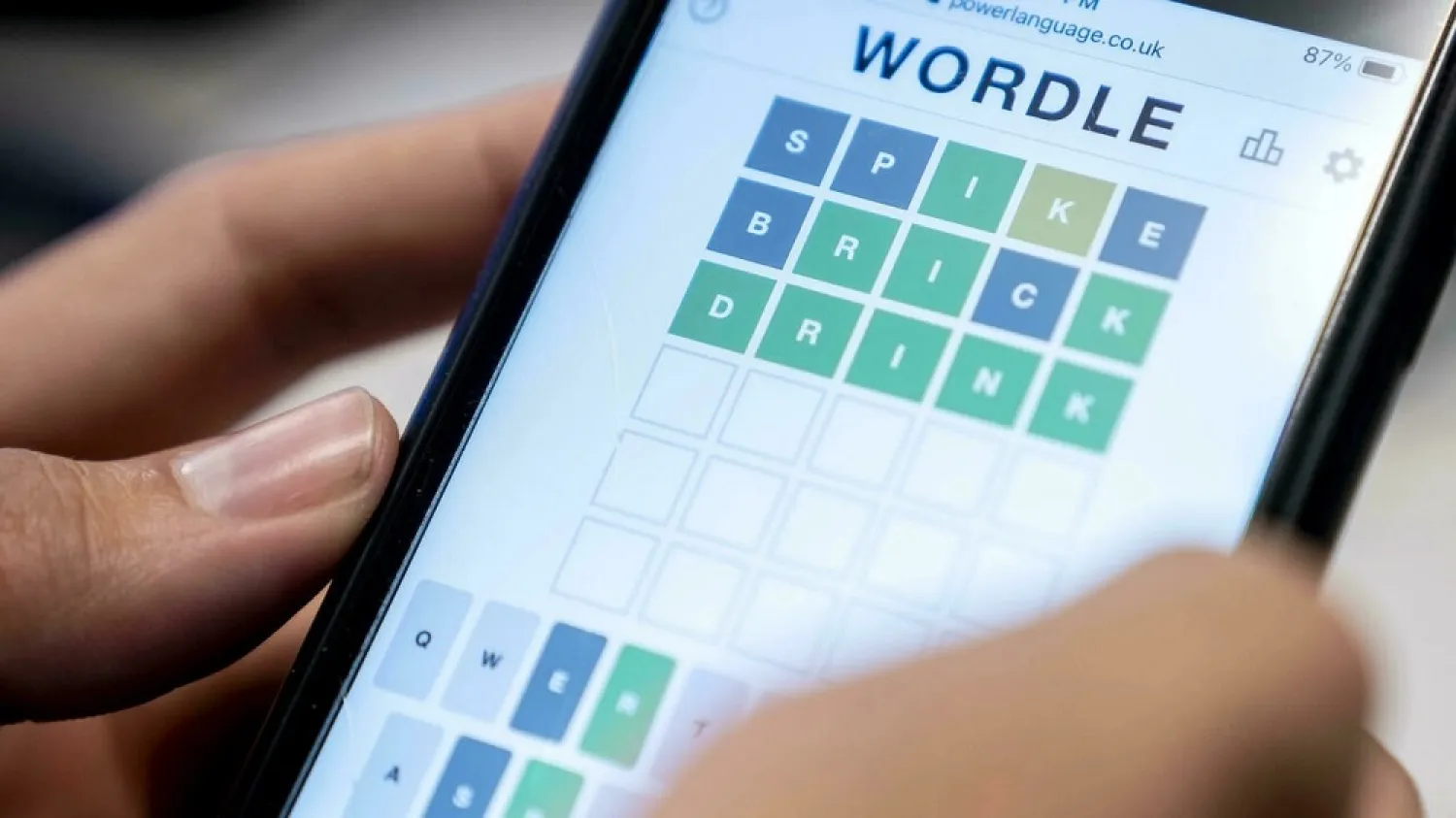
Wordle's rules are disarmingly simple: find the word of the day in six tries or fewer. Each guess must be a valid five letter word: letters in the correct space turn green, while letters that are part of the answer but in the wrong spot turn yellow.

Only one word is offered up per day, and it is the same for everyone. Can't crack today's puzzle? You'll just have to wait until tomorrow for the next one.

Although the game itself is accessed on a website, rather than an app, players can generate a shareable widget, with six lines of colored squares indicating how many tries it took to solve the riddle -- without giving away the day's answer, of course.

After a couple of weeks, Drubin -- like legions of players -- took to sharing her results on social media under the hashtag #Wordle.

And thus, a viral phenomenon was born.

'Just fun'

Part of what makes Wordle special is that it costs nothing to play -- and is also, more unusually, ad-free.

Its designer Josh Wardle, a software engineer based in Brooklyn but originally from Wales, has decided not to monetize the game.

"I think people kind of appreciate that there's this thing online that's just fun," Wardle told The New York Times on Monday. "It's not trying to do anything shady with your data or your eyeballs."

While the game website -- "powerlanguage.co.uk/wordle" -- is free of ads or pop-ups, it did not take long for enterprising copy-cats to try to mimic the game concept, devising app store clones for purchase which have since been taken down.

The lone app left standing is an unrelated game called "Wordle!" with an exclamation mark, created by a teenager five years ago.

Its developer Steven Cravotta, now 24, says he initially "had no idea what was going on" when his app starting logging more than 40,000 daily downloads.

"I didn't know it was a craze," Cravotta told The Wall Street Journal.

Bragging rights

For Mikael Jakobsson, a research coordinator for the Massachusetts Institute of Technology Game Lab, Wordle falls into the "gap-filler" category, a game "that you can pull out when you're waiting for a friend or... for the bus."

He puts its success partly down to how easy it is to share results with friends, either by social media or word-of-mouth.

When you crack the puzzle, "you feel very proud of yourself... You have that share button right there. So then you can brag a little bit about it, which we tend to like doing."

Rachel Kowert, a psychologist specializing in video games, also points to the social comparison theory, which holds that everyone wants to evaluate themselves in relation to others.

The temptation is such that tongue-in-cheek debates have sprung up online about muting friends who tweet out their "humble-brag" scores.

Another key part of the game's allure, says Kowert, is that being "limited to one a day gives you a sense of psychological scarcity."

"You're not overdoing it in any one session, and it keeps you wanting to come back to continue to play day after day," she said.

Wordle is already being adapted into other languages, including French, having swiftly conquered the English-speaking world -- although, spoiler alert, the Wednesday word's American spelling triggered howls of online player protests from its creator's fellow Britons.


US Allows Nvidia to Send Advanced AI Chips to China with Restrictions

An Nvidia logo and a computer motherboard appear in this illustration taken August 25, 2025. (Reuters)
TT

US Allows Nvidia to Send Advanced AI Chips to China with Restrictions

An Nvidia logo and a computer motherboard appear in this illustration taken August 25, 2025. (Reuters)

The US Commerce Department on Tuesday opened the door for Nvidia to sell advanced artificial intelligence chips in China with restrictions, following through on a policy shift announced last month by President Donald Trump.

The change would permit Nvidia to sell its powerful H200 chip to Chinese buyers if certain conditions are met -- including proof of "sufficient" US supply -- while sales of its most advanced processors would still be blocked.

However, uncertainty has grown over how much demand there will be from Chinese companies, as Beijing has reportedly been encouraging tech companies to use homegrown chips.

Chinese officials have informed some firms they would only approve buying H200 chips under special circumstances, such as development labs or university research, news website The Information reported Tuesday, citing people with knowledge of the situation.

The Information had previously reported that Chinese officials were calling on companies there to pause H200 purchases while they deliberated requiring them to buy a certain ratio of AI chips made by Nvidia rivals in China.

In its official update on Tuesday, the US Commerce Department's Bureau of Industry and Security said it had changed the licensing review policy for H200 and similar chips from a presumption of denial to handling applications case-by-case.

Trump announced in December an agreement with Chinese President Xi Jinping to allow Nvidia to export its H200 chips to China, with the US government getting a 25-percent cut of sales.

The move marked a significant shift in US export policy for advanced AI chips, which Joe Biden's administration had heavily restricted over national security concerns about Chinese military applications.

Democrats in Congress have criticized the move as a huge mistake that will help China's military and economy.

- Chinese chips -

Nvidia chief executive Jensen Huang has advocated for the company to be allowed to sell some of its more advanced chips in China, arguing the importance of AI systems around the world being built on US technology.

The chips -- graphic processing units or GPUs -- are used to train the AI models that are the bedrock of the generative AI revolution launched with the release of ChatGPT in 2022.

The GPU sector is dominated by Nvidia, now the world's most valuable company thanks to frenzied global demand and optimism for AI.

H200s are roughly 18 months behind the US company's most state-of-the-art offerings, which will still be off-limits to China.

Nvidia's Huang has repeatedly warned that China is just "nanoseconds behind" the United States as it accelerates the development of domestically produced advanced chips.

On Wednesday, leading Chinese AI startup Zhipu said it had used homegrown Huawei chips to train its new image generator.

Zhipu AI described its tool as "the first state-of-the-art multimodal model to complete the entire training process on a domestically produced chip".

The startup went public in Hong Kong last week and its shares have since soared 75 percent -- one of several dazzling recent initial public offerings by Chinese chip and generative AI companies, as high hopes for the sector outweigh concerns of a potential market crash.


Apple Rolls Out Creator Studio to Boost Services Push, Adds AI Features

A customer compares his old iPhone with the newly launched iPhone 17 pro max at an Apple retail store in Delhi, India, September 19, 2025. (Reuters)
TT

Apple Rolls Out Creator Studio to Boost Services Push, Adds AI Features

A customer compares his old iPhone with the newly launched iPhone 17 pro max at an Apple retail store in Delhi, India, September 19, 2025. (Reuters)

Apple on Tuesday unveiled Apple Creator Studio, a new subscription bundle of professional creative software priced at $12.99 a month or $129 a year, as the iPhone maker steps up its push into paid services for creators, students and professionals.

The company has used its services business, which includes its Apple ‌Music and ‌iCloud services, to drive ‌growth ⁠in recent ‌years, helping counter slower hardware growth and generate recurring revenue.

Apple Creator Studio bundles some of the company's best-known creative tools into a single subscription, including Final Cut Pro, Logic Pro ⁠and Pixelmator Pro across Mac and iPad.

The ‌package also adds premium ‍content and ‍new AI-powered features to Apple's productivity apps ‍Keynote, Pages and Numbers, while digital whiteboarding app Freeform will gain enhanced features later.

Final Cut Pro will offer new tools such as transcript-based search, visual search and beat detection to ⁠speed up video editing, while Logic Pro introduces AI-powered features like Synth Player and Chord ID to assist with music creation.

The company's Photoshop-alternative Pixelmator Pro will be available on iPad for the first time and will offer Apple Pencil support.

The subscription launches January 28 on ‌the App Store, Apple said.


Social Media Harms Teens, Watchdog Warns, as France Weighs Ban

The TikTok app logo is seen in this illustration taken January 16, 2025. (Reuters)
TT

Social Media Harms Teens, Watchdog Warns, as France Weighs Ban

The TikTok app logo is seen in this illustration taken January 16, 2025. (Reuters)

Social media harms the mental health of adolescents, particularly girls, France's health watchdog said Tuesday as the country debates banning children under 15 from accessing the immensely popular platforms.

The results of an expert scientific review on the subject were announced after Australia became the first country to prohibit big platforms including Instagram, TikTok and YouTube for under 16s last month, while other nations consider following its lead.

Using social media is not the sole cause of the declining mental health of teenagers, but its negative effects are "numerous" and well documented, the French public health watchdog ANSES wrote in its opinion, the result of five years of work by a committee of experts.

France is currently debating two bills, one backed by President Emmanuel Macron, that would ban social media for under 15s.

The ANSES opinion recommended "acting at the source" to ensure that children can only access social networks "designed and configured to protect their health".

This means that the platforms would have to change their personalized algorithms, persuasive techniques and default settings, according to the agency.

"This study provides scientific arguments for the debate about social networks in recent years: it is based on 1,000 studies," the expert panel's head Olivia Roth-Delgado told a press conference.

Social media can create an "unprecedented echo chamber" that reinforces stereotypes, promotes risky behavior and promotes cyberbullying, the ANSES opinion said.

The content also portrays an unrealistic idea of beauty via digitally altered images that can lead to low self-esteem in girls, which creates fertile ground for depression or eating disorders, it added.

Girls -- who use social media more than boys -- are subjected to more of the "social pressure linked to gender stereotypes," the opinion said.

This means girls are more affected by the dangers of social media -- as are people with pre-existing mental health conditions, it added.

On Monday, tech giant Meta urged Australia to rethink its teen social media ban, while reporting that it has blocked more than 544,000 Instagram, Facebook and Threads accounts under the new law.

Meta said parents and experts were worried about the ban isolating young people from online communities, and driving some to less regulated apps and darker corners of the internet.