


Rubble Brings Opportunity, and Risk, in War-scarred Gaza

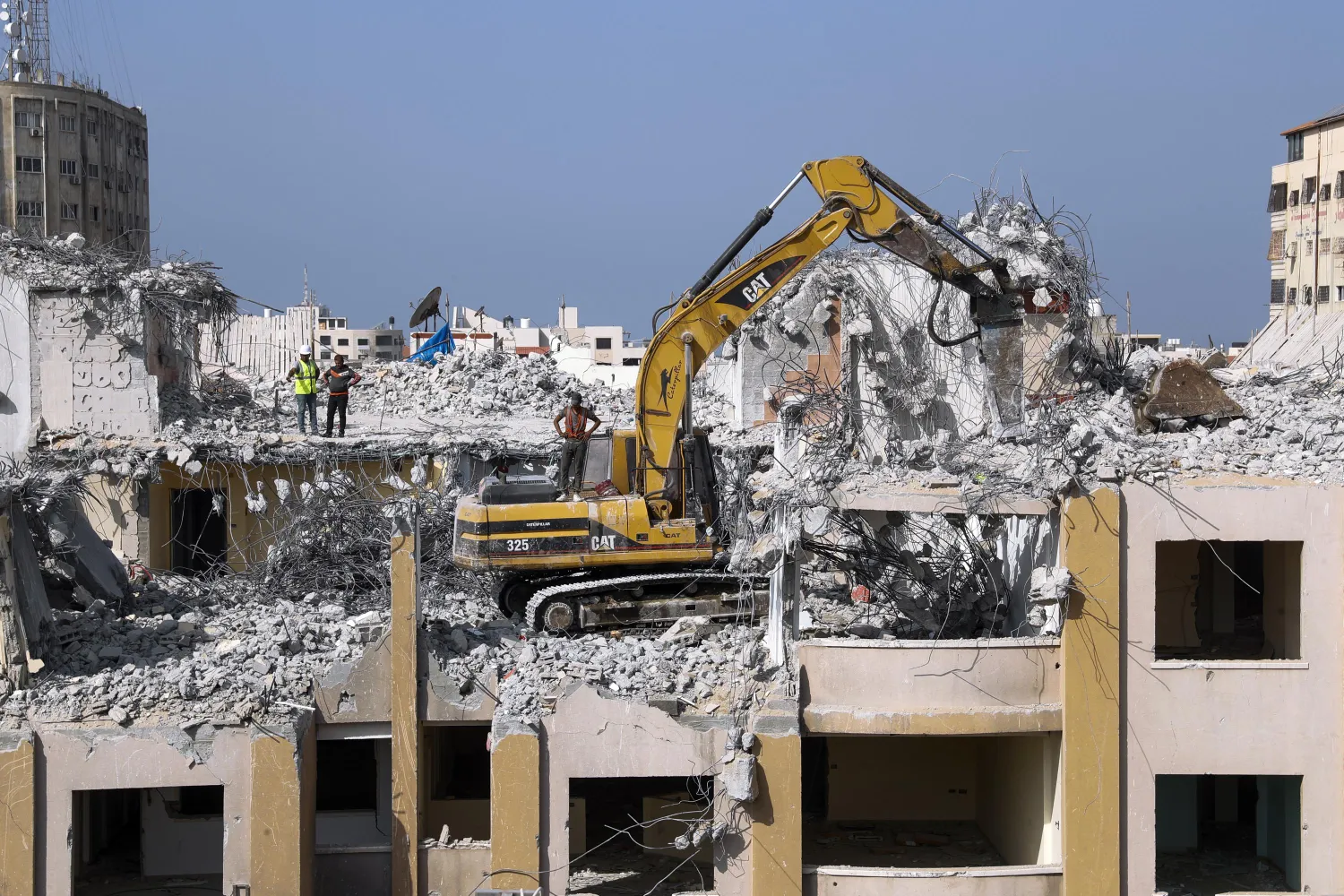
Palestinian workers use a backhoe to break and remove parts of the Al-Jawhara building, that was damaged in Israeli airstrikes during Israel's war with Gaza's Hamas rulers last May, in the central al-Rimal neighborhood of Gaza City, Nov. 16, 2021. (AP Photo/Adel Hana)
TT

Rubble Brings Opportunity, and Risk, in War-scarred Gaza

Palestinian workers use a backhoe to break and remove parts of the Al-Jawhara building, that was damaged in Israeli airstrikes during Israel's war with Gaza's Hamas rulers last May, in the central al-Rimal neighborhood of Gaza City, Nov. 16, 2021. (AP Photo/Adel Hana)

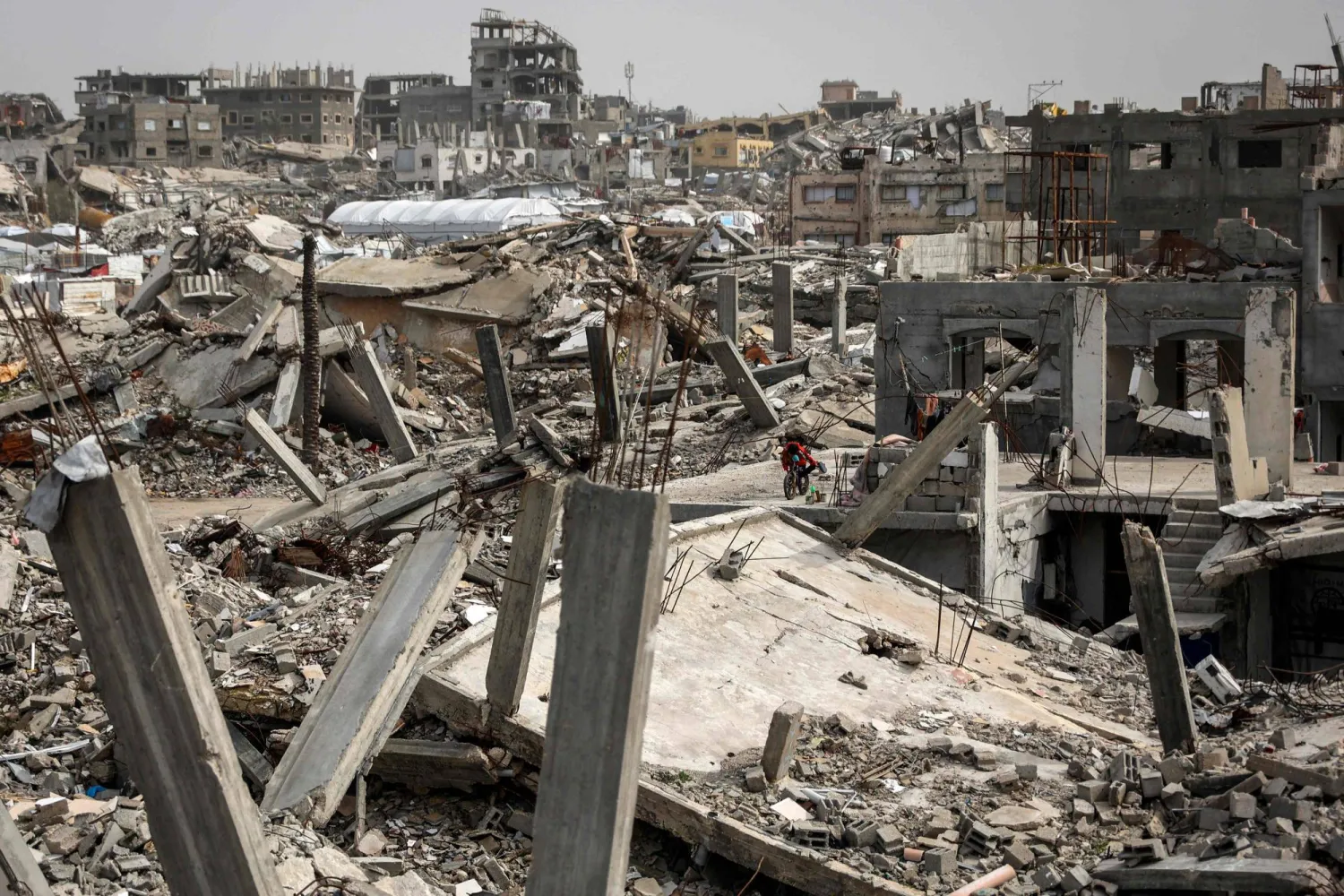
The Gaza Strip has few jobs, little electricity and almost no natural resources. But after four bruising wars with Israel in just over a decade, it has lots of rubble.

Local businesses are now finding ways to cash in on the chunks of smashed concrete, bricks and debris left behind by years of conflict. In a territory suffering from a chronic shortage of construction materials, a bustling recycling industry has sprouted up, providing income to a lucky few but raising concerns that the refurbished rubble is substandard and unsafe, The Associated Press said.

“It’s a lucrative business,” said Naji Sarhan, deputy housing minister in the territory’s Hamas-led government. The challenge, he said, is regulating the use of recycled rubble in construction.

“We are trying to control and correct the misuse of these materials,” he said.

Israel and Gaza’s Hamas rulers have gone to war four times since the ISIS group, which opposes Israel's existence, seized control of the territory in 2007. The most recent fighting was in May. Israeli airstrikes have damaged or leveled tens of thousands of buildings in the fighting.

The United Nations Development Program says it worked with the local private sector to remove some 2.5 million metric tons of rubble left behind from wars in 2009, 2012 and 2014. Gaza’s Housing Ministry says the 11-day war in May left an additional 270,000 tons.

The UNDP has worked on rubble recycling since Israel's 2005 withdrawal from Gaza. It also has played a key role in the latest cleanup, removing about 110,000 tons, or more than one-third of the rubble. That includes the Al-Jawhara building, a high-rise in downtown Gaza City that was damaged so heavily by Israeli missiles that it was deemed beyond repair. Israel said the building housed Hamas military intelligence operations.

Over the past three months, excavators lifted atop the building systematically demolished it floor by floor. Just one floor remains and the construction crews are now removing the building’s foundations and pillars on the ground.

In a common scene outside every building destroyed by the war, workers separated twisted rebar iron from the debris, to be straightened out and re-used in things like boundary walls and ground slabs.

Israel and Egypt have maintained a crippling blockade on Gaza for the past 15 years, restricting the entry of badly needed construction materials. Israel says such restrictions are needed to prevent Hamas from diverting goods like concrete and steel for military use. Since 2014, it has allowed some imports under the supervision of the United Nations. But thousands of homes need to be repaired or rebuilt, and shortages are rampant.

The UNDP has put tight restrictions on its recycling effort. It says that renewed rubble is not safe enough for use in building homes and buildings. Instead, it allows it to be used only for road projects.

“We do not recommend any of the rubble to be used for any reconstruction as such, because it is not a good quality material for reconstruction,” said Yvonne Helle, a UNDP spokeswoman. She said the metal is separated and returned to the buildings' owners because it “also has a value.”

On a recent day, trucks trickled into a lowland in central Gaza near the Israeli frontier, carrying large chunks from the Al-Jawhara tower. The site, adjacent to a mountain of garbage serving as Gaza’s main landfill, is overseen by the UNDP.

A wheel loader filled a bucket with debris that was tossed into a crushing machine. It produces large pieces of aggregate that the site supervisor said could be used as a base under the asphalt layer in street construction. Because of safety concerns, they are not allowed to crush the rubble into smaller aggregate that could be used in house construction.

The trucks then return to Gaza City where the UNDP is funding a road project, providing a much-needed source of work in a territory with nearly 50% unemployment.
The UN road projects have provided a partial solution for the rubble problem, but most of Gaza’s debris continues to make its way into the desperate private sector.

Sarhan, the Housing Ministry official, said it is forbidden to use recycled rubble in major construction. But he said enforcing that ban is extremely difficult and much of the material is creeping back into the local construction markets.

Ahmed Abu Asaker, an engineer from the Gaza Contractors’ Union, said many brick factories use the local aggregate, which he said is not a “great concern.” He said there have been a few isolated cases of it being mixed into concrete, which is far more dangerous.

There have not been any reports of building collapses. But Abu Asaker estimates that thousands of homes have been built with materials from recycled rubble since 2014.
Just north of the UNDP processing center, about 50 rubble crushers were hard at work at a private facility on a recent day, producing different kinds of aggregate.

The most popular items are the “sesame," which is used for making cinder blocks, and the “lentil-like” grind sent to cement-mixing factories.

Around the crushers were mounds of small aggregate, with tiny pieces of shredded plastic, cloth and wood clearly mixed in.

Antar al-Katatni, who runs a nearby brick factory, says he makes bricks using the sesame aggregate. He acknowledged the material has impurities like sand, but there is an upside. “It makes more bricks,” he said.

He said engineers do not buy his blocks for internationally funded projects, because they are not allowed to do so, “but poor people do.”

A brick costs two shekels, or about 65 cents, when it’s made with higher quality Israeli-imported aggregate. The price for the ones he makes are slightly cheaper, at 1.7 or 1.8 shekels. When a typical project might require several thousand bricks, even the small price difference can add up for a poor family.

Sarhan said that given the blockade and Gaza’s numerous other problems, it is difficult to regulate the gray market industry.

“We cannot patrol or control every citizen," he said. "That's why you may find someone used recycled rubble here or there.”


A Blast in Gaza Wounds Soldier and Israel Accuses Hamas of Ceasefire Violation

A woman sits next to her tent on an alley of a makeshift tent camp for displaced Palestinians in Deir al-Balah, central Gaza Strip, Tuesday, Dec. 23, 2025. (AP Photo/Abdel Kareem Hana)
TT

A Blast in Gaza Wounds Soldier and Israel Accuses Hamas of Ceasefire Violation

A woman sits next to her tent on an alley of a makeshift tent camp for displaced Palestinians in Deir al-Balah, central Gaza Strip, Tuesday, Dec. 23, 2025. (AP Photo/Abdel Kareem Hana)

An explosive device detonated in Gaza on Wednesday, injuring one Israeli soldier and prompting Israel to accuse Hamas of violating the US-backed ceasefire. It was the latest incident to threaten the tenuous truce that has held since Oct. 10 as each side accuses the other of violations.

The blast came as Hamas met with Turkish officials in Ankara to discuss the second stage of the ceasefire. Though the agreement has mostly held, its progress has slowed, The AP news reported.

All but one of the 251 hostages taken in the Hamas-led attack on Oct. 7, 2023, that sparked the war have been released, alive or dead, in exchange for Palestinian prisoners and detainees. The ceasefire's second phase has even bigger challenges: the deployment of an international stabilization force, a technocratic governing body for Gaza, the disarmament of Hamas and further Israeli troop withdrawals from the territory.

Israel vows to ‘respond accordingly’ Israel's military said the explosive detonated beneath a military vehicle as soldiers were “dismantling” militant infrastructure in the southern city of Rafah. The lightly injured soldier was taken to a hospital, the military said.

Prime Minister Benjamin Netanyahu in a statement called the incident a violation of the ceasefire and said Israel would "respond accordingly.”

Israel previously launched strikes in Gaza in response to alleged ceasefire violations. On Oct. 19, Israel said two soldiers were killed by Hamas fire and it responded with a series of strikes that killed over 40 Palestinians, according to local health officials.

Hamas accuses Israel of violating the ceasefire by not allowing enough aid into the territory and continuing to strike civilians. Palestinian health officials say over 370 Palestinians have been killed by Israeli fire since the truce.

On Friday, Israeli troops fired over the ceasefire line in northern Gaza, killing at least five Palestinians, including a baby, according to a local hospital that received the casualties.

Turkish Foreign Minister Hakan Fidan met with a Hamas delegation led by Khalil al-Haya to discuss the ceasefire's second phase, according to ministry officials.

Fidan reaffirmed Türkiye's efforts to defend the rights of Palestinians and outlined ongoing efforts to address shelter and other humanitarian needs in Gaza, the officials said.

The Hamas delegation said they had fulfilled the ceasefire’s conditions but that Israel’s continued attacks were blocking progress toward the next stage. They also asserted that 60% of the trucks allowed into Gaza were carrying commercial goods rather than aid.

According to the officials, the meeting also discussed reconciliation efforts between the Palestinian factions and the situation in the Israeli-occupied West Bank, stressing that Israel’s actions there were “unacceptable.”


Algeria Passes Law Declaring French Colonisation a Crime

Members of the committee drafting the law criminalizing colonialism (File Photo/ Algerian Parliament)
TT

Algeria Passes Law Declaring French Colonisation a Crime

Members of the committee drafting the law criminalizing colonialism (File Photo/ Algerian Parliament)

Algeria's parliament unanimously approved on Wednesday a law declaring France's colonisation of the country a crime, and demanding an apology and reparations.

Standing in the chamber, lawmakers wearing scarves in the colors of the national flag chanted "long live Algeria" as they applauded the passage of the bill, which states that France holds "legal responsibility for its colonial past in Algeria and the tragedies it caused".

The vote comes as the two countries are embroiled in a major diplomatic crisis, and analysts say that while Algeria's move is largely symbolic, it is still politically significant, AFP reported.

Parliament speaker Brahim Boughali told the APS state news agency before the vote that it would send "a clear message, both internally and externally, that Algeria's national memory is neither erasable nor negotiable".

The legislation lists the "crimes of French colonisation", including nuclear tests, extrajudicial killings, "physical and psychological torture", and the "systematic plundering of resources".

It states that "full and fair compensation for all material and moral damages caused by French colonisation is an inalienable right of the Algerian state and people".

France's rule over Algeria from 1830 until 1962 remains a sore spot in relations between the two countries.

The period was marked by mass killings and large-scale deportations, all the way up to the bloody war of independence from 1954-1962.

Algeria says the war killed 1.5 million people, while French historians put the death toll lower at 500,000 in total, 400,000 of them Algerian.

French President Emmanuel Macron has previously acknowledged the colonisation of Algeria as a "crime against humanity", but has stopped short of offering an apology.

Asked last week about the vote, French foreign ministry spokesman Pascal Confavreux said he would not comment on "political debates taking place in foreign countries".

Hosni Kitouni, a researcher in colonial history at the University of Exeter in the UK, said that "legally, this law has no international scope and therefore is not binding for France".

But "its political and symbolic significance is important: it marks a rupture in the relationship with France in terms of memory," he said.


Türkiye, Hamas Discuss Gaza Ceasefire Deal’s Second Phase, Turkish Source Says

Palestinian children play next to tents in a makeshift camp for displaced people set up on the beach in Gaza City, Tuesday, Dec. 16, 2025. (AP)
TT

Türkiye, Hamas Discuss Gaza Ceasefire Deal’s Second Phase, Turkish Source Says

Palestinian children play next to tents in a makeshift camp for displaced people set up on the beach in Gaza City, Tuesday, Dec. 16, 2025. (AP)

Turkish Foreign Minister Hakan Fidan on Wednesday ​met with Hamas political bureau officials in Ankara to discuss the ceasefire in Gaza and advancing the ‌agreement to ‌its ‌second ⁠phase, ​a ‌Turkish Foreign Ministry source said according to Reuters.

The source said the Hamas officials told Fidan that they had fulfilled ⁠their requirements as ‌part of the ‍ceasefire ‍deal, but that Israel's ‍continued targeting of Gaza aimed to prevent the agreement from ​moving to the next phase.

The Hamas members ⁠also said humanitarian aid entering Gaza was not sufficient, and that goods like medication, equipment for housing, and fuel were needed, the source ‌added.