

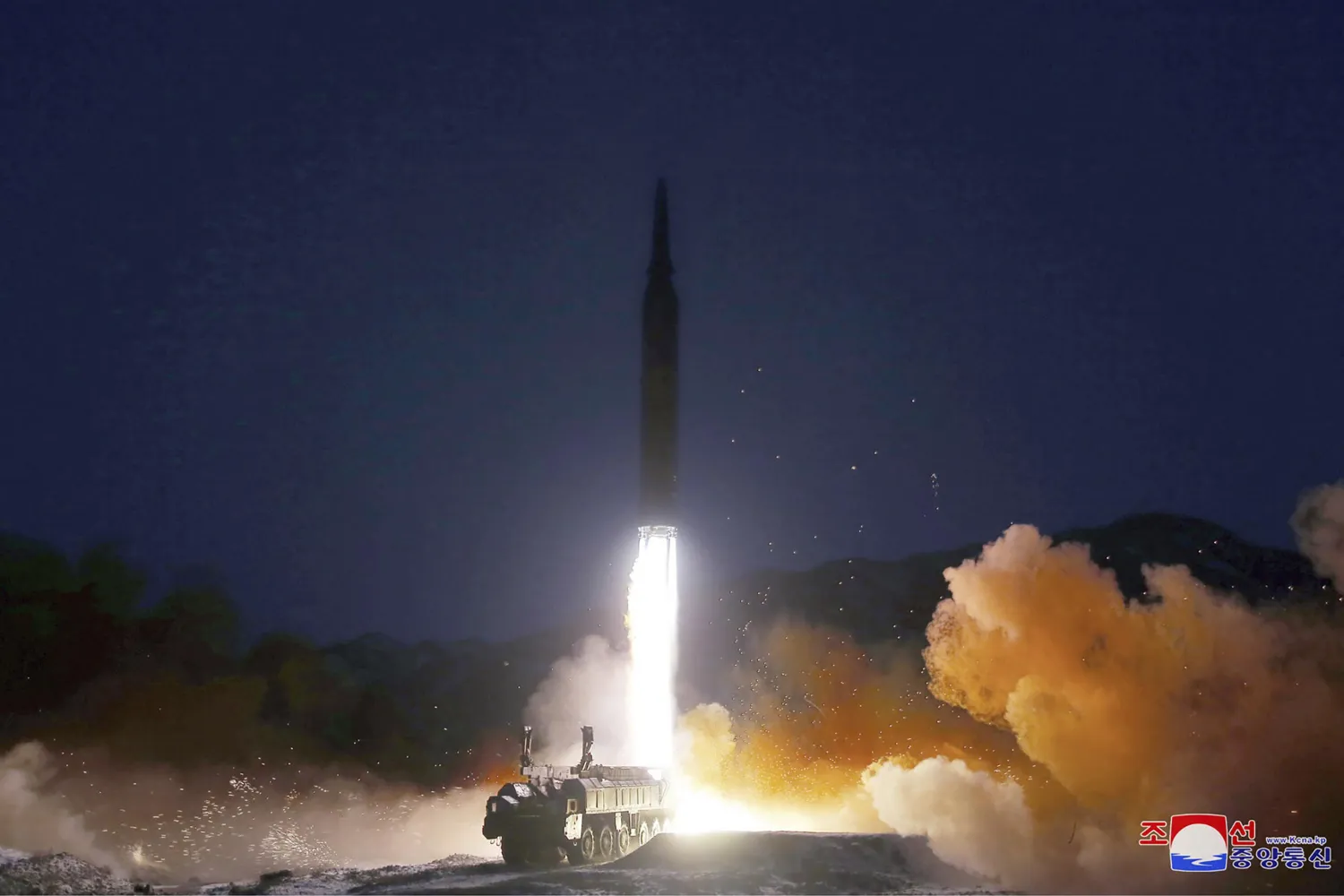

N. Korea Fires Fresh Missiles in Response to US Sanctions

FILE - This photo provided by the North Korean government shows what it says a test launch of a hypersonic missile on Jan. 11, 2022 in North Korea. (Korean Central News Agency/Korea News Service via AP, File)
TT

N. Korea Fires Fresh Missiles in Response to US Sanctions

FILE - This photo provided by the North Korean government shows what it says a test launch of a hypersonic missile on Jan. 11, 2022 in North Korea. (Korean Central News Agency/Korea News Service via AP, File)

North Korea on Friday fired what appeared to be two short-range ballistic missiles in its third weapons launch this month, officials in South Korea said, in an apparent reprisal for fresh sanctions imposed by the Biden administration for its continuing test launches.

South Korea’s Joint Chiefs of Staff said the missiles were fired 11 minutes apart from an inland area in western North Pyongan province, where North Korea is known to operate key missile bases and has frequently conducted test launches in recent years, The Associated Press said.

The missiles flew 430 kilometers (267 miles) cross-country on a maximum altitude of 36 kilometers (22 miles) before landing in the sea, the military said.

Japan’s coast guard urged vessels to pay attention to falling objects, but Chief Cabinet Secretary Hirokazu Matsuno said there were no reports of damage to vessels or aircraft.

Hours earlier, North Korea issued a statement berating the Biden administration for imposing fresh sanctions over its previous missile tests and warned of stronger and more explicit action if Washington maintains its “confrontational stance.”

The sanctions targeted five North Koreans over their roles in obtaining equipment and technology for the North’s missile programs in its response to the North’s missile test this week. Washington also said it would seek new UN sanctions.

The test-launch of a hypersonic missile on Tuesday — the second in a week — was overseen by leader Kim Jong Un, who said it would greatly increase his country’s nuclear “war deterrent.”

North Korea has been ramping up tests of new, potentially nuclear-capable missiles designed to overwhelm missile defenses in the region. Some experts say Kim is going back to a tried-and-true technique of pressuring the world with missile launches and outrageous threats before offering negotiations meant to extract concessions.

Following an unusually provocative run in nuclear and long-range missile tests in 2017 that demonstrated the North’s pursuit of an arsenal that could target the American homeland, Kim initiated diplomacy with former President Donald Trump in 2018 in an attempt to leverage his nukes for economic benefits.

But the negotiations derailed after Kim’s second summit with Trump in 2019, when the Americans rejected his demands for major sanctions relief in exchange for a partial surrender of the North’s nuclear capabilities.

Kim has since pledged to further expand a nuclear arsenal he clearly sees as his strongest guarantee of survival, despite the country’s economy suffering major setbacks after it shut its borders during the pandemic as well as persistent US-led sanctions.

His government has so far rejected the Biden administration’s open-ended offer to resume talks, saying Washington must abandon its “hostile policy” first — a term Pyongyang mainly uses to describe the sanctions and joint US-South Korea military drills.

South Korea’s presidential office said National Security Director Suh Hoon and other senior officials convened an emergency National Security Council meeting, expressed “strong regret” over the continued launches and urged Pyongyang to recommit to dialogue.

Leif-Eric Easley, a professor at Ewha University in Seoul, said North Korea appears to be signaling it will not be ignored and will respond to pressure with pressure.
“North Korea is trying to lay a trap for the Biden administration,” Easley said. “It has queued up missiles that it wants to test anyway and is responding to US pressure with additional provocations in an effort to extort concessions.”

The timing of the launch and detection of multiple missiles suggest North Korea demonstrated weapons that were already operational, rather than some of its other missiles under development, as it sought to signal Washington, said Kim Dong-yub, a professor at Seoul’s University of North Korean Studies.

He said the North may have tested a solid-fuel missile apparently modeled after Russia’s Iskander mobile ballistic system, or another short-range weapon that looks similar to the US MGM-140 Army Tactical Missile System.

Both missiles, which the North has tested since 2019, are designed to be maneuverable and fly at low attitudes, which potentially improves their chances of evading and defeating missile defense systems.

In a statement carried by North Korea’s official Korean Central News Agency, an unidentified Foreign Ministry spokesperson on Friday defended the North’s previous launches as a righteous exercise of self-defense.

The spokesperson said the new sanctions underscore hostile US intent aimed at “isolating and stifling” the North. The spokesperson accused Washington of maintaining a “gangster-like” stance, saying that the North’s development of hypersonic missiles is part of its efforts to modernize its military and does not target any specific country or threaten the security of its neighbors.

Hypersonic weapons, which fly at speeds in excess of Mach 5, or five times the speed of sound, could pose a crucial challenge to missile defenses because of their speed and maneuverability.

Such weapons were on a wish-list of sophisticated military assets Kim Jong Un unveiled early last year along with multi-warhead missiles, spy satellites, solid-fuel long-range missiles and submarine-launched nuclear missiles.

Still, experts say North Korea would need years and more successful and longer-range tests before acquiring a credible hypersonic system.

In an interview with MSNBC, Secretary of State Antony Blinken called the North’s latest tests “profoundly destabilizing” and said the United States was deeply engaged at the UN and with key partners, including allies South Korea and Japan, on a response.

“I think some of this is North Korea trying to get attention. It’s done that in the past. It’ll probably continue to do that,” Blinken said. “But we are very focused with allies and partners in making sure that they and we are properly defended and that there are repercussions, consequences for these actions by North Korea.”



Top Trump Iran Negotiator Says Visits US Aircraft Carrier in Middle East

US Special Envoy Steve Witkoff delivers a press conference upon the signing of the declaration on deploying post-ceasefire force in Ukraine, during the so-called "Coalition of the Willing" summit, at the Elysee Palace in Paris, France, January 6, 2026. (Reuters)
TT

Top Trump Iran Negotiator Says Visits US Aircraft Carrier in Middle East

US Special Envoy Steve Witkoff delivers a press conference upon the signing of the declaration on deploying post-ceasefire force in Ukraine, during the so-called "Coalition of the Willing" summit, at the Elysee Palace in Paris, France, January 6, 2026. (Reuters)

US President Donald Trump's lead Iran negotiator Steve Witkoff on Saturday said he visited the USS Abraham Lincoln aircraft carrier currently in the Arabian Sea, with Washington and Tehran due to hold further talks soon.

"Today, Adm. Brad Cooper, Commander of US Naval Forces Central Command, Jared Kushner, and I met with the brave sailors and Marines aboard the USS Abraham Lincoln, her strike group, and Carrier Air Wing 9 who are keeping us safe and upholding President Trump's message of peace through strength," said Witkoff in a social media post.

Iranian Foreign Minister Abbas Araghchi said on Saturday he hoped talks with the United States would resume soon, while reiterating Tehran's red lines and warning against any American attack.


Israel’s Netanyahu Expected to Meet Trump in US on Wednesday and Discuss Iran

Israeli Prime Minister Benjamin Netanyahu delivers a speech during a special session to mark the 77th anniversary of the Knesset's establishment and the 60th anniversary of the dedication of the current building at the Knesset, the Israeli parliament, in Jerusalem, 02 February 2026. (EPA)
TT

Israel’s Netanyahu Expected to Meet Trump in US on Wednesday and Discuss Iran

Israeli Prime Minister Benjamin Netanyahu delivers a speech during a special session to mark the 77th anniversary of the Knesset's establishment and the 60th anniversary of the dedication of the current building at the Knesset, the Israeli parliament, in Jerusalem, 02 February 2026. (EPA)

Israeli Prime Minister Benjamin Netanyahu is expected to meet US President Donald Trump on Wednesday in Washington, where they will discuss negotiations with Iran, Netanyahu's office said on Saturday.

Iranian and US officials held indirect nuclear ‌talks in the ‌Omani capital ‌Muscat ⁠on Friday. ‌Both sides said more talks were expected to be held again soon.

A regional diplomat briefed by Tehran on the talks told Reuters Iran insisted ⁠on its "right to enrich uranium" ‌during the negotiations with ‍the US, ‍and that Tehran's missile capabilities ‍were not raised in the discussions.

Iranian officials have ruled out putting Iran's missiles - one of the largest such arsenals in the region - up ⁠for discussion, and have said Tehran wants recognition of its right to enrich uranium.

"The Prime Minister believes that any negotiations must include limiting ballistic missiles and halting support for the Iranian axis," Netanyahu's office said in a ‌statement.


Italy FM Rules Out Joining Trump’s ‘Board of Peace’

Italy's Minister for Foreign Affairs Antonio Tajani speaks to the press during the EPP Leaders’ meeting, in Zagreb, Croatia, 30 January 2026. (EPA)
TT

Italy FM Rules Out Joining Trump’s ‘Board of Peace’

Italy's Minister for Foreign Affairs Antonio Tajani speaks to the press during the EPP Leaders’ meeting, in Zagreb, Croatia, 30 January 2026. (EPA)

Italy will not take part in US President Donald Trump's "Board of Peace", Italian Foreign Minister Antonio Tajani said Saturday, citing "insurmountable" constitutional issues.

Trump launched his "Board of Peace" at the World Economic Forum in Davos in January and some 19 countries have signed its founding charter.

But Italy's constitution bars the country from joining an organization led by a single foreign leader.

Prime Minister Giorgia Meloni, a Trump ally, last month noted "constitutional problems" with joining, but suggested Trump could perhaps reopen the framework "to meet the needs not only of Italy, but also of other European countries".

Tajani appeared Saturday to rule that out.

"We cannot participate in the Board of Peace because there is a constitutional limit," he told the ANSA news agency.

"This is insurmountable from a legal standpoint," he said, the day after meeting US Secretary of State Marco Rubio and US Vice President JD Vance at the Olympics in Milan.

Although originally meant to oversee Gaza's rebuilding, the board's charter does not limit its role to the Palestinian territory and appears to want to rival the United Nations.