


Peak Omicron? Experts Wary of Calling Time on Variant Wave in Europe

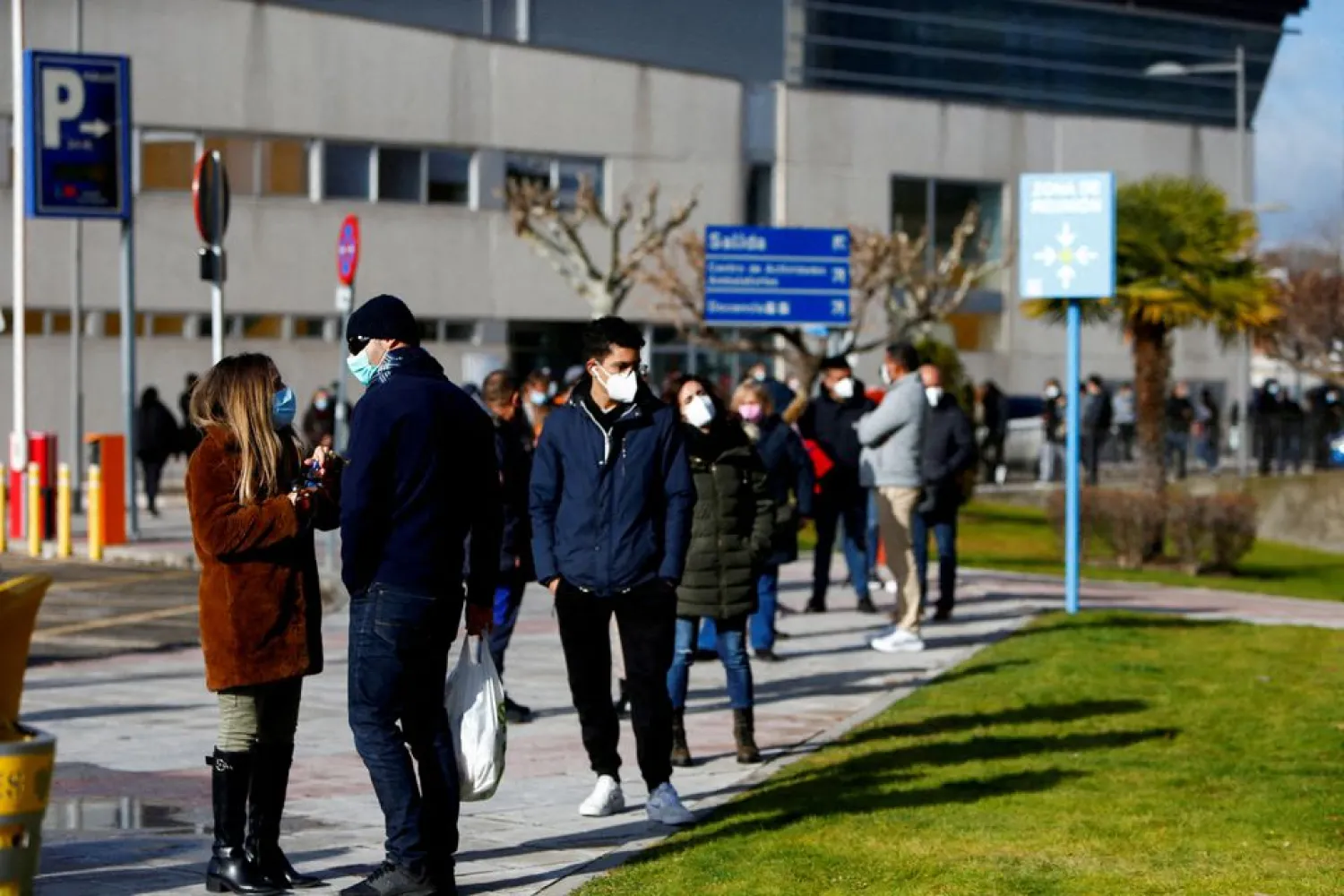
People queue to get tested for the coronavirus disease (COVID-19) after the Christmas holiday break, amid the COVID-19 pandemic, at Doce de Octubre Hospital in Madrid, Spain December 27, 2021. (Reuters)
TT

Peak Omicron? Experts Wary of Calling Time on Variant Wave in Europe

People queue to get tested for the coronavirus disease (COVID-19) after the Christmas holiday break, amid the COVID-19 pandemic, at Doce de Octubre Hospital in Madrid, Spain December 27, 2021. (Reuters)

A surge in coronavirus cases caused by the Omicron variant may have peaked in some parts of Europe but medics say the impact will continue to be felt across the region, with hospitals still at risk of facing a rush of admissions.

Health experts and politicians warn against complacency, saying it is not yet clear whether their data reflect the full impact of the Christmas and New Year holidays, when families gathered for long periods indoors and the risk of inter-generational spread of the virus may be greater.

Also, although vaccination and the lesser severity of the Omicron variant mean hospitalizations are lower than in previous waves of COVID-19 infections, Europe https://graphics.reuters.com/world-coronavirus-tracker-and-maps still accounts for about half of global cases and deaths.

But there are growing signs that the surge of infections caused by the Omicron variant, first identified in southern Africa and Hong Kong, is leveling off or even falling in some areas.

Britain's seven-day average of cases has fallen by 30,000 from its peak, Spain's prime minister has said infection numbers are stabilizing and a French public health institute has said the wave will peak in mid-January.

"We see a number of places where the peak is being reached or has been reached. It may be a bit earlier than anticipated, but remember the region is very diverse," Hans Kluge, the World Health Organization's Europe director, said this week.

"So we have to keep in mind the eastern part of the region, the Central Asian republics, where this peak still may come."

Health officials in Sweden and Switzerland have said the peak in those two countries is projected to be reached towards the end of this month.

"We could get to the peak within the next two weeks if contacts among people stay on the same level. If people are more cautious, it will take longer," Tanja Stadler, head of Switzerland's COVID-19 science task force, told reporters on Tuesday.

The trend echoes the Omicron wave in Africa, which the WHO's Africa office said appeared to be plateauing, making it the shortest surge in cases to date.

Denmark, where cases are dominated by Omicron, eased some restrictions this week, with the health minister saying the epidemic in the country was now under control.

Britain's Office of National Statistics has said the growth in infections has slowed in England. One in 15 people were estimated to have been infected in the week ending Jan. 6, the same as the previous week.

Caution prevails

Despite the positive signs, politicians remain cautious.

British Health Secretary Sajid Javid said on Thursday that while the rate of hospitalization was starting to slow, the health service would remain under pressure in the next few weeks.

"Omicron´s far greater transmissibility still has the potential to lead to significant numbers of people in hospital," he said.

He said there were encouraging signs that infections were falling in London and the east of England but "we're still currently seeing infections rise in other parts of the country and the data does not as of yet reflect the impact of people returning to work and school" after Christmas and New Year.

Scotland, which introduced tougher restrictions to combat Omicron than England, will start lifting those measures on Monday.

But, showing the stabilization in case numbers is not being seen everywhere, Italy's National Health Institute said on Friday that weekly incidence and hospital bed occupancy continued to increase this week.

German virologist Christian Drosten warned on Friday that there were far too many Omicron cases and that this reduced any gains from it being milder than other variants, and Germany's health minister said more coronavirus restrictions might be needed if hospitals are overwhelmed.

With Omicron initially spreading quickly among younger people, epidemiologists have said its impact on hospital admissions might be unpredictable as it moves into older age groups, even if headline case numbers come down.

But the ZOE COVID Symptom Study app, which collects data on self-reported symptoms to estimate prevalence in Britain, has found the Omicron wave has peaked, and that cases among the elderly have steadied at a low level.

"Just as it went up very fast, it also came down very fast and I think it is good news, it means that there will be easing of pressures on the hospitals," Tim Spector, lead scientist on the app, told Reuters.

Even so, the Omicron variant will not disappear, he said.

"It's just so infectious, there's no way we can pretend that it's going to get down to trivial levels, but it should be it should be manageable levels," he said.



Russia Hits Energy System in Several Regions of Ukraine, Kyiv Says

Local residents gather around a bonfire during an outdoor party to keep warm as many apartments remain without heating in Kyiv on January 18, 2026, amid the Russian invasion of Ukraine. (AFP)
TT

Russia Hits Energy System in Several Regions of Ukraine, Kyiv Says

Local residents gather around a bonfire during an outdoor party to keep warm as many apartments remain without heating in Kyiv on January 18, 2026, amid the Russian invasion of Ukraine. (AFP)

Russia launched a barrage of drone strikes on Ukraine's energy infrastructure overnight on Monday, cutting off power in five regions ​across the country amid freezing temperatures and high demand, Ukrainian officials said.

The Ukrainian air force said that Russian troops had launched 145 drones. Air defense units shot down 126 of them, it said.

"As of this morning, consumers in Sumy, Odesa, Dnipropetrovsk, Kharkiv, and Chernihiv regions are without power," the energy ministry said in a statement. "Emergency repair ‌work is ‌underway if the security situation ‌allows."

In ⁠the ​southern ‌Odesa region, energy and gas infrastructure was damaged, the regional governor said, adding that one person was hurt in the attack.

DTEK, Ukraine's largest private energy company, said its energy facility in Odesa was "substantially" damaged, knocking out power for 30,800 households.

A local power grid company in northern Chernihiv region said that ⁠five important energy facilities were damaged, leaving tens of thousands of consumers ‌without power.

Russia also hit Ukraine's second-largest ‍city of Kharkiv with missiles ‍on Monday morning, significantly damaging a critical infrastructure facility, ‍Mayor Ihor Terekhov said.

Moscow has stepped up a winter campaign of strikes on the Ukrainian energy system, including generation, electricity transmission and gas production facilities, amid freezing temperatures that complicate repair works.

The ​attacks have caused long blackouts.

"Being without electricity for more than 16 hours is awful," Serhii Kovalenko, ⁠CEO of energy distribution company Yasno, said on Facebook late on Sunday. "And it's not because of the energy companies, but because of cynical attacks by the enemy, who is trying to create a humanitarian disaster."

Ukraine declared an energy emergency last week as its grid crumbled due to accumulated wartime damage and a new targeted wave of Russian bombardments.

Energy Minister Denys Shmyhal said on Monday the government would implement projects to improve electricity transmission from the western part ‌of the country to its power-hungry east.


‘Not Right’ for Iran to Attend Davos Summit After Deadly Protests, Say Organizers

Iranian Foreign Minister Abbas Araghchi speaks in a joint press briefing with his Iraqi counterpart Fuad Hussein in Tehran, Iran, Sunday, Jan. 18, 2026. (AP)
TT

‘Not Right’ for Iran to Attend Davos Summit After Deadly Protests, Say Organizers

Iranian Foreign Minister Abbas Araghchi speaks in a joint press briefing with his Iraqi counterpart Fuad Hussein in Tehran, Iran, Sunday, Jan. 18, 2026. (AP)

Iran's foreign minister will not be attending the Davos summit in Switzerland this week, the organizers said Monday, stressing it would not be "right" after the recent deadly crackdown on protesters in Iran.

Abbas Araghchi had been scheduled to speak on Tuesday during the annual gathering of the global elite at the upscale Swiss ski resort town.

But activists have been calling on the World Economic Forum organizers to disinvite him amid what rights groups have called a "massacre" in his country.

"The Iranian Foreign Minister will not be attending Davos," the World Economic Forum said on X.

"Although he was invited last fall, the tragic loss of lives of civilians in Iran over the past few weeks means that it is not right for the Iranian government to be represented at Davos this year," it added.

Demonstrations sparked by anger over economic hardship exploded into protests late December in what has been widely seen as the biggest challenge to the Iranian leadership in recent years.

The rallies subsided after a government crackdown under the cover of a communications blackout that started on January 8.

Norway-based Iran Human Rights says it has verified the deaths of 3,428 protesters killed by security forces, confirming cases through sources within the country's health and medical system, witnesses and independent sources.

The NGO warned that the true toll is likely to be far higher. Media cannot independently confirm the figure and Iranian officials have not given an exact death toll.


Iran to Consider Lifting Internet Ban; State TV Hacked

People walk past a burnt-out building destroyed during public protests in the Iranian capital Tehran on January 19, 26. (AFP)
TT

Iran to Consider Lifting Internet Ban; State TV Hacked

People walk past a burnt-out building destroyed during public protests in the Iranian capital Tehran on January 19, 26. (AFP)

Iran may lift its internet blackout in a few days, a senior parliament member said on Monday, after authorities shut communications while they used massive force to crush protests in the worst domestic unrest since ​the 1979 revolution.

In the latest sign of weakness in the authorities' control, state television appeared to be hacked late on Sunday, briefly showing speeches by US President Donald Trump and the exiled son of Iran's last shah calling on the public to revolt.

Iran's streets have largely been quiet for a week since anti-government protests that began in late December were put down in three days of mass violence.

An ‌Iranian official ‌told Reuters on condition of anonymity that the ‌confirmed ⁠death ​toll ‌was more than 5,000, including 500 members of the security forces, with some of the worst unrest taking place in ethnic Kurdish areas in the northwest. Western-based Iranian rights groups also say thousands were killed.

Opponents accuse the authorities of opening fire on peaceful demonstrators to crush dissent. Iran's clerical rulers say armed crowds egged on by foreign enemies attacked hospitals and mosques.

The death tolls dwarf ⁠those of previous bouts of anti-government unrest put down by the authorities in 2022 and 2009. ‌The violence drew repeated threats from Trump ‍to intervene militarily, although he has backed ‍off since the large-scale killing stopped.

INTERNET TO RETURN WHEN 'CONDITIONS ARE APPROPRIATE'

Ebrahim ‍Azizi, the head of parliament's National Security and Foreign Policy Committee, said top security bodies would decide on restoring internet in the coming days, with service resuming "as soon as security conditions are appropriate".

Another parliament member, hardliner Hamid Rasaei, said authorities should ​have listened to earlier complaints by Supreme Leader Ali Khamenei about "lax cyberspace".

Iranian communications including internet and international phone lines were ⁠largely stopped in the days leading up to the worst unrest. The blackout has since partially eased, allowing accounts of widespread attacks on protesters to emerge.

During Sunday's apparent hack into state television, screens broadcast a segment lasting several minutes with the on-screen headline "the real news of the Iranian national revolution".

It included messages from Reza Pahlavi, the US-based son of Iran's last shah, calling for a revolt to overthrow rule by the clerics who have run the country since the 1979 revolution that toppled his father.

Pahlavi has emerged as a prominent opposition voice and has said he plans ‌to return to Iran, although it is difficult to assess independently how strong support for him is inside Iran.