


White House: Russia Prepping Pretext for Ukraine Invasion

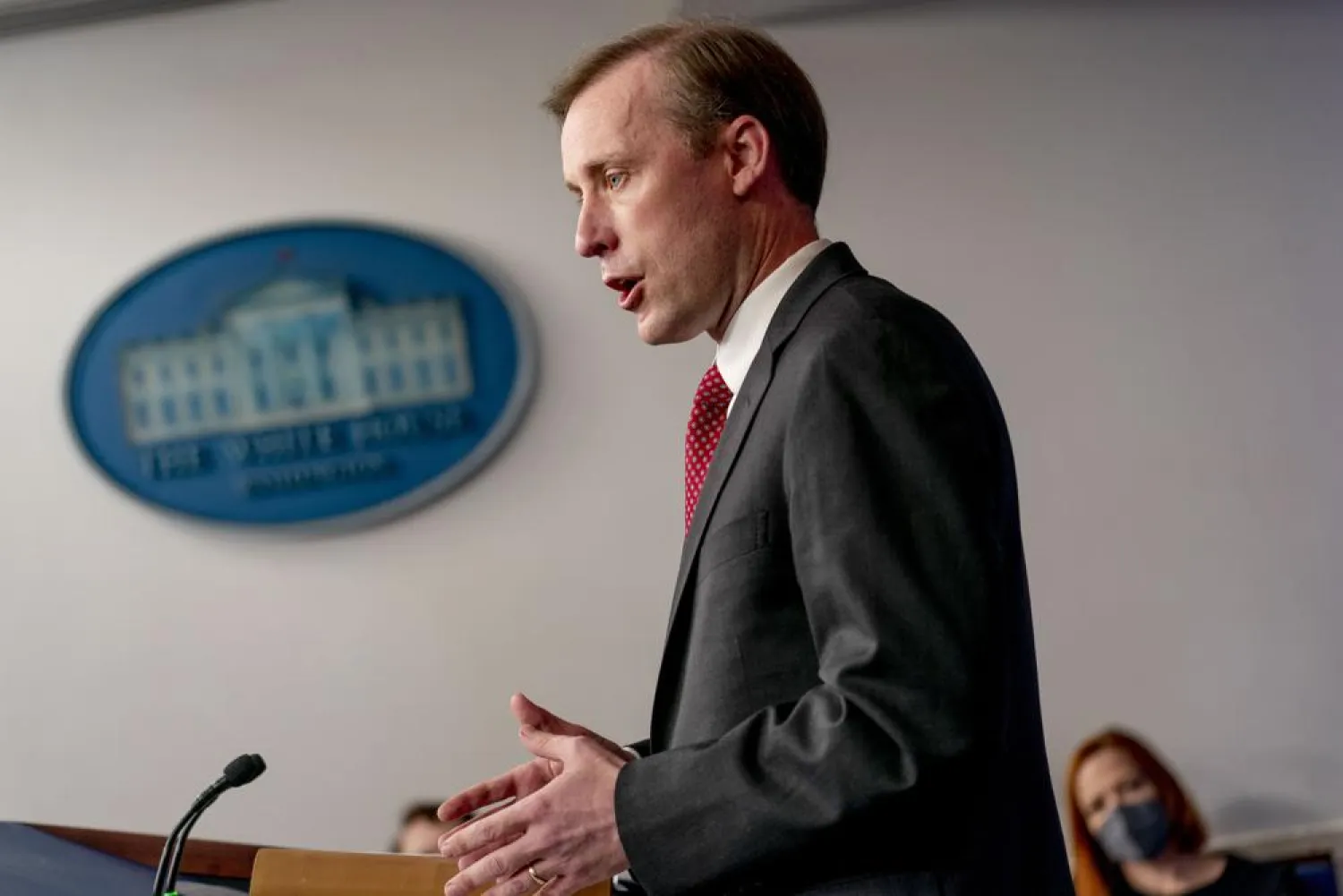
White House national security adviser Jake Sullivan gives an update about the ongoing talks with Russia at a press briefing at the White House in Washington, Thursday, Jan. 13, 2022. (AP)
TT

White House: Russia Prepping Pretext for Ukraine Invasion

White House national security adviser Jake Sullivan gives an update about the ongoing talks with Russia at a press briefing at the White House in Washington, Thursday, Jan. 13, 2022. (AP)

US intelligence officials have determined a Russian effort is underway to create a pretext for its troops to further invade Ukraine, and Moscow has already pre-positioned operatives to conduct “a false-flag operation” in eastern Ukraine, according to the White House.

White House press secretary Jen Psaki said on Friday the intelligence findings show Russia is also laying the groundwork through a social media disinformation campaign that frames Ukraine as an aggressor that has been preparing an imminent attack against Russian-backed forces in eastern Ukraine.

Psaki charged that Russia has already dispatched operatives trained in urban warfare who could use explosives to carry out acts of sabotage against Russia’s own proxy forces — blaming the acts on Ukraine — if Russian President Vladimir Putin decides he wants to move forward with an invasion.

“We are concerned that the Russian government is preparing for an invasion in Ukraine that may result in widespread human rights violations and war crimes should diplomacy fail to meet their objectives,” Psaki said.

The White House did not provide details about how much confidence it has in the assessment. A US official, who was not authorized to comment on the intelligence and spoke on condition of anonymity, said much of the intelligence was gleaned from intercepted communications and observations of the movements of people.

Ukraine is also monitoring the potential use of disinformation by Russia. Separately, Ukrainian media on Friday reported that authorities believed Russian special services were planning a possible false flag incident to provoke additional conflict.

The new US intelligence was unveiled after a series of talks between Russia and the US and its Western allies this week in Europe aimed at heading off the escalating crisis made little progress.

White House national security adviser Jake Sullivan on Thursday said the US intelligence community has not made an assessment that the Russians, who have massed some 100,000 troops on Ukraine's border, have definitively decided to take a military course of action.

But Sullivan said Russia is laying the groundwork to invade under false pretenses should Putin decide to go that route. He said the Russians have been planning “sabotage activities and information operations” that accuse Ukraine of prepping for its own imminent attack against Russian forces in eastern Ukraine.

He said this is similar to what the Kremlin did in the lead-up to Russia’s 2014 annexation of Crimea, the Black Sea peninsula that had been under Ukraine’s jurisdiction since 1954.

The Crimea crisis came at moment when Ukraine was looking to strengthen ties with the West. Russia had stepped up propaganda that Ukraine’s ethnic Russians were being oppressed in eastern Ukraine.

Russia has long been accused of using disinformation as a tactic against adversaries in conjunction with military operations and cyberattacks. In 2014, Russian state media tried to discredit pro-Western protests in Kyiv as “fomented by the US in cooperation with fascist Ukrainian nationalists” and promoted narratives about Crimea’s historical ties to Moscow, according to a report by Stanford University’s Internet Observatory.

Efforts to directly influence Ukrainians appear to have continued during the ongoing conflict in eastern Ukraine, in which at least 14,000 people have died. The Associated Press reported in 2017 that Ukrainian forces in the east were constantly receiving text messages warning that they would be killed and their children would be made orphans.

Nina Jankowicz, a global fellow at the Washington-based Wilson Center, said Russia’s disinformation efforts have evolved between the lead-up to its annexation of Crimea and now. This time, the Kremlin appears to be driving anti-Ukraine narratives with top officials making bellicose public statements, said Jankowicz, author of “How To Lose the Information War: Russia, Fake News, and the Future of Conflict.”

“The officials are setting the tone for the state media and they’re just running with it,” she said.

So-called “troll farms” that post fake comments are less influential in part because social media companies have gotten better at stopping them, she said. Russian efforts on social media often play on existing doubts in Ukrainian society about whether the US will support Ukraine in a conflict and whether the West can be trusted, she said.

The US intelligence community has taken note of a buildup on social media by Russian influencers justifying intervention by emphasizing deteriorating human rights in Ukraine, suggesting an increased militancy of Ukrainian leaders and blaming the West for escalating tensions.

“We saw this playbook in 2014,” Sullivan told reporters on Thursday. “They are preparing this playbook again.”

The Russians, while maintaining they don’t plan to invade Ukraine, are demanding that the US and NATO provide written guarantees that the alliance will not expand eastward. The US has called such demands nonstarters but said that it’s willing to negotiate with Moscow about possible future deployments of offensive missiles in Ukraine and putting limits on US and NATO military exercises in Eastern Europe.

Foreign Minister Sergei Lavrov warned on Friday that Moscow wouldn’t wait indefinitely for the Western response, saying he expects the US and NATO to provide a written answer next week.

Lavrov described Moscow’s demands for binding guarantees that NATO will not embrace Ukraine or any other former Soviet nations, or station its forces and weapons there, as essential for the progress of diplomatic efforts to defuse soaring tensions over Ukraine.

He argued that NATO’s deployments and drills near Russia’s borders pose a security challenge that must be addressed immediately.

“We have run out of patience,” Lavrov said at a news conference. “The West has been driven by hubris and has exacerbated tensions in violation of its obligations and common sense.”



2 Israelis Charged with Using Classified Military Information to Place Bets

The Israeli Iron Dome air defense system intercepts missiles during an Iranian attack on Tel Aviv, Israel, June 18, 2025. (AP Photo/Leo Correa, File)
TT

2 Israelis Charged with Using Classified Military Information to Place Bets

The Israeli Iron Dome air defense system intercepts missiles during an Iranian attack on Tel Aviv, Israel, June 18, 2025. (AP Photo/Leo Correa, File)

Two Israelis have been charged with using classified military information to place bets on how future events will unfold, Israeli authorities said Thursday, accusing the individuals of “serious security offenses.”

A joint statement by the Israeli Ministry of Defense, domestic security service Shin Bet and police said that a civilian and a reservist are suspected of placing bets on the US-based prediction market Polymarket on future military operations based on information that the reservist had access to, The AP news reported.

Israel’s Attorney General’s Office decided to prosecute the two individuals following a joint investigation by police, military intelligence and other security agencies that resulted in several arrests. The two face charges including bribery and obstruction of justice.

Authorities offered no details on the identity of the two individuals or the reservist's rank or position in the Israeli military but warned that such actions posed a “real security risk” for the military and the Israeli state.

Israel’s public broadcaster Kan had reported earlier that the bets were placed in June ahead of Israel’s war with Iran and that the winnings were roughly $150,000.

Israel's military and security services “view the acts attributed to the defendants very seriously and will act resolutely to thwart and bring to justice any person involved in the activity of using classified information illegally,” the statement said.

The accused will remain in custody until the end of legal proceedings against them, the Prosecutor's Office said.

Prediction markets are comprised of typically yes-or-no questions called event contracts, with the prices connected to what traders are willing to pay, which theoretically indicates the perceived probability of an event occurring.

Their use has skyrocketed in recent years, but despite some eye-catching windfalls, traders still lose money everyday. In the US, the trades are categorized differently than traditional forms of gambling, raising questions about transparency and risk.


WhatsApp Accuses Russia of Trying to Fully Block its Service

FILED - 21 January 2022, Berlin: The icon of Whatsapp is seen on the screen of a smartphone. Photo: Fabian Sommer/Deutsche Presse-Agentur GmbH/dpa
TT

WhatsApp Accuses Russia of Trying to Fully Block its Service

FILED - 21 January 2022, Berlin: The icon of Whatsapp is seen on the screen of a smartphone. Photo: Fabian Sommer/Deutsche Presse-Agentur GmbH/dpa

US messenger app WhatsApp, owned by Meta Platforms, accused authorities in Russia on Thursday of trying to fully block its service in order to drive Russians to a state-owned app, which it alleged was used for surveillance.

"Trying to isolate over 100 million users from private and secure communication is a backwards step and can only lead to less safety for people in Russia," WhatsApp said in a statement.

"We continue to do everything we can ‌to keep users connected."

Some ‌domain names associated with WhatsApp on Thursday disappeared from Russia's ‌national ⁠register of domain ⁠names, meaning that devices inside Russia stopped receiving its IP addresses from the app and that it could be accessed only by using a virtual private network (VPN), Reuters reported.

Roskomnadzor, the state communications regulator, and the Kremlin did not immediately respond to a request for comment.

Roskomnadzor first began restricting WhatsApp and other messenger services in August, making it impossible to complete phone calls on them, accusing the foreign-owned platforms of failing ⁠to share information with law enforcement in fraud and terrorism ‌cases.

It said in December it was taking ‌new measures to gradually restrict the app, which it accused of continuing to violate Russian ‌law and of being a platform used "to organize and carry out terrorist acts ‌on the territory of the country, to recruit their perpetrators and to commit fraud and other crimes."

Since then, many Russians have been able to use WhatsApp only in conjunction with a virtual private network and have switched to using rival messenger apps, though some ‌of those - like Telegram - are also under pressure from the authorities for the same reasons.

In a video published by state ⁠news agency ⁠TASS on Wednesday, Kremlin spokesman Dmitry Peskov said there was a possibility of reaching an agreement if Meta entered into dialogue with the Russian authorities and complied with the law.

"If the corporation (Meta) sticks to an uncompromising position and, I would say, shows itself unready to align with Russian legislation, then there is no chance," Peskov said.

Russian authorities, who also block or restrict social media platforms such as Snapchat, Facebook, Instagram and YouTube, are heavily pushing a state-backed messenger app called MAX, which critics say could be used to track users.

The authorities have dismissed those accusations as false and say MAX, which integrates various government-related services into it, is designed to simplify and improve the everyday lives of citizens.


Israel President Says at End of Visit Antisemitism in Australia 'Frightening'

Israel's President Isaac Herzog reacts during a Jewish community event in Melbourne on February 12, 2026. (Photo by WILLIAM WEST / AFP)
TT

Israel President Says at End of Visit Antisemitism in Australia 'Frightening'

Israel's President Isaac Herzog reacts during a Jewish community event in Melbourne on February 12, 2026. (Photo by WILLIAM WEST / AFP)

Antisemitism in Australia is "frightening" but most people want good relations, Israel's President Isaac Herzog said on Thursday as he wrapped up a four-day visit and was met by protests in the city of Melbourne.

Herzog's tightly policed visit to Australia this week was meant to offer consolation to the country's Jewish community following the mass shooting on Bondi Beach that killed 15 people in December, said AFP.

However, it sparked demonstrations in major cities, including in Sydney, where police used pepper spray on protesters and members of the media, including an AFP photographer, during scuffles in the central business district on Monday night.

Herzog told Channel Seven's Sunrise ahead of his Melbourne stop that a "wave" of anti-Jewish hatred in Australia had culminated in the December 14 killings at Bondi.

"It is frightening and worrying," he said.

"But there's also a silent majority of Australians who seek peace, who respect the Jewish community and, of course, want a dialogue with Israel."

The Israeli head of state said he had brought a "message of goodwill to the people of Australia".

"I hope there will be a change. I hope things will relax," he said.

Herzog attended a Jewish community event after a meeting with Victoria's governor at Melbourne's Government House.

Protesters waving Palestinian flags and chanting slogans squared off with police outside the event.

More are expected to turn out later at around 5 pm (0600 GMT) on Thursday.

Herzog told the audience at the community event: "We came here to be with you, to look you in the eye, to embrace and remember."

He also said demonstrators outside should instead "go protest in front of the Iranian embassy".

The Australian government accused Iran last year of orchestrating a recent wave of antisemitic attacks and expelled Tehran's ambassador.

Canberra, citing intelligence findings, accused Tehran of directing the torching of a kosher cafe in the Sydney suburb of Bondi in October 2024 and a major arson attack on the Adass Israel Synagogue in Melbourne in December 2024.

- Controversial visit -

Ahead of his arrival, national broadcaster ABC reported that a building at Melbourne University had been graffiti-ed with the phrase: "Death to Herzog".

Many Jewish Australians have welcomed Herzog's trip.

"His visit will lift the spirits of a pained community," said Alex Ryvchin, co-chief executive of the Executive Council of Australian Jewry, the community's peak body.

But some in the community disagreed, with the progressive Jewish Council of Australia saying he was not welcome because of his alleged role in the "ongoing destruction of Gaza".

The UN's Independent International Commission of Inquiry found last year that Herzog was liable for prosecution for inciting genocide after he said all Palestinians -- "an entire nation" -- were responsible for the Hamas attack on Israel in October 2023.

Israel has "categorically" rejected the inquiry's report, describing it as "distorted and false" and has called for the body's abolition.