


Headed to Disaster? US, Russia Harden Stances in Talks

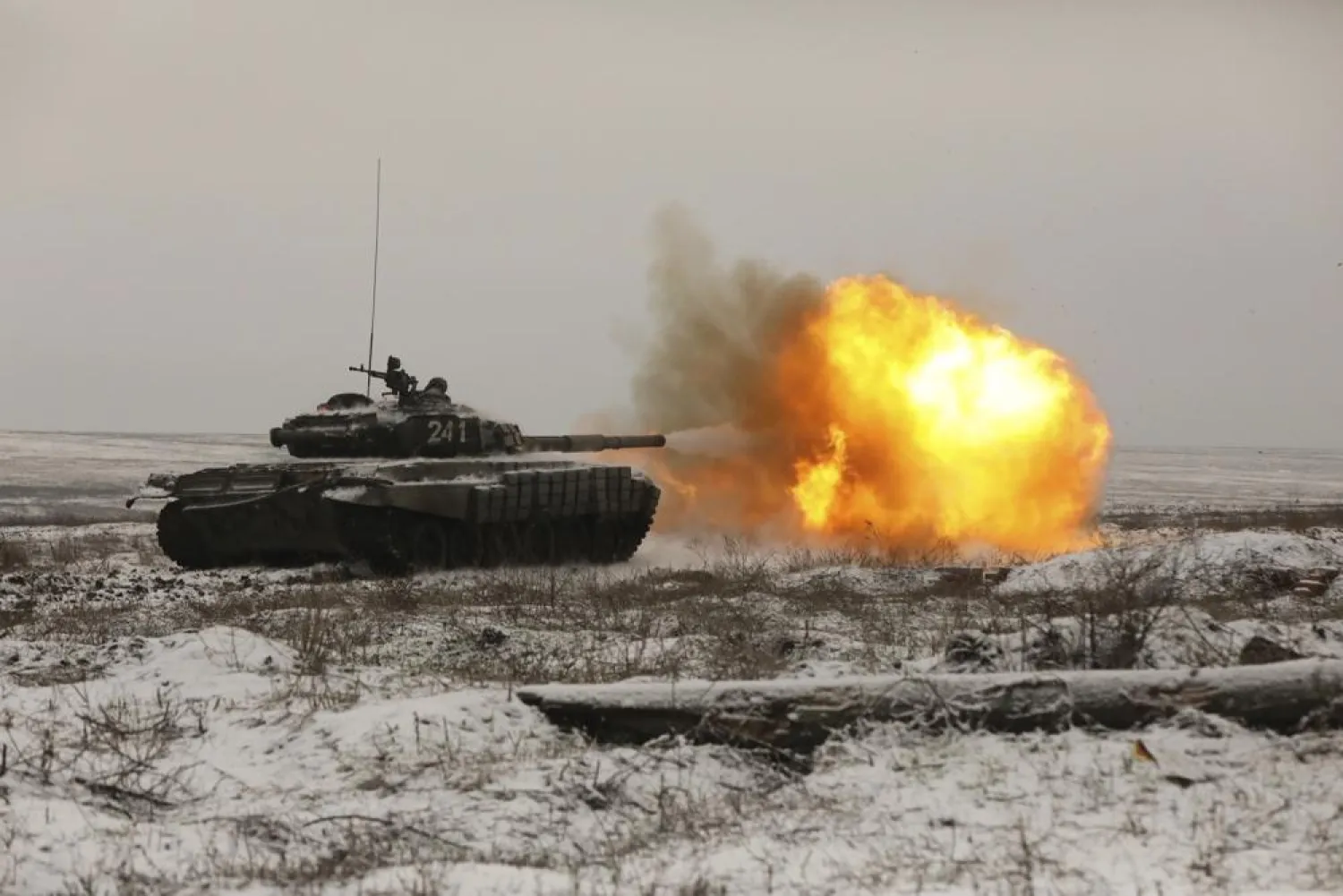
A Russian tank T-72B3 fires as troops take part in drills at the Kadamovskiy firing range in the Rostov region in southern Russia, on Jan. 12, 2022. (AP)
TT

Headed to Disaster? US, Russia Harden Stances in Talks

A Russian tank T-72B3 fires as troops take part in drills at the Kadamovskiy firing range in the Rostov region in southern Russia, on Jan. 12, 2022. (AP)

The failure of last week’s high-stakes diplomatic meetings to resolve escalating tensions over Ukraine has put Russia, the United States and its European allies in uncharted post-Cold War territory, posing significant challenges for the main players to avoid an outright and potentially disastrous confrontation.

Unlike previous disagreements that have arisen since the collapse of the Soviet Union, the current Ukraine crisis and seemingly insurmountable differences between Washington and Moscow carry real risks of debilitating economic warfare and military conflict that are exacerbated by the dangers of miscalculation and overreaction.

For the US and its NATO and other European allies, nothing less than a vast pullback of the roughly 100,000 Russian troops now deployed near the Ukrainian border will prove that Russian President Vladimir Putin has any intention of negotiating in good faith. For the Russians, the West’s absolute refusal to consider a ban on NATO expansion and the withdrawal of troops from Eastern Europe is proof of its perfidy.

Potential concessions are complicated by the fact neither Putin nor President Joe Biden wants to be seen as backing down before either domestic or foreign audiences.

The refusal thus far by each side to climb down from what the other regards as unrealistic and maximalist demands has left the prospects for diplomacy in limbo, with the US and its allies accusing Russia of stoking tensions for no legitimate reason and the Russians complaining again that the Americans are the aggressors.

Some believe the situation will have to become even more dire before the impasse can be broken.

“The gap in perceptions is so broad that a new and dangerous escalation could be necessary to make the parties open up their imagination and search for agreements,” Fyodor Lukyanov, the head of the Moscow-based Council for Foreign and Defense Policies, observed in a commentary.

For Western analysts, it seems a situation in which Putin will have to compromise if conflict is to be avoided. Some think Putin's focus on NATO, which has struggled for years with questions about its relevance, may have given the alliance a new lease on life.

“This is an extremely uncertain and tense period without an obvious way out unless Putin backs down,” said Jeff Rathke, a Europe expert and former US diplomat who is currently president of the American Institute for Contemporary German Studies at Johns Hopkins University.

“He’s talked himself into a frenzy that is hard to walk away from if he doesn’t get the fundamental redrawing of the European security architecture that he claims to want. He’s shown he’s ready to play chicken with the threat of massive military force to bring that about and he’s certainly gotten everyone’s attention, but he hasn’t changed anyone’s views,” Rathke said.

US officials from Biden, Secretary of State Antony Blinken and national security adviser Jake Sullivan to chief negotiator Wendy Sherman have said it is Russia that faces a “stark choice.” De-escalate or face punishing sanctions and the opposite of what it wants: an increased NATO presence in Eastern Europe and a more well-armed Ukraine.

Yet in Russia, officials say the shoe is on the other foot. They have cast their demands as an “absolute imperative” and have argued that the Western failure to meet them makes talks on other issues irrelevant.

Foreign Minister Sergei Lavrov said Friday that Russia had vainly tried for years to persuade the US and its allies to engage in talks on the non-deployment of intermediate-range missiles to Europe, limits on war games and rules to avoid dangerously close encounters between Russian and allied warships and aircraft until the US and NATO expressed willingness to discuss those issues this week.

He attributed the change in approach to a US desire to shift attention away from Russia’s main demands, adding that Moscow will focus on NATO non-expansion. And he insisted that it’s the US that’s formulating the position in talks while other allies just march on its orders.

“To be frank, everyone understands that the prospect for reaching a deal depends on the US,” Lavrov said. He said whatever the US says about the need to consult allies in negotiations "are just excuses and attempts to drag the process out.”
Thus, the stalemate.

The West’s approach has been to have “as much diplomatic effort as possible to de-escalate,” said Andrew Weiss, vice president for studies at the Carnegie Endowment for International Peace, where he oversees research in Washington and Moscow on Russia and Eurasia.

“The problem we’ve got is that the Russians mean business, and they’ve shown us in a bunch of cases, in 2014, in 2008, that they’re prepared to go to war to get these things, and we’re not," he said. "And that’s the challenge."

The tough and uncompromising Russian positions have led some to believe that Moscow will only up the ante after receiving what all sides expect will be formal, written refusals from the US and NATO to accede to its demands.

Indeed, the chief Russian negotiator in the talks, Deputy Foreign Minister Sergei Ryabkov, suggested Thursday that Moscow might respond to rejections by escalating matters outside of Europe through the potential deployment of troops to Cuba and Venezuela. The US has called such a suggestion “bluster” and said it would respond decisively if it happened.

“The lack of a diplomatic solution logically leads to the further exacerbation of the crisis,” wrote Dmitri Trenin, the head of the Carnegie Moscow Center, in an online analysis.

Trenin predicted that a set of “military-technical measures” that Putin said Russia would take if the West rejects its demands could include “a broad array of moves ... from the deployment of new weapons systems in various regions to much stronger military ties with Belarus and a closer coordination with the Chinese partners.”

Still, there's a risk that by focusing his ire on NATO, Putin may have inadvertently strengthened its hand, especially with its newer members like the Baltic states, Hungary, Poland and the Czech Republic.

“For countries that have joined NATO since the Cold War, you can definitely say that NATO is more relevant to them now than it was a year ago or in 2014,” Rathke said. “Anyone who thought that NATO was no longer relevant to European security has been taught a lesson in the last few months. And it’s only going to get worse.”



UK PM's Top Aide Quits over Mandelson-Epstein Scandal

FILE PHOTO: British Prime Minister Keir Starmer talks with Britain's ambassador to the United States Peter Mandelson during a welcome reception at the ambassador's residence on February 26, 2025, in Washington, DC, US. Carl Court/Pool via REUTERS/File Photo
TT

UK PM's Top Aide Quits over Mandelson-Epstein Scandal

FILE PHOTO: British Prime Minister Keir Starmer talks with Britain's ambassador to the United States Peter Mandelson during a welcome reception at the ambassador's residence on February 26, 2025, in Washington, DC, US. Carl Court/Pool via REUTERS/File Photo

British Prime Minister Keir Starmer's chief of staff, Morgan McSweeney, quit on Sunday, saying he took responsibility for advising Starmer to name Peter Mandelson as ambassador to the US despite his known links to Jeffrey Epstein.

After new files revealed the depth of the Labour veteran's relationship with the late sex offender, Starmer is facing what is widely seen as the gravest crisis of his 18 months in power over his decision to send Mandelson to Washington in 2024, Reuters reported.

The loss of McSweeney, 48, a strategist who was instrumental in Starmer's rise to power, is the latest in a series of setbacks, less than two years after the Labour Party won one of the largest parliamentary majorities in modern British history.

With polls showing Starmer is hugely unpopular with voters after a series of embarrassing U-turns, some in his own party are openly questioning his judgment and his future, and it remains to be seen whether McSweeney's exit will be enough to silence critics.

The files released in the US on January 30 sparked a police investigation for misconduct in office over indications that Mandelson leaked market-sensitive information to Epstein when he was a government minister during the global financial crisis in 2009 and 2010.

In a statement, McSweeney said: "The decision to ⁠appoint Peter Mandelson was wrong. He has damaged our party, our country and trust in politics itself.
"When asked, I advised the Prime Minister to make that appointment and I take full responsibility for that advice."

The leader of the opposition Conservative Party, Kemi Badenoch, said the resignation was overdue and that "Keir Starmer has to take responsibility for his own terrible decisions".

Nigel Farage, head of the populist Reform UK party, which is leading in the polls, said he believed Starmer's time would soon be up.

Starmer has spent the last week defending McSweeney, a strategy that could prompt further questions about his own judgment. In a statement on Sunday, Starmer said it had been "an honor" working with him.

Many Labour members of parliament had blamed McSweeney for the appointment of Mandelson and the damage caused by the publication of the exchanges between Epstein ⁠and Mandelson. Others have said Starmer must go.

One Labour lawmaker, speaking on condition of anonymity, said McSweeney's resignation had come too late: "It buys the PM time, but it's still the end of days."

Starmer sacked Mandelson as ambassador in September over his links to Epstein.

The government agreed last week to release virtually all previously private communications between members of his government from the time when Mandelson was being appointed.

That release could come as early as this week, creating a new headache for Starmer just as he hopes to move on. If previously secret messages about how London planned to approach its relationship with Donald Trump are made public, it could damage Starmer's relationship with the US President.

McSweeney had held the role of chief of staff since October 2024, when he was handed the job following the resignation of Sue Gray after a row over pay and donations.

Starmer on Sunday appointed his deputy chiefs of staff, Jill Cuthbertson and Vidhya Alakeson, to serve as joint acting chiefs of staff.


Iran Sentences Nobel Laureate Narges Mohammadi to 7 More Years in Prison

(FILES) A handout photo provided by the Narges Mohammadi Foundation on October 2, 2023 shows an undated, unlocated photo of Iranian rights campaigner Narges Mohammadi. (Photo by Handout / NARGES MOHAMMADI FOUNDATION / AFP)
TT

Iran Sentences Nobel Laureate Narges Mohammadi to 7 More Years in Prison

(FILES) A handout photo provided by the Narges Mohammadi Foundation on October 2, 2023 shows an undated, unlocated photo of Iranian rights campaigner Narges Mohammadi. (Photo by Handout / NARGES MOHAMMADI FOUNDATION / AFP)

Iran sentenced Nobel Peace Prize laureate Narges Mohammadi to over seven more years in prison after she began a hunger strike, supporters said Sunday.

Mohammadi’s supporters cited her lawyer, who spoke to Mohammadi.

The lawyer, Mostafa Nili, confirmed the sentence on X, saying it had been handed down Saturday by a Revolutionary Court in the city of Mashhad. Such courts typically issue verdicts with little or no opportunity for defendants to contest their charges.

“She has been sentenced to six years in prison for ‘gathering and collusion’ and one and a half years for propaganda and two-year travel ban,” he wrote, according to The Associated Press.

She received another two years of internal exile to the city of Khosf, some 740 kilometers (460 miles) southeast of Tehran, the capital, the lawyer added.

Supporters say Mohammadi has been on a hunger strike since Feb. 2. She had been arrested in December at a ceremony honoring Khosrow Alikordi, a 46-year-old Iranian lawyer and human rights advocate who had been based in Mashhad. Footage from the demonstration showed her shouting, demanding justice for Alikordi and others.

Supporters had warned for months before her December arrest that Mohammadi, 53, was at risk of being put back into prison after she received a furlough in December 2024 over medical concerns.

While that was to be only three weeks, Mohammadi’s time out of prison lengthened, possibly as activists and Western powers pushed Iran to keep her free. She remained out even during the 12-day war in June between Iran and Israel.

Mohammadi still kept up her activism with public protests and international media appearances, including even demonstrating at one point in front of Tehran’s notorious Evin prison, where she had been held.

Mohammadi had been serving 13 years and nine months on charges of collusion against state security and propaganda against Iran’s government.

She also had backed the nationwide protests sparked by the 2022 death of Mahsa Amini, which have seen women openly defy the government by not wearing the hijab.

Mohammadi suffered multiple heart attacks while imprisoned before undergoing emergency surgery in 2022, her supporters say. Her lawyer in late 2024 revealed doctors had found a bone lesion that they feared could be cancerous that later was removed.

“Considering her illnesses, it is expected that she will be temporarily released on bail so that she can receive treatment,” Nili wrote.

However, Iranian officials have been signaling a harder line against all dissent since the recent demonstrations. Speaking on Sunday, Iranian judiciary chief Gholamhossein Mohseni-Ejei made comments suggesting harsh prison sentences awaited many.

“Look at some individuals who once were with the revolution and accompanied the revolution," he said. "Today, what they are saying, what they are writing, what statements they issue, they are unfortunate, they are forlorn (and) they will face damage.”


Nigeria's President to Make a Sate Visit to the UK in March

Nigeria’s President Bola Tinubu gives a joint statement with Brazil’s President Luiz Inacio Lula da Silva, at the Planalto presidential palace, in Brasilia, Brazil, Aug. 25, 2025. (AP Photo/Eraldo Peres, File)
TT

Nigeria's President to Make a Sate Visit to the UK in March

Nigeria’s President Bola Tinubu gives a joint statement with Brazil’s President Luiz Inacio Lula da Silva, at the Planalto presidential palace, in Brasilia, Brazil, Aug. 25, 2025. (AP Photo/Eraldo Peres, File)

Nigeria’s president is set to make a state visit to the UK in March, the first such trip by a Nigerian leader in almost four decades, Britain’s Buckingham Palace said Sunday.

Officials said President Bola Tinubu and first lady Oluremi Tinubu will travel to the UK on March 18 and 19, The AP news reported.

King Charles III and Queen Camilla will host them at Windsor Castle. Full details of the visit are expected at a later date.

Charles visited Nigeria, a Commonwealth country, four times from 1990 to 2018 before he became king. He previously received Tinubu at Buckingham Palace in September 2024.m

Previous state visits by a Nigerian leader took place in 1973, 1981 and 1989.

A state visit usually starts with an official reception hosted by the king and includes a carriage procession and a state banquet.

Last year Charles hosted state visits for world leaders including US President Donald Trump, French President Emmanuel Macron and German President Frank-Walter Steinmeier.