


Travel Woes as Winter Storm Blankets Eastern US and Canada

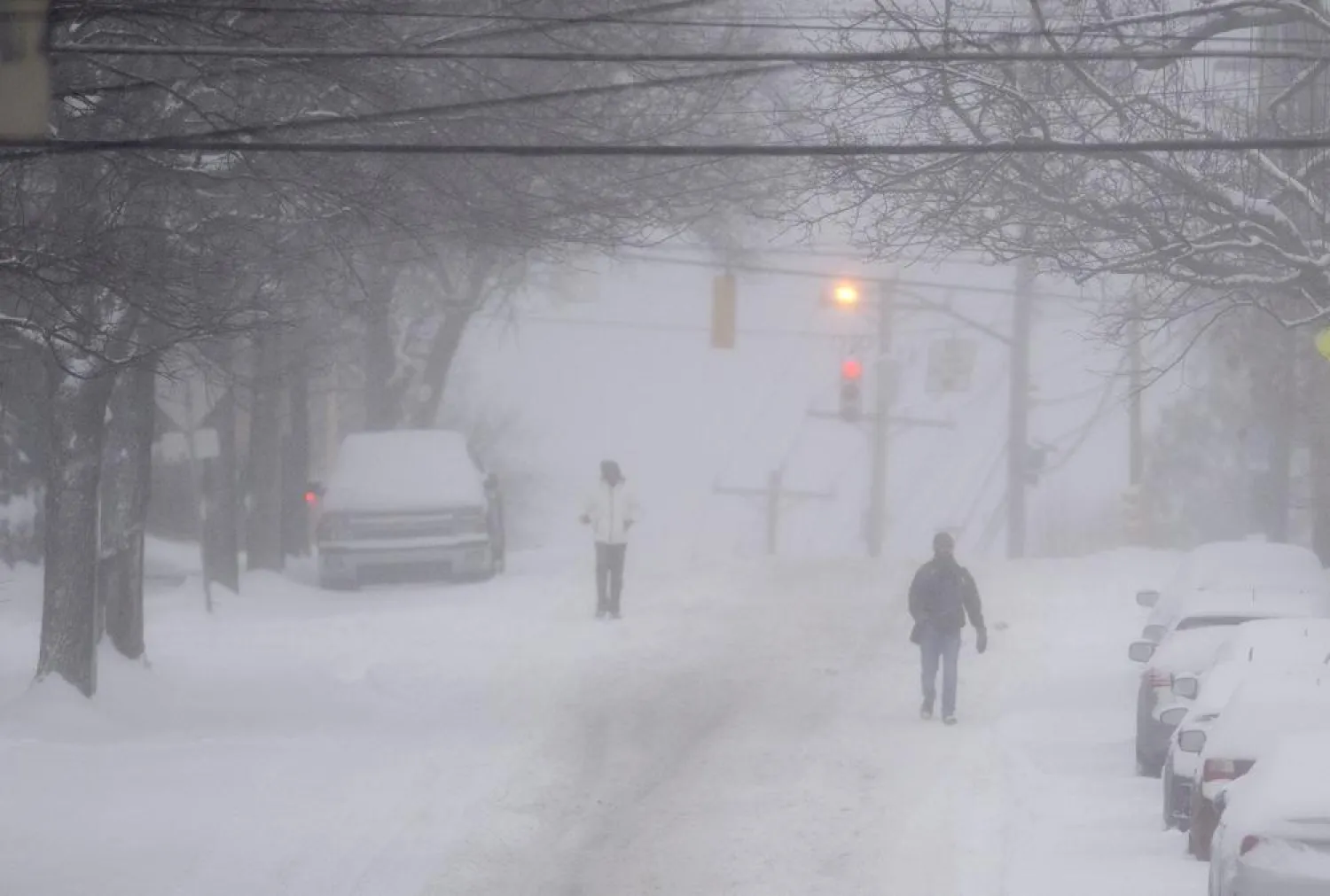
Pedestrians make their way down a partially plowed Murray Avenue Monday, Jan. 17, 2022, in Squirrel Hill neighborhood of Pittsburgh. (Pam Panchak/Pittsburgh Post-Gazette via AP)
TT

Travel Woes as Winter Storm Blankets Eastern US and Canada

Pedestrians make their way down a partially plowed Murray Avenue Monday, Jan. 17, 2022, in Squirrel Hill neighborhood of Pittsburgh. (Pam Panchak/Pittsburgh Post-Gazette via AP)

A major winter storm blanketed a swathe of North America in snow Monday as it sliced up the US east coast into Canada, disrupting travel and cutting power to thousands of homes.

Many Americans who had been without electricity -- about 120,000 of them Monday afternoon -- seemed to be back online by the evening, according to the website PowerOutage.us. The biggest concentration of outages came in the mid-Atlantic state of West Virginia and the southeastern states of North and South Carolina and Georgia, reported AFP.

More than 1,700 flights within, into or out of the United States were canceled by Monday evening, in addition to the 3,000 the day before, according to flight-tracking website FlightAware.

Large parts of the Canadian provinces of Quebec and Ontario remained under winter storm or blizzard warnings, according to a Canadian government website.

In Toronto, up to two feet (60 centimeters) of snow was expected -- "a historic storm for the city," tweeted Anthony Farnell, chief meteorologist of Canadian TV channel Global News.

"The @cityoftoronto has declared a major snow storm condition in response to today's heavy and disruptive snowfall which will help support our city-wide snow removal operations," Toronto Mayor John Tory tweeted Monday, and triggering a rule that prevents cars from parking in certain areas while the powder is cleared.

Many schools were closed and school buses were not operating in Quebec and the south of Ontario, including the Toronto area. Students had been due to return to classrooms on Monday in both provinces after the holiday break.

Monday was a national holiday in the United States, so most schools and businesses were already closed, though many people usually take the opportunity to travel during the long weekend.

The US National Weather Service (NWS) said earlier it expected the storm to "slowly wind down today," but that snow would continue to fall through the evening in upper New York and New England.

The heaviest snowfall was recorded in Ashtabula, Ohio, the agency said.

"Significant impacts due to snow, ice, wind, and coastal flooding will persist across a large area," NWS said in a tweet.

The storm spawned damaging tornadoes in Florida, while in the Carolinas and up through the Appalachian mountain region, icy conditions and blustery winds raised concerns.

Powerful winds downed trees and caused coastal flooding, with a 12-foot storm surge reported in Boston.

According to scientists, climate change could be an aggravating factor for extreme weather events like snowstorms, as well as deadly floods, typhoons and heat waves.

Transport was also seriously disrupted, with drivers warned of hazardous road conditions and major travel headaches from the southern US state of Arkansas to Quebec.

A portion of busy interstate highway I-95 was closed in North Carolina.

In Toronto, police tweeted that they had closed two sections of highway due to extreme weather, and asked drivers to stay home, "unless it's absolutely necessary."

- State of emergency -
"We're seeing a number of cars having to stop and de-ice their windshield," the Quebec transportation ministry tweeted Monday morning.

"Heavy precipitation and gusts allow ice to form, despite windshield wipers -- all the more reason to stay home!"

US officials also discouraged driving, and many states prepositioned teams to deal with the emergency, especially in the south, where snow is much less common.

The northeastern United States already experienced snow chaos earlier this month. When a storm blanketed the northeast, hundreds of motorists were stuck for more than 24 hours on the I-95, a major highway linking to Washington.



French, Japanese Ships Cross Strait of Hormuz in First Since War

A cargo ship in the Gulf, near the Strait of Hormuz, as seen from northern Ras al-Khaimah, near the border with Oman’s Musandam governance, amid the US-Israeli conflict with Iran, in United Arab Emirates, March 11, 2026. (Reuters)
TT

French, Japanese Ships Cross Strait of Hormuz in First Since War

A cargo ship in the Gulf, near the Strait of Hormuz, as seen from northern Ras al-Khaimah, near the border with Oman’s Musandam governance, amid the US-Israeli conflict with Iran, in United Arab Emirates, March 11, 2026. (Reuters)

One French- and another Japanese-owned vessel are among a handful of vessels to have crossed the war-torn Strait of Hormuz, maritime tracking data showed Friday.

The passage, a vital maritime route for oil and liquified natural gas, has been virtually blocked by Iran since the start of the war, said AFP.

But both ships made the crossing on Thursday, according to ship tracking company Marine Traffic's website.

The Maltese-flagged Kribi belonging to the French maritime transport group CMA CGM crossed the waterway to leave the Gulf on Thursday afternoon, Marine Traffic's data showed.

By early Friday, it was off Muscat, Oman, still broadcasting the message "owner France" on its transponder system in the field usually used to give the destination.

The vessel's navigation data showed it had crossed via an Iranian-approved route through its waters, dubbed the "Tehran Toll Booth" by leading shipping journal Lloyd's List.

- Southern route -

In addition, three tankers -- including one co-owned by a Japanese company -- crossed the Strait of Hormuz on Thursday by taking an alternative, southern route.

They hugged close to the shore of Oman's Musandam Peninsula -- a first in nearly three weeks according to Lloyd's List.

Before the war, which started more than a month ago, about a fifth of global oil and liquefied natural gas (LNG) passed through the Strait.

All three ships signaled they were an "OMANI SHIP" in the message broadcast by their transponder as they crossed the strait.

The Sohar LNG, which was empty when crossing, is co-owned by Japanese shipping company Mitsui O.S.K.

That makes it the first Japanese vessel to exit the Gulf since the start of the war, according to a company statement quoted by Japanese media.

The Hong-Kong flagged New Vision, which crossed the strait on March 1 right after the war started, is expected in the French port of Le Havre on Saturday evening.

Since the conflict started however, that has dwindled to a trickle as Iran selectively attacks ships and energy facilities throughout the Gulf in retaliation for US and Israeli attacks.

A few commercial ships crossing the Strait of Hormuz recently have passed through the Iranian-approved route in the north of the waterway.

- Down to a trickle -

Just 221 commodities vessels have crossed the Strait of Hormuz since March 1, some more than once, according to Kpler data up to Friday morning.

In peacetime, the same waterway handles around 120 daily transits, according to Lloyd's List.

Of the vessels that made the crossing, 60 percent either came from Iran or were heading there.

It was not clear from the data how many had been cleared to make the crossing by Tehran.

But it did show that, among the 118 crossings by ships carrying cargo, 37 had left the Gulf carrying crude oil.

Most of those oil tankers -- 30 of them -- came from Iran or sailed under the Iranian flag. And most ships carrying Iranian oil did not specify their destination on their transponder.

Of those who did, all but one reported they were heading to China.

In the early days of the war, transponder data showed dozens of ships broadcasting messages such as "Chinese crew" or "Chinese owner" in the field usually used for their destination.

This appeared to be an attempt by the ships to avoid being targeted by Iran.


Iran Executes Two Linked to Opposition Group

Executions in Iran have surged in recent years - AFP
TT

Iran Executes Two Linked to Opposition Group

Executions in Iran have surged in recent years - AFP

Iran on Saturday executed two men it said were convicted of links to an opposition group, the People's Mojahedin Organization of ‌Iran, and ‌of carrying out armed ‌attacks, ⁠domestic media reported.

The ⁠executions were the latest in recent days of individuals with PMOI links.

The PMOI confirmed ⁠Saturday's executions, saying ‌in ‌a statement that Iran was "trying ‌to hide its ‌weakness by executing political prisoners, especially PMOI members and supporters." Four PMOI ‌members were executed earlier this week, ⁠it ⁠said.

The group said the two men executed on Saturday were arrested in January 2024 and had their death sentences upheld in December 2025.


Earthquake Kills 8 Members of Same Family near Afghan Capital

Previous earthquake in Afghanistan (Archive-Reuters)
TT

Earthquake Kills 8 Members of Same Family near Afghan Capital

Previous earthquake in Afghanistan (Archive-Reuters)

An earthquake that struck Afghanistan overnight killed eight members of the same family in Kabul province, the health ministry said on Saturday.

The 5.8-magnitude quake struck at 8.42 pm (1612 GMT) on Friday at a depth of 186 kilometers (115 miles) at the epicenter in northeastern Badakhshan province, according to the US Geological Survey (USGS).

Shaking was felt in multiple parts of the country, including the capital Kabul, according to AFP journalists.

"In the Gosfand Dara area of Kabul Province, eight members of a family died as a result of the earthquake," Health Ministry spokesman Sharafat Zaman said in a message to media.

He added that a child aged around two years old was the only survivor from the household and the country's disaster management agency said the boy had been injured in the tremor.

Afghanistan is frequently jolted by earthquakes, particularly along the Hindu Kush mountain range near where the Eurasian and Indian tectonic plates meet.

In August, a shallow magnitude 6 earthquake wiped out mountainside villages and killed more than 2,200 people in eastern Afghanistan, making it the deadliest tremor in the country's recent history.