


'Extensive Damage' in Tsunami-struck Tonga

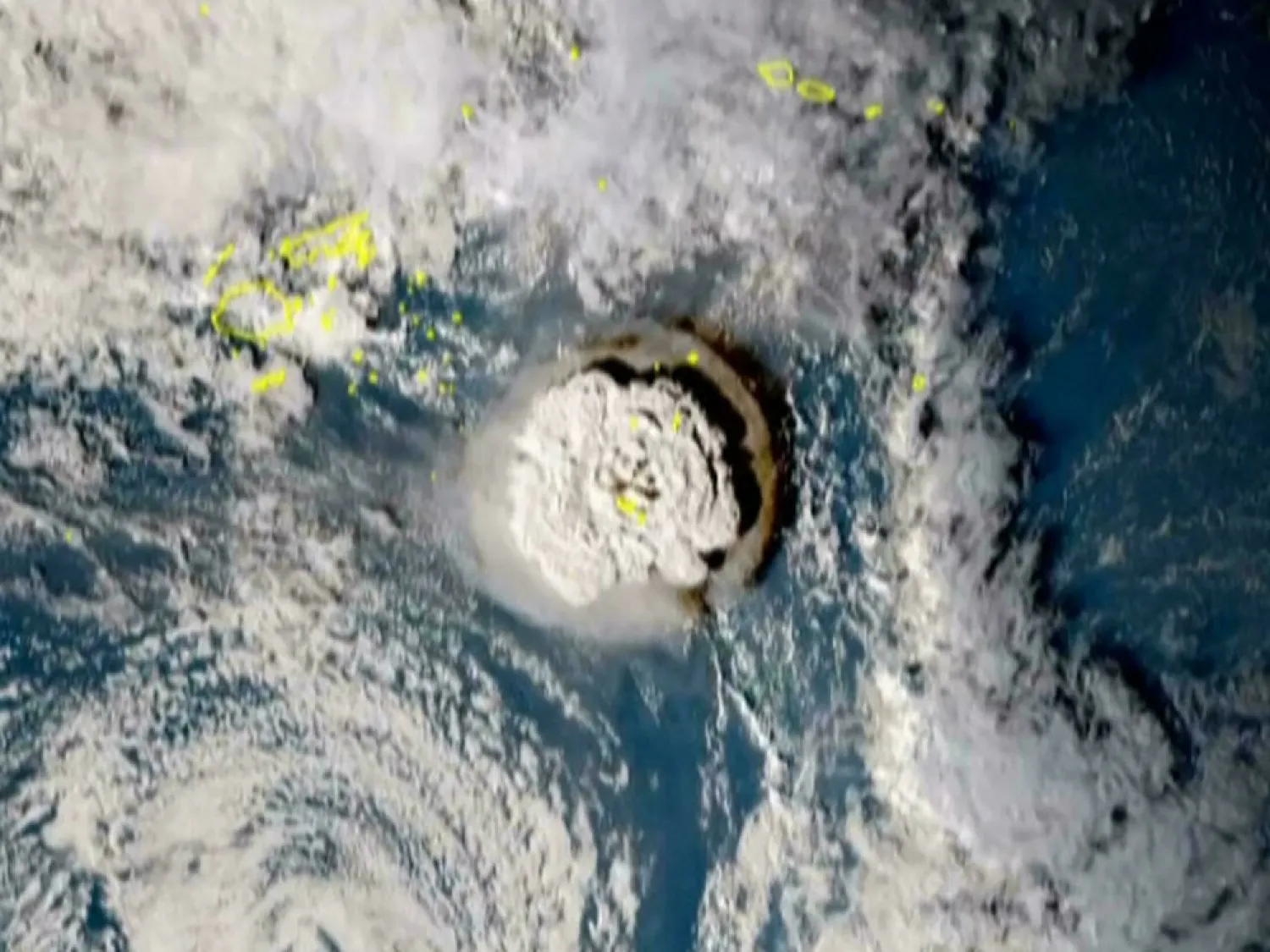
The eruption of the Hunga Tonga-Hunga Ha'apai volcano spewed smoke and ash in the air, with a thunderous roar heard 10,000 kilometers (6,000 miles) away in Alaska Handout NATIONAL INSTITUTE OF INFORMATION AND COMMUNICATIONS (JAPAN)/AFP
TT

'Extensive Damage' in Tsunami-struck Tonga

The eruption of the Hunga Tonga-Hunga Ha'apai volcano spewed smoke and ash in the air, with a thunderous roar heard 10,000 kilometers (6,000 miles) away in Alaska Handout NATIONAL INSTITUTE OF INFORMATION AND COMMUNICATIONS (JAPAN)/AFP

Aid agencies reported "extensive damage" in the Pacific island nation of Tonga on Tuesday following a massive underwater volcanic blast and tsunami, as the first death from the disaster was confirmed.

Early indications of the scale of the crisis on the virtually cut-off island kingdom were emerging through patchy satellite phone contact with Tonga, surveillance flights and satellite images, three days after the volcanic eruption.

The body of a British woman swept away by the tsunami had been found, her family said. At least one other person in Tonga was reported missing.

Australia and New Zealand, which scrambled Orion reconnaissance plane flights over Tonga the previous day, readied aid ships for deployment to Tonga.

The UN said a signal had been detected from a distress beacon on a low-lying island, Mango.

The UN Office for the Coordination of Humanitarian Affairs (OCHA) said surveillance flights had confirmed "substantial property damage" on Mango and another island, Fonoi.

"An active distress beacon had been detected from Mango," OCHA agency said in an urgent report. The island is home to more than 30 people, according to Tongan census figures.

- Volcanic ash and dust -
OCHA also reported "extensive damage" on the western beaches of the main island Tongatapu, "with several resorts and/or houses destroyed and/or badly damaged".

Tonga's capital Nuku'alofa was blanketed in two centimeters of volcanic ash and dust, it said. Power had been restored to parts of the capital. Local phones systems had been restored but international communications were severed.

The capital's waterfront, it said, was "seriously damaged with rocks and debris pushed inland from the tsunami".

Satellite images released by the United Nations Satellite Centre showed the impact of the eruption and tsunami on the tiny island of Nomuka, one of the closest to the Hunga-Tonga-Hunga-Ha'apai volcano.

The satellite center said of 104 structures analyzed in the cloud-free area, 41 structures were identified as damaged and almost all were covered with ash.

Tonga's airport had expected to clear volcanic ash from the capital's runway by Monday, OCHA said.

Australia said the ash must be cleared before it can land a C-130 military plane with aid.

The human toll remains largely unknown.

- 'Cling on to a tree' -
The first confirmed death was Angela Glover, a 50-year-old who ran a stray animals charity and was reported missing by her husband after the tsunami hit.

"Earlier today my family was sadly informed that the body of my sister Angela has been found," her brother Nick Eleini said after being given the news by the husband, James Glover.

"James was able to cling on to a tree for quite a long time, but Angela was unable to do so and was washed away with the dogs," he told The Guardian newspaper.

Tonga's worried neighbours are still scrambling to grasp the scale of the damage, which New Zealand's leader Jacinda Ardern said was believed to be "significant".

Australia's HMAS Adelaide, and New Zealand's HMNZS Wellington and HMNZS Aotearoa were deployed in case of any aid request from Tonga, which lies three days' sailing away.

Water is expected to be a priority, New Zealand's defense minister said Tuesday, as water sources in Tonga are at risk of being poisoned by the volcanic fallout.

France, which has territories in the South Pacific, pledged to help the people of Tonga's "most urgent needs" in cooperation with Australia and New Zealand.

Australia's international development minister, Zed Seselja, said a small contingent of Australian police stationed in Tonga had delivered a "pretty concerning" initial evaluation of the western beaches area.

- 'Devastation' -
Major aid agencies, which would usually rush in to provide emergency humanitarian relief, said they were stuck in a holding pattern, unable to contact local staff.

"From what little updates we have, the scale of the devastation could be immense -- especially for outlying islands," said Katie Greenwood, IFRC's Pacific Head of Delegation.

Even when relief efforts get under way, they may be complicated by Covid-19 entry restrictions. Tonga only recently reported its first-ever coronavirus case.

Saturday's volcanic blast was one the largest recorded in decades, erupting 30 kilometers (about 19 miles) into the air and depositing ash, gas and acid rain across a swathe of the Pacific.

The eruption was recorded around the world and heard as far away as Alaska, triggering a tsunami that flooded Pacific coastlines from Japan to the United States.

The eruption severed an undersea communications cable between Tonga and Fiji that operators said would take up to two weeks to repair.

"We're getting sketchy information, but it looks like the cable has been cut," Southern Cross Cable Network's networks director Dean Veverka told AFP.



Cuba to Protect Essential Services as US Moves to Cut Off Oil Supply

 People wait for transportation as Cubans brace for fuel scarcity measures after US tightens oil supply blockade, in Havana, Cuba, February 6, 2026. (Reuters)
People wait for transportation as Cubans brace for fuel scarcity measures after US tightens oil supply blockade, in Havana, Cuba, February 6, 2026. (Reuters)
TT

Cuba to Protect Essential Services as US Moves to Cut Off Oil Supply

 People wait for transportation as Cubans brace for fuel scarcity measures after US tightens oil supply blockade, in Havana, Cuba, February 6, 2026. (Reuters)
People wait for transportation as Cubans brace for fuel scarcity measures after US tightens oil supply blockade, in Havana, Cuba, February 6, 2026. (Reuters)

Cuba detailed a wide-ranging plan on Friday to protect essential services and ration fuel as the communist-run government dug in its heels in defiance of a US effort to cut off oil supply to the Caribbean island.

The rationing measures are the first to be announced since President Donald Trump threatened to slap tariffs on the US-bound products of any country exporting fuel to Cuba and suggested hard times ahead for Cubans already suffering severe shortages of food, fuel ‌and medicine.

Government ‌ministers said the measures would guarantee ‌fuel supply ⁠for key sectors, ‌including agricultural production, education, water supply, healthcare and defense.

Commerce Minister Oscar Perez-Oliva struck a defiant tone as he laid out details of the government plan.

"This is an opportunity and a challenge that we have no doubt we will overcome," Perez-Oliva told a television news program. "We are not going to collapse."

The government will supply fuel to the ⁠tourism and export sectors, including for the production of Cuba's world-famous cigars, to ensure ‌the foreign exchange necessary to fund other basic ‍programs, Perez-Oliva said, adding, "If we ‍don't have income, then we will not overcome this situation."

Domestic ‍and international air travel will not be immediately affected by the fuel rationing, although drivers will see cutbacks at the pump until supply normalizes, he said.

The government said it would protect ports and ensure fuel for domestic transportation in a bid to protect the island nation's import and export sectors.

Perez-Oliva also announced an ambitious ⁠plan to plant 200,000 hectares (500,000 acres) of rice to guarantee "an important part of our demand," but acknowledged fuel shortfalls would push the country to depend more on renewable energy for irrigation needs and animal-power for tilling fields.

Education Minister Naima Ariatne, appearing on the same program, said infant-care centers and primary schools would remain open and in person, but secondary schools and higher education would implement a hybrid system that would require more "flexibility" and vary by institution and region.

"As a priority, we want to leave (open) our primary schools," Ariatne said.

Top officials said ‌health care would also be prioritized, with special emphasis on emergency services, maternity wards and cancer programs.


Trump Signs Order Preparing for Tariffs on Iran’s Trade Partners

A man walks past a mural depicting the US Statue of Liberty with the torch-bearing arm broken, painted on the outer walls of the former US embassy, in Tehran on February 6, 2026. (AFP)
TT

Trump Signs Order Preparing for Tariffs on Iran’s Trade Partners

A man walks past a mural depicting the US Statue of Liberty with the torch-bearing arm broken, painted on the outer walls of the former US embassy, in Tehran on February 6, 2026. (AFP)

US President Donald Trump on Friday signed an executive order threatening tariffs on Iran's trade partners, after he pledged a further round of talks with Tehran next week.

The order, effective from Saturday, called for a fresh "imposition of tariffs" on countries still doing business with Iran.

It comes amid heightened tensions between Washington and Tehran, with an American naval group led by an aircraft carrier in Middle Eastern waters and indirect talks held on Tehran's nuclear program in Oman on Friday.

The levies "may be imposed on goods imported into the United States that are products of any country that directly or indirectly purchases, imports, or otherwise acquires any goods or services from Iran", the order said.

Trump issued a threat of 25 percent tariffs on any country trading with Iran last month.

This order establishes a process for his administration to impose tariffs on goods from those countries.

The rate is to be determined by Secretary of State Marco Rubio, although the order specifies that it could be "for example" 25 percent, the level first mentioned by the US president in mid-January.

Tariffs would affect trade with a number of countries including Russia, Germany, Türkiye and the United Arab Emirates.

More than a quarter of Iran's trade is with China, with $18 billion in imports and $14.5 billion in exports in 2024, according to World Trade Organization data.

The talks on Friday in Muscat, mediated by Oman, were the first between the two foes since the United States joined Israel's war with Iran in June with strikes on nuclear sites.

"We likewise had very good talks on Iran," Trump told reporters on board Air Force One en route to his Mar-a-Lago resort in Florida, adding, "we're going to meet again early next week."

Diplomatic relations between Iran and the US broke down with the 1979 revolution that brought the current government into power after hostages were taken at the US embassy in Tehran for 444 days.

Direct engagement has been rare in the decades since.

Iran remains under an internet blackout amid a harsh government crackdown on economic protests that began in December across the country.

The US-based Human Rights Activists News Agency (HRANA) said Friday it has confirmed 6,505 protesters were killed, as well as 214 members of the security forces and 61 bystanders.


Trump Says US Talks with Iran ‘Very Good,’ More Negotiations Expected

US President Donald Trump gaggles with reporters while aboard Air Force One on February 6, 2026 en route to Palm Beach, Florida. (Getty Images via AFP)
TT

Trump Says US Talks with Iran ‘Very Good,’ More Negotiations Expected

US President Donald Trump gaggles with reporters while aboard Air Force One on February 6, 2026 en route to Palm Beach, Florida. (Getty Images via AFP)

US President Donald Trump said Friday Washington held "very good talks" on Iran after the two sides held an indirect dialogue in Oman.

Iran for its part said it expected to hold more negotiations with the United States, hailing a "positive atmosphere" during a day of talks in the Gulf sultanate.

With an American naval group led by an aircraft carrier in Middle Eastern waters, US and Iranian delegations held talks in Muscat mediated by Oman without publicly meeting face-to-face.

Shortly after the talks concluded, the US announced new sanctions against shipping entities and vessels, aimed at curbing Iran's oil exports. But it was not clear if the move was linked to the talks.

The talks were the first between the two foes since the United States joined Israel's war with Iran in June with strikes on nuclear sites.

"We likewise had very good talks on Iran," Trump told reporters on board Air Force One en route to his Mar-a-Lago resort in Florida, adding, "we're going to meet again early next week."

However, as Iran warned against further threats after Washington raised the specter of new military action, Trump said: "If they don't make a deal, the consequences are very steep."

Foreign Minister Abbas Araghchi, who led Iran's delegation in Muscat, said talks "focused exclusively" on the Iranian nuclear program, which the West believes is aimed at making an atomic bomb but Tehran insists is peaceful.

The US delegation, led by Middle East envoy Steve Witkoff and Trump's influential son-in-law Jared Kushner, had also wanted Tehran's backing for militant groups, its ballistic missile program and treatment of protesters on the agenda.

"In a very positive atmosphere, our arguments were exchanged and the views of the other side were shared with us," Araghchi told Iranian state TV, adding that the two sides had "agreed to continue negotiations."

Speaking to the official IRNA news agency, Araghchi expressed hope that Washington would refrain from "threats and pressure" so that "the talks can continue."

- 'Destabilizing power' -

Admiral Brad Cooper, the commander of US Central Command, was present at the talks, according to images published by the Oman News Agency.

Multiple sessions of talks in the morning and afternoon saw both sides shuttling to and from the residence of Omani Foreign Minister Badr Albusaidi.

The foreign ministry of US ally Qatar expressed hope the talks would "lead to a comprehensive agreement that serves the interests of both parties and enhances security and stability in the region."

The White House has made clear it wants the talks to rein in Tehran's ability to make a nuclear bomb, an ambition the country has always denied.

French Foreign Minister Jean-Noel Barrot said on Friday that Iran should stop being a "destabilizing power," citing its nuclear program and support for "terrorist" groups.

Barrot also called on "groups supported by Iran" to exert "the utmost restraint" in the event of any military escalation involving Iran.

- 'Maximum pressure' -

Trump initially threatened military action against Tehran over its crackdown on protesters last month, which rights groups say killed thousands, and even told demonstrators "help is on its way."

Regional powers urged the United States not to intervene, calling on Washington and Tehran to instead return to talks.

The US-based Human Rights Activists News Agency (HRANA) said Friday it has confirmed 6,505 protesters were killed, as well as 214 members of the security forces and 61 bystanders.

Those numbers are expected to climb because the magnitude of the crackdown has masked by the blanket internet shutdown imposed by the authorities for a fortnight, rights groups say.

Almost 51,000 people are also confirmed to have been arrested amid "the growing use of forced confessions," according to HRANA.

Yet Trump's rhetoric in recent days has focused on reining in the Iranian nuclear program and the US has maneuvered a naval group led by aircraft carrier USS Abraham Lincoln into the region.

Iran has repeatedly vowed it will hit back at US bases in the region if attacked.

The new sanctions to curb Iran's oil exports come with Trump "committed to driving down the Iranian regime's illicit oil and petrochemical exports under the administration's maximum pressure campaign," State Department spokesman Tommy Pigott said in a statement.