

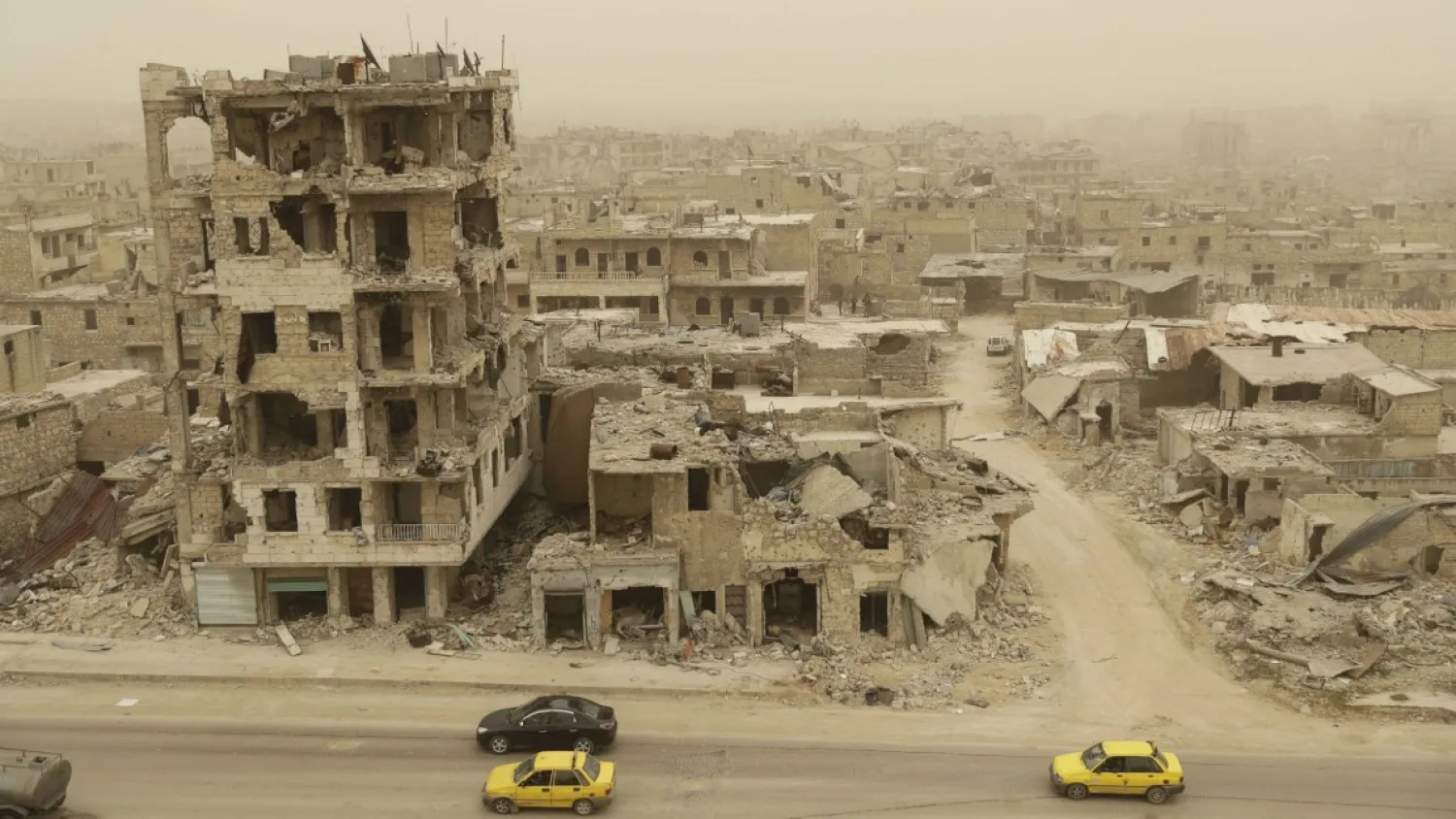

EU Says Won’t Contribute to Syria’s Reconstruction Without Genuine Political Transition

The European Union has already spent $1.1 billion in Syria. (AFP)
TT

EU Says Won’t Contribute to Syria’s Reconstruction Without Genuine Political Transition

The European Union has already spent $1.1 billion in Syria. (AFP)

The European Union said it will be ready to assist in the reconstruction of Syria only when a comprehensive, genuine and inclusive political transition is firmly under way.

It recalled that a sustainable solution to the conflict requires a genuine, inclusive political transition in line with UN Security Council Resolution 2254 and the 2012 Geneva communique negotiated by the Syrian parties within the UN-led Geneva process, with the full, equal and meaningful participation of women.

“The conflict in Syria has endured for more than a decade. The EU remains committed to the unity, sovereignty and territorial integrity of the Syrian state,” it said in a report published on Thursday.

“The EU wholeheartedly supports the efforts of UN Special Envoy Geir Pedersen to advance on all aspects of UNSCR 2254, including on the issues of detainees and missing persons at the hands of the regime, and the establishment of a safe and neutral environment in order for free and fair elections to be held under UN supervision.”

It called on all participants, particularly the Syrian regime, to engage in good faith in the political process, including the Constitutional Committee.

The EU has responded positively to the UNSE’s initiative for a ‘steps-for-steps’ approach to help move the political process forward.

According to some estimates, up to 1,500 civilians have been killed in Syria in 2021 alone, as a direct result of the conflict.

“Continued hostilities across Syria, provoked by various actors, render ordinary life impossible for the civilian population,” the report warned.

It urged parties of the conflict to uphold the ceasefire agreed in March 2020 in the northwest without reserve.

It once again echoed the calls made by the UN Security Council for the implementation of a nationwide ceasefire.

“Civilians must be protected at all times and attacks on civilian objects, including hospitals, must cease,” it stressed.

The EU further underlined the importance of accountability and justice for victims for a stable, peaceful Syria, based on a credible, inclusive and viable political solution in accordance with UNSCR 2254.

“In the absence of international justice, the prosecution of war crimes under national jurisdiction where possible, now under way in several EU member states, represents an important contribution towards securing justice.”

It added that it will continue to support efforts to gather evidence with a view to future legal action, including by the International, Impartial and Independent Mechanism for Syria, and the work of the Commission of Inquiry.

It stressed the need to address the underlying causes of the refugee and displacement crisis - 5.6 million Syrians are registered as refugees and another 6.7 million people displaced within Syria - under UNSCR 2254.

According to the report, the EU continues to warn against any further displacements in any part of Syria, as well as against the potential exploitation of such displacements for the purposes of social and demographic engineering.

Humanitarian needs in Syria continue to increase from 11 million in need of humanitarian assistance in 2020 to 14 million people at present.

The EU and its member states are the largest donor. They have provided 25 billion euros to meet the needs arising from the crisis over the last decade.

“We will continue to demonstrate solidarity with the Syrian people and call on the international community to increase their commitments,” said the EU.



Former Iraq President Named UN Refugee Chief, Document Shows

Former Iraqi President Barham Salih. (Reuters)
TT

Former Iraq President Named UN Refugee Chief, Document Shows

Former Iraqi President Barham Salih. (Reuters)

Iraq's former president Barham Salih has been chosen as the next High Commissioner for Refugees for the United Nations, a letter showed on Friday, breaking with a tradition of appointing leaders from major donor countries.

The letter, signed by UN Chief Antonio Guterres and dated December 11, says Salih has been appointed for a five-year term beginning January 1.

He replaces Italy's Filippo Grandi, a veteran UN official, who has held the position since 2016. The appointment is provisional and needs to be approved by UNHCR's Executive Committee, the document showed.

Salih, a British-educated engineer from Iraq's Kurdish region, faces major challenges with global displacement at record highs and about double the levels it was when Grandi first began.

In parallel, funding has fallen this year as key donors like the United States have cut back and other Western donors have shifted funds to defense.

About a dozen candidates were competing for the role, including several politicians as well as an IKEA executive, an ER doctor and a TV personality. More than half of them were from Europe, in keeping with a tradition of the Geneva-based agency's chief coming from top donor states.


Trump: ‘We Actually Do Have a Real Peace in the Middle East’

US President Donald Trump delivers remarks during the Congressional Ball in the Grand Foyer of the White House in Washington, DC, on December 11, 2025. (Photo by Alex WROBLEWSKI / AFP)
TT

Trump: ‘We Actually Do Have a Real Peace in the Middle East’

US President Donald Trump delivers remarks during the Congressional Ball in the Grand Foyer of the White House in Washington, DC, on December 11, 2025. (Photo by Alex WROBLEWSKI / AFP)

US President Donald Trump has said that there are prospects for “a real peace in the Middle East.”

When asked by a reporter at the White House about reports that he was planning to appoint an American two-star general to command the International Stabilization Force (ISF) in Gaza, Trump said Thursday: “We actually do have a real peace in the Middle East ... it’s never happened before and I think it’s very strong actually.”

The ceasefire, in effect since October 10, halted the war but it remains fragile as Israel and Hamas accuse each other almost daily of violations.

The agreement is composed of three phases. Israeli Prime Minister Benjamin Netanyahu recently indicated that he expected the second phase to begin soon.

That phase involves the Israeli army pulling farther back, the ISF deploying to Gaza, and a new governing structure coming into force, including the Trump-led Board of Peace.

Trump told reporters Wednesday that he's planning to announce the Gaza Board of Peace in early 2026.

Gaza’s population of around 2 million is almost entirely displaced, and most people live in vast tent camps stretching along the coast, or set up among the shells of damaged buildings.


Series of Israeli Strikes Hit Lebanon

A convoy of Lebanese army vehicles drives near the border with Israel in the village of Alma al-Shaab during a Lebanese army media tour in south Lebanon, Friday, Nov. 28, 2025. (AP Photo/Bilal Hussein)
TT

Series of Israeli Strikes Hit Lebanon

A convoy of Lebanese army vehicles drives near the border with Israel in the village of Alma al-Shaab during a Lebanese army media tour in south Lebanon, Friday, Nov. 28, 2025. (AP Photo/Bilal Hussein)

A series of Israeli strikes hit south and east Lebanon on Friday, state media reported, as Israel's army said it was targeting Hezbollah sites, the latest such raids despite a year-old ceasefire.

Lebanon's state-run National News Agency (NNA) reported strikes in around a dozen locations, including up to around 30 kilometers (20 miles) from the Israeli border, citing at times "heavy raids".

Israel has kept up strikes on Lebanon despite a November 2024 ceasefire that was supposed to end more than a year of hostilities with the Iran-backed militant group Hezbollah, and has also kept troops in five areas it deems strategic, reported AFP.

The Israeli military said in a statement that its forces "struck a training and qualification compound" used by Hezbollah's elite Radwan Force where operatives "underwent shooting exercises and additional training on the use of various types of weapons".

The army also "struck additional Hezbollah military infrastructure in several areas in southern Lebanon", it said.

According to the ceasefire, Hezbollah was required to pull its forces north of the Litani River, some 30 kilometers from the border with Israel, and have its military infrastructure there dismantled.

Under a government-approved plan, Lebanon's army is to dismantle Hezbollah's military infrastructure south of the Litani by the end of the year, before tackling the rest of the country.

The sites struck on Friday were generally north of the river.

Earlier this week, Israel launched a series of strikes on southern Lebanon, also saying it hit a Hezbollah training center and other targets.