

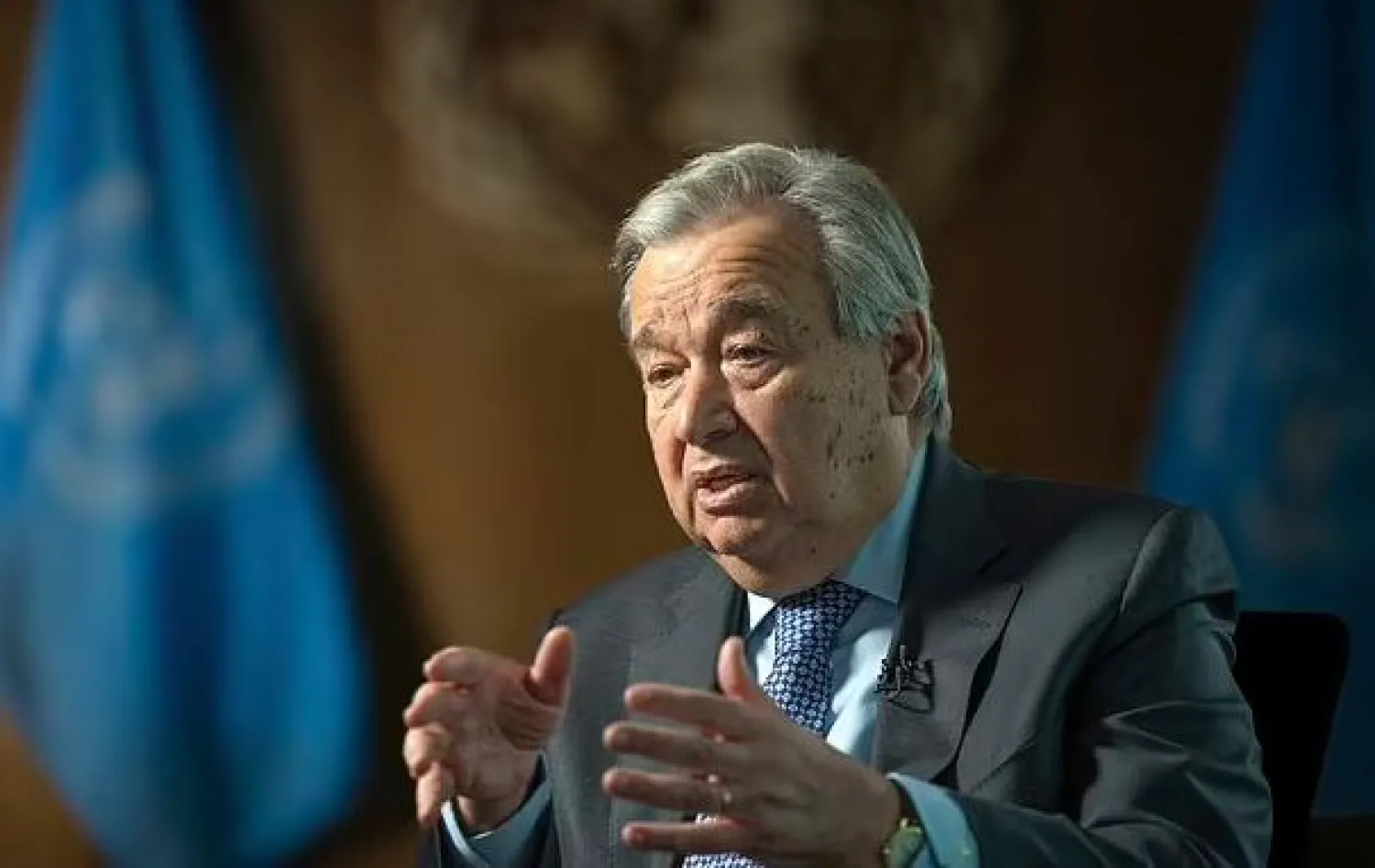

Guterres: World More Unpredictable than during the Cold War

United Nations Secretary-General Antonio Guterres speaks during interview at the UN Headquarters, Thursday, Jan. 20, 2022, in New York. (AP Photo/Robert Bumsted)
TT

Guterres: World More Unpredictable than during the Cold War

United Nations Secretary-General Antonio Guterres speaks during interview at the UN Headquarters, Thursday, Jan. 20, 2022, in New York. (AP Photo/Robert Bumsted)

UN Secretary-General Antonio Guterres said Friday the current world is "much more chaotic, much less predictable" than during the Cold War between the former Soviet Union and the United States, and it's dangerous because there are no "instruments" to deal with crises.

He said in a wide-ranging press conference that the Cold War was between two opposing blocs where there were clear rules and mechanisms to prevent conflict. It "never became hot because there was a certain level of predictability," he said.

He said he wouldn´t call the dangerous situation today a Cold War or a Hot War but probably "a new form of tepid confrontation."

As he starts his second term as UN secretary-general, Guterres said in an Associated Press interview on Thursday that the world is worse in many ways than it was five years ago because of the COVID-19 pandemic, the climate crisis and geopolitical tensions that have sparked conflicts everywhere - but unlike US President Joe Biden he thinks Russia will not invade Ukraine.

At the press conference, Guterres said his message to Russian President Vladimir Putin "is that there should not be any military intervention" in Ukraine.

"I am convinced it will not happen, and I strongly hope to be right," he said.

The UN chief spoke after US Secretary of State Antony Blinken and Russian Foreign Minister Sergey Lavrov met in Geneva on the crisis over Ukraine which has seen Moscow deploy tens of thousands of troops on its border and Western nations sending military hardware to Kyiv. Expectations were low for a breakthrough and there was none, but the top US and Russian diplomats agreed to meet again.

"What for me is essential is that this dialogue leads to a good solution and that that good solution is that there is de-escalation and this crisis ends," Guterres said. "That is our objective. I´ve been saying that I strongly hope that diplomacy will prevail."

Guterres reiterated in the AP interview that the UN Security Council, which does have the power to uphold international peace and security including by imposing sanctions and ordering military action, is divided, especially its five veto-wielding permanent members. Russia and China are often at odds with the United States, Britain and France on key issues, including Thursday on new sanctions against North Korea.

The secretary-general reiterated at the news conference that splitting the world in two -- with the United States and China creating rival economic systems and rules, each with dominant currency, its own Internet, technological strategy and artificial intelligence -- must be avoided "at all costs."

"I always advocated for the need for a unified global market, a unified global economy," Guterres said. "At the present moment there are a number of differences and I´ve been advocating both with the US and China on the importance of a serious dialogue and a serious negotiation on the aspect of trade and technology in which the two countries have ... different positions."

He said his aim is to see the two leading economic powers "overcome those difficulties and to be able to establish that global market in which all can cooperate and all can benefit."

Guterres spoke to reporters after presenting his priorities for 2022 to diplomats from the UN´s 193 member nations in the General Assembly and assessing the global landscape which he called "not a pretty picture."

"I see a five alarm global fire," the secretary-general said.

"Each of the alarms is feeding off the others," he said. "They are accelerants to an inferno."

He cited inequity and injustice in tackling the COVID-19 pandemic, "a global economic system rigged against the poor," insufficient action on "the existential climate threat" and "a wild west digital frontier that profits from division."

Guterres said all these "social and economic fires" are creating conflicts and unrest around the world, and all of them are fueling mistrust and people´s lost faith in institutions and their underlying values.

"In every corner of the world, we see this erosion of core values. Equality. Justice. Cooperation. Dialogue. Mutual respect," the secretary-general said.

He warned that injustice, inequality, mistrust, racism and discrimination "are casting dark shadows across every society" and said all nations must restore "human dignity and human decency" and "prevent the death of truth."

"We must make lying wrong again," Guterres said.


Quake Rattles Southeastern Türkiye

Image of earthquake monitoring (Reuters)
TT

Quake Rattles Southeastern Türkiye

Image of earthquake monitoring (Reuters)

An earthquake of 5.4 magnitude rattled cities in southeastern Türkiye on Thursday but there were no immediate reports of damage or injuries, the disaster agency said.

The quake, which occurred at 10:40 am (0740 GMT) was centered just north of the city of Sanliurfa, Türkiye's AFAD disaster agency said, adding "there are currently no reports of adverse effects".

Hasan Silda, governor of Sanliurfa province, said the quake had been felt "intensely", AFP reported.

"According to initial reports, there are no casualties or injuries. There is no destruction. There may be some partial damage to buildings," he told NTV private television.

Türkiye is crisscrossed by several geological fault lines that have previously caused catastrophes in the country.

A massive quake in February 2023 killed at least 53,000 people in southeastern Türkiye and around 7,000 others in Syria, that also caused damage and more than 300 deaths in Sanliurfa.


For Pope Leo, the Risk of an AI Apocalypse is a Major Concern

Pope Leo XIV leads the weekly Angelus prayer from a window at the Vatican, August 9, 2026. Vatican Media/Mario Tomassetti/­Handout via REUTERS
TT

For Pope Leo, the Risk of an AI Apocalypse is a Major Concern

Pope Leo XIV leads the weekly Angelus prayer from a window at the Vatican, August 9, 2026. Vatican Media/Mario Tomassetti/­Handout via REUTERS

The Vatican warned about the risk of an apocalypse spurred by artificial intelligence years before major American firms sounded the alarm at the United Nations Security Council on Wednesday - a concern that Pope Leo is placing at the heart of his papacy.

Leo, who in May called on world leaders for global rules to oversee the industry, is expected to warn about AI again on Friday in a speech at the Paris headquarters of the UN's culture and education body, UNESCO.

"This is not happening on day zero for the Holy See," Rev. Paolo Benanti, a leading Vatican advisor on AI issues, told Reuters, referring to recent calls for a slowdown that has been endorsed by the CEOs of AI firms Anthropic, OpenAI and xAI, among others.

"The transformative power of AI ... ‌could produce a magnitude ‌of societal changes that are very hard to predict," said Benanti, an Italian academic ‌who ⁠recently took part ⁠in the AI summit hosted by Britain's King Charles.

The priest said he could not reveal details about the contents of the summit's confidential discussions.

CARDINAL: THE FUTURE OF HUMANITY IS AT STAKE

Leo, the first US-born pope, has raised the possible dangers of AI development frequently throughout his 16-month-old papacy and first discussed the issue publicly on his third day in office.

In his May appeal, released as his first major document, Leo warned that AI systems spread misinformation, prioritize conflict and could lead the world down a path of unending war.

Cardinal Pietro Parolin, the Vatican's top diplomat, reiterated Leo's call for international regulation of ⁠the industry at an event in Rome last week, warning that countries cannot "go it alone" ‌on the technology.

"The future of humanity is really at stake here," ‌Parolin said. The world, he said, needs "everyone's involvement in establishing some common rules that can genuinely govern this phenomenon."

Anthropic co-founder Chris Olah ‌spoke at the Vatican's launch event for the pope's May document, known as an encyclical.

Asked if the Vatican is ‌in ongoing dialogue with any AI firms, Benanti stressed the decentralized nature of the global church and said some discussions are being led by local bishops.

On September 16, the US bishops' conference said it had created a new AI taskforce after several of its leaders met with executives that day.

"The dialogue focused on ways to keep any system of artificial intelligence at the service of ‌humanity and the urgent need to address the real and present dangers such technology presents," a statement said.

LEO WARNS ABOUT AUTONOMOUS WEAPONS

The Vatican began warning about the ⁠risks of AI in 2019, hosting ⁠two conferences that year on the possible dangers of the technology. The late Pope Francis warned attendees at one of the events that misinformation spread by AI could spark a world war.

The Vatican also teamed with Microsoft, IBM , the UN's Food and Agriculture Organization and the Italian government in 2020 to issue a call for AI development that "does not have as its sole goal greater profit or the gradual replacement of people in the workplace."

Leo has urged oversight especially for the development of weapons systems, such as those being used in the Russia-Ukraine war. He said in his encyclical that such weapons have advanced "practically beyond any human reach to govern them."

The Vatican's advocacy on the global stage against autonomous weaponry goes back decades, Benanti said, likening AI-powered drones to landmines that are indiscriminate with their targets.

The priest compared the Vatican's warnings about the risks of AI to how popes have long called for nuclear disarmament.

"If nuclear weapons can destroy humanity ... the manipulation of generative AI content in social spaces can destroy the capabilities of people to stay together as a society," he said.

"Nuclear weapons have to be stocked inside facilities and you can count and control them. AI is not this visible."


Poland Says Fire at Starlink Station is Act of 'Sabotage'

FILE PHOTO: An evening launch of a SpaceX Falcon 9 rocket carrying 22 Starlink satellites to low-Earth orbit is seen over the Pacific Ocean from Encinitas, California, US, April 1, 2024.  REUTERS/Mike Blake/File Photo
FILE PHOTO: An evening launch of a SpaceX Falcon 9 rocket carrying 22 Starlink satellites to low-Earth orbit is seen over the Pacific Ocean from Encinitas, California, US, April 1, 2024. REUTERS/Mike Blake/File Photo
TT

Poland Says Fire at Starlink Station is Act of 'Sabotage'

FILE PHOTO: An evening launch of a SpaceX Falcon 9 rocket carrying 22 Starlink satellites to low-Earth orbit is seen over the Pacific Ocean from Encinitas, California, US, April 1, 2024.  REUTERS/Mike Blake/File Photo
FILE PHOTO: An evening launch of a SpaceX Falcon 9 rocket carrying 22 Starlink satellites to low-Earth orbit is seen over the Pacific Ocean from Encinitas, California, US, April 1, 2024. REUTERS/Mike Blake/File Photo

A fire broke out at a Starlink satellite communications station in central Poland overnight, the digital affairs minister said on Thursday, calling the blaze an act of "sabotage."

"This act of sabotage was deliberately designed to disable the station ... disrupting internet access for various institutions, including the Ukrainian army," Krzysztof Gawkowski told Polish public broadcaster TVP Info, adding that the fire broke out late on Wednesday and that the station was still operational.

"There is much to suggest that we are dealing with an element of the next phase of hybrid warfare," he added, according to AFP.

The station, owned by state-owned telecommunications company Exatel, is used, among other things, to transmit internet traffic through Poland, including to Ukraine, according to the minister.

It is also used by SpaceX systems that provide connectivity via Starlink terminals.

Gawkowski said that the investigation was ongoing into the causes of the blaze, "many indications suggest that it fits into this new Russian doctrine of attack.”

Poland, a NATO and EU member state along the alliance's eastern flank, has accused Russia of "sabotage" on several occasions since Moscow's full-scale invasion of Ukraine in 2022.

Poland has become the main hub for transporting Western military and humanitarian support to Kyiv.

Earlier this month, Prime Minister Donald Tusk warned that Russia's plans in the war against Ukraine include "hybrid" drone and missile strikes against Kyiv's allies.
