


NASA’s New Space Telescope Nears Destination in Solar Orbit

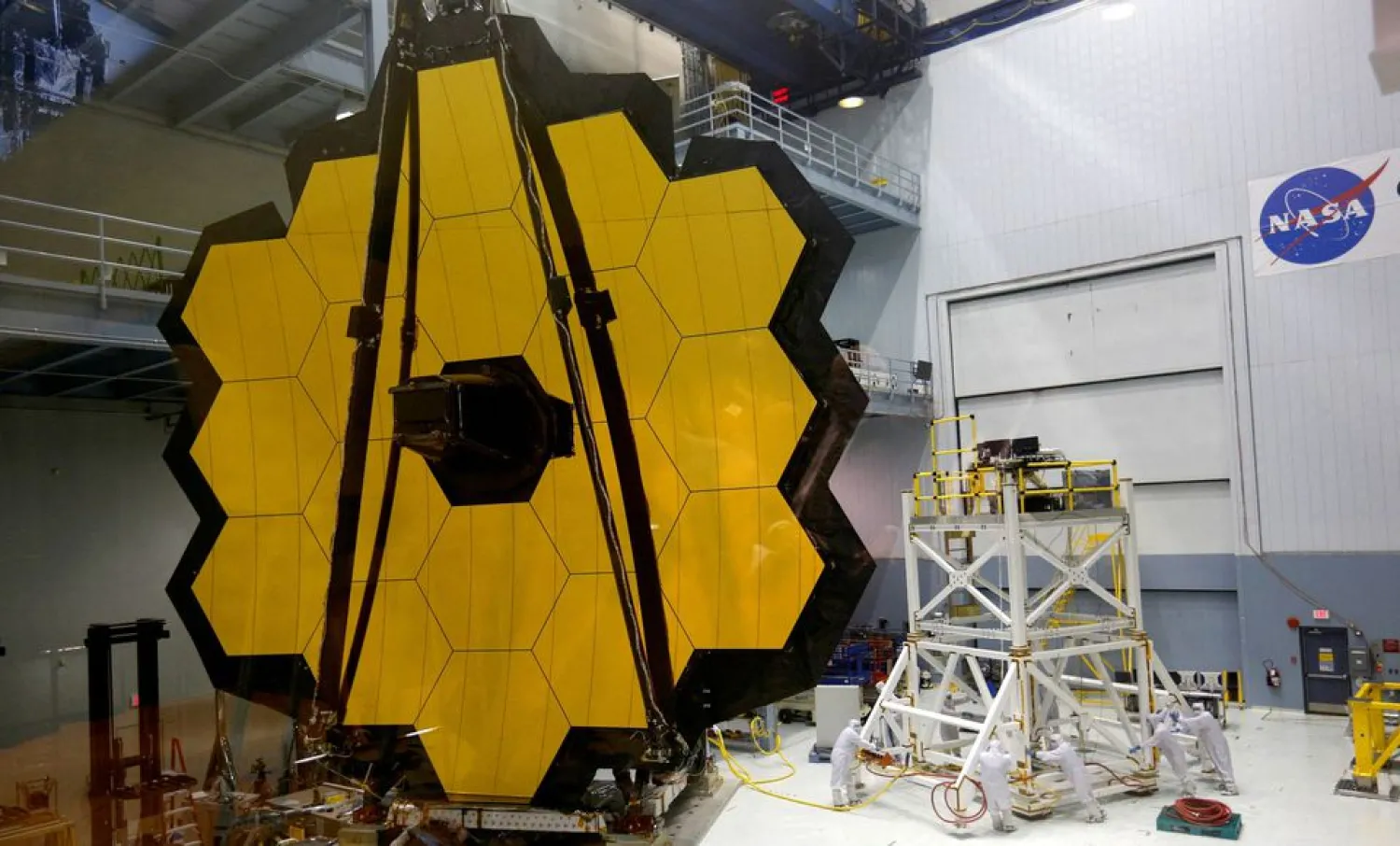
The James Webb Space Telescope Mirror is seen during a media unveiling at NASA’s Goddard Space Flight Center at Greenbelt, Maryland November 2, 2016. (Reuters)
TT

NASA’s New Space Telescope Nears Destination in Solar Orbit

The James Webb Space Telescope Mirror is seen during a media unveiling at NASA’s Goddard Space Flight Center at Greenbelt, Maryland November 2, 2016. (Reuters)

NASA's James Webb Space Telescope, designed to give the world an unprecedented glimpse into the earliest stages of the universe, neared its gravitational parking space on Monday in orbit around the sun, almost 1 million miles from Earth.

With a final course-correcting maneuver by on-board rocket thrusters set for 2 p.m. EDT (1900 GMT), Webb is expected to reach its destination at a position of orbital stability between the Earth and sun known as Lagrange Point Two, or L2, arriving one month after launch.

The thrusters will be activated by mission control engineers at the Space Telescope Science Institute in Baltimore, and the ground team will use radio signals to confirm when Webb has been successfully "inserted" into orbit, said Eric Smith, NASA's program scientist for Webb.

From its vantage point in space, Webb will follow a special path in constant alignment with Earth, as the planet and telescope circle the sun in tandem, enabling uninterrupted radio contact.

By comparison, Webb's 30-year-old predecessor, the Hubble Space Telescope, orbits the Earth from 340 miles (547 km) away, passing in and out of the planet's shadow every 90 minutes.

The combined pull of the sun and Earth at L2 can hold the telescope firmly in place so it takes little additional rocket thrust to keep Webb from drifting.

Utilized by several other deep space satellites over the years, an L2 position allows a "minimum amount of fuel to stay in orbit," Smith said.

The operations center has also begun fine-tuning the telescope's primary mirror - an array of 18 hexagonal segments of gold-coated beryllium metal measuring 21 feet, 4 inches (6.5 meters) across - far larger than Hubble's main mirror.

Its size and design to operate mainly in the infrared spectrum will allow Webb to peer through clouds of gas and dust and observe objects at greater distances, thus farther back in time, than Hubble or any other telescope.

These features are expected to usher in a revolution in astronomy, giving a first view of infant galaxies dating to just 100 million years after the Big Bang, the theoretical flashpoint that set the expansion of the known universe in motion an estimated 13.8 billion years ago.

Webb's instruments also make it ideal to search for signs of potentially life-supporting atmospheres around scores of newly documented exoplanets - celestial bodies orbiting distant stars - and to observe worlds much closer to home, such as Mars and Saturn's icy moon Titan.

Next steps

It will take several more months of work to prepare Webb for its astronomical debut.

The 18 segments of its principal mirror, which had been folded together to fit inside the cargo bay of the rocket that carried the telescope to space, were unfurled with the rest of its structural components during a two-week period following Webb's launch on Dec. 25.

Those segments were recently detached from fasteners that held them in place for the launch and slowly moved forward half an inch from their original configuration, allowing them to be adjusted into a single, unbroken, light-collecting surface.

The 18 segments now need to be aligned to achieve the mirror's proper focus, a process that will take three months to complete.

As the alignment progresses, ground teams will start activating the observatory's spectrograph, camera and other instruments. This will be followed by two months calibrating the instruments themselves, Smith said.

If all goes smoothly, Webb should be ready to begin making observations by early summer, with initial images used to demonstrate the instruments function properly.

But Smith said Webb's most ambitious work, including plans to train its mirror on objects farthest from Earth, will take longer to conduct so it will be a while till the world gets a look at such images.

The telescope is an international collaboration led by NASA in partnership with the European and Canadian space agencies. Northrop Grumman Corp was the primary contractor.



Olives, Opera and a Climate-Neutral Goal: How a Mural in Greece Won ‘Best in the World’ 

A building with the mural entitled “Kalamata” depicting opera legend Maria Callas by artist Kleomenis Kostopoulos is seen in Kalamata town, about 240 kilometers (150 miles) southwest of Athens, Monday, Feb. 9, 2026. (AP) 
TT

Olives, Opera and a Climate-Neutral Goal: How a Mural in Greece Won ‘Best in the World’ 

A building with the mural entitled “Kalamata” depicting opera legend Maria Callas by artist Kleomenis Kostopoulos is seen in Kalamata town, about 240 kilometers (150 miles) southwest of Athens, Monday, Feb. 9, 2026. (AP) 

Long known for its olives and seaside charm, the southern Greek city of Kalamata has found itself in the spotlight thanks to a towering mural that reimagines legendary soprano Maria Callas as an allegory for the city itself.

The massive artwork on the side of a prominent building in the city center has been named 2025’s “Best Mural of the World” by Street Art Cities, a global platform celebrating street art.

Residents of Kalamata, approximately 240 kilometers (150 miles) southwest of Athens, cultivate the world-renowned olives, figs and grapes that feature prominently on the mural.

That was precisely the point.

Vassilis Papaefstathiou, deputy mayor of strategic planning and climate neutrality, explained Kalamata is one of the few Greek cities with the ambitious goal of becoming climate-neutral by 2030. He and other city leaders wanted a way to make abstract concepts, including sustainable development, agri-food initiatives, and local economic growth, more tangible for the city’s nearly 73,000 residents.

That’s how the idea of a massive mural in a public space was born.

“We wanted it to reflect a very clear and distinct message of what sustainable development means for a regional city such as Kalamata,” Papaefstathiou said. “We wanted to create an image that combines the humble products of the land, such as olives and olive oil — which, let’s be honest, are famous all over the world and have put Kalamata on the map — with the high-level art.”

“By bringing together what is very elevated with ... the humbleness of the land, our aim was to empower the people and, in doing so, strengthen their identity. We want them to be proud to be Kalamatians.”

Southern Greece has faced heatwaves, droughts and wildfires in recent years, all of which affect the olive groves on which the region’s economy is hugely dependent.

The image chosen to represent the city was Maria Callas, widely hailed as one of the greatest opera singers of the 20th century and revered in Greece as a national cultural symbol. She may have been born in New York to Greek immigrant parents, but her father came from a village south of Kalamata. For locals, she is one of their own.

This connection is also reflected in practice: the alumni association at Kalamata’s music school is named for Callas, and the cultural center houses an exhibition dedicated to her, which includes letters from her personal archive.

Artist Kleomenis Kostopoulos, 52, said the mural “is not actually called ‘Maria Callas,’ but ‘Kalamata’ and my attempt was to paint Kalamata (the city) allegorically.”

Rather than portraying a stylized image of the diva, Kostopoulos said he aimed for a more grounded and human depiction. He incorporated elements that connect the people to their land: tree branches — which he considers the above-ground extension of roots — birds native to the area, and the well-known agricultural products.

“The dress I create on Maria Callas in ‘Kalamata’ is essentially all of this, all of this bloom, all of this fruition,” he said. “The blessed land that Kalamata itself has ... is where all of these elements of nature come from.”

Creating the mural was no small feat. Kostopoulos said it took around two weeks of actual work spread over a month due to bad weather. He primarily used brushes but also incorporated spray paint and a cherry-picker to reach all edges of the massive wall.

Papaefstathiou, the deputy mayor, said the mural has become a focal point.

“We believe this mural has helped us significantly in many ways, including in strengthening the city’s promotion as a tourist destination,” he said.

Beyond tourism, the mural has sparked conversations about art in public spaces. More building owners in Kalamata have already expressed interest in hosting murals.

“All of us — residents, and I personally — feel immense pride,” said tourism educator Dimitra Kourmouli.

Kostopoulos said he hopes the award will have a wider impact on the art community and make public art more visible in Greece.

“We see that such modern interventions in public space bring tremendous cultural, social, educational and economic benefits to a place,” he said. “These are good springboards to start nice conversations that I hope someday will happen in our country, as well.”


Nine Skiers Missing, Six Rescued after California Avalanche

FILE PHOTO: The snow-covered Sierra Nevada Mountains are seen from the air during a Pacific Gas and Electric snowpack survey near Nevada City, California, US April 3, 2017.  REUTERS/Bob Strong/File Photo
FILE PHOTO: The snow-covered Sierra Nevada Mountains are seen from the air during a Pacific Gas and Electric snowpack survey near Nevada City, California, US April 3, 2017. REUTERS/Bob Strong/File Photo
TT

Nine Skiers Missing, Six Rescued after California Avalanche

FILE PHOTO: The snow-covered Sierra Nevada Mountains are seen from the air during a Pacific Gas and Electric snowpack survey near Nevada City, California, US April 3, 2017.  REUTERS/Bob Strong/File Photo
FILE PHOTO: The snow-covered Sierra Nevada Mountains are seen from the air during a Pacific Gas and Electric snowpack survey near Nevada City, California, US April 3, 2017. REUTERS/Bob Strong/File Photo

Nine skiers were missing after an avalanche in California's Sierra Nevada mountains on Tuesday, but six others, who had been stranded, have since been rescued, authorities said.

The avalanche swept the Castle Peak area of Truckee, California, about 10 miles north of Lake Tahoe, at about 11:30 a.m. Pacific time, engulfing a group of skiers, according to a Facebook statement posted by the Nevada County Sheriff's Office.

Those rescued have varying injuries and two were ‌sent to a hospital ‌for treatment.

The sheriff's office revised the number of ‌people ⁠in the group to ⁠15 from an earlier estimate of 16, adding that no further updates were expected on Tuesday evening.

If all nine of the missing skiers should perish, the incident would rank among the deadliest single avalanches on record in the United States. The Colorado Avalanche Information Center has tallied six US avalanche fatalities so far this season.

Avalanches have claimed an average of 27 lives ⁠each winter in the United States over the past ‌decade, the center reported.

A winter storm warning ‌was in effect for much of northern California on Tuesday, with heavy snow ‌forecast in the upper elevations of the Sierra Nevada.

The Sierra Avalanche Center ‌had posted an alert before dawn on Tuesday, warning of a "high avalanche danger" in the ski region, the sheriff's statement said.

"I don't think it was a wise choice," Greene said of the decision of a ski tour company to take paying ‌customers out into the backcountry under such conditions, adding, "but we don't know all the details yet." He declined to ⁠name the company involved.

Rescue ⁠ski teams were dispatched to the avalanche zone from the Boreal Mountain Ski Resort and Tahoe Donner's Alder Creek Adventure Center.

The survivors had taken refuge in a makeshift shelter, constructed partly from tarpaulin sheets and communicated with rescuers via radio beacon and text messaging.

Greene declined to say how many of the ski guides and how many of their customers were among the missing.

Weather conditions remained hazardous in the Sierra backcountry slopes, with additional avalanche activity expected through Tuesday night and into Wednesday, according to the sheriff's statement.

California Governor Gavin Newsom was briefed on the avalanche, and state authorities were "coordinating an all-hands search-and-rescue effort" in conjunction with local emergency teams, his office said in a posting on X.


Surprise Shark Caught on Camera for 1st Time in Antarctica’s Near-freezing Deep

In this image made from video and released by the University of Western Australia, a sleeper shark swims into the spotlight of a video camera in Antarctica in January 2025. (Minderoo-UWA Deep-Sea Research Centre, Inkfish, Kelpie Geoscience via AP)
TT

Surprise Shark Caught on Camera for 1st Time in Antarctica’s Near-freezing Deep

In this image made from video and released by the University of Western Australia, a sleeper shark swims into the spotlight of a video camera in Antarctica in January 2025. (Minderoo-UWA Deep-Sea Research Centre, Inkfish, Kelpie Geoscience via AP)

An ungainly barrel of a shark cruising languidly over a barren seabed far too deep for the sun’s rays to illuminate was an unexpected sight.

Many experts had thought sharks didn’t exist in the frigid waters of Antarctica before this sleeper shark lumbered warily and briefly into the spotlight of a video camera, researcher Alan Jamieson said this week. The shark, filmed in January 2025, was a substantial specimen with an estimated length of between 3 and 4 meters (10 and 13 feet).

“We went down there not expecting to see sharks because there’s a general rule of thumb that you don’t get sharks in Antarctica,” Jamieson said.

“And it’s not even a little one either. It’s a hunk of a shark. These things are tanks,” he added.

The camera operated by the Minderoo-UWA Deep-Sea Research Centre, which investigates life in the deepest parts of the world’s oceans, was positioned off the South Shetland Islands near the Antarctic Peninsula. That is well inside the boundaries of the Antarctic Ocean, also known as the Southern Ocean, which is defined as below the 60-degree south latitude line.

The center on Wednesday gave The Associated Press permission to publish the images.
The shark was 490 meters (1,608 feet) deep where the water temperature was a near-freezing 1.27 degrees Celsius (34.29 degrees Fahrenheit).

A skate appears in frame motionless on the seabed and seemingly unperturbed by the passing shark. The skate, a shark relative that looks like a stingray, was no surprise since scientists already knew their range extended that far south.

Jamieson, who is the founding director of the University of Western Australia-based research center, said he could find no record of another shark found in the Antarctic Ocean.

Peter Kyne, a Charles Darwin University conservation biologist independent of the research center, agreed that a shark had never before been recorded so far south.

Climate change and warming oceans could potentially be driving sharks to the Southern Hemisphere’s colder waters, but there was limited data on range changes near Antarctica because of the region’s remoteness, Kyne said.

The slow-moving sleeper sharks could have long been in Antarctica without anyone noticing, he said.

“This is great. The shark was in the right place, the camera was in the right place and they got this great footage,” Kyne said. “It’s quite significant.”

The sleeper shark population in the Antarctic Ocean was likely sparse and difficult for humans to detect, Jamieson said.

The photographed shark was maintaining a depth of around 500 meters (1,640 feet) along a seabed that sloped into much deeper water. The shark maintained that depth because that was the warmest layer of several water layers stacked upon each other to the surface, Jamieson said.

The Antarctic Ocean is heavily layered, or stratified, to a depth of around 1,000 meters (3,280 feet) because of conflicting properties including colder, denser water from below not readily mixing with fresh water running off melting ice from above.

Jamieson expects other Antarctic sharks live at the same depth, feeding on the carcasses of whales, giant squids and other marine creatures that die and sink to the bottom.

There are few research cameras positioned at that specific depth in Antarctic waters.

Those that are can only operate during the Southern Hemisphere summer months, from December through February.

“The other 75% of the year, no one’s looking at all. And so this is why, I think, we occasionally come across these surprises,” Jamieson said.