


US, Europe Declare 'Unity' against Russia over Ukraine

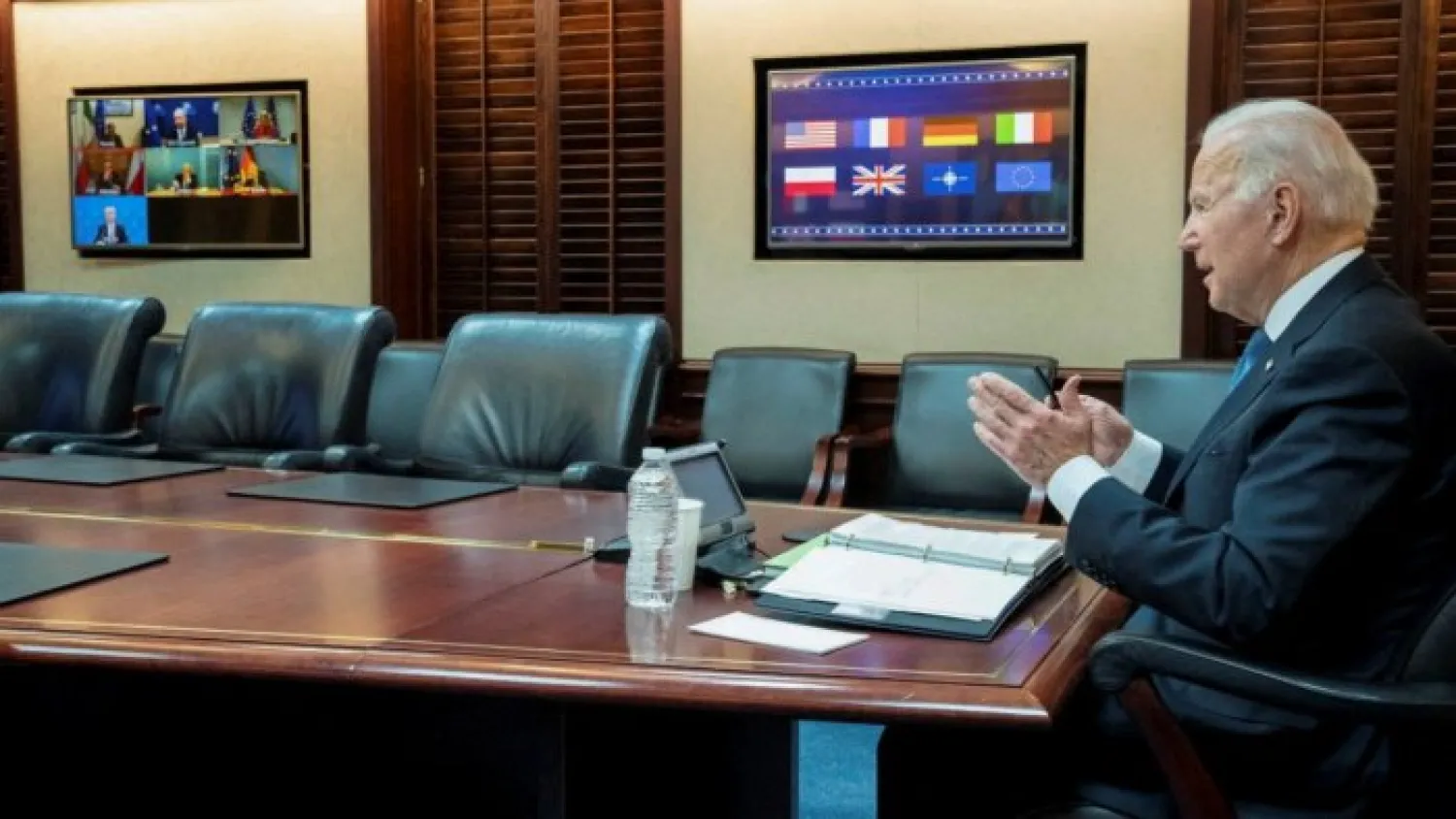
US President Joe Biden is seen in a White House handout photo as he speaks with European leaders about Russia and the situation in Ukraine during a secure video teleconference from the Situation Room of the White House in Washington, US. Credit: Reuters Photo
TT

US, Europe Declare 'Unity' against Russia over Ukraine

US President Joe Biden is seen in a White House handout photo as he speaks with European leaders about Russia and the situation in Ukraine during a secure video teleconference from the Situation Room of the White House in Washington, US. Credit: Reuters Photo

President Joe Biden declared "total" unity among Western powers Monday after crisis talks with European leaders on deterring Russia from an attack against Ukraine, while the Pentagon said 8,500 US troops were put on standby for possible deployment to boost NATO.

"I had a very, very, very good meeting -- total unanimity with all the European leaders," Biden told reporters shortly after finishing a one hour and 20 minute video conference with allied leaders from Europe and NATO.

In London, Prime Minister Boris Johnson's office also said "the leaders agreed on the importance of international unity in the face of growing Russian hostility," reported AFP.

German Chancellor Olaf Scholz said "it is up to Russia to undertake visible de-escalation," while NATO Secretary-General Jens Stoltenberg warned of "severe costs" if there is "any further aggression" by Moscow against Ukraine.

Also on the call were the leaders of France, Italy, Poland and the European Union.

Despite insisting he has no intention of attacking, President Vladimir Putin has deployed some 100,000 troops close to Ukraine, where Russia already seized Crimea in 2014 and backs a separatist army in the east.

Moscow is demanding a guarantee that Ukraine, a former Soviet republic, never be allowed to join NATO, as well as other concessions by the United States in return for a decrease in tension.

The United States and NATO have rejected the Russian demands and told Putin to withdraw from Ukraine's borders, warning that a Russian attack will trigger damaging economic sanctions, as well as a beefed-up NATO presence in eastern Europe.

In Washington, Pentagon spokesman John Kirby said a force of up to 8,500 US troops was on "heightened alert" for potential deployment to reinforce any activation of the NATO Response Force in the region, where there are growing fears of spillover from the Ukraine conflict.

"What this is about... is re-assurance to our NATO allies," Kirby said. "It sends a very clear signal to Mr. Putin that we take our responsibilities to NATO seriously."

NATO also said it was sending jets and ships to bolster its eastern flank.

The tension helped fuel instability in global markets, while Russia's main stock index plunged and the central bank suspended foreign currency purchasing after the ruble slumped.

The French government announced that Russian and Ukrainian officials would meet, along with French and German counterparts, in Paris on Wednesday to try to find a way out of the impasse.

President Emmanuel Macron "thinks there is a space for diplomacy, a path to de-escalation," an aide said, confirming that Macron would speak to Putin "in the coming days."

- Unity search -
Washington is trying to maintain transatlantic unity to build a credible threat of sanctions as a deterrence against Moscow.

However, members of the 27-nation European Union have starkly differing approaches and ties to Russia, which supplies about 40 percent of the trade bloc's natural gas supplies.

The new government in EU economic powerhouse Germany in particular has faced criticism from Kyiv over its refusal to send defensive weapons to Ukraine, as well as hesitating over one of the harshest economic sanctions under discussion -- cutting Moscow from the global SWIFT payments system.

Echoing other US warnings, Kirby said on Monday that intelligence shows "it's very clear that the Russians have no intention right now of de-escalating."

However, some European leaders are signaling less alarm.

EU foreign policy chief Josep Borrell said after talks with US top diplomat Antony Blinken that there was nothing to suggest an "immediate" Russian attack.

"You have to stay calm doing what you have to do, and avoid a nervous breakdown," he said.

While Britain and Australia followed the United States in ordering diplomats' families to leave Kyiv, the EU and the Ukrainian government said any withdrawal of foreign embassy personnel was premature.

France told citizens to avoid non-essential travel to the country.

- NATO troops 'on standby' -
The US-led NATO alliance said members were placing troops "on standby" and sending ships and jets to bolster eastern Europe's defenses, pointing to recent mobilizations by Denmark, Spain and the Netherlands.

Stoltenberg said the alliance "will continue to take all necessary measures to protect" members.

The Kremlin accused NATO of "hysteria."

It also claimed that Ukrainian troops fighting Russian-backed separatists in the east of the country could launch an offensive, prompting President Volodymyr Zelensky's office to say that Ukraine will not "succumb to provocations."

The United States has warned that Moscow could manufacture a "false flag" incident in Ukraine to be able to then frame an invasion as a justified response.

Non-NATO member Ireland meanwhile sounded the alarm over upcoming Russian military exercises off its southwest coast in international waters of the Atlantic.




Adviser to Iran's Supreme Leader to Visit Oman on Tuesday

FILED - 06 February 2009, Bavaria, Munich: Ali Larijani, then chairman of the Iranian parliament, speaks at the 45th Munich Security Conference in Munich. Photo: Andreas Gebert/dpa
TT

Adviser to Iran's Supreme Leader to Visit Oman on Tuesday

FILED - 06 February 2009, Bavaria, Munich: Ali Larijani, then chairman of the Iranian parliament, speaks at the 45th Munich Security Conference in Munich. Photo: Andreas Gebert/dpa

Ali Larijani, an adviser to Iran's Supreme Leader Ali Khamenei, will visit Oman accompanied by a delegation on Tuesday, the ‌semi-official Tasnim news ‌agency reported ‌on ⁠Monday.

American and ‌Iranian diplomats held indirect talks in Oman last week, aimed at reviving diplomacy amid a US ⁠naval buildup near Iran and ‌Tehran's vows ‍of a ‍harsh response if ‍attacked.

"During this trip, (Larijani) will meet with high-ranking officials of the Sultanate of Oman and discuss the latest regional ⁠and international developments and bilateral cooperation at various levels," Tasnim said.

The date and venue of the next round of talks are yet to be announced.


Russia’s Lavrov Sees No ‘Bright Future’ for Economic Ties with US

06 February 2026, Russia, Moscow: Russian Foreign Minister Sergei Lavrov gives a press conference following a meeting with Organization for Security and Cooperation in Europe (OSCE) Chairperson-in-Office Ignazio Cassis, head of Switzerland's Federal Department of Foreign Affairs, Federal Councilor of the Swiss Confederation, and OSCE Secretary General Feridun Sinirlioglu at the Russian Foreign Ministry's Reception House. (Sofya Sandurskaya/TASS via ZUMA Press/dpa)
TT

Russia’s Lavrov Sees No ‘Bright Future’ for Economic Ties with US

06 February 2026, Russia, Moscow: Russian Foreign Minister Sergei Lavrov gives a press conference following a meeting with Organization for Security and Cooperation in Europe (OSCE) Chairperson-in-Office Ignazio Cassis, head of Switzerland's Federal Department of Foreign Affairs, Federal Councilor of the Swiss Confederation, and OSCE Secretary General Feridun Sinirlioglu at the Russian Foreign Ministry's Reception House. (Sofya Sandurskaya/TASS via ZUMA Press/dpa)

Russia remains open for cooperation with the United States but is not hopeful about economic ties despite Washington's ongoing efforts to end the Ukraine war, Russian Foreign Minister Sergei Lavrov said in an interview published on Monday.

Speaking to Russia-based media outlet TV BRICS, ‌Lavrov cited what ‌he called the ‌United ⁠States' declared ‌aim of "economic dominance".

"We also don't see any bright future in the economic sphere," Lavrov said.

Russian officials, including envoy Kirill Dmitriev, have previously spoken of the prospects for a major restoration ⁠of economic relations with the United States as ‌part of any eventual Ukraine ‍peace settlement.

But although ‍President Donald Trump has also ‍spoken of reviving economic cooperation with Moscow and has hosted his Russian counterpart Vladimir Putin on US soil since returning to the White House, he has imposed further onerous sanctions on Russia's vital ⁠energy sector.

Lavrov also cited Trump's hostility to the BRICS bloc, which includes Russia, China, India, Brazil and other major developing economies.

"The Americans themselves create artificial obstacles along this path (towards BRICS integration)," he said.

"We are simply forced to seek additional, protected ways to develop our financial, economic, logistical and ‌other projects with the BRICS countries."


Prince William, Kate 'Deeply Concerned' by Latest Epstein Revelations

Britain's Prince William (R), Prince of Wales and Catherine (C), Princess of Wales arrive to meet with the Archbishop of Canterbury Sarah Mullally at Lambeth Palace in London on February 5, 2026. (Photo by Aaron Chown / POOL / AFP)
TT

Prince William, Kate 'Deeply Concerned' by Latest Epstein Revelations

Britain's Prince William (R), Prince of Wales and Catherine (C), Princess of Wales arrive to meet with the Archbishop of Canterbury Sarah Mullally at Lambeth Palace in London on February 5, 2026. (Photo by Aaron Chown / POOL / AFP)

Britain's Prince William and his wife Catherine have been "deeply concerned" by the latest revelations linking William's uncle Prince Andrew to late US sex offender Jeffrey Epstein, Kensington Palace said Monday.

"I can confirm that the Prince and Princess of Wales have been deeply concerned by the continued revelations," the palace said in a statement.

The statement -- first public comments from the heir to the throne and his wife on the scandal since the latest release of Epstein files more than a week ago -- added that "their thoughts remain focused on the victims" of Epstein, who died in prison awaiting trial on sex trafficking charges in 2019.

King Charles III’s 65-year-old brother is now known simply as Andrew Mountbatten-Windsor.

The king last week forced Mountbatten-Windsor to leave his longtime home at Royal Lodge near Windsor Castle, accelerating a move that was first announced in October but wasn’t expected to be completed until later this year.

Mountbatten-Windsor is now living on the king’s Sandringham estate in eastern England. He will live temporarily at Wood Farm Cottage while his permanent home on the estate undergoes repairs.