


Russia: US Response on Ukraine Offers Little Optimism

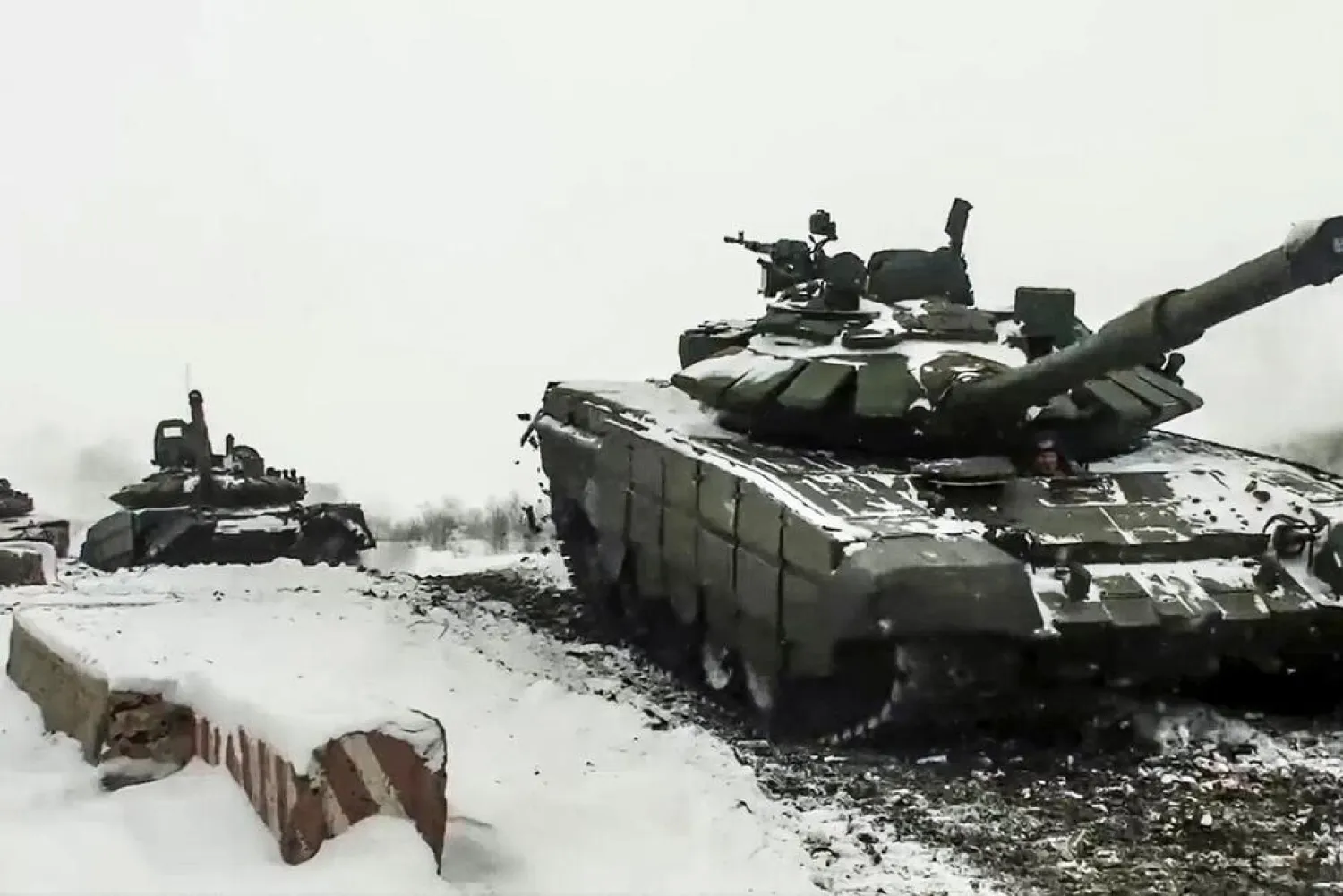
In this photo taken from a video provided by the Russian Defense Ministry Press Service on Wednesday, Jan. 26, 2022,  Russian tanks roll during a military exercise at a training ground in Rostov region, Russia. (Russian Defense Ministry Press Service via AP) THE ASSOCIATED PRESS
In this photo taken from a video provided by the Russian Defense Ministry Press Service on Wednesday, Jan. 26, 2022, Russian tanks roll during a military exercise at a training ground in Rostov region, Russia. (Russian Defense Ministry Press Service via AP) THE ASSOCIATED PRESS
TT

Russia: US Response on Ukraine Offers Little Optimism

In this photo taken from a video provided by the Russian Defense Ministry Press Service on Wednesday, Jan. 26, 2022,  Russian tanks roll during a military exercise at a training ground in Rostov region, Russia. (Russian Defense Ministry Press Service via AP) THE ASSOCIATED PRESS
In this photo taken from a video provided by the Russian Defense Ministry Press Service on Wednesday, Jan. 26, 2022, Russian tanks roll during a military exercise at a training ground in Rostov region, Russia. (Russian Defense Ministry Press Service via AP) THE ASSOCIATED PRESS

The US rejection of Russia’s main demands to resolve the crisis over Ukraine leaves little ground for optimism, the Kremlin spokesman said Thursday, while adding that dialogue was still possible.

Tensions have soared in recent weeks, as the United States and its NATO allies expressed fear that a buildup of about 100,000 Russian troops near Ukraine signaled Moscow planned to invade its ex-Soviet neighbor. Russia denies having any such designs — and has laid out a series of demands it says will improve security in Europe, The Associated Press said.

But as expected, the US and the Western alliance firmly rejected any concessions on Moscow's main points Wednesday, refusing to permanently ban Ukraine from joining NATO and saying allied deployments of troops and military equipment in Eastern Europe are nonnegotiable. The US did outline areas in which some of Russia’s concerns might be addressed, possibly offering a path to de-escalation.

“There is no change, there will be no change,” US Secretary of State Antony Blinken said, repeating the warning that any Russian incursion into Ukraine would be met with massive consequences and severe economic costs.

All eyes are now on how Russia will respond amid fears that Europe could again be plunged into war. That decision that rests squarely with President Vladimir Putin.
Kremlin spokesman Dmitry Peskov told reporters that the response from the US — and a similar one from NATO — leaves “little ground for optimism.”

At the same time, he added that “there always are prospects for continuing a dialogue, it’s in the interests of both us and the Americans.”

Russian Foreign Minister Sergey Lavrov noted that the US response contains some elements that could lead to “the start of a serious talk on secondary issues" but emphasized that “the document contains no positive response on the main issue,” the Russian demands for the non-expansion of NATO and the non-deployment of weapons that may threaten Russia.

Lavrov told reporters that top officials will now submit their proposals to Putin, who has the American response, and Peskov said the Russian reaction would come soon.
The evasive official comments reflect the fact that it's Putin who single-handedly determines Russia's next moves. The Russian leader has warned that he would order unspecified “military-technical measures” if the West refuses to heed the Russian security demands.

Peskov added that Putin and US President Joe Biden will decide whether they need to have another conversation following two calls last month.

While the diplomacy sputters on, so, too, do maneuvers on both sides that have escalated tensions. Russia has launched a series of military drills: Motorized infantry and artillery units in southwestern Russia practiced firing live ammunition, warplanes in Kaliningrad on the Baltic Sea performed bombing runs, dozens of warships sailed for training exercises in the Black Sea and the Arctic, and Russian fighter jets and paratroopers arrived in Belarus for joint war games.

Meanwhile, NATO said it was bolstering its deterrence in the Baltic Sea region, and the US ordered 8,500 troops on higher alert for potential deployment to Europe.
Amid the fears of Russian invasion in Ukraine, a top Putin associate alleged the country has become a Western tool to contain Russia.

“Ukraine has become a toy in the hands of NATO and, primarily, the United States, which are using it as an instrument of geopolitical pressure against Russia,” Dmitry Medvedev, a deputy head of Russia’s Security Council, said in an interview with Russian media.

He acknowledged that a Russia-NATO conflict “would be the most dramatic and simply catastrophic scenario, and I hope it will never happen.”

Medvedev argued that Moscow sees no point in talking to Ukrainian President Volodymyr Zelenskyy, but voiced hope that the Ukrainians would eventually become “weary of that bedlam and elect the leadership that would pursue policies ... aimed at normal economic relations with Russia.”

Medvedev’s comment follows a British claim that the Kremlin is seeking to replace Ukraine’s government with a pro-Moscow administration — an allegation Russia denied.

In 2014, following the ouster of a Kremlin-friendly president in Kyiv, Moscow annexed Ukraine’s Crimean Peninsula and threw its weight behind a separatist insurgency in the country’s eastern industrial heartland. Fighting between Ukrainian forces and Russia-backed rebels has killed over 14,000 people, and efforts to reach a settlement have stalled.

While a senior Russian diplomat has pointedly refused to rule out military deployments to Cuba and Venezuela, Medvedev expressed skepticism about such prospect.
“Cuba and Venezuela are aiming to come out of isolation and restore normal relations with the US to a certain extent, so there can’t be any talk about setting up a base there as it happened during the Soviet times,” he said.



Iran Warns Will Not Give Up Enrichment Despite US War Threat

Traffic moves through a street in Tehran on February 7, 2026. (Photo by ATTA KENARE / AFP)
TT

Iran Warns Will Not Give Up Enrichment Despite US War Threat

Traffic moves through a street in Tehran on February 7, 2026. (Photo by ATTA KENARE / AFP)

Iran will never surrender the right to enrich uranium, even if war "is imposed on us,” its foreign minister said Sunday, defying pressure from Washington.

"Iran has paid a very heavy price for its peaceful nuclear program and for uranium enrichment," Abbas Araghchi told a forum in Tehran.

"Why do we insist so much on enrichment and refuse to give it up even if a war is imposed on us? Because no one has the right to dictate our behavior," he said, two days after he met US envoy Steve Witkoff in Oman.

The foreign minister also declared that his country was not intimidated by the US naval deployment in the Gulf.

"Their military deployment in the region does not scare us," Araghchi said.


Washington Post Publisher Will Lewis Stepping Down Days after Big Layoffs

A person walks outside The Washington Post headquarters in Washington, DC, USA, 04 February 2026. EPA/JIM LO SCALZO
TT

Washington Post Publisher Will Lewis Stepping Down Days after Big Layoffs

A person walks outside The Washington Post headquarters in Washington, DC, USA, 04 February 2026. EPA/JIM LO SCALZO

Washington Post publisher Will Lewis said Saturday that he’s stepping down, ending a troubled tenure three days after the newspaper said that it was laying off one-third of its staff.

Lewis announced his departure in a two-paragraph email to the newspaper's staff, saying that after two years of transformation, “now is the right time for me to step aside.” The Post's chief financial officer, Jeff D'Onofrio, was appointed temporary publisher, The Associated Press reported.

Neither Lewis nor the newspaper's billionaire owner Jeff Bezos participated in the meeting with staff members announcing the layoffs on Wednesday. While anticipated, the cutbacks were deeper than expected, resulting in the shutdown of the Post's renowned sports section, the elimination of its photography staff and sharp reductions in personnel responsible for coverage of metropolitan Washington and overseas.

They came on top of widespread talent defections in recent years at the newspaper, which lost tens of thousands of subscribers following Bezos' order late in the 2024 presidential campaign pulling back from a planned endorsement of Kamala Harris, and a subsequent reorienting of its opinion section in a more conservative direction.

Martin Baron, the Post’s first editor under Bezos, condemned his former boss this week for attempting to curry favor with President Donald Trump and called what has happened at the newspaper “a case study in near-instant, self-inflicted brand destruction.”

The British-born Lewis was a former top executive at The Wall Street Journal before taking over at The Post in January 2024. His tenure has been rocky from the start, marked by layoffs and a failed reorganization plan that led to the departure of former top editor Sally Buzbee.

His initial choice to take over for Buzbee, Robert Winnett, withdrew from the job after ethical questions were raised about both he and Lewis' actions while working in England. They include paying for information that produced major stories, actions that would be considered unethical in American journalism. The current executive editor, Matt Murray, took over shortly thereafter.

Lewis didn't endear himself to Washington Post journalists with blunt talk about their work, at one point saying in a staff meeting that they needed to make changes because not enough people were reading their work.

This week's layoffs have led to some calls for Bezos to either increase his investment in The Post or sell it to someone who will take a more active role. Lewis, in his note, praised Bezos: “The institution could not have had a better owner,” he said.

“During my tenure, difficult decisions have been taken in order to ensure the sustainable future of The Post so it can for many years ahead publish high-quality nonpartisan news to millions of customers each day,” Lewis said.

The Washington Post Guild, the union representing staff members, called Lewis' exit long overdue.

“His legacy will be the attempted destruction of a great American journalism institution,” the Guild said in a statement. “But it’s not too late to save The Post. Jeff Bezos must immediately rescind these layoffs or sell the paper to someone willing to invest in its future.”

Bezos did not mention Lewis in a statement saying D'Onofrio and his team are positioned to lead The Post into “an exciting and thriving next chapter.”

“The Post has an essential journalistic mission and an extraordinary opportunity,” Bezos said. “Each and every day our readers give us a roadmap to success. The data tells us what is valuable and where to focus.”

D'Onofrio, who joined the paper last June after jobs at the digital ad management company Raptive, Google, Zagat and Major League Baseball, said in a note to staff that "we are ending a hard week of change with more change.

“This is a challenging time across all media organizations, and The Post is unfortunately no exception,” he wrote. “I've had the privilege of helping chart the course of disrupters and cultural stalwarts alike. All faced economic headwinds in changing industry landscapes, and we rose to meet those moments. I have no doubt we will do just that, together.”


US Concerned About Expansion of Terrorism in Sahel, West Africa

Members of the Nigeria Armed Forces interact with residents following an attack in Woro, Kwara State, on February 5, 2026. (Photo by Light Oriye Tamunotonye / AFP)
TT

US Concerned About Expansion of Terrorism in Sahel, West Africa

Members of the Nigeria Armed Forces interact with residents following an attack in Woro, Kwara State, on February 5, 2026. (Photo by Light Oriye Tamunotonye / AFP)

The United States is concerned by the “expansion” of al-Qaeda affiliates in the Sahel and West Africa, including Jama'at Nusrat al-Islam wal-Muslimin (JNIM) and ISIS-Sahel’s territorial gains.

US Ambassador to the United Nations Mike Waltz shared the concern in his remarks at this week’s UN Security Council Briefing on Terrorist Threats to International Peace and Security caused by terrorist acts.

Highlighting JNIM and ISIS-Sahel’s territorial gains and use in particular of kidnapping for ransom, Waltz said the threats are increasingly diffuse and complex as they involve foreign fighters converging in multiple conflict zones.

The diplomat cited the latest Analytical Support and Sanctions Monitoring Team report, which showed that terror cells continue to adapt and exploit instability across Africa, the Middle East, and South Asia.

Waltz said ISIS’ growing focus on Africa, and the resilience of its cells in Syria and Iraq, and the persistent threat from ISIS-K in Afghanistan, truly reinforces the need for sustained, coordinated counterterrorism efforts.

Washington is particularly concerned by terrorist groups’ exploitation of new technologies, such as commercial satellite communications, artificial intelligence, drones and cryptocurrencies, he said.

“All of these further complicates the threat landscape and it requires our vigilance, vigilance from Member States and particularly where I think there is room for all of us to improve – is our coordination with the private sector as we face this threat,” Waltz added.

The ambassador called for further disruption of terrorist financing networks, saying the recent successes in Somalia and in West Africa demonstrate that following the money and stopping the money to these various groups can have bold decisive effects.

He said the US commends UN Member States whose counterterrorism operations have constrained ISIS and al-Qaeda, especially in Iraq, Syria, and Somalia.

He also urged all states to strengthen cooperation, including intelligence sharing and joint operations, and to support the effective implementation and evolution of the 1267 sanctions regime.

“Member States should collaborate on screening and information sharing to prevent terrorist movement across borders, in support of UN Security Council Resolution 2396,” Waltz noted.

Last November, the United Kingdom, which currently chairs the UN Security Council, expressed similar concern about the proliferation of terrorist groups in the Sahel and West Africa.

The US has sent a small team of troops to Nigeria, the general in charge of the US command for Africa said on Tuesday, the first acknowledgment of US forces on the ground since Washington struck by air on Christmas Day.

General Dagvin RM Anderson, head of the US military's Africa Command AFRICOM, said the US team was sent after both countries agreed that more needed to be done to combat the terrorist threat in West Africa.

“That has led to increased collaboration between our nations to include a small US team that brings some unique capabilities from the United States,” he told journalists during a press briefing in Dakar on Tuesday.