


Hong Kong Outbreak Exposes Flaws in 21-day Quarantine Policy

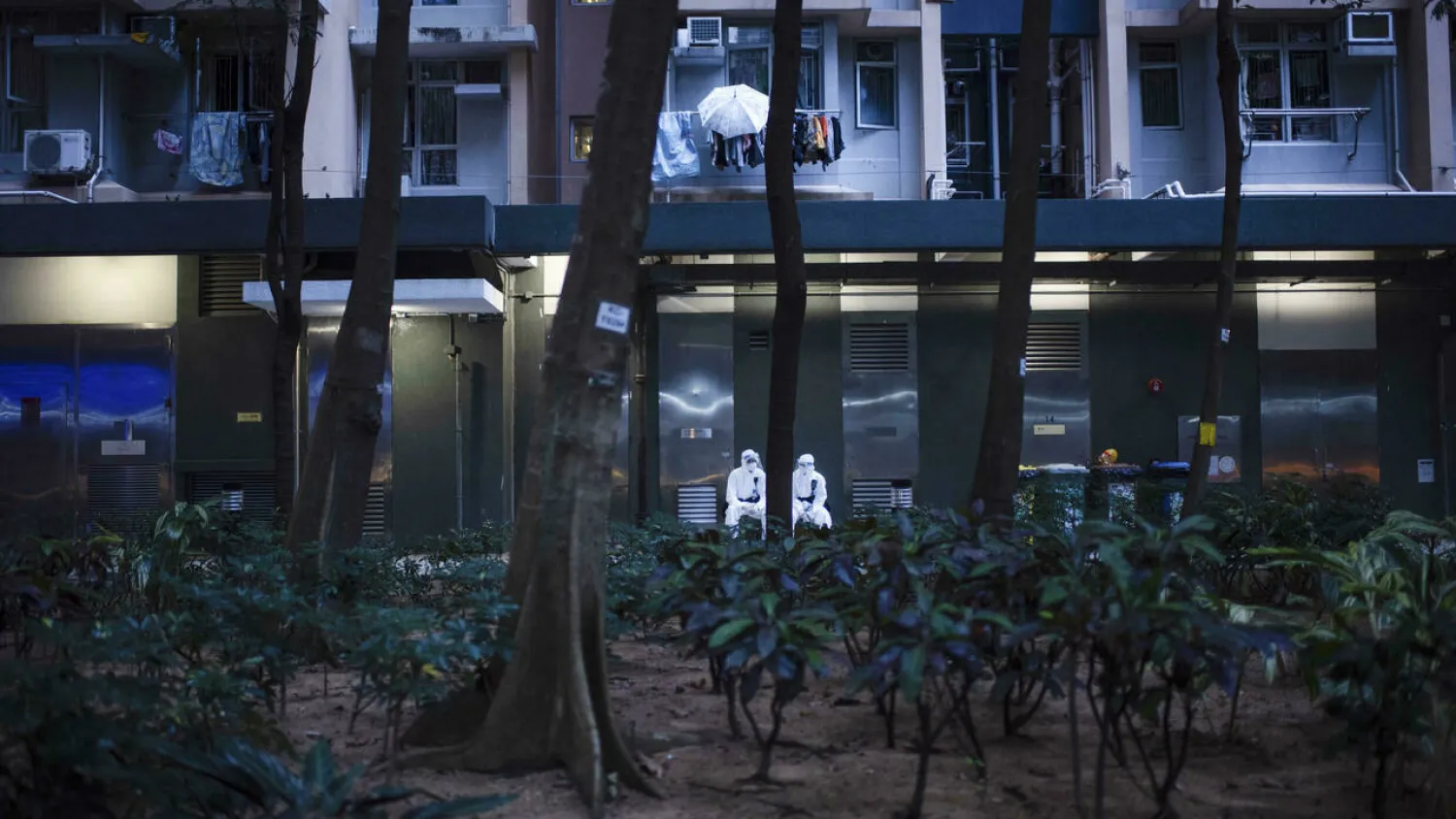
An outbreak at Hong Kong's Kwai Chung Estate public housing complex has exposed flaws in the city's strict quarantine rules. Louise Delmotte AFP
TT

Hong Kong Outbreak Exposes Flaws in 21-day Quarantine Policy

An outbreak at Hong Kong's Kwai Chung Estate public housing complex has exposed flaws in the city's strict quarantine rules. Louise Delmotte AFP

Hong Kong's U-turn on its mandatory three-week quarantine for arrivals follows growing scrutiny of the strict policy after a coronavirus outbreak was traced to a woman infected during her hotel stay.

Like mainland China, Hong Kong is one of the few places left in the world still pursuing a zero-Covid strategy that has largely kept the virus at bay but left the finance hub internationally isolated.

On Thursday, city leader Carrie Lam announced the 21-day quarantine period that most arrivals faced -- among the world's longest -- would be cut to two weeks because the increasingly dominant Omicron variant has a shorter incubation period.

The surprise move came after multiple recent outbreaks forced the reimposition of economically painful social-distancing measures and saw thousands of residents in one district confined to their homes.

One large cluster tore through densely crowded public housing blocks and was traced to a 43-year-old woman from Pakistan who was infected in one of the city's 40 designated quarantine hotels during the latter stage of her stay.

Some Hong Kong health experts had been warning that the length of hotel quarantines could make people more vulnerable to cross-infections.

"The quarantine facilities in hotels are clearly failing travelers time and time again, and putting them at risk of catching Covid-19," Siddharth Sridhar, a microbiologist at the University of Hong Kong, told AFP before Lam's announcement.

- 'Luck ran out' -
Ben Cowling, an epidemiologist at HKU, had long argued that 21 days was without scientific merit and raised risks.

Multiple instances of hotel cross-infection had been recorded but spotted before people left quarantine.

"I don't think it's a surprise that we've had an outbreak... if anything, it's a surprise that we have six months with zero," Cowling told AFP, referring to low case numbers in the second half of last year.

"I think our luck's run out."

Hong Kong's government maintains its zero-Covid policy has strong support among locals, but there are signs public opinion is turning.

A survey by Hong Kong's Democratic Party in January found 65 percent of residents supported "living with the virus", up from 42 percent last November.

International businesses have sounded a growing alarm, warning of a talent drain and worsening recruiting issues as rival hubs are reopening.

But the government has so far given no indication of when, or even if, there will be a post-zero-Covid Hong Kong.

In a draft report obtained this week by Bloomberg News, the European Chamber of Commerce warned businesses that the city could remain internationally isolated until 2024.

"We anticipate an exodus of foreigners, probably the largest that Hong Kong has ever seen, and one of the largest in absolute terms from any city in the region," the draft report said.

The Financial Times reported this week that Bank of America is the latest blue-chip firm to examine relocating staff to Singapore.

- 'End of the beginning' -
Since 2019's huge and disruptive democracy protests, Hong Kong's government has increasingly acted in lockstep with Beijing on an array of issues, from coronavirus policy to an ongoing crackdown on political dissent.

Lam has said reopening travel with the mainland must come before the rest of the world, even as China faces its own outbreaks and shows no sign of wanting to open to Hong Kong any time soon.

"For the rest of the world, 2022 is the beginning of the end of the pandemic. For Hong Kong, it is just the end of the beginning," Sridhar wrote in a recent Facebook post.

Hong Kong's ability to live with Covid-19 has also been hampered by a woeful vaccination campaign.

Despite ample supplies, just over 70 percent of Hong Kong's eligible population has received two vaccine doses.

And less than half of those aged 70 or above -- the most vulnerable demographic -- have been jabbed.

Hong Kong experts, including Sridhar and Cowling, agree that the city's priority must be to vaccinate its elderly for it to have any chance to move away from zero-Covid policies.

But given the local government's reluctance to stake out a path different from the mainland's, there is skepticism within the business community that a higher vaccination rate would result in an international reopening unless China did the same.



Russia's FSB Says Ukraine's SBU Was behind Assassination Attempt on Top General

In this image made from video and provided by the Russian Defense Ministry Press Service, on June 23, 2023, Lt. Gen. Vladimir Alexeyev speaks to servicemen in an undisclosed location. (Russian Defense Ministry Press Service via AP)
TT

Russia's FSB Says Ukraine's SBU Was behind Assassination Attempt on Top General

In this image made from video and provided by the Russian Defense Ministry Press Service, on June 23, 2023, Lt. Gen. Vladimir Alexeyev speaks to servicemen in an undisclosed location. (Russian Defense Ministry Press Service via AP)

Russia's Federal Security Service said on Monday that the men suspected of shooting one of the country's most senior military intelligence officer had confessed that they were carrying out orders from the Security Service of Ukraine (SBU).

Ukraine has denied any involvement in Friday's attempted assassination of Lieutenant General Vladimir Alexeyev, deputy head of Russia's ‌GRU military ‌intelligence service. Alexeyev has regained ‌consciousness ⁠after surgery, reported Reuters.

Russia ‌said that the suspected shooter, a Ukrainian-born Russian citizen named by Moscow as Lyubomir Korba, had been questioned after he was extradited from Dubai. A suspected accomplice, Viktor Vasin, has also been questioned.

The FSB said in ⁠a statement that both Korba and Vasin had "confessed their ‌guilt" and given details ‍of the shooting which ‍they said was "committed on behalf of ‍the Security Service of Ukraine."

The FSB did not provide any evidence that Reuters was able to immediately verify. It was not possible to contact the men while they were in detention in Russia. The SBU could ⁠not be reached for immediate comment on the FSB statement.

The FSB said Korba was recruited by the SBU in August 2025 in Ternopil, western Ukraine, underwent training in Kyiv and was paid monthly in crypto-currency. For killing Alexeyev, Korba was promised $30,000 by the SBU, the FSB said.

The FSB said Polish intelligence was involved in his recruitment. ‌Poland could not be reached for immediate comment.


Venezuela's Machado Says Ally 'Kidnapped' after His Release

Venezuelan political leader Juan Pablo Guanipa gestures after their release outside Zona 7 prison in Caracas on February 8, 2026.  (Photo by Juan BARRETO / AFP)
Venezuelan political leader Juan Pablo Guanipa gestures after their release outside Zona 7 prison in Caracas on February 8, 2026. (Photo by Juan BARRETO / AFP)
TT

Venezuela's Machado Says Ally 'Kidnapped' after His Release

Venezuelan political leader Juan Pablo Guanipa gestures after their release outside Zona 7 prison in Caracas on February 8, 2026.  (Photo by Juan BARRETO / AFP)
Venezuelan political leader Juan Pablo Guanipa gestures after their release outside Zona 7 prison in Caracas on February 8, 2026. (Photo by Juan BARRETO / AFP)

Venezuela's Nobel peace laureate Maria Corina Machado said on Monday that armed men "kidnapped" a close ally shortly after his release by authorities, following ex-leader Nicolas Maduro's capture.

The country's Public Prosecutor's Office confirmed later that same day that former National Assembly vice president Juan Pablo Guanipa, 61, was again taken into custody and to be put under house arrest, arguing that he violated the conditions of his release.

Guanipa would be placed under house arrest "in order to safeguard the criminal process," the office said in a statement on Monday. The conditions of Guanipa's release have yet to be made public.

Machado claimed that her close ally had been "kidnapped" in the capital Caracas by armed men "dressed in civilian clothes" who took him away by force.

"We demand his immediate release," she wrote on social media platform X.

The arrest came after his release from prison on Sunday along with two other opposition figures, and as lawmakers prepared to vote Tuesday on a historic amnesty law covering charges used to lock up dissidents in almost three decades of socialist rule, reported AFP.

Shortly after his release, Guanipa visited several detention centers in Caracas, where he met with relatives of political prisoners and spoke to the press.

Guanipa had appeared earlier Sunday in a video posted on his X account, showing what looked like his release papers.

"Here we are, being released," Guanipa said in the video, adding that he had spent "10 months in hiding, almost nine months detained here" in Caracas.

- 'Let's go to an electoral process' -

Speaking to AFP later on Sunday, he had called on the government to respect the 2024 presidential election, which opposition candidate Edmundo Gonzalez Urrutia was widely considered to have won. Maduro claimed victory and remained in power till January.

"Let's respect it. That's the basic thing, that's the logical thing. Oh, you don't want to respect it? Then let's go to an electoral process," Guanipa said.

The opposition ally of Machado was arrested in May 2025, in connection with an alleged conspiracy to undermine legislative and regional elections that were boycotted by the opposition.

He was charged with terrorism, money laundering and incitement to violence and hatred.

Guanipa had been in hiding prior to his arrest. He was last seen in public in January 2025, when he accompanied Machado to an anti-Maduro rally.

Following Maduro's capture by US special forces on January 3, authorities have started to slowly release political prisoners. Rights groups estimate that around 700 people are still waiting to be freed.

A former Machado legal advisor, Perkins Rocha, was also freed on Sunday. So was Freddy Superlano, who once won a gubernatorial election in Barinas, a city that is the home turf of the iconic late socialist leader Hugo Chavez.

"We hugged at home," Rocha's wife Maria Constanza Cipriani wrote on X, with a photo of them.

Machado, who was awarded the 2025 Nobel Peace Prize for her efforts to advance democracy in Venezuela, had initially celebrated Guanipa's release.

"My dear Juan Pablo, counting down the minutes until I can hug you! You are a hero, and history will ALWAYS recognize it. Freedom for ALL political prisoners!!" she wrote on X on Sunday.

NGO Foro Penal said it had confirmed the release of 35 prisoners on Sunday. It said that since January 8 nearly 400 people arrested for political reasons have been freed thus far.

Lawmakers gave their initial backing to a draft amnesty last week which covered the types of crimes used to lock up dissidents during 27 years of socialist rule.

But Venezuela's largest opposition coalition denounced "serious omissions" in the proposed amnesty measures on Friday.

Meanwhile, relatives of prisoners are growing increasingly impatient for their loved ones to be freed.

Acting president Delcy Rodriguez, who was Maduro's vice president, is pushing the amnesty bill as a milestone on the path to reconciliation.

Rodriguez took power in Venezuela with the blessing of US President Donald Trump, who is eyeing American access to what are the world's largest proven oil reserves.

As part of its reforms, Rodriguez's government has taken steps towards opening up the oil industry and restoring diplomatic ties with Washington, which were severed by Maduro in 2019.


SKorea Grounds Aging Attack Choppers after Fatal Training Crash

South Korean military officials secure the site where an AH-1S Cobra attack helicopter crashed in Gapyeong, South Korea, February 9, 2026. Yonhap via REUTERS
TT

SKorea Grounds Aging Attack Choppers after Fatal Training Crash

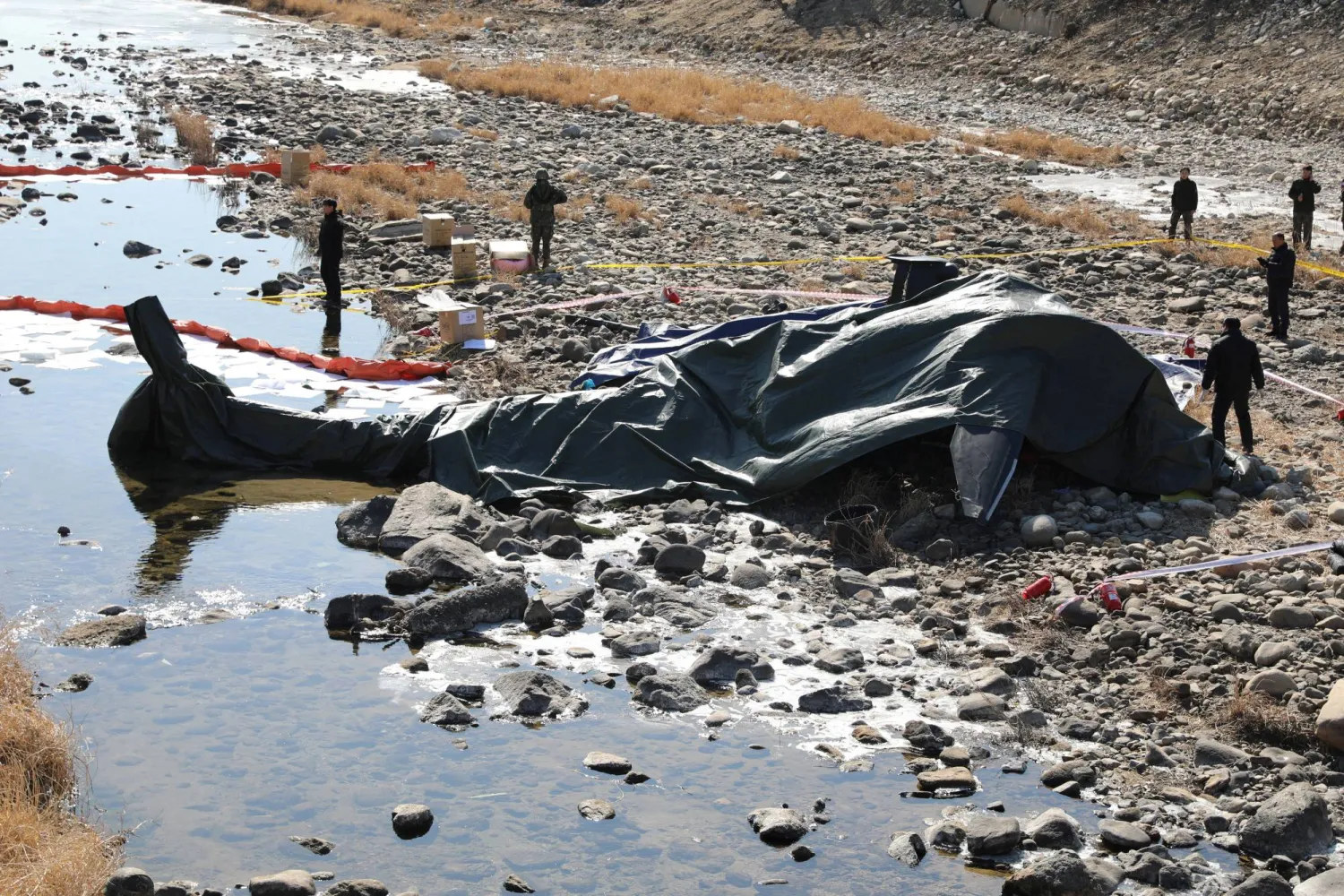
South Korean military officials secure the site where an AH-1S Cobra attack helicopter crashed in Gapyeong, South Korea, February 9, 2026. Yonhap via REUTERS

South Korea grounded an aging fleet of military helicopters on Monday after a chopper crashed during a training exercise and killed two people on board.

The AH-1S Cobra was training for emergency landings when it "crashed due to an unidentified cause" in Gapyeong county west of Seoul, the army said in a statement.

Two service members were taken to hospital and later pronounced dead, AFP reported.

Photos in local media showed the helicopter's crumpled fuselage lying on a rocky river bank.

"Following the accident, the Army has suspended operations of all aircraft of the same model" and is investigating the cause, the forces said.

The AH-1S Cobra is a US-made, single-engine anti-tank attack helicopter.

Some of those used by South Korea's military are more than 30 years old. It is not clear how many are currently in service.

The country's defense acquisition agency said in 2022 that the Army's Cobra helicopters were "scheduled to be retired" as domestically developed light-armed choppers started flying.