

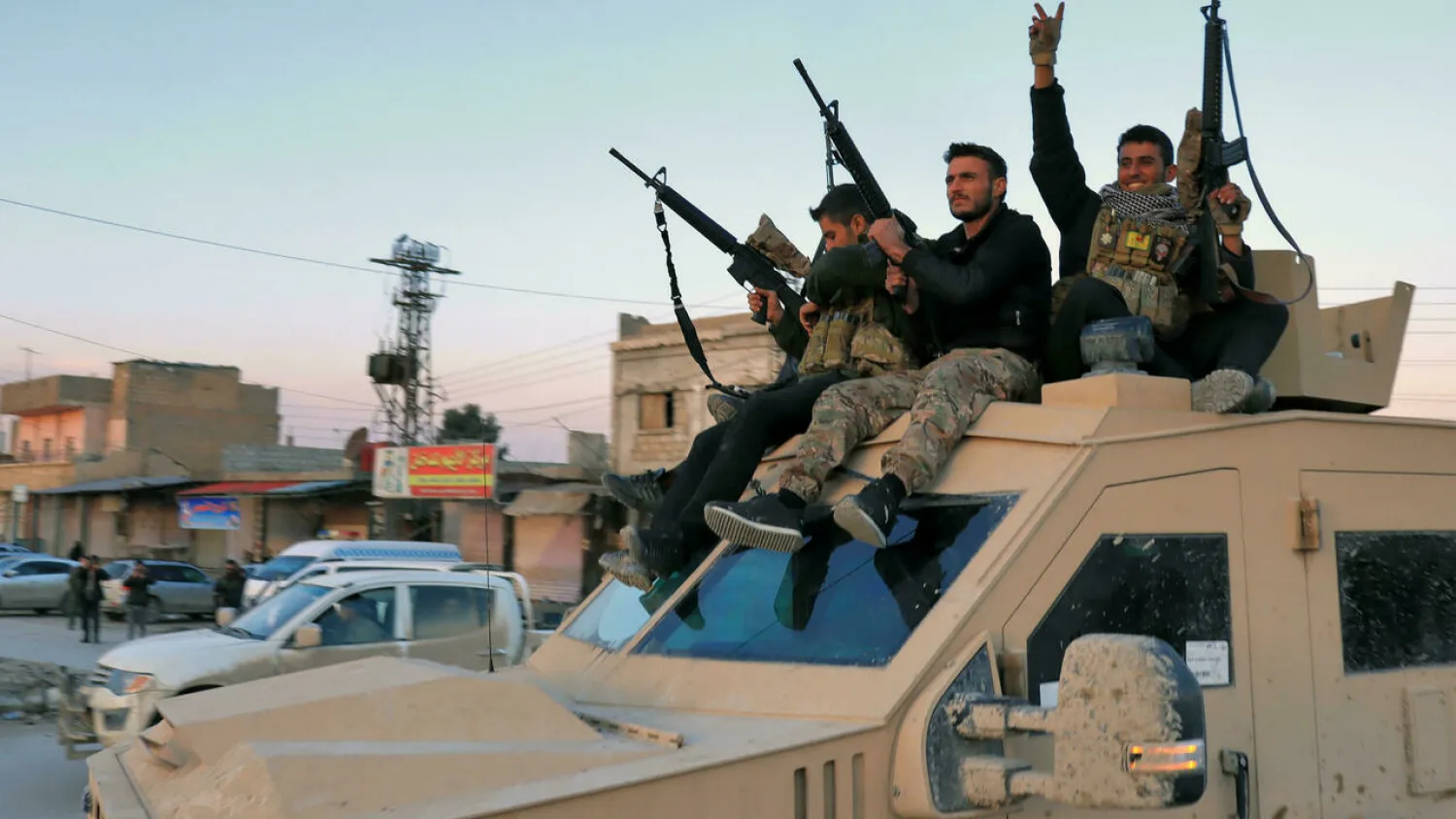

Syrian Kurdish Forces End Mop-up Operations in ISIS-hit Jail

Members of the Syrian Democratic Forces (SDF) deploy outside Ghwayran prison in Syria's northeastern city of Hasakeh on January 26 - AFP
TT

Syrian Kurdish Forces End Mop-up Operations in ISIS-hit Jail

Members of the Syrian Democratic Forces (SDF) deploy outside Ghwayran prison in Syria's northeastern city of Hasakeh on January 26 - AFP

US-backed Kurdish forces on Sunday said they had defeated all ISIS group militants left inside the Syrian jail that the extremists stormed 10 days ago, sparking battles that left over 370 dead.

The Kurdish-led Syrian Democratic Forces (SDF) announced the end of its mopping-up campaign inside the prison "after ending the last pockets in which ISIS terrorists were present", according to a statement.

ISIS fighters on January 20 launched their biggest assault in years, attacking the Ghwayran prison in the Kurdish-controlled northeast Syrian city of Hasakeh, aiming to free fellow extremists.

After six days of intense fighting, the SDF announced on Wednesday they had recaptured the prison, but intermittent clashes continued until Saturday between Kurdish fighters and militants near the jail.

Several ISIS fighters had been holed up in "northern dormitories" inside the prison, but the SDF on Sunday said they had been defeated.

"Thanks to the bravery and determination of the SDF, many of whom paid the ultimate sacrifice, ISIS failed in its efforts to conduct a large-scale prison break to reconstitute its ranks," US National Security Advisor Jake Sullivan said in a statement.

ISIS gunmen had been hiding in prison "cellars that are difficult to target with air strikes or infiltrate", the Syrian Observatory for Human Rights said.

- Hunt for fugitives -
The war monitor, which relies on a network of sources inside Syria, said operations were still ongoing near the prison hunting for escaped ISIS fugitives.

"Dozens of ISIS members managed to escape from Ghwayran prison... in the early hours of the attack," the war monitor said.

It reported that 20 ISIS fighters had surrendered on Saturday, while the SDF killed another five in an exchange of fire inside the prison.

The Britain-based group said 373 people had been killed since the onset of the attack -- including 268 militants, 98 Kurdish-led fighters and seven civilians -- and warned that the numbers could still rise.

The toll jumped from 332 reported earlier Sunday after more bodies of both extremists and Kurdish fighters were found during search operations inside the prison buildings and in areas near the facility, the Observatory said.

The SDF had found more than 50 more bodies overnight Saturday to Sunday, the war monitor had reported.

On Saturday, an AFP correspondent saw a truck carrying away piles of bodies from an area near the prison, believed to be those of ISIS fighters.

A bulldozer dumped more corpses onto the truck, which then headed to an unknown location.

Farhad Shami, who heads the SDF's media office, told AFP that the bodies would be buried in "remote, dedicated areas" under SDF control.

The violence prompted 45,000 people to flee Hasakeh, the United Nations said. Many took refuge in relatives' homes, while hundreds more slept in the city's mosques and wedding halls.

Syria's war, which broke out in 2011, has killed close to half a million people and spurred the largest conflict-induced displacement since World War II.



Israeli Military Issues Evacuation Warning to Residents of Lebanon’s Tyre

 Smoke rises from an Israeli airstrike that hit Qlaileh village, as it seen from the southern port city of Tyre, Lebanon, Tuesday, June 2, 2026. (AP)
Smoke rises from an Israeli airstrike that hit Qlaileh village, as it seen from the southern port city of Tyre, Lebanon, Tuesday, June 2, 2026. (AP)
TT

Israeli Military Issues Evacuation Warning to Residents of Lebanon’s Tyre

 Smoke rises from an Israeli airstrike that hit Qlaileh village, as it seen from the southern port city of Tyre, Lebanon, Tuesday, June 2, 2026. (AP)
Smoke rises from an Israeli airstrike that hit Qlaileh village, as it seen from the southern port city of Tyre, Lebanon, Tuesday, June 2, 2026. (AP)

The Israeli military issued an evacuation warning to the residents of the southern Lebanese city of Tyre and its surrounding areas on Sunday ahead of possible strikes as clashes between Israel and Hezbollah continue.

The military said earlier it had ‌intercepted two ‌projectiles that crossed into Israeli ‌territory ⁠from Lebanon, after ⁠sirens sounded in the areas of Yiftah and Ramot Naftali.

Lebanese group Hezbollah has not claimed responsibility for the launches.

The Iran-backed group rejected proposals linking a ceasefire to its disarmament, ⁠saying Israel must first halt ‌its attacks ‌and withdraw its forces from southern Lebanon.

Iran ‌has made a ceasefire in Lebanon ‌between its close ally and Israel a condition for any peace deal with the United States.

Hezbollah entered the war ‌on March 2, saying it was retaliating for the killing ⁠of ⁠Iran's Supreme Leader at the start of a conflict that has since killed thousands in Lebanon and displaced more than a million people.

Israel continued to carry out strikes in Lebanon even before March 2, despite a US-brokered ceasefire that took effect in November 2024. It said its attacks are aimed at Hezbollah members and infrastructure.


Israel Army Says Intercepted Two Projectiles Fired from Lebanon

Smoke billows from southern Lebanon following an Israeli strike, as seen from Marjaoun, Lebanon, June 6, 2026. REUTERS/Stringer
TT

Israel Army Says Intercepted Two Projectiles Fired from Lebanon

Smoke billows from southern Lebanon following an Israeli strike, as seen from Marjaoun, Lebanon, June 6, 2026. REUTERS/Stringer

Israel's military said Sunday that it had intercepted two projectiles launched from Lebanon into Israeli territory, despite a new ceasefire agreement announced this week aimed at ending hostilities between Israel and Hezbollah.

"Following the sirens that sounded a short while ago in the areas of Yiftah and Ramot Naftali, two projectiles that crossed from Lebanon into Israeli territory were intercepted," the military reported.

Israel and Lebanon agreed to a new US-brokered ceasefire on Wednesday. However, Hezbollah has rejected the agreement.


Palestinians Suffer from Lack of Proper Toilets Across Gaza’s Vast Tent Cities

Palestinians walk along the street on a hot day at the Nuseirat refugee camp in the central Gaza Strip on June 5, 2026. (AFP)
TT

Palestinians Suffer from Lack of Proper Toilets Across Gaza’s Vast Tent Cities

Palestinians walk along the street on a hot day at the Nuseirat refugee camp in the central Gaza Strip on June 5, 2026. (AFP)

In their bare-bones tent in southern Gaza, Mostafa Shaaban built his family’s makeshift toilet behind a curtain in a corner. He dug a shallow pit in the sandy soil, poured a concrete slab around it, fixed a bottomless bucket over the hole, then topped it off with a battered, plastic toilet seat.

It reeks with a foul odor and buzzes with flies and mosquitoes only a few feet from where they sleep and prepare meals. Every week, Shaaban has to dig the sewage sludge out of the pit. But at least it’s more private than the fetid communal latrines used by hundreds of other people in their sprawling tent camp.

“I did not want the kids and my wife to use any public toilet. It is humiliating,” said the 38-year-old Shaaban, who was driven from his home city of Rafah by Israeli forces two years ago and eventually settled in a tent camp in Khan Younis.

“The situation is revolting,” he said of having the toilet inside the tent, “but at least it has more dignity.”

There is not a single proper toilet across the vast tent cities housing most of Gaza’s 1.7 million Palestinians left homeless by the war. Displaced families have largely been left on their own to dig their own latrines, some shared by extended families.

At communal camp toilets, men, women and children wait in long lines then do their business behind a thin cloth or sheet of metal separating them from the crowd of strangers outside. Women fear walking to the communal toilets at night.

The result is a hygienic nightmare as horrible smells drift among the tightly packed tents and pools of sewage collect from leaking cesspits or from people dumping the contents of their latrines. More than 80% of the sewage pumping stations in Gaza have collapsed under Israel’s bombardment and offensives over the past 2 ½ years, rights groups say.

Some aid groups have carried out projects to improve family toilets, but they have been small scale and supplies are limited. It remains far from certain when reconstruction of Gaza will begin.

The US-backed official overseeing the ceasefire in place since October has blamed Hamas for holding up the process by failing to reach an agreement on disarmament. The ceasefire deal calls for the entry of major construction and repair equipment into Gaza even before disarmament, and so far little has entered.

“It’s the most basic right. Making a toilet is more important than food and water, because you see the insects everywhere, the smell covers everyone,” said Shaaban’s wife, Iman Mansour, who is pregnant with their third child. “We want something clean.”

Building a latrine is not cheap. Shaaban said it took him a long time to set up his toilet because he had to buy the pipe for the latrine hole and the concrete to seal around it. The concrete often crumbles, so he has to buy more when he can afford it.

A porcelain toilet seat runs from 1,700 to 2,000 shekels ($500 to $680), out of reach for most families. In any case, a seat in a tent latrine would simply be set over the hole to provide a more comfortable seat, unable to flush. So people improvise, using chairs or buckets with the bottom knocked out. Or they just squat over the hole.

One vendor working out of a tent in Khan Younis makes metal sheets to fit around a latrine hole that at least are easier to clean, selling them for 100 shekels ($34).

In one of the camps around Khan Younis, Khaled Kollab laboriously cleared the sewage drain and pools of untreated wastewater next to his tent. His tent latrine is a simple squat toilet with no seat, which he said was made of ramshackle supplies because he couldn’t afford anything better. His 3-year-old daughter, Sila, stood nearby, her body covered in lesions.

“You go into this toilet and feel humiliation and shame,” Kollab said.