


US Warns Chinese Firms against Helping Russia against Potential Ukraine Sanctions

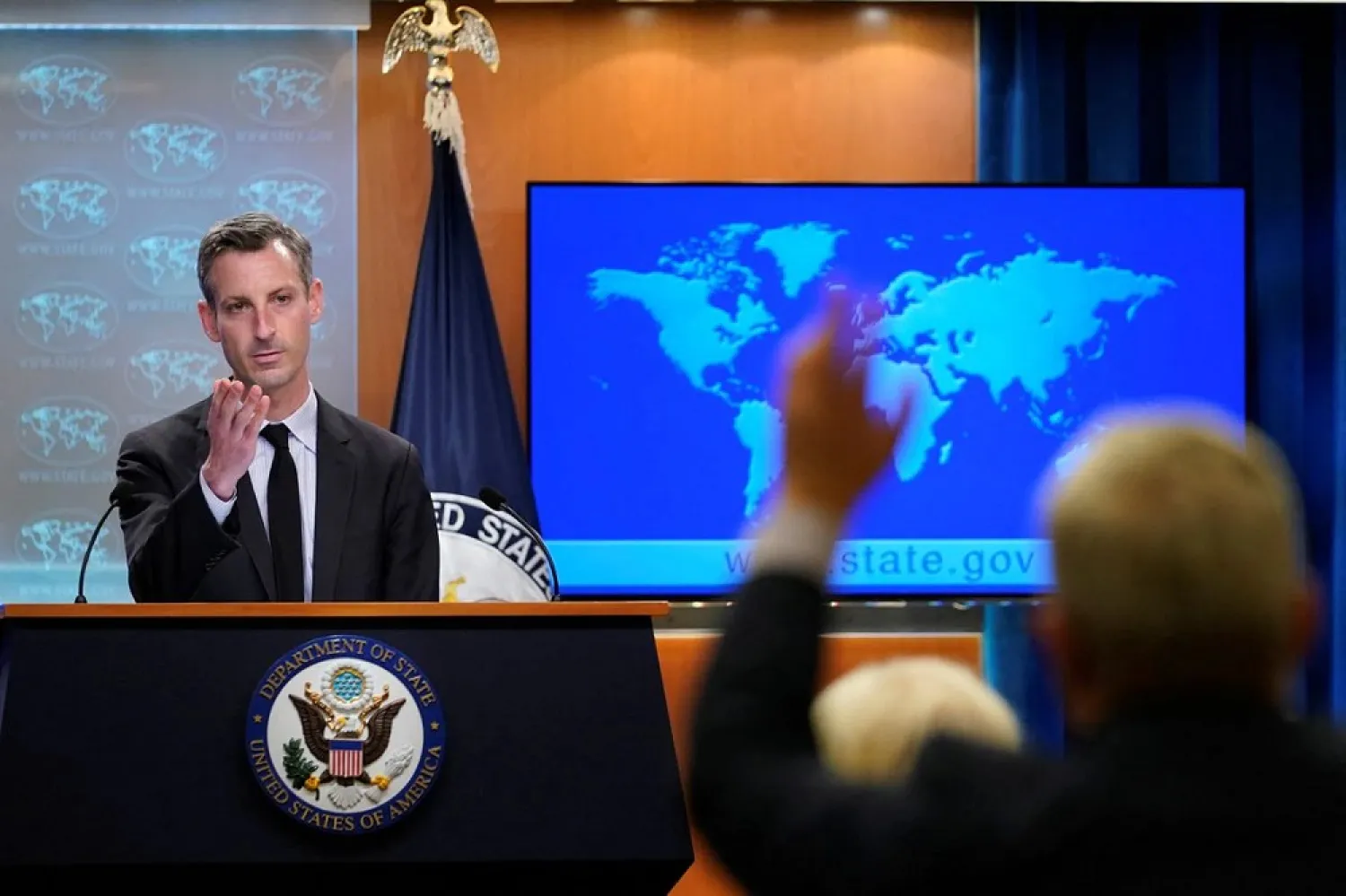
US State Department spokesperson Ned Price gestures during a briefing at the State Department in Washington, DC, US, February 1, 2022. (Reuters)
TT

US Warns Chinese Firms against Helping Russia against Potential Ukraine Sanctions

US State Department spokesperson Ned Price gestures during a briefing at the State Department in Washington, DC, US, February 1, 2022. (Reuters)

The United States warned Chinese firms on Thursday they would face consequences if they sought to evade any export controls imposed on Moscow in the event of Russia invading Ukraine.

US State Department spokesman Ned Price made the remark after China's Foreign Ministry said China and Russia had coordinated their positions on Ukraine during a meeting between their foreign ministers in Beijing on Thursday.

"We have an array of tools that we can deploy if we see foreign companies, including those in China, doing their best to backfill US export control actions, to evade them, to get around them," Price told a regular news briefing.

Western countries say any invasion of Ukraine by Russia would bring sanctions on Moscow and Washington has said it is prepared to impose financial sanctions as well as export-control measures.

White House national security official Peter Harrell said on Wednesday that Washington was working on the export-control measures with allies in Asia, including Japan and South Korea.

Price said Russia should know that a closer relationship with Beijing would not make up for the consequences imposed in response to an invasion.

"If Russia thinks that it will be in a position ... to mitigate some of those consequences, by a closer relationship with (China), that is not the case. It will actually make the Russian economy, in many ways, more brittle," he said.

"If you deny yourself the ability to transact with the West, to import with the West, from Europe, from the United States, you are going to significantly degrade your productive capacity and your innovative potential."

Price said US Secretary of State Antony Blinken and China's Foreign Minister Wang Yi had an extended discussion on potential implications of Russian action against Ukraine in a phone call last week.

Asked to comment on Price's remarks, Liu Pengyu, the spokesman for China's Washington embassy, replied: "We have noted relevant reports. Creating tensions does no good to easing the Ukraine crisis, but only adds more uncertainties to the region and the whole world. China is firmly opposed to this."

China's foreign ministry earlier said Wang met with Russian counterpart Sergei Lavrov and expressed "understanding and support" for Russia's position on security regarding Russia's relationship with the United States and NATO.

It said both sides coordinated their positions on regional issues of common concern, such as Ukraine, Afghanistan and the situation on the Korean Peninsula.

The UN Security Council is due to meet on Friday at the request of the United States and Britain after North Korea's launch of an intermediate-range ballistic missile last weekend.

The United States has been pushing for more international sanctions on North Korea over a recent spate of missile tests, but last month China and Russia delayed a US bid to impose UN sanctions on five North Koreans linked to their country's weapons programs.

Lavrov is in Beijing with President Vladimir Putin, who will meet Chinese President Xi Jinping on Friday before attending the opening ceremony of the Beijing Winter Olympics.



US Invites Putin to December G20 Meeting, Possible Trump Summit

Russian President Vladimir Putin holds a meeting with members of the Russian government via videoconference at the Novo-Ogaryovo state residence, outside Moscow, Russia, 23 September 2026. (EPA/Vyacheslav Prokofyev / Sputnik / Kremlin Pool)
TT

US Invites Putin to December G20 Meeting, Possible Trump Summit

Russian President Vladimir Putin holds a meeting with members of the Russian government via videoconference at the Novo-Ogaryovo state residence, outside Moscow, Russia, 23 September 2026. (EPA/Vyacheslav Prokofyev / Sputnik / Kremlin Pool)

The United States has invited Russian President Vladimir Putin to a December G20 meeting in Miami, Florida where he could hold a summit with President Donald Trump, US Secretary of State Marco Rubio said on Wednesday.

The Kremlin said Russia would consider the invitation.

Rubio, speaking after meeting ‌Russian Foreign ‌Minister Sergei Lavrov on the sidelines ‌of ⁠the UN General ⁠Assembly, said the US remained open to engaging with Russia on the war in Ukraine, despite stalled efforts to bring an end to the conflict.

"We’ve invited President Putin to the G20. We think ⁠it’s an opportunity for him to ‌engage not just ‌with the president but with other world leaders. ‌We hope that’s an invitation he’ll accept," ‌Rubio said.

Putin and Trump met in Anchorage, Alaska in August last year, but Putin has not visited the lower 48 states since ‌before Russia's full-scale invasion of Ukraine.

Russian news agencies quoted Kremlin spokesman ⁠Dmitry ⁠Peskov as saying that Russia was "grateful and appreciative for this invitation."

"We will make a decision and work through it via diplomatic channels," he added.

Rubio also said Trump could potentially meet again with China's President Xi Jinping, who arrived in Washington for a state visit on Wednesday, at the G20 summit as well as at the Asia-Pacific Economic Cooperation meeting in Shenzhen.


Heads of AI Firms Tell UN Security Council That It Could Be a Risk to All Humanity

CEO of OpenAI Sam Altman speaks during a UN Security Council meeting on AI and international security under “Maintenance of International Peace and Security” during the 81st session of the UN General Assembly at the UN Headquarters on September 23, 2026 in New York City. (Getty Images/AFP)
TT

Heads of AI Firms Tell UN Security Council That It Could Be a Risk to All Humanity

CEO of OpenAI Sam Altman speaks during a UN Security Council meeting on AI and international security under “Maintenance of International Peace and Security” during the 81st session of the UN General Assembly at the UN Headquarters on September 23, 2026 in New York City. (Getty Images/AFP)

The heads of major artificial intelligence firms pleaded with the United Nations on Wednesday to save the world or at least its people — in the form of somehow regulating the burgeoning technology that they have been designing.

“If managed poorly, I even believe AI could be a risk to humanity as a whole,” said Dario Amodei, chief executive officer of Anthropic. And from his competitor Sam Altman, CEO of OpenAI, came this assessment: “We could lose control of the future to AI.”

Both said the countries of the world, through the UN Security Council, where they testified Wednesday, have to set safeguards of some kind, which would be actual controls to prevent the technology from getting too powerful to rein in.

They also called for the world to make sure that the power of AI isn’t concentrated in one company or country. They said that as they also touted the benefits of the technology for bettering humanity and what Altman called “giving people more power over their own lives.”

Those tech leaders “are telling us in stark terms that it cannot be left to them to prevent disaster from befalling the world,” said United Kingdom Foreign Secretary Ed Miliband said at the Security Council. “We cannot ignore them because they are right.”

AI will be at the heart of G20 discussions

Miliband said when the UK takes control of the G20 next year it will put controlling AI at the heart of discussions, looking for a single set of global standards “to insure that AI development is safe.”

But the United States said don’t do it.

Worries about control of AI are “not a reason to pause its further development or to constrain it with new global governance structure,” said White House Science Adviser Michael Kratsios. “We want you, our allies and partners, to share in the benefits of this technology.”

For most of the world leaders, along with California Governor Gavin Newsom in New York for climate discussions, one of the key questions about AI is this: Who should control life-and-death decisions — human or machine?

Amodei, Altman and Hugging Face CEO Clément Delangue, who spoke via a glitchy remote connection, spoke with the UN’s most powerful council because they and world leaders are trying to figure out not just whether to control AI, but by who, how it could possibly be done and when it might be just too late.

The day before, UN Secretary-General Antonio Guterres warned of “killer robots.” Experts and European leaders said that’s not hyperbole but something that’s either already a grim reality or perilously close.

Amodei called on the nations of the world to agree on not letting AI build biological weapons, figure out how to verify what models have the capability to do and “establish common standards” for testing and for loss of control and misuse.

French Foreign Minister Jean-Noel Barrot, whose country convened Wednesday’s meeting and has fostered various other coalitions and discussions about AI, compared the current state of it to both the runaway computer HAL9000 in the movie “2001: A Space Odyssey” and the dawn of the atomic age.

“Just as with the atom back then, the international community must now regulate AI in order to make the most of its potential and avoid the worst,” Barrot said.

Other leaders and nations are paying close attention to AI

His wasn't the only concern expressed during this high-profile UN meeting week.

Ukrainian President Volodymyr Zelenskyy, speaking at the General Assembly, said some kind of human control over machines must achieved soon. Otherwise, he said, for his country it may be just too late.

“There is already a real possibility that AI, not only people, will begin to decide what happens on the battlefield. And we need peace before we reach that point,” Zelenskyy said.

Last month, a Russian drone seemingly using AI “autonomously made a targeting decision that killed three Ukrainians. Killer robots are technically easy to build, and they are real. We should not be under any illusions otherwise,” said Kentaro Toyama, an information technology professor at the University of Michigan.

The UN meeting unfolded as Chinese President Xi Jinping headed to Washington for a much-anticipated state visit. The US and China are jostling for AI dominance, and AI interests are looking to what comes out of Xi’s discussions with US President Donald Trump.

Ahead of the meeting, US Treasury Secretary Scott Bessent said the two countries had discussed a potential new “notification mechanism” for AI incidents that could impact national security.

But on Tuesday, Trump, lauding AI as “superintelligence,” said the United States would reject efforts to control the technology as it tries to win the development race with China. Kratsios was the one of the few who used that term in the Security Council.

Meanwhile, regional groups in Europe, Asia and elsewhere also are trying to coordinate AI policies, and various nations — and even subcomponents, such as US states — are crafting their own.

Still, UN watchers and risk experts say the world body hasn’t been relegated to the sidelines on AI regulation.

“The UN is not in the driver’s seat of global discussions on AI, but it hasn’t been kicked out of the car yet,” said Daniel Forti, who oversees UN affairs at the International Crisis Group, a think tank.


North Korea Conducted Test of Upgraded Rocket Launcher System, KCNA Says

North Korean leader Kim Jong Un, accompanied by his daughter Kim Ju Ae, attends a test of a new type of weapon in Pyongyang, North Korea, in this picture released by North Korea's official Korean Central News Agency on September 22, 2026. (KCNA via Reuters)
TT

North Korea Conducted Test of Upgraded Rocket Launcher System, KCNA Says

North Korean leader Kim Jong Un, accompanied by his daughter Kim Ju Ae, attends a test of a new type of weapon in Pyongyang, North Korea, in this picture released by North Korea's official Korean Central News Agency on September 22, 2026. (KCNA via Reuters)

North Korea conducted a test firing of an upgraded 240mm guided multiple rocket launcher system on Tuesday, state news agency KCNA reported on Thursday.

The test proved the accuracy and superiority of the range-extended rockets, which use an autonomous precision guidance system, KCNA said.

The rockets are able to ‌strike targets ‌100 km (62 miles) away in ‌a ⁠trajectory flight mode ⁠and 115 km away in a combined glide mode, it added.

The development of such rockets assures North Korea of a significant change in the firepower readiness along the southern border, the ⁠news agency said, effectively ‌referring to the ‌one it shares with South Korea.

Pak Jong-chon, ‌vice-chairman of the Central Military Commission who ‌oversaw the test, stressed the need to concentrate the deadliest and most destructive attack forces on the southern border, KCNA said.

South ‌Korea's defense ministry did not immediately respond to an emailed ⁠Reuters ⁠request for comment

Pyongyang has been steadily upgrading its tactical and conventional arsenal that it intends to deploy near the border with South Korea.

In June, North Korean leader Kim Jong Un oversaw tests of key weapons, including an upgraded rocket launcher and tactical missiles, that the country said would also be used to defend its southern border.