


Russia and China Hail ‘No Limits’ Partnership to Stand Up to US

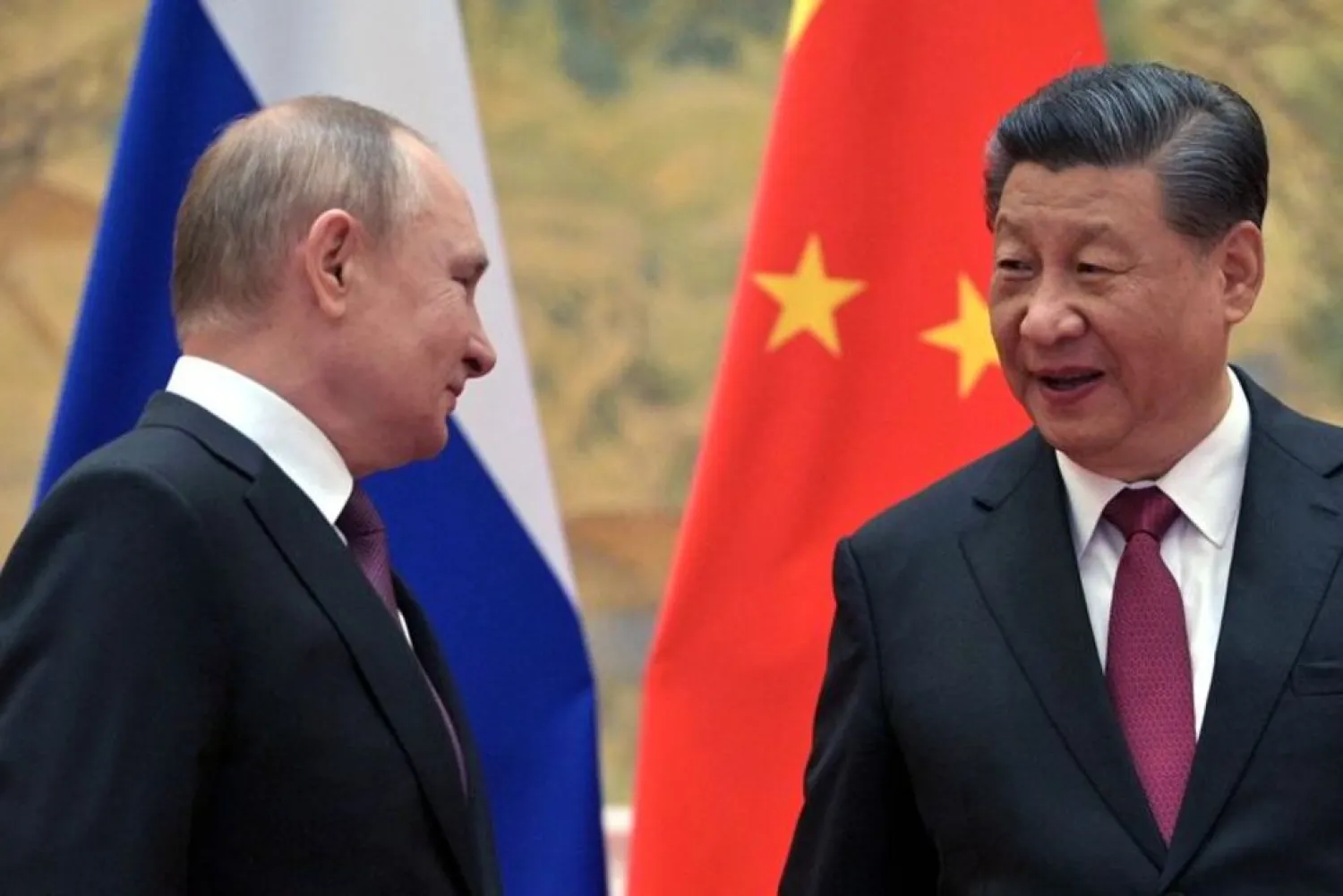
Russian President Vladimir Putin attends a meeting with Chinese President Xi Jinping in Beijing, China February 4, 2022. (Reuters(
TT

Russia and China Hail ‘No Limits’ Partnership to Stand Up to US

Russian President Vladimir Putin attends a meeting with Chinese President Xi Jinping in Beijing, China February 4, 2022. (Reuters(

China and Russia proclaimed a deep strategic partnership on Friday to balance what they portrayed as the malign global influence of the United States as China's President Xi Jinping hosted Russia's Vladimir Putin on the opening day of the Beijing Winter Olympics.

In a joint statement, the two countries affirmed that their new relationship was superior to any political or military alliance of the Cold War era.

"Friendship between the two States has no limits, there are no 'forbidden' areas of cooperation," they declared, announcing plans to collaborate in a host of areas including space, climate change, artificial intelligence and control of the Internet.

The agreement marked the most detailed and assertive statement of Russian and Chinese resolve to work together - and against the United States - to build a new international order based on their own interpretations of human rights and democracy.

Steeped in ideological discourse, it was not clear whether it would immediately translate into an increase in tangible and practical cooperation despite Putin trumpeting a new gas deal with China on Friday, or was intended as more of a statement of general policy intent.

"The two leaders are announcing their determination to stand together and to stand against the US and the West - ready to withstand sanctions and contest American global leadership," said Daniel Russel of the Asia Society think tank, who served as the US State Department's top diplomat for East Asia under the Obama administration.

While not formally allied, the two "are making common cause as a tactical matter to better defend their respective interests and their authoritarian systems from Western pressure", he said.

Jonathan Eyal of the London-based Royal United Services Institute said the declaration marked a "frontal rebuttal" of the US and Western view of the world and a possible building block towards a military alliance.

"It's the most explicit articulation of the 'making the world safe for dictatorship' strategy," he said. "It is a historic point because they both feel cornered and they feel their moment has arrived to state their vision of the world and promote it aggressively."

Mutual support

The two countries have moved closer together as both have come under pressure from the West on a host of issues including their human rights records and Russia's military build-up near Ukraine. The timing of their announcement was highly symbolic, at a China-hosted Olympics that the United States has subjected to a diplomatic boycott.

There was no immediate comment from the White House or State Department.

In the lengthy document - nearly 5,400 words in English translation - each went significantly further than before in backing the other on key flashpoints of tension with the West.

- Russia voiced its support for China's stance that Taiwan is an inalienable part of China, and opposition to any form of independence for the island. Moscow and Beijing also voiced their opposition to the AUKUS alliance between Australia, Britain and the United States, saying it increased the danger of an arms race in the region.

- China joined Russia in calling for an end to NATO enlargement and supported its demand for security guarantees from the West - issues at the heart of Moscow's confrontation with the United States and its allies over Ukraine.

The two countries expressed concern about "the advancement of US plans to develop global missile defense and deploy its elements in various regions of the world, combined with capacity building of high-precision non-nuclear weapons for disarming strikes and other strategic objectives".

Elsewhere, without naming Washington, they criticized attempts by "certain states" to establish global hegemony, fan confrontation and impose their own standards of democracy.

Tech and energy

In the technology arena, Russia and China said they were ready to strengthen cooperation on artificial intelligence and information security.

They said they believed that "any attempts to limit their sovereign right to regulate national segments of the Internet and ensure their security are unacceptable".

Meanwhile Russian state energy giants Gazprom and Rosneft on Friday agreed new gas and oil supply deals with Beijing worth tens of billions of dollars.

The deals capitalize on Putin's drive to diversify Russian energy exports away from the West, which started shortly after he came to power in 1999. Since then Russia has become China's top energy supplier and cut its reliance on the West for revenues.

The Kremlin said the presidents also discussed the need to broaden trade in national currencies because of unpredictability surrounding the use of the dollar.

US President Joe Biden has said Russian companies could be cut off from the ability to trade in dollars as part of sanctions if Russia invades Ukraine.

Moscow denies any such intention, but has used a build-up of more than 100,000 troops near Ukraine's border to grab the attention of the West and press its demands for security guarantees.

The Chinese gas supplies are not directly linked with Russian gas exports to Europe, and more Russian gas for Beijing does not automatically mean less for Europe. However, they serve Putin as an addition revenue cushion amid the rising threat of US and EU sanctions.



Top Trump Iran Negotiator Says Visits US Aircraft Carrier in Middle East

US Special Envoy Steve Witkoff delivers a press conference upon the signing of the declaration on deploying post-ceasefire force in Ukraine, during the so-called "Coalition of the Willing" summit, at the Elysee Palace in Paris, France, January 6, 2026. (Reuters)
TT

Top Trump Iran Negotiator Says Visits US Aircraft Carrier in Middle East

US Special Envoy Steve Witkoff delivers a press conference upon the signing of the declaration on deploying post-ceasefire force in Ukraine, during the so-called "Coalition of the Willing" summit, at the Elysee Palace in Paris, France, January 6, 2026. (Reuters)

US President Donald Trump's lead Iran negotiator Steve Witkoff on Saturday said he visited the USS Abraham Lincoln aircraft carrier currently in the Arabian Sea, with Washington and Tehran due to hold further talks soon.

"Today, Adm. Brad Cooper, Commander of US Naval Forces Central Command, Jared Kushner, and I met with the brave sailors and Marines aboard the USS Abraham Lincoln, her strike group, and Carrier Air Wing 9 who are keeping us safe and upholding President Trump's message of peace through strength," said Witkoff in a social media post.

Iranian Foreign Minister Abbas Araghchi said on Saturday he hoped talks with the United States would resume soon, while reiterating Tehran's red lines and warning against any American attack.


Israel’s Netanyahu Expected to Meet Trump in US on Wednesday and Discuss Iran

Israeli Prime Minister Benjamin Netanyahu delivers a speech during a special session to mark the 77th anniversary of the Knesset's establishment and the 60th anniversary of the dedication of the current building at the Knesset, the Israeli parliament, in Jerusalem, 02 February 2026. (EPA)
TT

Israel’s Netanyahu Expected to Meet Trump in US on Wednesday and Discuss Iran

Israeli Prime Minister Benjamin Netanyahu delivers a speech during a special session to mark the 77th anniversary of the Knesset's establishment and the 60th anniversary of the dedication of the current building at the Knesset, the Israeli parliament, in Jerusalem, 02 February 2026. (EPA)

Israeli Prime Minister Benjamin Netanyahu is expected to meet US President Donald Trump on Wednesday in Washington, where they will discuss negotiations with Iran, Netanyahu's office said on Saturday.

Iranian and US officials held indirect nuclear ‌talks in the ‌Omani capital ‌Muscat ⁠on Friday. ‌Both sides said more talks were expected to be held again soon.

A regional diplomat briefed by Tehran on the talks told Reuters Iran insisted ⁠on its "right to enrich uranium" ‌during the negotiations with ‍the US, ‍and that Tehran's missile capabilities ‍were not raised in the discussions.

Iranian officials have ruled out putting Iran's missiles - one of the largest such arsenals in the region - up ⁠for discussion, and have said Tehran wants recognition of its right to enrich uranium.

"The Prime Minister believes that any negotiations must include limiting ballistic missiles and halting support for the Iranian axis," Netanyahu's office said in a ‌statement.


Italy FM Rules Out Joining Trump’s ‘Board of Peace’

Italy's Minister for Foreign Affairs Antonio Tajani speaks to the press during the EPP Leaders’ meeting, in Zagreb, Croatia, 30 January 2026. (EPA)
TT

Italy FM Rules Out Joining Trump’s ‘Board of Peace’

Italy's Minister for Foreign Affairs Antonio Tajani speaks to the press during the EPP Leaders’ meeting, in Zagreb, Croatia, 30 January 2026. (EPA)

Italy will not take part in US President Donald Trump's "Board of Peace", Italian Foreign Minister Antonio Tajani said Saturday, citing "insurmountable" constitutional issues.

Trump launched his "Board of Peace" at the World Economic Forum in Davos in January and some 19 countries have signed its founding charter.

But Italy's constitution bars the country from joining an organization led by a single foreign leader.

Prime Minister Giorgia Meloni, a Trump ally, last month noted "constitutional problems" with joining, but suggested Trump could perhaps reopen the framework "to meet the needs not only of Italy, but also of other European countries".

Tajani appeared Saturday to rule that out.

"We cannot participate in the Board of Peace because there is a constitutional limit," he told the ANSA news agency.

"This is insurmountable from a legal standpoint," he said, the day after meeting US Secretary of State Marco Rubio and US Vice President JD Vance at the Olympics in Milan.

Although originally meant to oversee Gaza's rebuilding, the board's charter does not limit its role to the Palestinian territory and appears to want to rival the United Nations.