


What Happens to Europe’s Energy If Russia Acts?

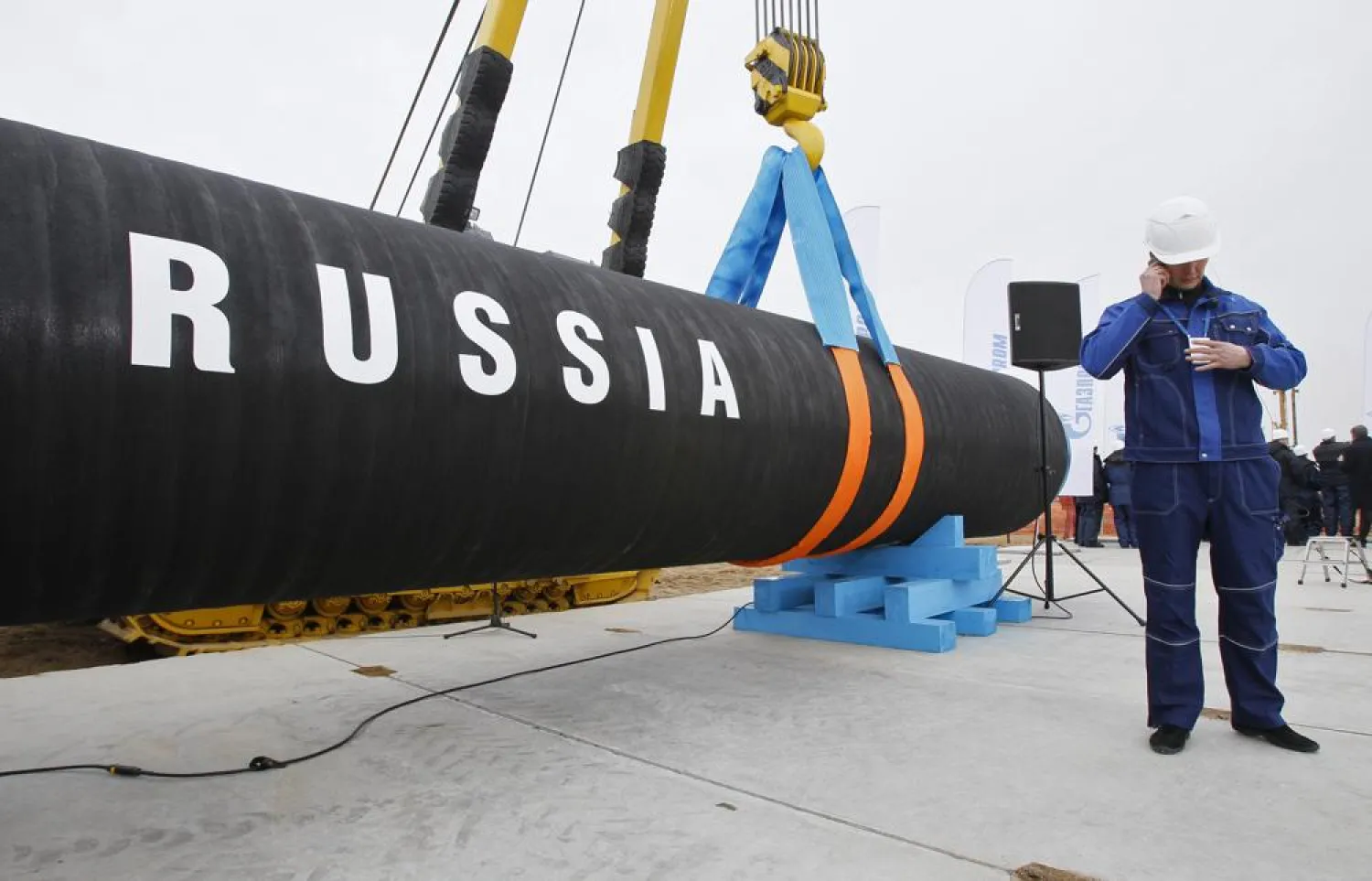
A Russian construction worker speaks on a mobile phone during a ceremony marking the start of Nord Stream pipeline construction in Portovaya Bay some 170 kms (106 miles) north-west from St. Petersburg, Russia on April 9, 2010. (AP)
TT

What Happens to Europe’s Energy If Russia Acts?

A Russian construction worker speaks on a mobile phone during a ceremony marking the start of Nord Stream pipeline construction in Portovaya Bay some 170 kms (106 miles) north-west from St. Petersburg, Russia on April 9, 2010. (AP)

Fears are rising about what would happen to Europe’s energy supply if Russia were to invade Ukraine and then shut off natural gas exports in retaliation for US and European sanctions.

The tensions show the risk of Europe’s reliance on Russia for energy, which supplies about a third of the continent’s natural gas. And Europe’s stockpile is already low. While the US has pledged to help by boosting exports of liquefied natural gas, or LNG, there’s only so much it can produce at once.

It leaves Europe in a potential crisis, with its gas already sapped by a cold winter last year, a summer with little renewable energy generation and Russia delivering less than usual. Prices have skyrocketed, squeezing households and businesses.

Here’s what to know about Europe’s energy supply if tensions boil over into war and Russia is hit with sanctions:

Will Russia cut off gas supplies to Europe?
No one knows for sure, but a complete shutoff is seen as unlikely, because it would be mutually destructive.

Russian officials have not signaled they would consider cutting supplies in the case of new sanctions. Moscow relies on energy exports, and though it just signed a gas deal with China, Europe is a key source of revenue.

Europe is likewise dependent on Russia, so any Western sanctions would likely avoid directly targeting Russian energy supplies.

More likely, experts say, would be Russia withholding gas sent through pipelines crossing Ukraine. Russia pumped 175 billion cubic meters of gas into Europe last year, nearly a quarter of it through those pipelines, according to S&P Global Platts. That would leave pipelines under the Baltic Sea and through Poland still operating.

“I think in the event of even a less severe Russian attack against Ukraine, the Russians are almost certain to cut off gas transiting Ukraine on the way to Germany,” said former US diplomat Dan Fried, who as State Department coordinator for sanctions policy helped craft 2014 measures against Russia when it invaded and annexed Ukraine’s Crimea peninsula.

Russia could then offer to make up the lost gas if Germany approves the new Nord Stream 2 pipeline, whose operators may potentially face US sanctions even though a recent vote to that effect failed. German officials also have said blocking operation of the pipeline would be “on the table” if there’s an invasion.

Interrupting gas supplies beyond the Ukrainian pipelines is less likely: “If they push it too far, they’re going to make a breach with Europe irreparable, and they have to sell the oil and gas someplace,” Fried said.

What can the US do?
It’s a major gas producer and already is sending record levels of liquefied natural gas, or LNG, by ship worldwide. It could only help Europe a little.

“We’re talking about small increases to the size of US exports, whereas the hole that Europe would need to fill if Russia backed away or if Europe cut Russia off would be much larger than that,” said Ross Wyeno, lead analyst for Americas LNG at S&P.

The Biden administration has been talking with gas producers worldwide about whether they can boost output and ship to Europe, and it has been working to identify supplies of natural gas from North Africa, the Middle East, Asia and the US

The administration also is talking with buyers about holding off.

“Is there some other country that was planning to get an LNG shipment that doesn’t need it and could give it to Europe?” said Amy Myers Jaffe, managing director of the Climate Policy Lab at Tufts University, mentioning Brazil or countries in Asia.

Over the past month, two-thirds of American LNG exports went to Europe. Some ships filled with LNG were heading to Asia but turned around to go to Europe because buyers there offered to pay higher prices, S&P said.

Is there enough liquefied gas worldwide to solve the problem?
Not in the event of a full cutoff, and it can’t be increased overnight. Export terminals cost billions of dollars to build and are working at capacity in the US.

Even if all Europe’s LNG import facilities were operating at capacity, the amount of gas would only be about two-thirds of what Russia sends via pipelines, Jaffe said.

And there could be challenges distributing the LNG to parts of Europe that have fewer pipeline connections.

If Russia stopped sending just the gas that goes through Ukraine, it would take the equivalent of about 1.27 shiploads of additional LNG per day to replace that supply, said Luke Cottell, senior LNG analyst at S&P. Russia also could reroute some of that gas through other pipelines, reducing the need for additional LNG to about a half-shipload per day, he said.

Is Russia already supplying less gas?
Russia has been fulfilling its long-term contracts to supply gas to Europe, but it’s been selling less on the spot market and hasn’t been filling the storage containers it owns in Europe, experts say.

“It’s already happened. It’s not theoretical,” Jaffe said.

Russian cutbacks to spot gas supplies have contributed to sharply higher natural gas prices in Europe. They went as high as 166 euros ($190) per megawatt hour in December, more than eight times their level at the start of 2021. Prices have fallen to under 80 euros per kilowatt hour as more LNG arrives.

But consumers are feeling the crunch in higher electric and gas bills. European governments are rolling out subsidies and tax breaks to ease the financial stress on households.

Is there impact in the US?
As the US ramped up LNG exports, domestic prices of natural gas also rose. More than 10% of gas produced in the US last year was exported, said Clark Williams-Derry, analyst at the Institute for Energy Economics and Financial Analysis.

US gas prices spiked by more than 30% in the last week of January, primarily because of an approaching winter storm in New England, Williams-Derry said. But prices also were affected by tighter US supplies amid uncertainty over Russia, he said.

“Russia is disturbing European gas markets, with the US talking about exporting basically the next ‘Berlin airlift’ for natural gas to Europe,” he said.

If the US pushes for increased LNG exports, prices at home would likely rise, Williams-Derry added.

Ten Democratic senators, led by Jack Reed of Rhode Island and Angus King of Maine, recently urged the Energy Department to study the effect of higher exports on domestic prices and pause approvals of proposed terminals. They said they understood “geopolitical factors” give rise to sending more gas.

“However, the administration must also consider the potential increase in cost to American families,” the senators said.



Saudia to Launch Riyadh-Kozhikode Flights in February

Saudi Arabian Airlines plane, is seen at the airport of the Red Sea resort of Sharm el-Sheikh, Egypt, August 9, 2021. Picture taken through a window. REUTERS/Mohamed Abd El Ghany/File Photo
TT

Saudia to Launch Riyadh-Kozhikode Flights in February

Saudi Arabian Airlines plane, is seen at the airport of the Red Sea resort of Sharm el-Sheikh, Egypt, August 9, 2021. Picture taken through a window. REUTERS/Mohamed Abd El Ghany/File Photo

Saudia Airlines has added Kozhikode, India, to its network of scheduled international destinations, marking its seventh destination in the country alongside Bangalore, Mumbai, Kochi, Delhi, Hyderabad, and Lucknow, as part of the airline’s strategy to reach new international markets, connect the Kingdom to the world through its modern fleet, and strengthen its global competitive position, SPA reported.

Flights to Kozhikode will begin on February 1, 2026, with four weekly departures from King Khalid International Airport in Riyadh.

Reservations are available through the airline’s website and mobile applications.

The addition of Kozhikode further expands Saudia's growing operational network, which now covers over 100 destinations across four continents and operates more than 550 domestic and international flights daily.


Egypt Signs Renewable Energy Deals Worth $1.8 Billion

The Wolf Moon, the first supermoon of 2026, lights up the night sky in Cairo, Egypt, January 3, 2026. REUTERS/Mohamed Abd El Ghany
TT

Egypt Signs Renewable Energy Deals Worth $1.8 Billion

The Wolf Moon, the first supermoon of 2026, lights up the night sky in Cairo, Egypt, January 3, 2026. REUTERS/Mohamed Abd El Ghany

Egypt has signed renewable energy deals worth a combined $1.8 billion, state TV reported on Sunday.

Among the deals were contracts with Norwegian renewable energy developer Scatec and China's Sungrow.

Egypt hopes to have renewable energy reach 42% of its electricity generation mix by 2030, but officials say the goal will be ⁠at risk without more international support.

The first project will be the construction by Scatec of a solar energy plant to generate electricity and energy storage stations in Upper Egypt's Minya, ⁠an Egyptian cabinet statement said.

It would have a generation capacity of 1.7 gigawatts supported by battery storage systems with total capacity of 4 gigawatt hours.

A second project will be a Sungrow factory to manufacture energy storage batteries at the Suez Canal Economic Zone. A share of the factory's output ⁠would be supplied to the first project, the cabinet said.

The deals also include power purchase agreements, with Scatec signing a deal for total capacity of 1.95 gigawatts and 3.9 gigawatt hours of battery storage systems, the Norwegian company said in a statement.


Iraq Says Gas Flaring to Reach Zero by End-2028

Iraq’s Prime Minister Mohammed Shia al-Sudani inspects the electricity ministry pavilion at the Iraq Energy Exhibition and Conference
TT

Iraq Says Gas Flaring to Reach Zero by End-2028

Iraq’s Prime Minister Mohammed Shia al-Sudani inspects the electricity ministry pavilion at the Iraq Energy Exhibition and Conference

Iraq’s Prime Minister Mohammed Shia al-Sudani stated on Saturday that the government is moving forward with the development of clean and renewable energy sectors.

Speaking at the opening of the Iraq Energy Exhibition and Conference, al-Sudani said Iraq has made significant progress in capturing associated gas, with the rate of flaring reduced by more than 72%.

He said flaring will be fully eliminated by the end of 2028.

“We have infrastructure projects at the level of the Ministry of Oil that ensure export capacity and the diversification of export outlets,” al-Sudani said, according to the Iraqi News Agency.

He added that Iraq is holding talks with international companies to invest in associated gas and free gas in oil fields and exploration blocks, expressing hope that the conference would help reinforce this direction. He said the government has also moved toward establishing a permanent platform to secure Iraq’s gas needs through imports or future exports.

Al-Sudani stated that the Ministry of Electricity is working to increase power generation under an ambitious plan that exceeds 57,000 megawatts through the Siemens and GE project.

He added that the ministry is also advancing renewable energy projects, both large and small, with a plan at the district and subdistrict levels in Baghdad and other provinces to transition to renewable energy, which is expected to be implemented by next summer.

He said the government is placing strong emphasis on both conventional and renewable energy in a way that ensures sustainable development.

Al-Sudani stated that the exhibition showcases Iraq’s position as a promising market with significant opportunities in the energy sector, through various projects, partnerships, and investment opportunities.

He said the government has made significant progress in boosting energy production through major oil projects in partnership with global companies, including TotalEnergies and BP, adding that talks are ongoing with ExxonMobil, Chevron, and other international firms.

Talks with Chevron

Iraq’s Oil Minister Hayan Abdul Ghani said talks are underway with Chevron regarding the West Qurna 2 oil field, which is operated by Lukoil and represents the company’s largest foreign asset.

Chevron and Exxon Mobil are among the potential bidders for Lukoil’s overseas assets following the imposition of US sanctions on the Russian oil producer.

Speaking to reporters after the opening of the energy exhibition and conference, Abdul Ghani stated that negotiations with Chevron over the West Qurna 2 field in Basra province are ongoing.

He added that Basra Oil Company, the second partner in the field, has not yet taken over operations following Lukoil’s withdrawal.

Al-Sudani opened the 11th edition of the Iraq Energy Exhibition and Conference in Baghdad on Saturday, with the participation of more than 450 local, Arab, and international companies specializing in energy and investment.

The event runs for three days.

The Iraqi Company for Exhibitions and Commercial Services said the conference, held at the Baghdad International Fairgrounds from Jan. 10 to 12, will feature panel discussions, specialized workshops, and meetings aimed at supporting the energy sector and expanding partnership and investment opportunities, with participation from more than 450 companies.

Iranian gas

Iraq’s Ministry of Electricity said there are no indications that Iranian gas supplies will resume soon.

A ministry spokesperson stated that media outlets were notified via a message from Iran on Telegram, which indicated that gas supplies had been halted due to low temperatures and Tehran’s domestic gas needs.

Iraq announced in December that Iranian gas supplies had ceased, resulting in the shutdown of some power generation units and load reductions at others. The Ministry of Electricity said the grid lost between 4,000 and 4,500 megawatts as a result.

Iran supplies between 30% and 40% of Iraq’s gas and electricity needs.

Electricity ministry officials previously stated that peak winter demand in Iraq reaches approximately 48,000 megawatts, while domestic production stands at around 27,000 megawatts, forcing the country to rely on imports to bridge the gap.