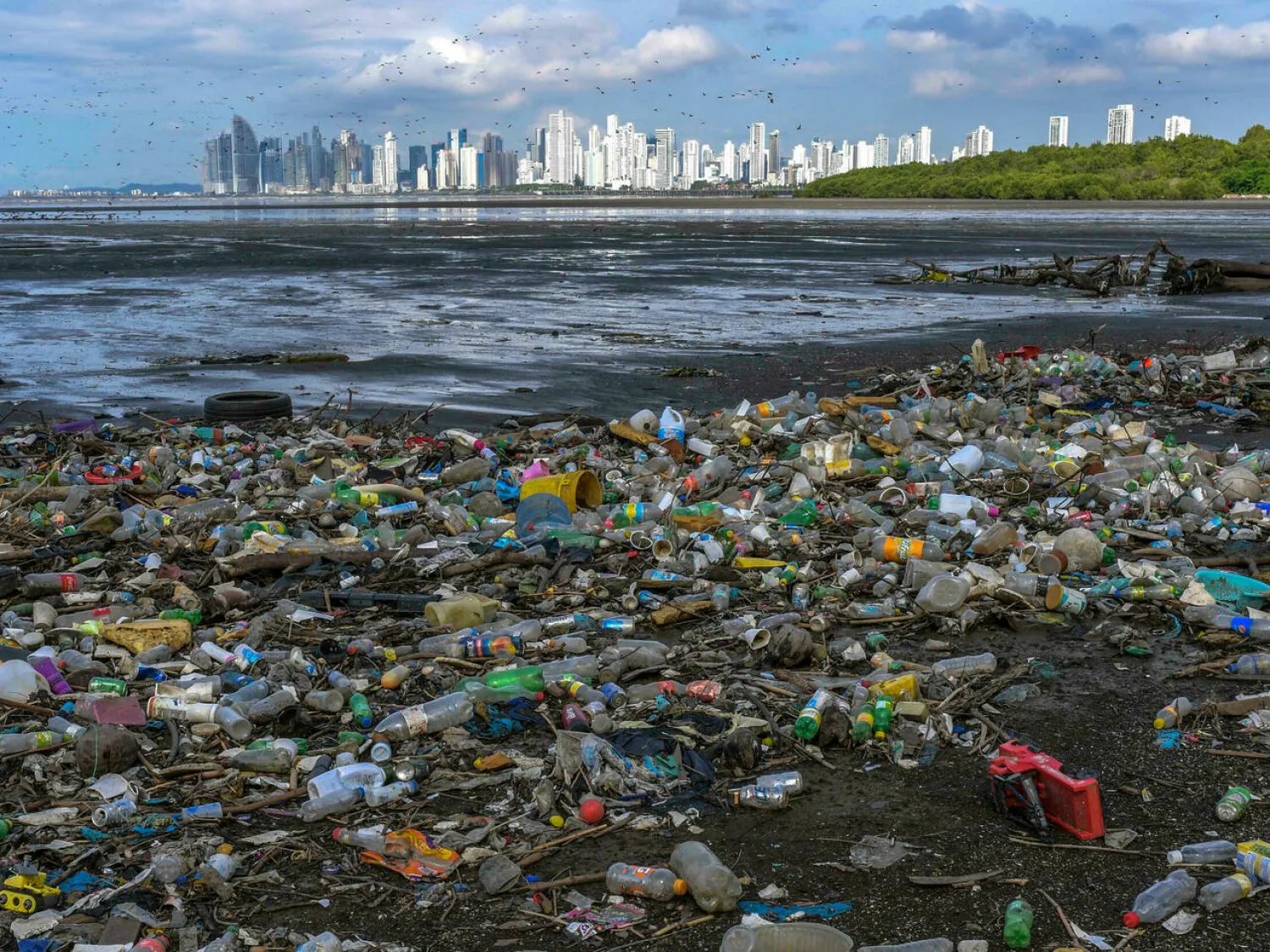
World Must Work Together to Tackle Plastic Ocean Threat

Much of the plastic pollution in the sea is from single-use items. Luis ACOSTA AFP/File
TT

World Must Work Together to Tackle Plastic Ocean Threat

Much of the plastic pollution in the sea is from single-use items. Luis ACOSTA AFP/File

Plastic has infiltrated all parts of the ocean and is now found "in the smallest plankton up to the largest whale" wildlife group WWF said on Tuesday, calling for urgent efforts to create an international treaty on plastics.

Tiny fragments of plastic have reached even the most remote and seemingly-pristine regions of the planet: it peppers Arctic sea ice and has been found inside fish in the deepest recesses of the ocean, the Mariana Trench, AFP said.

There is no international agreement in place to address the problem, although delegates meeting in Nairobi for a United Nations environment meeting this month are expected to launch talks on a worldwide plastics treaty.

WWF sought to bolster the case for action in its latest report, which synthesizes more than 2,000 separate scientific studies on the impacts of plastic pollution on the oceans, biodiversity and marine ecosystems.

The report acknowledged that there is currently insufficient evidence to estimate the potential repercussions on humans.

But it found that the fossil-fuel derived substance "has reached every part of the ocean, from the sea surface to the deep ocean floor, from the poles to coastlines of the most remote islands and is detectable in the smallest plankton up to the largest whale".

- 'Saturation point' -
According to some estimates, between 19 and 23 million tons of plastic waste is washed into the world's waterways every year, the WWF report said.

This is largely from single-use plastics, which still constitute more than 60 percent of marine pollution, although more and more countries are acting to ban their use.

"In many places (we are) reaching some kind of saturation point for marine ecosystems, where we're approaching levels that pose a significant threat," said Eirik Lindebjerg, Global Plastics Policy Manager at WWF.

In some places there is a risk of "ecosystem collapse", he said.

Many people have seen images of seabirds choking on plastic straws or turtles wrapped in discarded fishing nets, but he said the danger is across the entire marine food web.

It "will affect not only the whale and the seal and the turtle, but huge fish stocks and the animals that depend on those", he added.

In one 2021 study, 386 fish species were found to have ingested plastic, out of 555 tested.

Separate research, looking at the major commercially fished species, found up to 30 percent of cod in a sample caught in the North Sea had microplastics in their stomach.

Once in the water, the plastic begins to degrade, becoming smaller and smaller until it is a "nanoplastic", invisible to the naked eye.

So even if all plastic pollution stopped completely, the volume of microplastics in the oceans could still double by 2050.

But plastic production continues to rise, potentially doubling by 2040, according to projections cited by WWF, with ocean plastic pollution expected to triple during the same period.

- Enduring risk -
Lindebjerg compares the situation to the climate crisis -- and the concept of a "carbon budget", that caps the maximum amount of CO2 that can be released into the atmosphere before a global warming cap is exceeded.

"There is actually a limit to how much plastic pollution our marine ecosystems can absorb," he said.

Those limits have already been reached for microplastics in several parts of the world, according to WWF, particularly in the Mediterranean, the Yellow and East China Seas (between China, Taiwan and the Korean Peninsula) and in the Arctic sea ice.

"We need to treat it as a fixed system that doesn't absorb plastic, and that's why we need to go towards zero emissions, zero pollution as fast as possible," said Lindebjerg.

WWF is calling for talks aimed at drawing up an international agreement on plastics at the UN environment meeting, from February 28 to March 2 in Nairobi.

It wants any treaty to lead to global standards of production and real "recyclability".

Trying to clean up the oceans is "extremely difficult and extremely expensive", Lindebjerg said, adding that it was better on all metrics not to pollute in the first place.


Missing Teen Found Alive After 6 Days in Australian Woodlands

In this image made from video and provided by the Victoria State Police 17-year-old William, center right, is embraced by his mother Elizabeth, only first names were provided by police, while in a helicopter in Cowwarr, Australia, Thursday, Nov. 12, 2026, after William spent six days lost in eastern Australian woodlands. (Victoria Police via AP)
TT

Missing Teen Found Alive After 6 Days in Australian Woodlands

In this image made from video and provided by the Victoria State Police 17-year-old William, center right, is embraced by his mother Elizabeth, only first names were provided by police, while in a helicopter in Cowwarr, Australia, Thursday, Nov. 12, 2026, after William spent six days lost in eastern Australian woodlands. (Victoria Police via AP)

A 17-year-old boy with autism was found alive Thursday after six days lost in eastern Australian woodlands.

The boy, whom police identified only as William, had begun camping with a teenage friend when he disappeared last Friday near Walhalla, a former gold-mining town 185 kilometers (115 miles) east of Melbourne, police said.

A police helicopter crew found him surrounded by wilderness lying asleep on a flat rock beside a creek, and he was later reunited with his mother. William was in good spirits and mostly in good health, the police statement said.

Video shot from the rescue helicopter showed he was shirtless and sunburned. He was wearing shorts and boots and was using towels as blankets.

“I’m just over the moon that he’s alive,” his mother, Elizabeth, told reporters.

The AP has decided not to provide her family name to avoid identifying her son.

“And he’s never leaving the house again. He’s grounded for life. He’s not going anywhere ever again,” she joked.

William was later taken to a hospital for his health to be monitored, police said.

William's family have said he has Level 2 autism. That requires “substantial support,” according to the Australian advocacy group Autism360.

Such a person may have marked deficits in verbal and non-verbal social communication and rely heavily on routines and predictable activities.

Disruption can cause significant distress.

The Southern Hemisphere spring weather had been mild for the past week in the alpine region where William was lost and there had been little rain.

Elizabeth had dropped off her son and his friend last Friday for a weekend of camping. William walked a short distance from the campsite to the drop-off location to collect more camping equipment but never returned to his friend, police said.

After becoming lost, William trekked for days up and down “some very steep terrain,” Acting Police Inspector Jason Benbow said.

He spent the last two days where he was found at the creek, trapped by the steepness of his surrounds 2 kilometers (1.2 miles) from his camp site, Benbow said.

“He woke up to the sound of the helicopter, gave them a thumbs up and they winched him to safety,” Benbow told reporters.

The extensive police search for him involved more than 100 emergency services personnel and volunteers.


Europe’s Hera Spacecraft Begins Close Inspections of an Asteroid Rammed by NASA in a 2022 Test

This undated image provided by the European Space Agency on Nov. 5, 2026 and taken by the Hera spacecraft, shows asteroid Didymos. (European Space Agency via AP)
TT

Europe’s Hera Spacecraft Begins Close Inspections of an Asteroid Rammed by NASA in a 2022 Test

This undated image provided by the European Space Agency on Nov. 5, 2026 and taken by the Hera spacecraft, shows asteroid Didymos. (European Space Agency via AP)

A European spacecraft has begun close inspections of an asteroid rammed by NASA four years ago in a planetary defense test.

The European Space Agency announced Wednesday that the Hera spacecraft is now studying Didymos and its moonlet Dimorphos from just 15 miles to 18 miles (25 kilometers to 30 kilometers) away, The AP news reported.

NASA’s Dart spacecraft deliberately slammed into little Dimorphos in 2022 to see whether such a defensive move might help save Earth from a killer space rock one day.

The impact shortened the moonlet’s orbit around Didymos. More importantly, it nudged the moonlet into a slightly different path around the sun.

Next month, the small car-sized Hera, launched in 2024, will venture even closer — just 12 miles (20 kilometers) away.

ESA officials consider this a “crash site investigation” worthy of its finest robotic detective. Hera is carrying 25 science instruments as well as a pair of shoebox-sized Cubesats to survey Dimorphos even more closely and attempt to land on it.

The Dart spacecraft — short for Double Asteroid Redirection Test — sent rubble and even boulders flying off Dimorphos, providing an extra kick to the impact’s momentum. The debris trail extended thousands of miles (more than 10,000 kilometers) into space for months.

Some of that debris could still be in the vicinity, according to scientists.

Dimorphos is an estimated 500 feet (151 meters) in diameter. Didymos is roughly 2,560 feet (780 meters) in diameter.


Euclid Mission Data Release Spans More than 900 Million Galaxies

Looking across vast distances means peering into the past because of the time needed for light from distant objects to reach us (Reuters)
TT

Euclid Mission Data Release Spans More than 900 Million Galaxies

Looking across vast distances means peering into the past because of the time needed for light from distant objects to reach us (Reuters)

The European Space Agency has released its first big collection of data from the orbiting Euclid telescope's mission to map the universe's large-scale structure, including observations of more than 900 million galaxies, as scientists investigate the puzzling cosmic components dark matter and dark energy.

The data unveiled on Thursday covered a survey of the sky equal to about 9,500 times the size of the moon as viewed from Earth. The mission's goal is to complete the largest-ever three-dimensional atlas of the cosmos, spanning more than a third of the sky, in 2031.

Thursday's release encompassed around 13 months of Euclid observations, totaling an enormous 1.7 petabytes — 1.7 million gigabytes — of data, Reuters reported.

"It marks a major milestone for ESA's Euclid mission and for everyone involved," said astrophysicist Valeria Pettorino, ESA's Euclid project scientist.

Euclid, launched from Florida in 2023, is gathering data on how the universe has expanded and how its structure has formed over time while amassing information about the nature of dark energy and dark matter and the role of gravity on large scales.

"Euclid will not just take images of galaxies in the sky, in two dimensions, but will also measure their distance, the third dimension. This will tell us where galaxies are in space and time, across 10 billion years, and in all directions beyond our galactic plane," Pettorino said.

"Galaxies cluster along filaments, surrounded by empty space, and form a network that we call the cosmic web. Euclid will reconstruct the cosmic web and how it has grown over time. This is important because the exact configuration of the cosmic web, how many clusters or voids are there, how fast it changed, depend on the properties of dark energy and dark matter," Pettorino said.

The universe's contents include ordinary matter as well as dark matter and dark energy.

Ordinary matter — stars, planets, gas, dust and all the familiar stuff on Earth — represents about 5% of the contents. Dark matter, known from the gravitational effects it exerts on galactic scales, is invisible material that may make up about 27% of the cosmos. Dark energy, thought to be responsible for the accelerated expansion of the universe, may account for 68%.

Dark matter and dark energy do not emit or absorb light and cannot be directly observed.

Previous Euclid data releases covered only a few days of observations. The newly released dataset includes more than a year of data and still spans only 14% of the total sky area Euclid is due to survey in visible and near-infrared light over six years. This data release will be completed next year with the first results on dark energy and dark matter.

GRAVITATIONAL LENSING

Light traveling toward Earth from faraway galaxies can be bent and distorted by normal matter and dark matter in the foreground, an effect called gravitational lensing. Thus, the nearer galaxy's gravity warps the light coming from the one behind.

Gravitational lensing is one of the tools being used to study dark matter's distribution. The new Euclid data includes about 15,000 strong gravitational lens candidates, exceeding the total number discovered in the previous half century.

"Gravitational lenses are nature's own weighing scales," said Natalie Lines, a doctoral student in astrophysics at the University of Portsmouth in England and a member of the Euclid Consortium of scientists.

"How strongly the light is bent tells us how much matter a galaxy contains, including invisible components like dark matter. With thousands of lenses, we can study how dark matter is spread through galaxies and understand how galaxies form and evolve over cosmic time," Lines said.

Lines noted the sharpness of the Euclid images over a huge area of the cosmos.

"Telescopes on Earth can cover large areas of the night sky, but their view is blurred by the atmosphere. The Hubble and James Webb space telescopes take beautifully sharp images, but only of tiny patches of sky. Euclid does both at once, and that is crucial for finding things that are small and rare, like strong gravitational lenses," Lines said.

Looking across vast distances means peering into the past because of the time needed for light from distant objects to reach us. The most distant objects Euclid has viewed are quasars, the brilliant cores of galaxies powered by supermassive black holes. The telescope has pinpointed 60 million of them.

"Euclid has found some dating back to when the universe was just 5% of its current age, so their light set off around 13 billion years ago," Lines said.