Turkish Opposition Leaders Meet to Counter Erdogan’s System

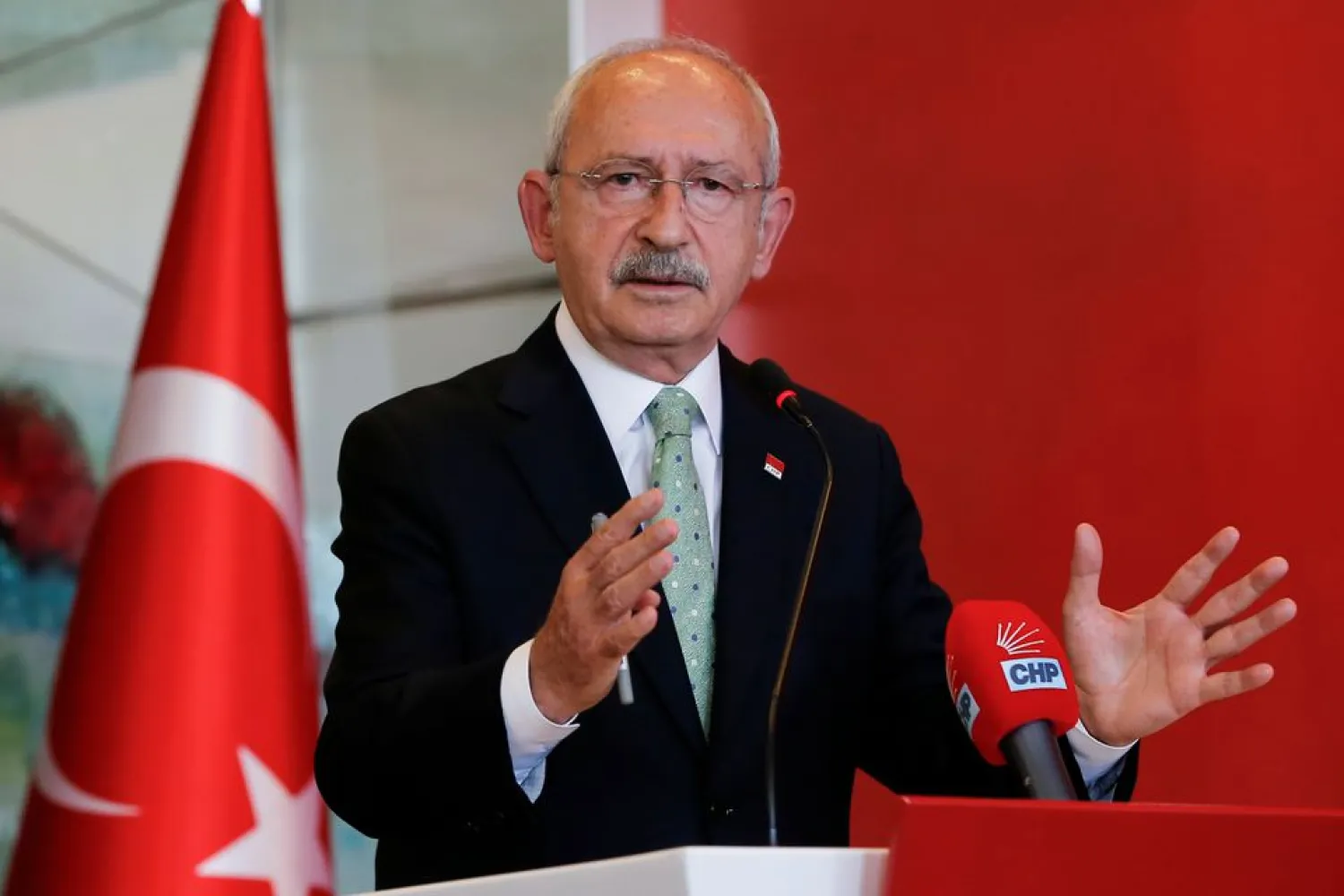
Kemal Kilicdaroglu, the leader of the main opposition Republican People's Party (CHP), speaks during a news conference in Ankara, Turkey October 11, 2021. REUTERS/Cagla Gurdogan
TT

Turkish Opposition Leaders Meet to Counter Erdogan’s System

Kemal Kilicdaroglu, the leader of the main opposition Republican People's Party (CHP), speaks during a news conference in Ankara, Turkey October 11, 2021. REUTERS/Cagla Gurdogan

The leaders of six opposition parties in Turkey met Saturday to strategize about the future of the country’s governing system — a move that aims to unseat the country's longtime ruler.

In a statement following the working dinner, the party leaders said Turkey was experiencing “the deepest political and economic crisis” of its history and blamed it on the executive presidential system. They said their joint goal was to transform Turkey’s governance to a “strengthened parliamentary system.”

They did not mention President Recep Tayyip Erdogan by name, but their clear aim is to find a way to work together to unseat him, according to The Associated Press.

After more than 11 years as Turkey's prime minister, Erdogan was elected president in 2014. At the time, the position was primarily ceremonial, however in 2017 Turkish voters approved an executive presidential system, greatly expanding Erdogan's powers at the expense of those of the prime minister and parliament. Erdogan was re-elected the following year. Critics call the system “one-man rule.”

The leaders at the dinner were Kemal Kilicdaroglu, the head of the main opposition Republican People’s Party; Meral Aksener from the nationalist Good Party; Temel Karamollaoglu from the conservative Felicity Party; Gultekin Uysal from the Democrat Party; Democracy and Progress Party’s Ali Babacan; and Future Party’s Ahmet Davutoglu. They had previously conducted bilateral meetings but Saturday's meeting was their first all together. They are expected to release details of their agreement on Feb. 28.

Davutoglu and Babacan were co-founders of Erdogan’s ruling party and served in top positions but broke away to form their own parties in criticism of Erdogan’s policies.

The second largest opposition party, the pro-Kurdish Peoples’ Democratic Party, was not at the meeting. The government has attacked that party and many of its members, including its former leaders, have been imprisoned over alleged links to outlawed Kurdish militants. Erdogan has also accused the Republican People’s Party of siding with “terrorists.”

The next parliamentary and presidential elections are scheduled for June 2023.


Democratic 'Blue Wave' Swept Through State Capitals across US

Birds fly in front of the US Capitol at sunrise a day after the US midterm elections. ROBERTO SCHMIDT / AFP
TT

Democratic 'Blue Wave' Swept Through State Capitals across US

Birds fly in front of the US Capitol at sunrise a day after the US midterm elections. ROBERTO SCHMIDT / AFP

The blue wave Democrats rode to retake control of the US Congress this week extended into state-level races, as the party won majorities in a number of legislatures previously held by Republicans.

Democrats secured new trifectas -- control of both chambers of the legislature and the governor's seat -- in at least five states in Tuesday's midterms, flipping at least 11 state legislative chambers from Republican control, according to data from NGO State Navigate late Wednesday.

The victories mean the party will have the power to lead policy decisions on everything from health care to taxation in states such as Texas and Georgia, where they had long taken a backseat.

"Democrats are on track to have their largest net gain in state legislative seats in the 21st century," Chaz Nuttycombe, State Navigate's executive director, told AFP.

"It's not a blue wave; it's a blue cataclysm."

Among the most striking results are in Texas, where Democrats wrested the majority in the state's lower chamber from Republicans for the first time since 2002 while also winning the governorship.

In Georgia, Keisha Lance Bottoms turned the governor's seat blue for the first time in more than two decades, and Democrats similarly flipped control of the legislature's lower chamber.

- Far from Washington gridlock -

President Donald Trump has vowed to use his veto powers to reject legislation from the incoming Democratic Congress, a move that could lead to gridlock at the national level.

Experts have suggested the state-level gains could circumvent that issue.

Democrats this week won complete control of government in five states -- Wisconsin, Michigan, Minnesota, Pennsylvania and Nevada -- and were on the verge of doing the same in Arizona as of early Thursday.

"They won't have to be frustrated by vetoes and Senate filibusters, which are no doubt going to frustrate Democrats at the national level," said Thad Kousser, a professor at the University of California, San Diego, referring to the state Democratic trifectas.

The victories will allow Democrats the freedom to legislate on prominent policy points.

Kousser noted that many of the most pressing issues in voters' lives are now decided at the state level, referencing the 2022 Supreme Court decision ending federal abortion protections and giving states the power to dictate their own abortion laws.

Data centers and artificial intelligence have also emerged as top issues as the Trump administration has shied away from regulatory action.

In Texas, Democratic Governor-elect Gina Hinojosa campaigned on tighter regulations for AI data centers.

"The key issues that matter most for Americans' daily lives are things like education, criminal justice and medical care, and those policies are primarily made by states," Kousser said.

Nuttycombe of State Navigate put it this way: "State governments are much more efficient than Congress and can actually get things done."

"Some of these states haven't had Democratic trifectas in decades; the legislators will feel they have a lot of catching up to do."


Iran Says Two Tankers and Tugboat Caught Fire in Hormuz

FILE PHOTO: Vessels at the Strait of Hormuz, as seen from Musandam, Oman, November 3, 2026. REUTERS/Stringer/File Photo
TT

Iran Says Two Tankers and Tugboat Caught Fire in Hormuz

FILE PHOTO: Vessels at the Strait of Hormuz, as seen from Musandam, Oman, November 3, 2026. REUTERS/Stringer/File Photo

Two oil tankers and a tugboat caught fire in the Strait of Hormuz, Iran's Revolutionary Guards said, according to local media on Thursday.

Since the outbreak of the Iran war on February 28, Tehran has severely restricted traffic through the strategic waterway, which normally carries about one-fifth of global oil consumption.

The United States has in response imposed a blockade on Iranian ports and helped tankers travel the strait.

"Last night, in two separate incidents, a large oil tanker attempting to pass through the illegal passageway south of the Strait of Hormuz suffered a fire after striking a mine and was brought to a halt," the Guards told the Fars news agency.

"Another supertanker was halted by a massive fire while exiting the eastern Strait of Hormuz. A tugboat that had approached the supertanker to extinguish the fire also caught fire."

Fars also reported the IRGC navy's electronic warfare unit had taken control of two LUCAS drones, a US-developed model short for Low-cost Uncrewed Combat Attack System.


France Braces for Demonstrations as Trade Unions Strike

The high school student movement that began with youth protesting dismal learning conditions. Alex MARTIN / AFP/File
TT

France Braces for Demonstrations as Trade Unions Strike

The high school student movement that began with youth protesting dismal learning conditions. Alex MARTIN / AFP/File

Hundreds of thousands of people are expected to take to the streets across France on Thursday, as unions hold strikes alongside student-led demonstrations that have gripped the country for weeks.

The high school student movement that began with youth protesting dismal learning conditions has coincided with widespread anger over the rising cost of living and inequality, which culminated on October 17 in the worst rioting France has seen in years, said AFP.

On Thursday, authorities estimate some 500,000 to 700,000 people will protest across the country, while as many as 80,000 people are expected to march in the capital Paris.

"It's going to be a strong mobilization," said Marylise Leon of the CFDT union, anticipating a turnout comparable to France's pension reform protests in 2023 that saw over one million people march.

Public and private education unions have called for strike action, as well as unions representing rail workers, public hospitals and postal services.

In demands addressed to both the government and employers, the unions are calling for an increase in the minimum wage, which has not received any discretionary boost since 2012, across-the-board wage raises, tax reforms and better learning conditions for young people.

Interior Minister Laurent Nunez announced Wednesday that 70,000 police officers and security forces would be deployed across the country, promising "an extremely firm response" to any "acts of violence" or disorder.

- 'Wake-up call' -

Although student-led protests were largely peaceful, some saw clashes with police erupt with tear gas and water cannon fired to disperse crowds.

An attempted murder investigation has been launched after petrol bombs were thrown at security forces in Paris on Saturday.

Meanwhile, the police response has been criticized as heavy-handed and internal police investigations have been launched over allegations of brutality against demonstrators.

Several teenage protesters have been seriously wounded and thousands arrested.

Authorities have admitted to security and intelligence failures that paved the way for the clashes, large-scale looting and vandalism of public property that erupted on October 17.

On Wednesday, the Paris prefecture banned a major protest route planned between Place de la Bastille and Place de la Concorde, which would have crossed the center of the city.

Police instead replaced it with an authorized route moving eastward away from the center.

Several unions have denounced route bans as a move to repress freedom of demonstration, and some have filed last-minute appeals to have the routes reinstated.

"We can feel a cumulative effect: public sympathy for the high school and university students' movement is not waning, and people are questioning restrictions on liberties, especially bans on demonstrations," Fabrice Fort of the CGT union explained.

"This has sparked a wake-up call among people who usually don't speak out much," he added.

Similar protests have sparked in other European countries in recent weeks with youth-led demonstrations seen in Denmark, Germany and Italy.